Thursday, April 4, 2024

Places I'm Visiting: Japan 2024 – Konpira-san and Noodles

Last night I returned from a two-day excursion to Naoshima, one of Japan's so-called "art islands" in Kagawa Prefecture, a two-hour drive to the east from my wife's home island of Iyo-Oshima, with a stop at Konpira-san, a famous shrine known for its hilltop position requiring a climb of 764 steps to the top – sort of. Once at the top, a small sign notes that a smaller, associated shrine sits up by another 400 steps or so. Once there, another discreet sign informs the intrepid of yet another shrine at the very top requiring the mounting of another couple hundred stairs – 1,368 in all. I rarely look at the health apps built in to my iPhone, but the activity piqued my curiosity. According to the phone, the climb was the equivalent of walking to the top of a 62-storey building. 

The first third of the route is lined with souvenir shops. Higher up, the stairs are flanked by stone lanterns and a seemingly endless row of stone steles carved with the names of companies and individuals that have contributed to the shrine over the years, complete with the amounts donated. Cherry trees were coming in to bloom at the shrine, as they are everywhere. Mountain cherries emerging as clouds of pale pink from a background of leafless trees on the hillsides are particularly pretty. It's only at this time of year that their presence is obvious. The rows of cherry trees planted deliberately at shrines and temples, in parks, and along roads are easier to spot when not in bloom. After a night at an attractive little inn called Gamou-ya in the town of Sakaide, we headed for Naoshima.

Kagawa Prefecture might as well be called Udon Prefecture. Shops offering the fat, slick wheat noodles, are everywhere – for consumption on the premises or to take away for preparation at home. The climate in Kagawa Prefecture is said to be good for growing wheat (and we saw many winter wheat fields). The soft local water is supposed to be good for preparing the noodles. Udon would not have been my first choice for breakfast, but the proprietor of Gamou-ya recommended we try a noodle shop a couple of minutes away on foot before departing for the ferry terminal for the trip to Naoshima. When I questioned the idea of noodles for breakfast, he assured me it was the thing to do. 

There was already a line at the shop when we arrived and it had grown to about 70 people by the time we left, but it moved quickly. ¥180 (today about $1.20) buys you a bowl of noodles which you take to a table laid out with all kinds of tempura to choose from (¥120, or about $0.80, a piece). I added a slice of pumpkin tempura and a slice of eggplant to my bowl and from there stepped to a cauldron of hot broth that I ladled onto the noodles and tempura. I topped it off with a spoonful of chopped green onions. The shop is tiny, with barely enough room to complete the course, but the customers navigated it all with ease, as if they'd done it many times – and no doubt they had. A bowl of noodles turned out to be a tasty and filling way to start the day for a mere $2.80 or so. An unusually strong dollar (a dollar buys ¥150 at the moment) makes a lot of things here seem cheap.

I photographed a Pale Thrush (Turdus pallidus, another addition to my life list) on the way up to the shrines above Konpira-san.


Saturday, March 30, 2024

Places I'm Visiting: Japan 2024 – Ehime and Oshima

Still in Japan. Thanks again to Jason and Annabelle who have been living in our house and taking care of Eric the cat while I've been away. 

I'm now on Oshima Island, Ehime Prefecture, the little island my wife is from. 'Oshima' means 'big island', but Oshima is quite small. You could drive the perimeter in a little over an hour. This part of Japan is today known mainly for five things I can think of: First, Oshima is the last island in the chain of islands across which bridges have been built to connect Shikoku (the smallest of Japan's four main islands) with Honshu (the largest of the four). Between Oshima and the city of Imabari (on Shikoku) stretches the 4km-long Kurashima Kaikyo Ohashi, the only three-span suspension bridge in the world. The Inland Sea area, dotted with islands, some now connected by the chain of bridges, has become a popular destination for cyclists from around the globe.

Second, Imabari, across from Oshima is a major shipbuilding hub. Imabari Zosen, in Imabari, is Japan's largest shipbuilder and among the half dozen biggest in the world. 

Third, this part of Japan's Inland Sea was the base of the Murakami Kaizoku, an association of seafaring bands that were both pirates and guides active among the islands of the inland Sea between the 12th and 18th centuries. 

Navigation routes through the Inland Sea are among the most dangerous anywhere. The straits between the islands are known for their rapid currents and the whirlpools that form as the tides shift, alternately pushing water from the Inland Sea into the Pacific and pulling water from the Pacific into the Inland Sea as the direction of the tides changes four times a day, with short periods of equilibrium in between. The sailors of the Murakami Kaizoku acted as guides, demanding in return a percentage of the value of the goods that passed through the channels in return for their knowledge. With completion of the bridge connection, travelers no longer have to stop on Oshima and many of the small shops that once served visitors and the (now dwindling) population of the island have vanished. There are many empty houses and shops. The population was well over 10,000 in the 1970s. Today it is half that. The town I lived in as a high school exchange student is about 45 minutes to the south of Imabari – likewise left behind by development when road traffic that used to pass through its center was diverted by a modern bypass. 

Finally, aside from shipbuilding, Imabari, across from the island, is known for its towel-making industry, and the island itself is the source of Oshima Ishi, a grey granite prized for building and for headstones, but even the island stone works are not what they once were, hurt by competition from similar, less expensive stone imported from Korea and China (although the locals will tell you that Oshima Ishi is superior). 

On the birdwatching front, since last reporting I've seen at least two new birds, Bull-headed Shrike (Lanius bucephalus) and Small Collared Plover. I was able to get a nice shot of the latter. 


Thursday, March 28, 2024

Places I'm Visiting: Japan 2024 – Tottori

Visiting the Tottori Sand Dunes turned out to be something of a waste of time. It's been pouring with rain all morning and, at the coast, where the dunes are, the wind was fierce. We made a half-hearted attempt to talk a walk out on the sand, but ended up standing in the biting wind, getting slapped in the face by rain for a few minutes and then turning back. We took shelter in the inevitable o-miyage (gift) shop. The 'Tottori Sand Cookies' actually looked pretty good – cream sandwiched between wafers, the name playing on the fact that 'sand' is often used in Japan as shorthand for 'sandwich'. We took home a couple of packages.

I couldn't resist buying a bottle of locally produced Cabernet Sauvignon (2017)* out of curiosity. It's probably been sitting in the shop through multiple hot summers, stewing in the heat. It may therefore be in bad shape, but I gave in to temptation also because, coincidentally, the wine was made in a place called Hojyo, which happens to be the name of the (unrelated) town in Ehime Prefecture that I lived in as a high school exchange student on my very first visit to Japan (1977-1978).   

In a shop in the station, while waiting for my next train, I came upon canned hamburgers –  or 'Can-burgs'. My curiosity in this case was not enough to induce me to make a purchase.

Before leaving Kyoto, I came across a vending machine selling nothing but Sriracha sauce. Japan is known for selling just about anything in vending machines – I've seen neckties, underwear, shirts, toothbrushes, razors, hot sake, cold sake, every manner of cold soft drink, but also hot drinks like coffee in cans, sandwiches, cakes, and even porn magazines in roadside or train station vending machines but never hot sauce before. What will they think of next?

*The wine turned out to be OK. It wasn't remarkable, but it was quite acceptable everyday wine. According to the bottle, grapes have been grown in the Hojyo area of Tottori Prefecture since the late Edo Period (the Edo Period ended in 1868) and wine has been made there since around 1945.

Monday, March 25, 2024

Places I'm Visiting: Japan 2024 – Kyoto

I've spent the last two days in Kyoto, but mostly not doing the typical things a tourist does in Kyoto – which is visiting temple after temple after temple and maybe a shrine or two. That said, I did stop at Sanjusangen-do for the first time in nearly fifty years. The first time I saw the place was in 1978. The grounds have been spruced up since then. It now has its own parking lot and a fancy modern entrance. When I first saw the main hall, I think I was pretty much alone. Yesterday I was one of hundreds of visitors. 

Sanjusangen-do is famous for its 1,001 statues of the thousand-armed Kannon, each one carved by hand, each one slightly different. The statues have eleven heads (one large, with ten more small heads on top) and many arms (although not actually 1,000 arms). The life-sized statues are arranged in tiers in the main hall of the complex, which also displays 28 guardian figures, and a large central Kannon figure. The statues of Kannon and the guardian figures all have the designation 'National Treasure', the highest in Japan's system of recognizing important cultural properties. According to Discoverkyoto.com, the thousand-armed Kannon is said to have eleven heads to better see the suffering of mankind, and one thousand arms to save everyone in need. The statues actually have only 42 arms, but each holds a Buddhist symbol or is posed in a symbolic Buddhist gesture (known as a mudra).

The temple was founded in 1164. The main hall with the statues was completed in 1266, rebuilt after an earlier structure burned. 124 of the Kannon statues survived the fire. The remainder there now were created over a 16-year period following the fire. Thus, even the youngest statues are going on 750 years old. 

Sanjusangen-do is known also for the archery contests it hosted for hundreds of years. These are said to have begun around 1606 and at peak drew crowds of thousands to watch sometimes as many as 10,000 or more archers shoot at targets down the length of the building's veranda. These events appear to have petered out in the 1850s, but the tradition has been revived and a couple thousand archers compete in January exhibitions today. 

No photography is allowed in the hall as the statues are considered sacred, but I've reproduced a stock image from the Internet. I also visited the Kyoto National Museum, which had a small but interesting exhibit of Heian Period Buddhist sculptures and painting, but the ceramics and textiles sections of the museum that I would liked to have seen were both closed. 
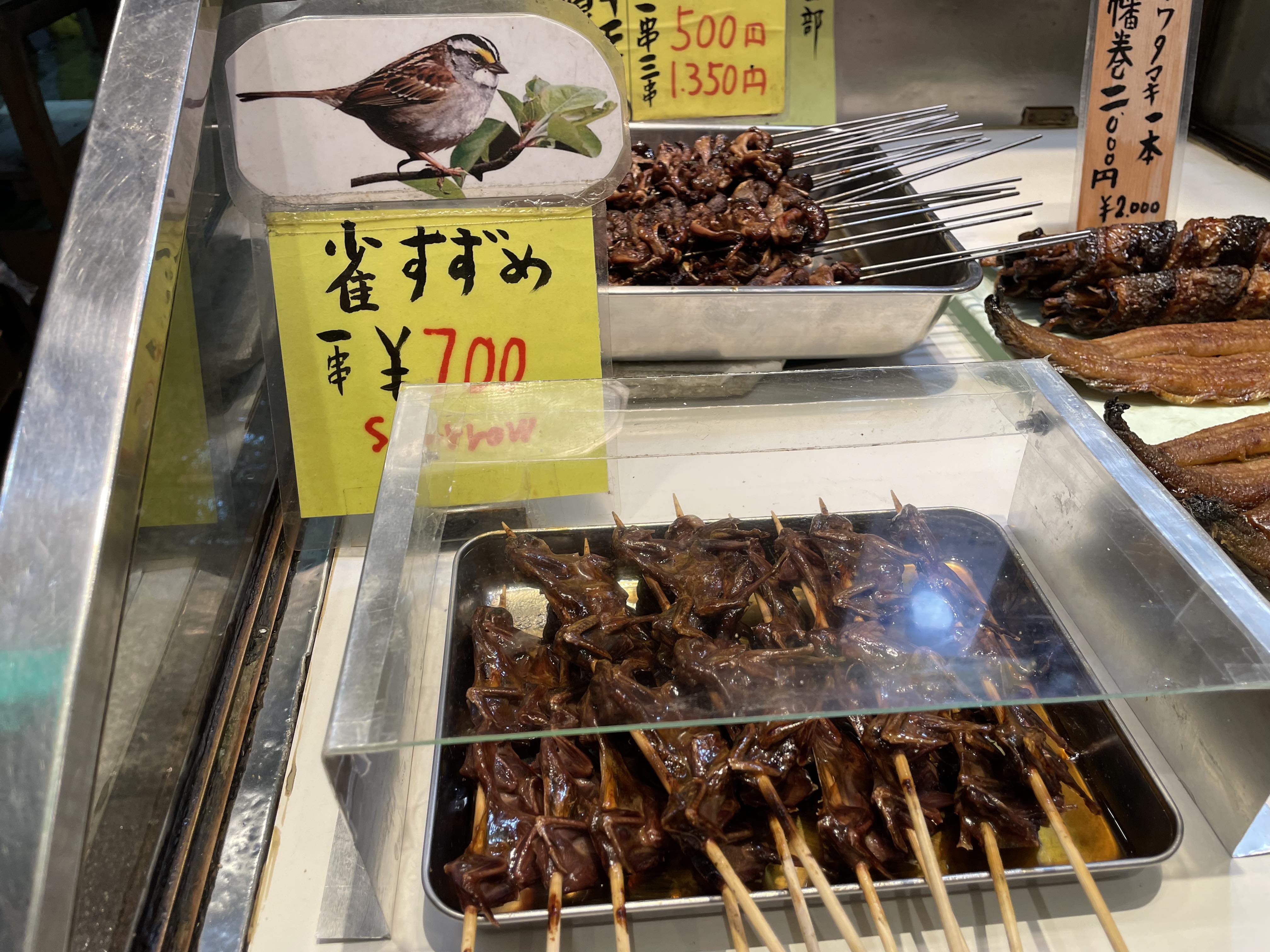
I walked through a market similar to the one I visited in Kanazawa. Among the many things on offer this time were skewers of sparrows. Many of my friends reading this will know that the 'tori' [bird] in 'yakitori' traditionally was a small songbird, usually some kind of sparrow, but it's rare these days to see actual sparrows on a stick. It was funny to me that the photo used was a photo of a White-throated Sparrow, a bird native to North America. I hope they aren't importing North American sparrows to skewer.  

Before leaving I also walked around the grounds of Miidera, a temple near the house of the friend I was visiting. The temple was pretty in the rain and there were some birds present. I saw a Japanese Pygmy Woodpecker and Oriental Greenfinches, both new to my life list. I heard the distinctive song of the Uguisu (Japanese Bush Warbler) and saw the Brown-eared Bulbuls that seem to be everywhere. I also got.a good look at a Daurian Redstart, one of the birds I saw fleetingly in Tokyo near the Imperial Palace moat. As I was leaving, the temple's mascot (in the form of a anthropomorphized bronze bell came walking through the main gate and posed for a picture. The ancient temple gate and the stylized bell figure made of styrofoam created an odd contrast.

On the first day in Kyoto, my son and I had lunch with the college friend we were visiting, dining in a striking building along the Kamo River built in 1926 designed by the American architect William Merrell Vories. According to the Internet, it opened as the Chinese restaurant Toka Saikan (where we ate) in 1945. The building has a richly decorated facade, the oldest continuously operating elevator in Japan, and numerous interior details to look at while enjoying the food. It rained most of the day and it's supposed to rain all day tomorrow again. I'm now in Tottori, hoping to visit the famous Tottori sand dunes tomorrow, but I'm not hopeful they will look like much in the rain. We'll see...


Places I'm Visiting: Japan 2024 – Kanazawa

My son and I arrived last night in Kanazawa from Sado and indulged in another sushi dinner, this time at a place called Ippei Sushi, right off the main drag in the Katamachi area. Before heading back to our hotel, we stopped in at a bar called Griffith for a quick drink. The place was deserted on a Friday night at 11:00PM in an entertainment district, which left me wondering how the place survives. The two bartenders seemed happy to have some company. One of them was a talkative fellow who brought out a map and gave us recommendations on things to do in the city. 

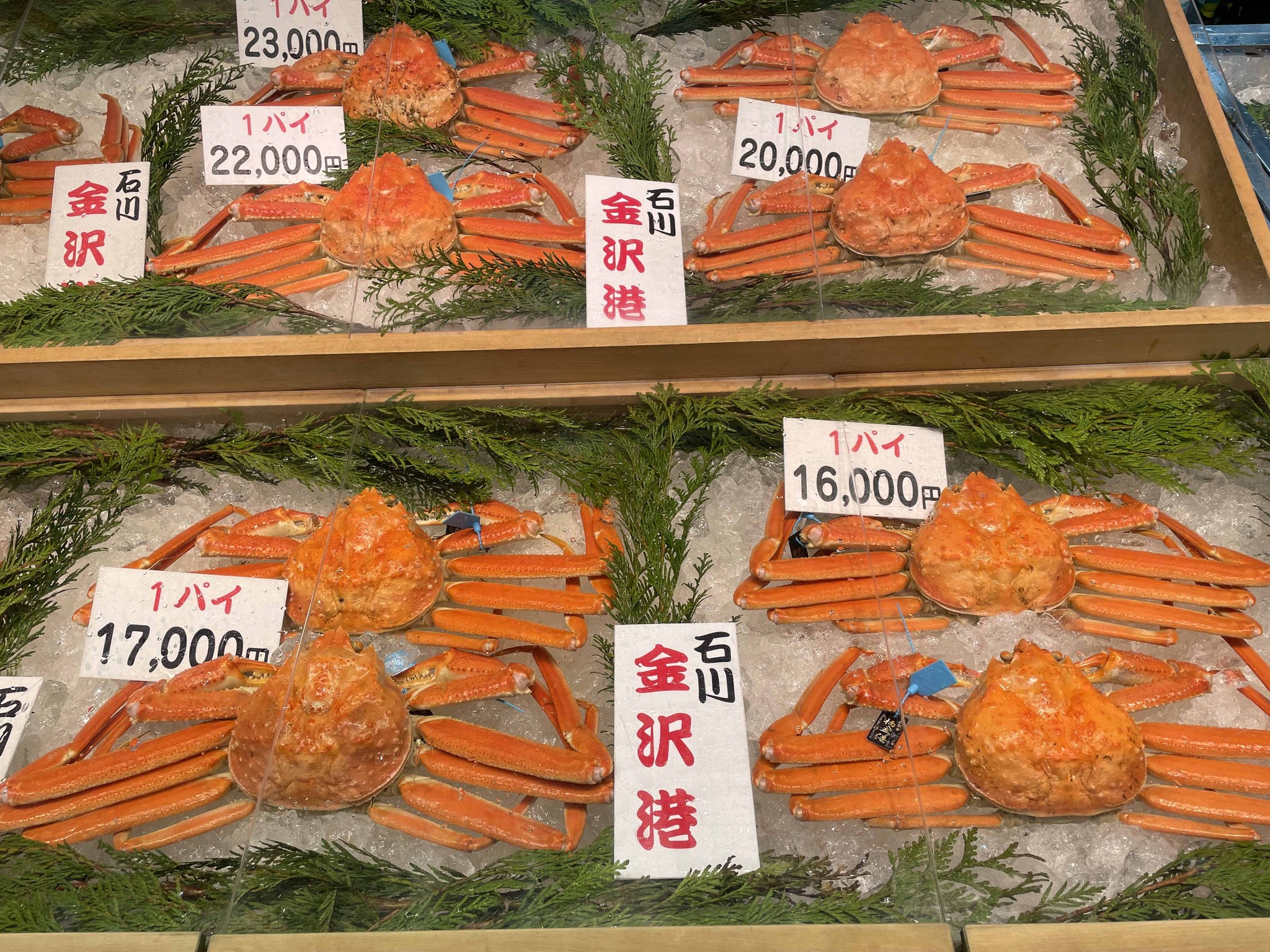
In particular, he recommended Kenrokuen, which is said to be one of Japan's three most beautiful public gardens. We spent the afternoon there after visiting the Ohmi Market, which was rather reminiscent of markets I've seen in places like Barcelona but with a greater emphasis on seafood. There were stalls full of sashimi, oysters and other shellfish of all kinds, shrimp, fish, squid, and crab. Crab everywhere – mostly zuwaigani (snow crab) and kegani (horsehair crab). The snow crab was very expensive, ranging in price from about $110 a piece to as much as $160 a piece. The vendors were selling seafood to take home but also for immediate consumption. I was tempted by the oysters...

At Kenrokuen, the moss was spectacular, virtually glowing after recent rains. Plums were in bloom. I saw Brown-eared Bulbuls taking nectar from the plum blossoms as I saw them do near the Palace moat in Tokyo. I also saw Varied Tits, Eastern Great Tits, Long-tailed Tits, and, on the grounds of a shrine near Kanazawa Castle, a pair of Oriental Turtle Doves. We are now in Kyoto, staying with friends for a couple of nights. 


Saturday, March 23, 2024

Places I'm Visiting: Japan 2024 – Sado

Aside from seeing the rare Japanese Crested Ibis on Sado, the highlight of our brief stay on the island was the friendly and helpful people. We stayed at a rather quirky bed and breakfast that served no breakfast run by a Mr. Kondo, an audiophile and jazz enthusiast. The downstairs lounge area was essentially a large listening room with vintage audio equipment and the room we stayed in upstairs had its own audio system, film projector, and stacks of LPs, CDs, and DVDs. There was even an outdoor seating area fully equipped with yet another sound system, speakers exposed to the elements but holding their own, that plays jazz 24 hours a day. The neighbors don't seem to mind. 

Mr. Kondo greeted us warmly and showed us how to use everything and what he didn't tell us about we would have had little trouble with as virtually everything was labeled with instructions. The Japanese certainly love to keep everyone informed of the etiquette appropriate to almost every situation. In the bathroom, one sign suggested using the fancy remote-controlled washlet sitting down, another noted that the remote was to be used for flushing but that the seat and covers were to be operated by hand. Still another pointed out that the bathroom light was automatic. There were signs explaining the audio equipment, a sign by the bed asking guests to refrain from moving the beds, and signs explaining the remote control for the overhead lights. Mr. Kondo is quite proud of his beds, pointing out that he has equipped the rooms with Simmons mattresses. A small wooden plaque above the bed I slept in noted that I was using a 'Simmons semi-double'. The best information he gave us was recommending Kinpuku, a nearby yakitori izakaya.

We didn't use any of the audio equipment as we spent most of our time outside, looking for the Ibis or eating at Kinpuku (which we later learned was recently named the best izakaya in Niigata  Prefecture). 

Kinpuku is an unimposing establishment. You'd easily miss it if you didn't know it was there. Aside from a tiny lantern out front, the only external clue is a little charcoal smoke from the vents and the scent of grilling meat the vents deliver to the surrounding area. We arrived by car, but were told there was no parking lot, so we said we would go back to Mr. Kondo's place and walk back, but one of the guests already at the bar got up and said 'I know a place nearby you can park. Follow me!' We walked a couple of blocks to what turned out to be the man's own house and the bar he runs. We left the car there and returned to Kinpuku. Stepping inside provided not only the prospect of good food but a respite from the snow and wind outside. Kinpuku seats only 12. There were two seats left. Mr. Kondo had told us to go early, as people are frequently turned away or have to wait for a seat sometimes as long as an hour or two. 

The proprietor, Mr. Fukushima, is a jazz guitarist as well as the one-man band that runs the place. He told us he's been grilling skewers of meat over natural charcoal as he does today for 36 years. Jazz was playing over the speakers. He told us that when he first opened, people thought it was strange that he played jazz and often didn't like it, but the customers eventually came around to his way of thinking and he seems to have found a niche. We ate there both of the nights we were on Sado. The first night we tried two locally brewed beers, one a nicely fruity blonde ale, the other an IPA-style beer. On the second night, we drank a well-made Muscadet. Many of his customers ordered wine to go with their yakitori. Kinpuku serves wine only by the bottle. My son and Mr. Fukushima had a long conversation about guitar technique on the second of our two nights. Everything was delicious, but the chicken and onion skewers, the tsukudane, and the lightly salted grilled chicken wings were especially good. I also enjoyed the skewers of cherry tomatoes wrapped in very thin pork strips. 

On the first night (March 20), we learned that the man with the bar who let us park our car at his place regularly hosts the practice sessions of a group of local musicians and dancers that do traditional dances during festivals. We were invited to come by after Kinpuku to hear the singing and dancing, the singing accompanied by flutes, shamisen, and drums. I've always thought it strange how much this kind of Japanese music resembles the music of the fife and drum bands that once flourished deep in the Mississippi Delta area. A couple of young women at the bar borrowed flutes and tried to play along. Everybody seemed to know everybody. 

Today (March 22) we took the jetfoil from Sado back to Niigata and there boarded a Shinkansen train to Kanazawa. In the morning, before leaving, we did a quick tour of the Sado gold mine, which, according to the pamphlet I read, was the longest continuously run mine in the world, having operated 388 years, from 1601 until 1989. In its peak year, the mine produced about 1,500kg of gold, which I roughly calculate would be worth about $15,000,000 in today's money. The gold was present in seams of quartz. Silver was also mined at the same location. Apparently, homeless people and criminals back in the day were sometimes  exiled to Sado and forced to work in the mines. 

Wednesday, March 20, 2024

Places I'm Visiting: Japan 2024 – Leaving Tokyo

Before leaving Tokyo, I went back to the National Museum of Modern Art, in Takebashi, where I enjoyed seeing some old favorites, notably a Foujita self-portrait with a cat, and the famous portrait by Ryusei Kishida of his five-year-old daughter Reiko, which I hadn't realized is actually a painting of a painting of the young girl. There was also an exhibition of textile designs going on. I noticed a woman in a kimono looking at a pair of yukata in the show with designs apparently derived from the hiragana script.

Afterwards, I met former work colleagues for lunch at a Thai restaurant we used to frequent. After lunch, we moved on for tea and Oban-yaki (grilled batter filled with sweet bean paste). Walking around Takebashi near the Palace moat, I noticed that almost the entire moat frontage there has been rebuilt since I was last in Japan.

Before leaving Tokyo for Sado, I enjoyed an excellent (and reasonably priced) sushi dinner at Sushiko along with my son and a friend of his. We had to line up and wait outside for about 40 minutes, but it was worth the wait.


Places I'm Visiting: Japan 2024 – Sado

I'm now on the island of Sado, north of Niigata. Once known for its large gold and silver mine, it's now known (at least in my mind) for the reintroduction there of the Toki, or Japanese Crested Ibis (Nipponia nippon), Japan's national bird. The Toki is endangered throughout its much-reduced range (mostly now in China), and it was eliminated entirely in Japan (how embarrassing to have let your national bird go locally extinct) because of habitat loss and excessive use of pesticides, but it has been reintroduced from China and a small population is established on the Island again.

The weather has been terrible here – very cold, and very windy. Overnight it has snowed. Yesterday it was so windy I couldn't hold my lens still enough to get a photograph of a Toki in flight, but I did observe a few birds poking around in the post-harvest rice paddies. The Toki is usually pictured in the peachy-white non-breeding plumage it shows in the winter months. Right now, however,  the birds are in breeding plumage – stained slaty grey on the neck, nape, and upper back – but they still have their distinctive red faces, and, in flight, their beautiful peach-tinted white wings are visible. 

Tuesday, March 19, 2024

Places I'm Visiting: Japan 2024 Day Four

Yesterday, between business calls, I wandered along the Imperial Palace moat near Takebashi. In the moat were the usual Eurasian Coots, Tufted Ducks, and Shovelers. In the trees and flycatching over the water were a number of birds that I photographed poorly in the hope of later identifying them. I had only a wide angle lens with me, so I was unable to get good close-up shots. Still, sitting on the Shinkansen, heading north to Niigata, Asian bird field guide in my lap, I've decided a small, brownish bird with a rufous tail and a conspicuous white wing patch I saw at the moat was a female Daurian Redstart (Phoenicurus auroreus). I saw a White Wagtail (Motacilla alba) on top of one of the moat walls, wagging its tail. Larger birds, flycatching over the moat, appear to have been Brown-eared Bulbuls (Hypsipetes amaurotis), and I again saw the Eurasian Tree Sparrows (Passer montanus) that I first noticed the day before yesterday. I even found a pair of these nesting in a tree hollow (pictured).

Monday, March 18, 2024

Places I'm Visiting: Japan 2024 Day Three

Leaving Tokyo tomorrow for Sado, where I hope to see the Japanese Crested Ibis, or Toki, Japan's national bird with the wonderful Latin name Nipponia nippon. It has been warm these last few days in Tokyo but it's starting to turn colder and it's expected to snow during the two days I plan to be on Sado. I need to find some gloves...

Yesterday and again today has been filled with shopping for items I need that are available only in Japan. Yesterday I secured two of the high-quality brayers I use in making my monotype-based collages at Bumpodo, one of Japan's oldest and best art supply stores. I wandered around the used book district in Jimbocho and stopped in to the English school I taught at when I first arrived in Tokyo. I was vaguely hoping someone (anyone) I once knew was still there, but it's been too long. I tried to visit the Tokyo Kindai Bijutsu Kan (The National Museum of Modern Art), but on a Monday, it was closed.  I did, however, see the Fuji Latex building, an old favorite among architectural oddities. It's built in the shape of a ribbed condom. Fuji Latex, as you may have guessed, is one of Japan's leading makers of condoms. 

Along the Imperial Palace moat nearby I noticed some varieties of cherries are starting to bloom. One tree was being visited by a pair of Japanese White-eyes and what looked like a thrush of some kind (which I later determined to be a Brown-eared Bulbul). They appeared to be taking nectar from the base of the blossoms, a behavior I've noted before. In the moat were Tufted Ducks. Earlier, in Shinjuku, I saw an Eurasian Tree Sparrow, a bird I had never seen before. 

I visited my old haunt, Yoseido Gallery, in Ginza, hoping to see some work by artist Mikio Tagusari. Turns out that the building the gallery has been in for at least 35 years (when I first found the place) is to be torn down and rebuilt. They are moving to a new location. They promised to send me photos of the inventory they have after they've settled in to their new home. While waiting for the gallery to open, I walked around Mitsukoshi department store, foolishly including a visit to the underground food floor, which, on an empty stomach was a mistake. 

Construction everywhere. It's always been that way in Tokyo. Turn around and an entire building is shrouded in scaffolding. Turn around again and a new building is in its place. The  pace of change can be disorienting even when you live here. It's amplified by a long absence. Walking to the station yesterday morning, I noticed a crew laying asphalt on a little side street. On another, they had finished and laid chalk lines indicated where street markings were to go. On my way back that evening, the work had been finished, with 止まれ (stop) neatly painted in dazzling white. 

Today will mostly be business. Meeting co-workers that I work with daily but have never met. Meeting former co-workers for lunch and other former co-workers later in the day. Preparing for the trip to Sado tomorrow....


Places I'm visiting: Japan 2024 Day Two

Had a fairly random day of wandering in Tokyo yesterday. Spent the morning in Shibuya looking at guitars with my son and then visited one of Tokyo's giant record stores, in this case Tower Records (still alive and well in Japan), with its eight floors of offerings. I spent my time on the 8th floor, which is entirely classical. The selection is amazing. Thousands and thousands of CDs and LPs to look at. 

The Japanese have a tendency to be very thorough about everything they go about. In another record store I stopped into, the storage accessory section (outer sleeves and inner sleeves of every description) alone was as big as a small record store at home. 

Earlier, I came across a store selling children's school backpacks, which are a big deal in Japan. They are typically red or black, made of high-quality leather, built to last, costing hundreds of dollars. This store had an unusual range of these all in pastel colors and with large bows – fancy backpacks for the children of the well to do. I didn't look at the prices. 

I wandered through a Sunday morning farmers market. Expensive strawberries were a hot item. A lot of artisan bread. Handmade kitchen utensils. Carrots. Eggs. The carrots in many colors. 

Later in the day, visited Kagurazaka, the neighborhood I lived in when Tokyo was my home. It has changed a great deal. All my favorite restaurants are gone. The area has been tidied up and prettied up with new buildings. There were a few familiar storefronts, though. The noodle shop at the bottom of the street that I used to go to for tempura soba is still there. The Mosburger next door remains. I walked by the two apartments that I lived in that are nearby. The second of these backs on to the compound where the chief  justice of Japan's Supreme Court lives. At the entrance the  guard stationed there 24 hours a day was at his post. As if I'd never left. 

Feet aching from walking, we rested at a fancy Kagurazaka coffee shop where the prices for a cup of joe ranged from about eight dollars to about 15 dollars. Here was another example of the Japanese doing nothing by halves. Each cup is individually brewed and delivered to your table by a uniformed waitress in the beaker it was brewed in, the coffee then poured at the table, the ritual as important as the product. I was happy to pay for the rest that the visit afforded. The place reminded me of a San Francisco Chinatown teahouse in its design with its square cubicles and heavily detailed ceiling. 

We had had extraordinary luck with food at lunchtime, in Shibuya, on spec adding ourselves to the end of a line that had formed in front of Tokyo Tarako, a restaurant that serves nothing but mentaiko (salted cod roe or pollock roe) spaghetti. Absolutely delicious. Mine came with a small pat of herbed butter to melt on top. Many of the selections came with little pots of broth (made from kelp and bonito flakes) that you add to make Japanese-style soup-spaghetti. A treat. Tokyo Tarako is at Shibuya 1 Chome-14-9. They appear to have a sister restaurant in Harajuku as well. At dinner time, we were not so lucky. It was a Sunday night, many stores and restaurants were closed. We were craving good sushi, but had to settle for mediocre yakitori in Jimbocho, the district I worked in as an English teacher when I first arrived in Tokyo. 

Along the way
, we passed Yasukuni Shrine, controversial because it enshrines all of Japan's WWII war dead, including the men designated as Class A war criminals by the post-war Tokyo Tribunal. It's a pretty spot, despite the controversy. Pictured here is  the large copper torii at the main entrance. 


Related Posts with Thumbnails