Showing posts with label Plants I'm growing. Show all posts

Wednesday, November 5, 2025

Plants I'm growing (and rain): Last peppers of the year

Winter approaches. Yesterday I picked what will likely be the last of the peppers from the garden this year – shishito, jalapeƱo, and poblano peppers. That said, winters are mild here. Yesterday I also planted two kinds of spinach, three kinds of lettuce, arugula, mustard greens, and mini turnips. Obligingly the skies dropped 1.30 inches of rain overnight. That brings the total so far in the 2025-2026 rain year to about 3.20 inches at my location.

Saturday, July 26, 2025

Plants I'm Growing: Garden produce

The garden is finally starting to produce. We got a late start this year because I was away in Japan in April – just when we normally set out starts and plant seeds – and this has been an extraordinarily cool summer so far. Something I read suggested  Northern California has been having its coolest summer since some time in the 1980s. Normally, the grapes have fully taken on color by now, but veraison has barely started. Harvest will be late.  

However, we're still getting lettuce and spinach, and we're now getting green beans, arugula, mustard greens, zucchini, other squash, poblano peppers, Fresno peppers, and green peppers. The first tomatoes have been a small variety called "Jaune Flamme" (or "yellow flame") that I've not grown before. It's not a cherry tomato but it's not a full-sized tomato either. It's one of those hat has fruit about the size of a golf ball. It's meaty and very flavorful. I'll look for it again in the future. 

Wednesday, July 16, 2025

Plants I'm growing: Is it all arugula?

I love the pungent leaves of the plant that I call "arugula." Nothing spices up a salad like arugula, but there appears to be a great deal of confusion surrounding this arugula (Latin name, Eruca sativa). It has many common names (besides arugula, referred to as rocket, rocket salad, roquette, rucola, and garden arugula, among others, with arugula and rucola coming from the Italian and rocket and variants coming from the French roquette) and it's often confused with (or wrongly thought to be the same as) Diplotaxis tenuifolia, which likewise has a number of common names; I've seen it called wild arugula, perennial arugula, perennial wall arugula, and, in plastic bags at the supermarket "baby arugula." While both are in the mustard family (Brassicaceae), they are not in the same genus and therefore not closely related. 

I know the two are distinct simply because the Latin names differentiate them, which is the whole point of Latin names – to distinguish between plants and animals with overlapping common names and different names in different languages around the world, but I also know how different they are because I grow both types in my garden. Eruca sativa, which comes up from seed quicker than just about any other plant I've ever sown, is an annual that grows quickly, producing flat, notched leaves typically about three to six inches long. It is fairly quick to bolt in the summer. Its flowers, on stems up to about 18 inches tall, are typical mustard family flowers with four   petals in a bilaterally symmetrical arrangement, pale cream colored with fine, dark, purplish veining (see photos below). 

Diplotaxis tenuifolia looks altogether different. The leaves are shorter, narrower, and more heavily if not more deeply notched. It forms mounds of dainty foliage, growing up to about 24 inches high or as much as about 36 inches including the long, thin flower stalks. The flowers are again typical mustard family flowers with four petals, but the flowers are a plain, unveined yellow (see photos). Finally, Diplotaxis tenuifolia is a perennial.  

What the two plants have in common is the presence of chemicals in the leaves of glucosinolates that break down into isothiocyanates, which as a group (if I understand correctly) are referred to as "mustard oils." These are the compounds responsible for the sharp and bitter flavors we know from mustard, radishes, watercress, capers, and others – including arugula, or rucola, or rocket, or roquette, or perennial arugula. The two plants smell and taste similar, so they share names, despite their taxonomical distance.

I find it frustrating that there seems to be no agreement about the common names. I've seen almost all of the names listed above for Eruca sativa used for both plants. I've even seen Japanese mizuna (which is another mustard family plant altogether, Brassica rapa var. nipposinica or Brassica rapa var. japonica) erroneously referred to as "arugula." While the Latin names clear things up and I'm perhaps a nerd, I'm not nerdy enough to ask for Diplotaxis at the supermarket. It's bad enough when I pronounce shiitake properly and they have no idea what I'm talking about. 


Sunday, May 11, 2025

Plants I'm Growing: Pawpaws

Two days before leaving for an extended stay overseas (at the end of April), two pawpaw plants arrived in the mail – trees I had ordered almost three months earlier (the nursery shipped the trees when they were considered ready to plant rather than when they were purchased). I would like to have been at home to watch over them as they settled in, but I had to leave. In the first couple of months after planting, a new tree is always vulnerable, so I was worried about them, but I'm happy to say that with the help of friends and neighbors who agreed to keep an eye on the garden during my absence, they have both successfully leafed out and seem to be doing well. It will be a couple of years before they start producing fruit, but so far so good.

Monday, September 16, 2024

Plants I'm Growing: Aloe Polyphylla

The comparatively rare
Aloe polyphylla in the garden, with its spirals of leaves, bloomed this year for the first time. The seed pods are now mature and I've been able to collect hundreds of seeds. I'm looking forward to raising some babies.


Friday, May 3, 2024

Plants I'm Growing: Aloe polyphylla

Aloe polyphylla is a fairly hard-to-find aloe variety prized for its large spirals of small leaves (its Latin name means 'many-leaved'). I have two, one doing poorly, the other very happy. Watering the garden this morning, I was thrilled to see that the larger of the two appears to be very happy, indeed; it's preparing to flower. It has developed a large cluster of buds.  I've never seen this variety in flower before. Looking forward to it... 

Monday, July 24, 2023

Plants I'm Growing: Summer vegetables

Things are beginning to pick up in the garden. Recently harvested zucchini, yellow squash, Japanese cucumbers, slicing cucumbers, lemon cucumbers, lettuce, and garlic. Soon tomatoes will start coming and eggplants are coming along, too.

Saturday, May 27, 2023

Plants I'm Growing: Peonies

Peonies and German irises were the centerpiece of my grandmother's garden in Dayton, Ohio – a garden that later, when I lived in the house, I was mostly responsible for taking care of. I've always associated these two flowers with her. When I moved to California (from Tokyo) 22 years ago now, I planted both. The irises do fine here, but peonies need a colder winter than we usually have in Santa Rosa. While the clump of peonies I put in always comes up in the spring, never has even a single bud appeared – until this year. Winter weather this year was cold enough for long enough that the peonies bloomed for the first time, after about 15 years. Four large, pink blossoms. 

Saturday, January 15, 2022

Plants I'm growing: First blooms (2022)—Cyclamen Coum
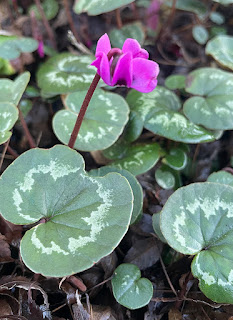
I note here a little belatedly that Cyclamen coum was the first plant in the garden to bloom this year, as it is in most years. The first couple of flowers opened this year on January 7, which is typical. Cyclamen coum normally blooms in the first week of January, occasionally in the last week of December. Also blooming in the garden right now is the pink flowering plum at the front of the house. The first flowers opened on January 10 or so, although, strictly speaking, I missed their first day.  

Wednesday, March 31, 2021

Plants I'm Growing: First Blooms—Bosc pear, flowering crabapple

Spring is here. I've been lazy about keeping track of what's started to bloom in the garden this year, but note here that the flowering crabapple toward the back of the house (above) and the Bosc pear at the front of the house (below) both started blooming in the past couple of days, on March 28 to be exact. 


Tuesday, March 23, 2021

Plants I'm growing: First blooms—Species tulips (March 20, 2021)

I planted a variety of species tulips (as opposed to the more common hybrid tulips) in the garden many years ago now—maybe nine of ten years ago. I planted hundreds. They were beautiful and, apparently, delicious. I large fraction of them disappeared into the gullets of a local colony of ground squirrels (since departed). Others gradually stopped blooming after a year or two, as tulips often do (while daffodils seem immortal). One species, Tulipa bakeri, has proven the most robust. These (those that remain) still come up  year after year. The first buds opened this year on March 20. 

It is from species like these that what most people think of as tulips today were developed. Tulips are native to places like Turkey and the countries of the Caucasus region. This is a variety called "Lilac Wonder." Tulipa bakeri bloomed in the garden on March 5 in 2009 and on March 16 in 2010 (although I seem to have two contradictory dates for 2010--also February 24), on March 14 in 2011, on March 4 in 2012, on February 25 in 2013, on March 6 in 2014, on February 20 in 2015, on March 9 in 2018, and on March 16 in 2019, so this is toward the late end of the range I've noted over the years, but nothing out of the ordinary.

Sunday, February 23, 2020

Plants I'm Growing: First Blooms—Spring Flowers (2020)

I've been rather lazy this year about recording the first blooms of plants in the garden this year. I missed the date of the miniature cyclamen that is always the first flower of the new year and likewise the date of the first blooms on the white plum tree in the side yard. I have recorded a few, though. The yellow daffodils in the front of the house first bloomed this year on February 20. The pluot "Dapple Dandy" bloomed on April 15. The pluot called "Flavor King" first bloomed on February 18 and the dwarf peach behind the house had its first flowers on February 21. The two-toned daffodils at the front of the house bloomed on February 29, more than a week later than the yellow ones, which is normal. The magnolia-like Michelia yunnanensis bloomed on February 29 as well.


Sunday, July 21, 2019

Organic Fertilizer Bounty

Thanks to an amazing homemade organic fertilizer I learned about from a neighbor (who attributes it to a farmer in Wyoming with a YouTube video), our garden this year is producing an overwhelming amount of food. Summer squash, zucchini, Japanese turnips, green beans, bell peppers, jalapeƱo peppers, cayenne peppers, Fresno peppers, Italian horn peppers, lemon cucumbers, peaches..... Soon eggplant and tomatoes will start coming as well.

Very easy to make this fertilizer, which has only three ingredients: Alfalfa pellets, blackstrap molasses, and fish emulsion. Feed stores generally have the pellets. A big bag will last all year. Any good garden store will have the fish emulsion (should be marked 5-1-1 or very close to that). The molasses (unsulphured) is available online. The one-gallon jug of the molasses and the fish emulsion I bought are not even half empty and I started this regimen in April.

Put one pound of the pellets in the bottom of a five-gallon bucket (I've found that a one-liter measure filled to the brim with pellets is about a pound). Put about a gallon of water in and let the pellets soak up the water and swell up. There should be enough water that you're left with a soupy mixture with liquid, not mush. After a few hours, or overnight, add 150ml each of the fish emulsion and the blackstrap molasses (about 2l3 of a cup maybe. Measurements don't have to be exact). Stir well and let sit for a couple of hours.

This I dilute again for use, putting one gallon of the mixture into a five-gallon watering can--so, diluting 1:4. It sounds more complicated than it is. Once you've done it a couple of times, it's quite easy. Apply once or twice a week. As plants start to flower and produce fruit, I add an organic guano-based 0-4-3 fertilizer to the mix called HDK (25ml/five gallons) easily available from the cannabis hydroponics stores if you live in a cannabis-legal state. This all-organic mixture works wonders!

Saturday, February 23, 2019

Plants I'm Growing--First Blooms: Daffodils, Pink Flowering Plum 2019

The yellow daffodils in front of the house and the pink flowering plum behind the house generally bloom at about the same time each year. This year, the first daffodils opened on February 6. The first flowers on the plum (Prunus blireiana) opened on February 9. Early to mid-February is normal for both plants. They have bloomed between February 2 and about February 20 in a typical year in the past. A storm is on the way that is supposed to drop as much as 10 inches of rain in the coming seven days. I hope these blossoms aren't all lost before we've had a chance to enjoy them.

Friday, January 18, 2019

Plants I'm Growing: First Blooms--Pink Flowering Plum and "Noyo Dream" Rhododendron

I've been keeping track of the first flowering of many plants in the garden for about eight years now. I have analyzed the data to see if the flowering period of plants are shifting, which was my original intent in creating a kind of botanical calendar, but the Rhododendron "Noyo Dream" bloomed today, which seems very early. Usually this plant blooms in February or even early March. For example, "Noyo Dream" bloomed on February 25 in 2009, on February 7 in 2010, on February 2 in 2011, and March 2 in 2012.

On January 13, the first blossoms opened on the pink flowering plum alongside the house. Today both this plum and the white plum on the other side of the house are in full bloom and buzzing with bees.


Thursday, January 10, 2019

Plants I'm Growing: First Blooms—Cyclamen Coum and White Flowering Plum (First Week of January 2019)

I've become lazy about keeping track of first blooms in the garden. I think this is because, having taken fairly careful notes, for several years, I've satisfied my original curiosity about the consistency of bloom dates. At first I recorded the first blossoming of virtually every plant in the garden. More recently I've limited by attention to a smaller sampling and missed a few dates I would have liked to have recorded more carefully.

As usual, Cyclamen coum, a dwarf cyclamen variety, was the first flower to bloom in the garden in the new year, several blossoms were already open on the 2nd or 3rd of January, but a single blossom had already opened on December 16--which is quite a bit earlier than every before. Probably an outlier, not part of a trend. Last year this plant bloomed first on January 4. So, aside from the one early bloom, this is in line with its usual pattern.

The white flowering plum on the side of the house began blooming almost a week ago, but I missed the exact date. Probably around January 4. Always pretty, always delightfully fragrant, the bees are already swarming it, probably mostly to collect the abundant pollen. We lost our bees this past summer, so these are bees from hives the neighbors keep. The plum first bloomed last year on January 14, so this is comparatively early, although not unusually so. The tree has had its first flowers as early as December 30 in the past.

Thursday, May 24, 2018

Plants I'm Growing: Cactus "Scarlet Cup"

Once a year, fleetingly, the several varieties of cacti we have in pots on the deck give a good show. Perhaps my favorite among these is Echinocereus triglochidiatus, a type of hedgehog cactus known as scarlet cup, or claret cup, among other names. The flowers just began to open today. They will last perhaps over the weekend.--or maybe not that long.

Tuesday, March 27, 2018

Plants I'm Growing: First Blooms—Flowering Crabapple, California Poppies (March 26, 2018)

Yesterday, March 26, brought the first blooms on the flowering crabapple in the side garden. The first California poppies in the garden bloomed yesterday, too, although they've been blooming in various places around town for the last week or more. This is fairly typical for the crabapple, which usually blooms in the second week of March in early years, the last week of March when it's later, and for the poppies as well. In past years they've opened as early as the first week of March and usually always before April.


Monday, February 5, 2018

Plants I'm Growing: First Blooms--Yellow Daffodils (February 4, 2018)

The yellow daffodils in the front garden starting blooming yesterday, February 4, 2018, in response to the unseasonably warm weather we've had this week. It seems like spring already, with highs in the 70s. That said, this has been typical. These flowers have frequently bloomed in the first week of February since I started keeping track.

Sunday, January 14, 2018

Plants I'm Growing: First Blooms—Cyclamen Coum, White Flowering Plum

On the first day of 2018, the white Japanese flowering plum in the back yard started to bloom. It has bloomed as early as December 30, but it typically blooms in the middle of January (about now, today being January 14), so the flowers opened somewhat early this year.

On January 4, the first blooms appeared on the delicate dwarf cyclamen we have growing in back of the house under a Japanese maple--Cyclamen coum. The flower stalks stand only about two inches high. This tiny cyclamen typically blooms anywhere from late December to early January, so, that was in line with its usual pattern.


Related Posts with Thumbnails