Showing posts with label San Francisco Symphony. Show all posts

Tuesday, June 16, 2026

Music I'm Listening To: Maria Dueñas with the San Francisco Symphony

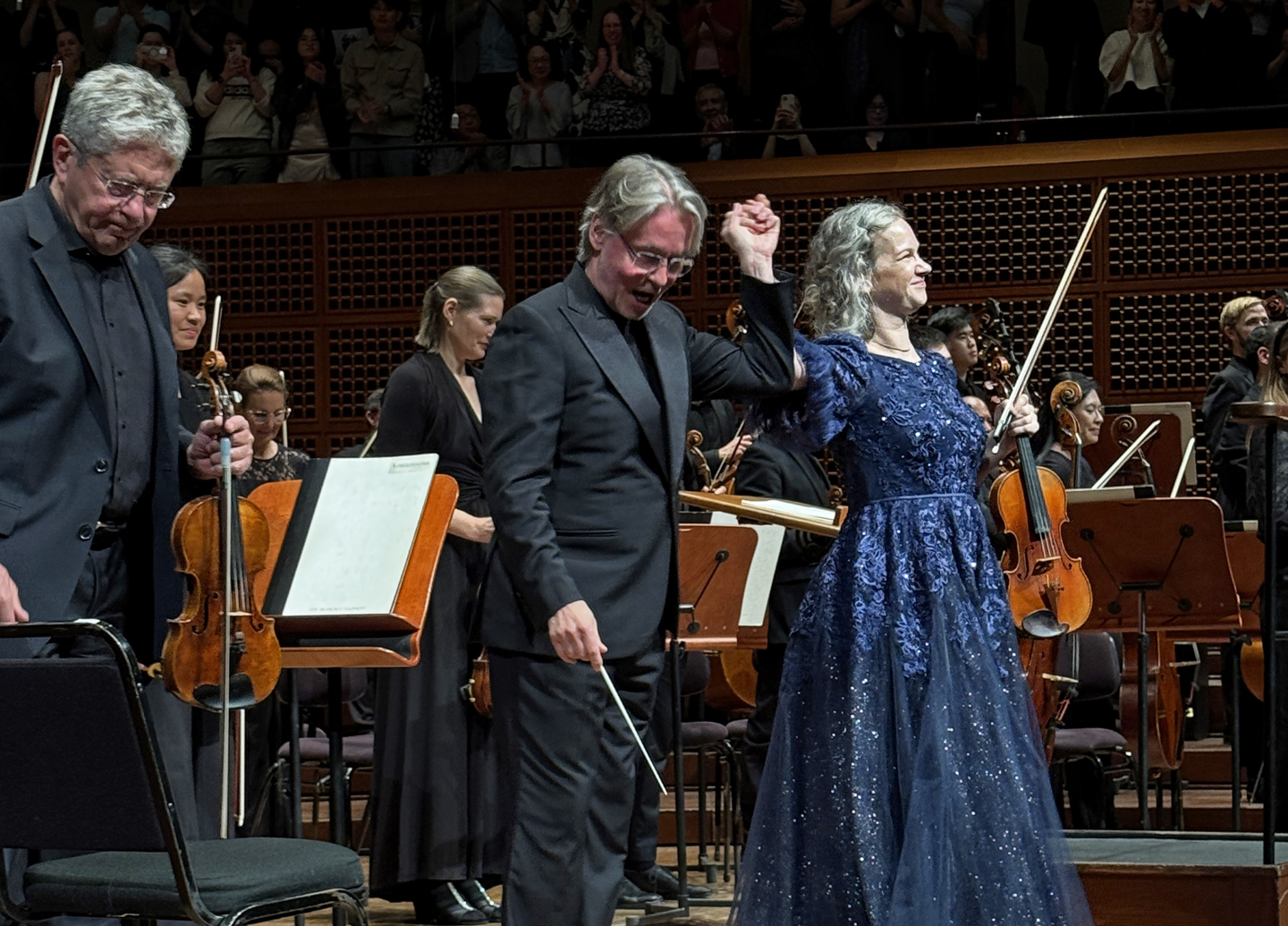
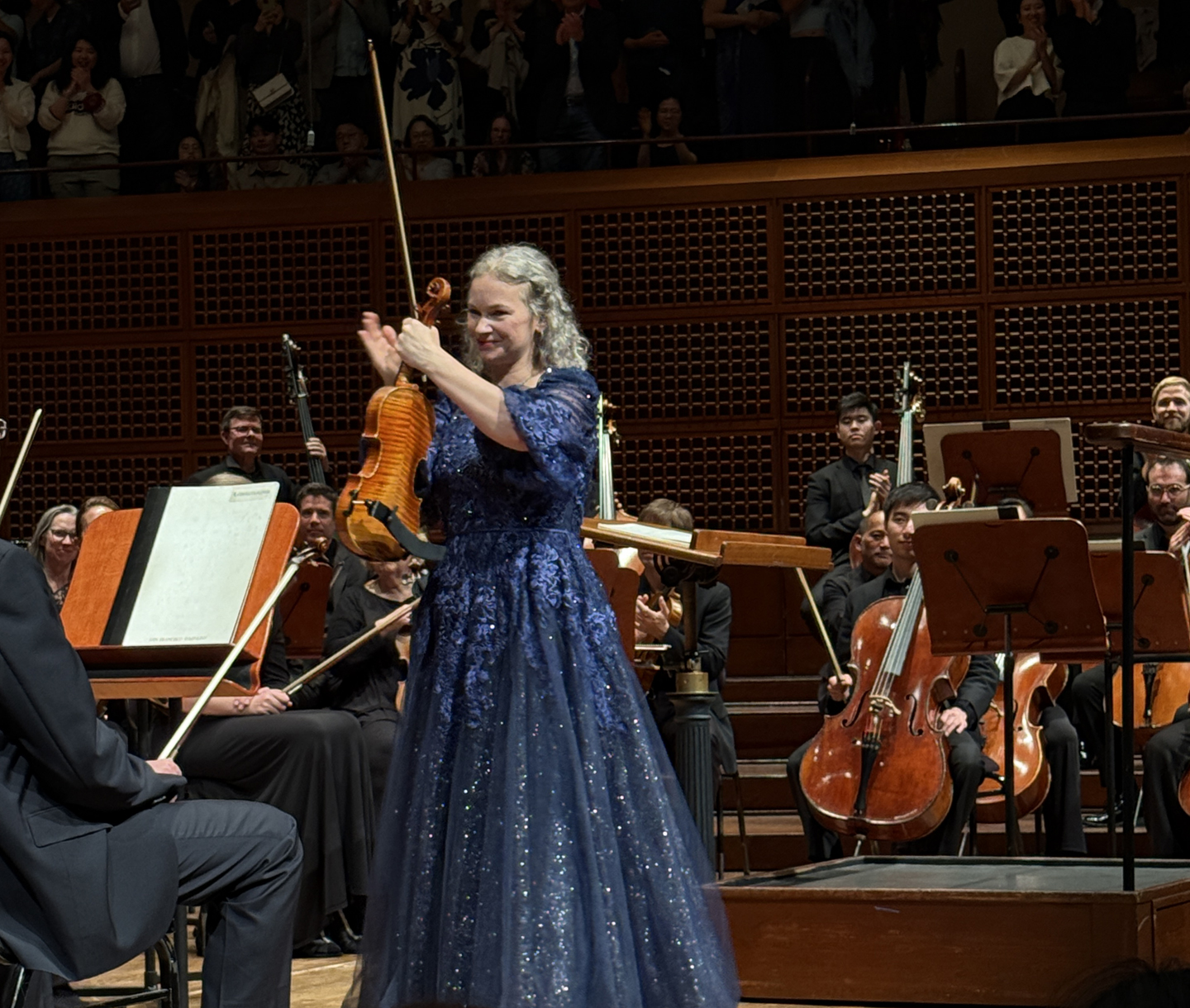
I attended the Friday 12 June performance of the San Francisco Symphony at Davies Symphony Hall. On the program were a new piece by Iranian composer Iman Habibi entitled Zhian, the Korngold Violin Concerto, and, after intermission, Rimsky-Korsakov’s Scheherazade. On the podium was guest conductor Tianyu Lu, an entirely new name to me. The soloist in the concerto, I was excited to find was Spanish violinist, Maria Dueñas. I say “excited to find” because, being a subscriber to the symphony, I buy tickets in May for the following year’s season, and by June, the end of the season, I frequently forget who’s performing by the time the concert comes around. The Symphony never prints the full program on the tickets, so I wasn’t aware until I sat down with the program at my seat. More importantly, perhaps, I had never heard of Dueñas last year when buying the subscription, so, at that time I would have had no particular expectations. I became aware of her fairly recently and I’ve been impressed by what I’ve heard, so it was a very pleasant surprise to learn as I settled in that I was about to hear her in person. 

I wasn’t disappointed. While the Korngold isn’t among my favorite violin concertos, it has its moments and Dueñas attacked it with vigor. I particularly enjoyed the sound of her violin in the low register. It had an extraordinary, rich, throaty, tone that fit the concerto perfectly, I thought. According to some Internet sleuthing, she plays a number of different violins on loan to her but she appears to have played a 1779 Giambattista Guadagnini violin on Friday, this one on loan from the Karolina Blaberg Foundation via the Deutsche Stiftung Musikleben*. She was called back for an encore (something I didn’t recognize) after an extended standing ovation. The crowd loved it. Conductor Lu was great fun to watch. She’s a tiny woman but she is overflowing with energy. A fun concert all around.  

*Ms. Dueñas contacted me a couple of days later. She said she played the 1718 "Michelangelo" Stradivari violin, not the Guadagnini.


Saturday, March 21, 2026

Music I'm Listening To: The San Francisco Symphony

I attended the Friday, March 20 performance of the San Francisco Symphony at Davies Symphony Hall. On the program were Overture to Euryanthe (Carl Maria Von Weber), Mozart's Piano Concerto No. 9, an early work that I have surely heard before but didn't really recognize, and Dvorak's Symphony No. 7, perhaps my favorite of them (but it's hard not to like No. 8 and No. 9 as well). The soloist in the Mozart was Jan Lisiecki, a Canadian-born pianist that appears to be well known, but I hadn't been aware of him. The guest conductor was Andrés Orozco-Estrada. 

Orozco-Estrada was a lot of fun to watch. Some conductors barely move. Orozco-Estrada was virtually dancing on the podium, and with great energy, his baton seemingly a wizard's wand. It was a uniformly excellent concert, but I thought his reading of the Dvorak was particularly good. The audience seemed to agree with me. The concert ended with a prolonged standing ovation. 

According to the program notes, Orozco-Estrada will take over as director of the Swedish Radio Symphony next season. He has in the past been the music director of the Houston Symphony, and conducted the Hesse Radio Symphony and the Vienna Symphony. 

Sunday, March 1, 2026

Music I'm Listening to: Santa Rosa and San Francisco

Some odd and ends. I've been lazy about posting comments on recent concerts I've attended – which I do mostly so that I can look back and remember what performers I heard and where. So, just for the record, The Santa Rosa Symphony just finished three performances of Mahler's Symphony No. 3, which is one of my favorites. I applaud the music director for attempting such a long and challenging piece. I attended the February 23 performance. The orchestra is huge for the Mahler. There were nine French horns!

In January, at Davies Symphony Hall in San Francisco, I heard Emanuel Ax with the San Francisco Symphony, Jaap van Sweden conducting.  Ax played Mozart's Piano Concerto No. 25 and afterward played an encore, something familiar by Schubert, but I can't remember now what it was. Jaap van Zweden is a fierce-looking man on the podium. Ax gives the impression of being a gentle, kind man, but these are just impressions from the gallery. I attended the January 30 performance. Also on the program was Bruckner's Symphony No. 7

On February 27, at Davies Symphony Hall again, the Symphony, conducted by Manfred Honeck, performed Beethoven's Coriolan Overture – one of those Beethoven overtures I used to use in college as a musical pep talk. I'd play one, loud, before heading out for final exams. Somehow, the music ringing in my head convinced me I'd do well. Haydn's Symphony No. 93 followed. After intermission, Honeck led an unusual performance of Mozarts Requiem with additions and subtractions from the versions we usually hear – those filled out after Mozart died leaving the piece unfinished. Honeck played only the portions actually written by Mozart but interspersed with Gregorian chant and readings by an onstage performer of portions of a letter by Mozart to his father, by Bible excerpts, and some modern poetry. The performances were dedicated to the late Joshua Robinson, MTT's partner, who died a few days before concert I heard. 


Sunday, November 9, 2025

Music I'm Listening To: The San Francisco and Santa Rosa Symphonies

I attended the Santa Rosa Symphony concert last night (November 8 2025) at the Green Music Center. On the program was Clarice Assad's Baião ‘N’ Blues, Joaquin Rodrigo's Concierto de Aranjuez for Guitar and Orchestra, and Manuel de Falla's El Sombrero de Tres Picos [The Three-Cornered Hat]. The soloist in the Concerto was Raphaël Feuillâtre (Guitar). The vocalist in the Three-cornered Hat was mezzo-soprano Leah Finn.

It was a very impressive performance by the symphony, I thought – among the best I've seen. Feuillâtre was impressive in the concerto as well and he wowed the crowd with an exciting encore. Tickets are probably still available for the Monday night performance. 

In San Francisco, the night before, I heard the San Francisco Symphony at Davies Symphony Hall. French pianist Alexandre Kantorow made his debut with the Symphony (in concerts on November 7, 8, and 9) playing Prokofiev’s Third Piano Concerto. Karina Canellakis conducted.


Monday, June 2, 2025

Music I'm Listening to: Recent San Francisco Symphony concerts

Unusually, I recently had three San Francisco Symphony concerts on three successive Friday nights, May 16, May 23, and May 30. It's always hard to write about music but particularly hard to after the fact, so just a few highlights here, as a couple of weeks have passed already.... 

On May 16, cellist Johannes Moser joined the SF Symphony for the world premiere of Before We Fall, a cello concerto by Anna Thorvaldsdottir. It was a rather abstract piece – the sort that's difficult to process on first hearing – but rich in texture and I thought it interesting enough that I'd enjoy hearing it again or finding a recording of it. As always, Moser was superb. 

The program began with Fantasia on a Theme of Thomas Tallis, by Ralph Vaughn Williams. Conductor Dalia Stasevska handled it beautifully, I thought, without rushing but also without letting it get too lush. It was as satisfying as any recording I've ever heard of it. This was the second time I've had the privilege of attending a concert with Stasevska conducting. She seems to have established a real connection with the San Francisco musicians despite being an occasional guest conductor. She's precise, in control, and on top of things. After intermission, the Symphony played Sibelius's Symphony No. 5.

The following Friday, Isabelle Faust was the guest soloist in the Berg Violin Concerto. Esa-Pekka Salonen conducted. Also on the program were Chorale, by Magnus Lindberg, and, after intermission, Stravinsky's The Firebird. This was a concert I got tickets to by trading in an unused ticket for an earlier performance, so the seat was not especially good. When there's a soloist, I like to be right up front and just left of stage right, so I'm right in front of the soloist (D104 is my usual seat), but this time I was well off to stage left, which was a little disappointing. I did, however, enjoy Salonen's reading of The Firebird. He got a very warm welcome when he first appeared on stage and, as at other recent concerts I've attended with Salonen conducting, calls from the crowd for him to stay in San Francisco. 

On the 30th, it was an all-Beethoven program. Beethoven's Symphony No. 4 came before intermission, his Violin Concerto was performed after intermission with Hilary Hahn as soloist. Elsa-Pekka Salonen conducted. The highlight was the concerto. Hahn was in top form. Precise, with each note articulated, and with nearly perfect intonation, but never cold or distant-seeming. A very full house gave her a long standing ovation. She came back for an encore (something from the Bach solo partitas and sonatas) and then came back for a second encore, doing a piece I didn't recognize. It's always fun to watch her during rests because she often turns her back to the audience to watch the orchestra herself and really seems to enjoy listening from what is perhaps the best 'seat' in the house. I've noticed also that she always applauds for those who accompany her. A memorable performance. 


Friday, March 28, 2025

Music I'm Listening to: Gil Shaham and Juraj Valčuha with the San Francisco Symphony

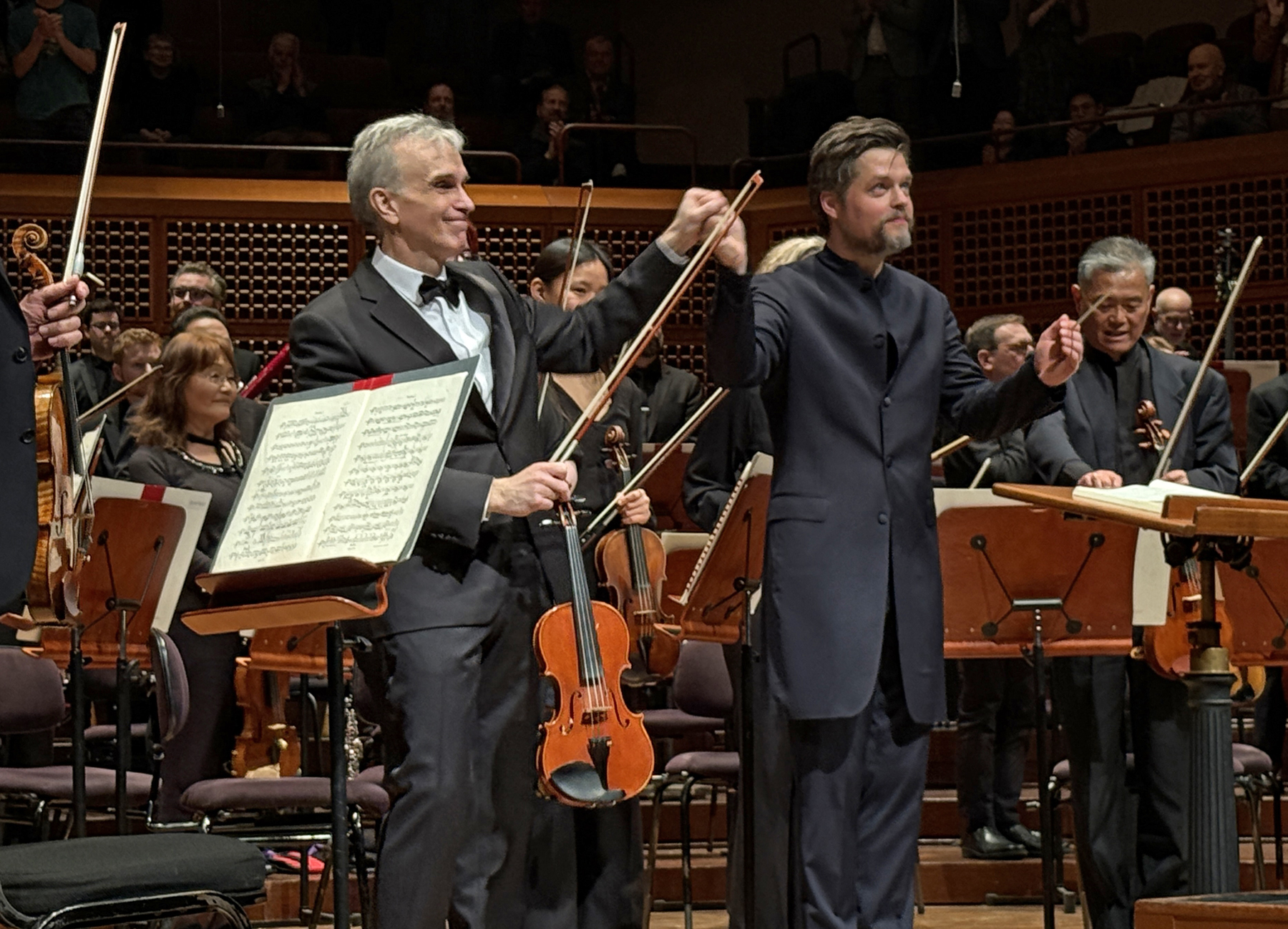
Last night, March 27, I attended a San Francisco Symphony concert featuring Gil Shaham as soloist in the Brahms Violin Concerto and, after intermission, Shostakovich's Symphony No. 10. Shaham, Valčuha, and the Symphony performers were in fine form. I had never heard of Valčuha before. According to the program notes, from 2016 to 2022 he was the music director of the Teatro di San Carlo in Naples and he has been the music director of the Houston Symphony since 2022.  I liked his approach. He elicited a rather clipped, precise phrasing from the orchestra in both pieces on the program that gave the performances a crispness I rather liked without sacrificing feeling in the more lyrical passages. A very enjoyable evening. 


Saturday, February 22, 2025

Music I'm Listening to: Daniil Trifonov with the San Francisco Symphony

Last night (February 21, 2025) I had the pleasure of attending the San Francisco Symphony concert at Davies Symphony Hall. On the program were a new piece, Strange Beasts (a San Francisco Symphony Commission and World Premiere) by the appropriately named composer Xavier Musik, Prokofiev's Piano Concerto No. 2 (with soloist Daniil Trifonov), and, after intermission, Stravinsky's The Rite of Spring

Strange Beasts was interesting for its wide range of aural textures and the sense of unease it created (in several places I was reminded of a Bernard Herrmann score), this heightened by angular photographs of Los Angeles projected above the orchestra, images taken by the composer. Muzik spoke before the performance, explaining that he suffers from anxiety, that, if left unchecked, tends toward catastrophic imaginings and that composing and photography help him to stay sane. He said he imagines the looming buildings in the slide show (many projected upside down) as being like monsters or the strange beasts of the title of his composition. While I thought the photographs mostly ordinary snapshots of no special interest in themselves, the way they were projected, rapidly changing, worked fairly well with the repeated crescendos of unsettling sound welling up in the music. I thought Strange Beasts was longer than it needed to be, but I'll be interested to watch this young man's career. I think in places it was very successful even if it seemed a bit rambling and without structure (at least without structure discernible to me). 

Prokofiev's Piano Concerto No. 2 followed with Trifonov at the keyboard. His manner on stage was serious but, at the same time, he gave the impression of being on the verge of spinning slowly out of control. He seemed nervous and awkward. At the piano, however, Trifonov was electric. I was very impressed by the clarity of his phrasing despite the very fast tempos in the concerto. He got an extended standing ovation and came back to play two encores, the first I think was from one of Prokofiev's piano sonatas, but it was not something familiar. The second I recognized immediately, a piece from Prokofiev's Cinderella, that seemed perfect to me. 

After intermission, Salonen conducted the orchestra members in a tight performance of The Rite of Spring. Overall, it was an excellent concert, but that second encore may have been the highlight of the evening. 

Saturday, February 8, 2025

Music I'm Listening to: Paavo Järvi and Kirill Gerstein with the San Francisco Symphony

Last night (February 7) I attended the San Francisco Symphony concert at Davies Symphony Hall. Paavo Järvi conducted Shostakovich's Piano Concerto No. 2 and, after intermission, Mahler's Symphony No. 7, a long but engaging program. Gerstein really attacked the piano. It was an aggressive performance. At times I felt like I was listening to a recording with too much of the mics on the piano mixed in. It was enjoyable nevertheless. After the main event, he played a Chopin waltz as an encore that the symphony performers, particularly concertmaster Alexander Barantschik, really seemed to enjoy – as did the audience. 

Among Mahler's symphonies, Nos 2, 7, and 8 are the ones I've never really understood or appreciated. I know No. 2 is particularly revered by many, but it's never appealed to me. Someday, perhaps, I will make headway toward better understanding it. I've felt the same way about No. 7, but the performance last night was eye-opening for me. The piece is complex and long and it's never really held my attention all the way through, but Järvi and the San Francisco Symphony made it come alive and I found myself enjoying every detail. I had no idea that there was a guitar part in the piece or that the mandolin makes an appearance. Hearing it live brings out nuances easily lost in a recording. 

I have only two recordings of No. 7, one with Maurice Abravanel conducting the Utah Symphony (Vanguard – VSD 71141/2), one with Georg Solti conducting the Chicago Symphony (London CSA2231). Although I love the Abravanel/Utah recordings of some of the other Mahler Symphonies (particularly No. 3), I can't say their presentation of No. 7 has ever done much for me. This morning, the day after, I'm listening to the Solti recording, which I think is much better and, having just heard the piece live last night, I'm suddenly hearing a great deal that I never noticed before – and enjoying it. I seem to have made a breakthrough.

Friday, January 17, 2025

Music I'm listening to: James Gaffigan and Ray Chen with the San Francisco Symphony

I attended the January 10 San Francisco Symphony concert, which featured soloist Ray Chen doing the Samuel Barber Violin Concerto and Prokofiev's Symphony No. 5. The concert opened with a piece by Missy Mazzoli called Sinfonia (for Orbiting Spheres). James Gaffigan, formerly an assistant conductor in San Francisco but now active mostly in Europe, was the guest conductor. In retrospect, I think I was coming down with Covid or the flu as I began to feel quite sick the following morning. That had nothing to do with the concert, but last week I didn't have the energy to record any immediate impressions of the concert, which, nevertheless, was quite enjoyable. 

Chen gave a fine performance of the Barber, I thought, despite a little dramatic flourishing of his bow at the end of particularly challenging passages, which seemed unnecessary. I liked Gaffigan's reading of the Prokofiev. That second movement gets me every time.... A real pleasure to hear it live. Chen gave an encore in the form of a portion of one of the Bach solo partitas. 

Dinner afterward was at Brazen Head, a place that I had heard good things about, but the food was disappointing. It's an interesting hole in the wall at the corner of Buchanan and Greenwich streets that is probably better for cocktails and the atmosphere than it is for its rather pedestrian steak-and-potato menu. It was fun to try something different, but I don't imagine I'll be going back soon. I really miss Monsieur Benjamin for after-concert meals.   

Saturday, October 5, 2024

Music I'm Listening to: Sayaka Shoji with the San Francisco Symphony

Last night (October 4) I attended a San Francisco Symphony concert at Davies Symphony Hall. On the program were, somewhat unusually, only two pieces (typically classical concerts open with a short piece to allow stragglers to be seated right afterward). Esa-Pekka Salonen conducted Shostakovich's Violin Concerto No. 1 and, after intermission, Brahms's Symphony No. 4, both very familiar pieces. 

The soloist in the Shostakovich was Sayaka Shoji, a violinist I had never heard of before despite all my years in Japan. That said, according to the program, while she was born in Tokyo, her family moved to Italy when she was a small child and today she appears to be based in France. I looked her up. She's recorded a fair amount, mostly for Deutsche Gramophon, but online availability suggests most of what she's done hasn't been marketed much in the US.

I was a bit skeptical at first. In the opening movement, she seemed a bit tentative and I thought she overdid the vibrato a bit initially, but, by the end of the piece I was quite persuaded. Despite her small stature, she plays with real vigor and I noticed that her violin seems to have an inherently powerful voice. I'm no expert in violin acoustics, but clearly some instruments project more than others and this one seemed particularly muscular. According to the program, she plays the "Recamier" Stradivarius (c. 1729), on loan to her from Ueno Fine Chemicals Industry. These historical instruments have become so expensive that it's now quite common for corporate owners or foundations to own them but place them with deserving artists to use, as in this case.  I did a little Internet sleuthing and it appears that the Recamier was once owned by Napoleon Bonaparte and, before Shoji, played for many years by violinist Mischa Elman.

The audience was very appreciative. She received a long standing ovation and was finally persuaded to do an encore that featured rapid variations and some powerful left-handed pizzicato at the end. It was not familiar. Unfortunately, she didn't identify the piece*.

It's always fun to hear a live performance of music familiar from recordings. I enjoy watching the way the music moves physically through the orchestra as different sections take up their cues. The Brahms Symphony No. 4 is particularly good for this as so much is going on simultaneously in different sections – in the strings, in particular. At the end of the performance, Salonen recognized various performers, including the triangle player, who gets quite a workout in this one, but also the entire cello and bass sections – which is quite unusual. It's rare for any of the string players to be acknowledged at the end unless there's been a prominent solo, but Salonen evidently wanted to recognize the heavy lifting the low strings do in the Brahms No. 4. Very enjoyable all around.

*I later asked on her official website and got a reply. The encore on the night I attended was the last variation from Paganini's Nel cor piu non mi sento.

Monday, July 1, 2024

Music I'm Listening To: Esa-Pekka Salonen conducting Mahler's 3rd Symphony

I attended the Friday, June 28 performance at Davies Symphony Hall in San Francisco. The San Francisco Symphony played Mahler's Symphony No. 3. Esa-Pekka Salonen conducted. The soloist was mezzo-soprano Kelley O'Connor. The San Francisco Symphony Chorus was led by Jenny Wong. The Pacific Boychoir Academy was led by Kevin Fox or Andrew Brown – I'm not quite sure which from the program. The symphony was the only thing on the program and it was played straight through with no intermission. 

This is my favorite of all the Mahler symphonies. If I were to play the game of ranking them in order of preference my top three would probably be No. 3, No. 1, and No. 6, followed by No. 4 and No.5, and then by No. 9, and then No. 7 and No. 8 (which I don't know well). No. 2 has never appealed to me. I do, however, like what we have of No. 10. It was a treat to hear Symphony No. 3 live. I think this is the first time, unless I'm forgetting a performance.

Salonen was his usual reliable self and I really liked O'Connor's voice, although she had a habit of slightly over-emphasizing the final syllables of the German she was singing. A weak soloist can ruin the whole thing, but, overall, this was a very enjoyable performance. The audience was very appreciative giving the ensemble an extended standing ovation. Salonen looked exhausted at the end but touched by the outpouring of support, including calls for him to re-think his decision to leave at the end of next season. After the last notes had died away, the conductor walked back to the brass section and gave the principal trombone a big hug before returning to the podium to acknowledge other brass players, the woodwinds, the percussion, the harps, and others. Afterwards, dinner at Monsieur Benjamin, which, sadly is closing down. The following night was the last service. I guess it's back to Absinthe for after-concert dining. 

Saturday, June 22, 2024

Music I'm Listening to: Sheku Kanneh-Mason plays Shostakovich

I attended the Friday, June 14, concert at Davies Symphony Hall in San Francisco. Esa-Pekka Salonen conducted the San Francisco Symphony doing Shostakovich's Cello Concerto No. 1 in E-flat Major, Op. 107. Sheku Kanneh-Mason was the soloist. After intermission, the program continued with a short piece by Sofia Gubaidulina called Fairytale Poem for Orchestra and then Tchaikovsky's Francesca da Rimini

Kanneh-Mason was interesting to watch. He seemed almost to be in a trance as he played, but he projected confidence and played with great precision that did not sacrifice expressiveness. He finished seemingly exhausted, but played a short encore that I didn't recognize and he didn't say anything about it from the stage. 

On the other hand, Salonen spoke quite extensively after intermission, telling the story behind the Gubaidulina piece, which was written as the score for a children's TV show broadcast in 1971 in the Soviet Union. The protagonist of the story is a piece of chalk bored with the grammar and mathematics it's used for and longing to be used to draw gardens and flowers and castles and the like. Eventually, the chalk is worn down to a stub and thrown away. The chalk stub is picked up and plunged into darkness and the chalk thinks its fate is sealed, but it turns out that it is in the pocket of a young boy, and soon the boy takes the chalk out into the light and starts using it to draw the fanciful scenes the chalk has dreamed of. The chalk is so happy, that it doesn't mind being used up entirely and disappearing. The music was interesting, using a great deal of percussion and of varied textures. I rather enjoyed it. 

In contrast, Francesca da Rimini was an unfamiliar piece that didn't leave much of an impression on me. The Shostakovich, although played at the beginning, was the centerpiece of this concert. In the upper balcony, behind the orchestra, a couple of people in the audience brought signs. One said "We love Salonen." Another simply said "STAY!" Many are hoping Salonen with reconsider his apparent decision to leave as music director at the end of next season. 

Sunday, May 19, 2024

Music I'm Listening to: Recent concerts

I attended the Friday, May 10 performance of the San Francisco Symphony at Davies Symphony Hall. Guest conductor Marta Gardlolinska had to cancel at the last minute. She was replaced by Gemma New (currently music director of the Hamilton Philharmonic Orchestra and principal conductor of the New Zealand Symphony Orchestra). I had heard of neither conductor, but I rather liked New. She was interesting to watch on the podium, her movements short and sharp, and slightly stiff, but she made the music flow. The concert opened with a piece called Overture, written in 1943 by Grazyna Bacewicz. It was not particularly memorable, but it was interesting to hear as I'm a fan of Bacewicz's chamber music. I have several recordings of her string quartets and other pieces for small ensembles. I was under the impression that she was a contemporary composer. I had no idea that the she was born in 1909 and died in 1969. Her music sounds more modern than her birth and death years might suggest. 

That was followed by Elgar's Cello Concerto in E Minor. The soloist was a Spanish cellist, Pablo Ferrandez. I had never heard of him either, but the San Francisco Symphony always brings in good guest conductors and soloists, and it was an excellent performance, although taken rather more slowly than I'm used to, particularly in the opening of the first movement. The Elgar was followed after intermission by Mendelssohn's Symphony No. 3, also nicely done. Just as impressive as the conducting was the way Ms. New acknowledged various members of the orchestra during the applause at the close of the concert. Often orchestra members hesitate to stand up and take a bow when pointed at by the conductor after a performance, but usually it's not out of modesty but because they aren't always sure who the conductor is indicating for recognition. New, with precise hand gestures, had them standing and taking the applause quickly and efficiently in what amounted to an entirely independent conducting performance. I was quite impressed. 

Dinner at Monsieur Benjamin after the concert. I've abandoned Absinthe, which for more than a decade was my go-to after-concert restaurant. Absinthe has raised its wine-by-the-glass prices to absurd levels. It just ruins the whole experience. Monsieur Benjamin is not cheap, but it now seems a better value. New and Ferrandez came into the restaurant shortly after we settled in and they happened to be seated at the table next to us. I resisted the temptation to do anything more than to quickly say that I'd enjoyed the concert – until shortly before we were leaving. I leaned over  to ask the conductor about the tempo of the Elgar and she agreed that they had taken some parts comparatively slowly but pointed out that she had taken other parts quite quickly, which was true. "Rubato," I said. "Exactly" she answered. She's one I'll look out for in the future. 

The following day, I attended the Santa Rosa Symphony concert at the Green Music Center. The jazz-focused program comprised four pieces: George Gershwin's Catfish Row: Symphonic Suite from Porgy and Bess, Gershwin's well known Rhapsody in Blue for Piano and Orchestra (but in the original jazz band version), Conrad Tao's Flung Out for Piano and Orchestra (a world premiere) and Edward "Duke" Ellington's Black, Brown and Beige – Suite for Orchestra. Conrad Tao was the piano soloist in both the performance of Rhapsody in Blue (played from memory) and Flung Out (during which he used a score on an iPad), conceived as a companion piece to the Gershwin but it was rather more abstract. Rhapsody in Blue was the highlight of the evening. Tao was exciting to listen to – fast, precise, and expressive all at the same time.  


Tuesday, May 7, 2024

Music I'm Listening to: San Francisco Symphony

While away in Japan, I missed two concerts to which I had tickets, one by the Santa Rosa Symphony and one by the San Francisco Symphony, but I attended the Friday April 26 concert in San Francisco, which featured a short piece by Shostakovich at the top of the bill and ended with Prokofiev's Symphony No. 3 after intermission, with the Walton Viola Concerto as the centerpiece before the break. Gustavo Gimeno, music director of the Luxembourg Philharmonic and of the Toronto Symphony, was the guest conductor. The San Francisco Symphony's own Jonathan Vinocour was the viola soloist. 

I had never heard the Shostakovich before – Funeral March from The Great Citizen, Op. 55 and I can't say it was especially memorable, but both the Walton and Prokofiev pieces were familiar. Whenever a member of the Symphony appears as a soloist I'm reminded of just how high the overall level of musicianship is on the stage at every concert in San Francisco. Off hand, I can remember concerts over the years featuring soloists from among the Symphony's own ranks including Alexander Barantschick (violin), Peter Wyrick (cello), Mark Inouye (trumpet), and Scott Pingel (bass) – and now Jonathan Vinocour– all top notch. The Prokofiev symphony is not among my favorites. It's rather abstract and, despite some comparatively accessible sections that are quite fun, I'm not surprised that it's not often performed. Still, it's always interesting to hear pieces familiar from recording live for the first time.
  

Saturday, January 27, 2024

Music I'm Listening to: Michael Tilson Thomas conducting Mahler's 5th Symphony

I attended the San Francisco Symphony concert last night (January 26) at Davies Symphony Hall. On the program was a single piece, Mahler's Symphony No. 5. Michael Tilson Thomas conducted. It was played straight through with no intermission. I hadn't known it before, but, according to the program, MTT made his debut with the SF Symphony in 1974, conducting another Mahler symphony – Symphony No. 9. So, MTT has been conducting Mahler in San Francisco for 50 years. 

The concert hall was packed – not an empty seat. I don't think I've ever seen the place completely full like that before. The entire audience rose to give MTT a standing ovation as he walked on stage. The concert ended the same way – with an extended standing ovation for the conductor, who was looking a little frail, but no frailer that when I last saw him, which was during his first performance after recovering from his brain surgery. Before that, the last time I saw him was in March 2018, in a concert that, coincidentally, included the Mahler 5. That was a brilliant performance. 

This performance was almost as good. There was a little highly uncharacteristic wobbling in the brass section in one or two places last night, but, aside from that, the SF Symphony was its usual highly competent self. MTT takes this piece slowly, letting the spaces speak in a way that is highly effective, never rushing. As I've noted before, I've not been especially fond of MTT as a conductor over the years – except when he does Mahler. 

MTT looked deeply touched by the long ovation after the performance, after a few minutes he raised his hands to stop the applause and he addressed the audience. He thanked the orchestra and the audience for the many years and many experiences shared by all of us. He seemed a bit wistful, giving the impression that he knows and has accepted the fact that most of his career and his life are behind him. The entire audience seemed to understand. There was much love in the air.

Sunday, October 29, 2023

Music I'm Listening to: Concerts at Davies Symphony Hall

I attended San Francisco Symphony concerts at Davies Symphony Hall in San Francisco on October 6 and then again on October 13. Esa-Pekka Salonen conducted both concerts. The first one featured an electronically augmented, very abstract violin concerto by Jesper Nordin (a world premiere). Pekka Kuusisto was the soloist. 

The second concert featured Emanuel Ax playing The MAX Concerto, written for him by Anders Hillborg, another world premiere, and, after intermission, a strong performance of Beethoven's Symphony No. 2. During intermission, I took an opportunity to photograph some of the double basses, which are always photogenic. 


Sunday, June 18, 2023

Music I'm Listening to: Beatrice Rana with the San Francisco Symphony

I belatedly note here that I attended the June 2 performance of the San Francisco Symphony at Davies Symphony Hall, the last concert of the season for me. On the program were a piece called Amazon, by Gloria Isabel Ramos Triano, Rachmaninoff's Rhapsody on a Theme of Paganini, and, after intermission, Schubert's Symphony in C ("The Great"). 

Beatrice Rana was the soloist in the Rachmaninoff. The guest conductor was Manfred Honeck. I enjoyed the whole program, but Rana was the highlight. She played with all the energy and precision she's recently gotten a great deal of notice for. My seat this time was somewhat further to the left than usual, which, in the end, was quite fun, as it afforded an excellent view of her fingers on the keyboard. She played an encore that I did not recognize and she didn't identify it. 


Sunday, May 14, 2023

Music I'm Listening To: Bruce Liu with the San Francisco Symphony

I attended the Friday, May 11 San Francisco Symphony Concert at Davies Symphony Hall. It was supposed to have featured Hilary Hahn playing the Brahms Violin Concerto, with guest conductor Rafael Payare, but Hahn canceled her appearances for an unspecified illness. While I hope she is OK and I wish her a speedy and complete recovery, it was a great disappointment. I heard her recently in recital (in March), but it's been many years since I've had the chance to hear her with a full orchestra. I was very much looking forward to the Brahms. 

Having said that, with only one exception in going on 15 years of attending SFS concerts, I've never been disappointed by artists unknown to me that they've brought in. Pianist Bruce Liu, who in 2021 won the 18th Chopin International Piano Competition, replaced Hahn, performing the Beethoven Piano Concerto No. 3. I had never heard of Liu, who now records with Deutsche Grammophon, or the guest conductor, Rafael Payare, but I enjoyed the concert, which opened with William Grant Still's Darker America, before the Beethoven. Intermission was followed by Strauss's Ein Heldenleben. Liu followed the concerto with a jazzy set of variations on Für Elise that had the audience giggling. He received a prolonged standing ovation. 

The conductor was a lot of fun to watch. Tall, thin, and with a great mop of hair that made him look a little top-heavy, he is about the most athletic conductor I've ever seen. He was virtually dancing on the podium. Despite all the activity, at times he would stand quite still, with his feet pressed together, stretched to his full height, gesturing grandly, letting only his upper body move, which made him look rather like one of those tubular plastic advertising figures animated from below by blasts of air that seem to live mostly on used car lots. By dwelling on his antics I don't mean to disparage his conducting. He got a very expressive, full-throated version of Heldenleben from the always-reliable SFS musicians. Concertmaster Alexander Barantschik was featured on the violin in the Strauss.  

Sunday, April 30, 2023

Music I'm Listening to: Joshua Bell with the San Francisco Symphony

I attended the Friday, April 28 San Francisco Symphony concert at Davies Symphony Hall. Featured was Joshua Bell performing the Sibelius violin concerto. On the whole, I've never been a particular fan of Bell's recordings (with the exception of his recording of Corigliano's 'The Red Violin Concerto'; he tends to pick more overtly romantic music than I like and he can sometimes use a bit more vibrato than I care for), but I've heard him live now four times in San Francisco, once with him leading the Academy of St. Martin in the Fields, and three times as a soloist, and I've been impressed every time. He made the very challenging Sibelius concerto seem effortless and clearly the guest conductor, Dalia Stasevska (currently chief conductor of Lahti Symphony Orchestra) really understands Sibelius.

The program began with a short, relentlessly dynamic composition by Anna Meredith called 'Nautilus' originally written as a piece of electronic music (here transcribed for orchestra), and finished, after the violin concerto and intermission, with Sibelius's 'Symphony No. 2'. After the concerto, Bell played a duet for two violins by Shostakovich, joined by the evening's concertmaster, Wyatt Underhill, as an encore. It was a very full house – the fullest I've seen at Davies Symphony Hall since the pandemic. Both the Sibelius pieces received unreserved, much deserved, standing ovations.
 

Wednesday, January 18, 2023

Music I'm Listening to: James Ehnes with the San Francisco Symphony

I attended the January 13 San Francisco Symphony concert at Davies Symphony Hall. On the program were a new piece called Moondog by composer Elizabeth Ogonek, who introduced the piece from the stage. This was the world premiere. That was followed by Prokofiev's Violin Concerto No. 2 in G Minor, Op. 63 and, after intermission, Tchaikovsky's Symphony No. 2 in C Minor, OP. 17. James Ehnes was the soloist in the concerto. Elim Chan led the orchestra. 

I had never heard of Hong Kong native Chan – a tiny woman brimming over with energy – but she studied with the likes of Valery Gergiev and Bernard Haitink, according to the program. Overall, I very much liked her interpretations, which struck me as disciplined and precise, but fluid and musical at the same time. Ehnes offered a solid, if not exciting, rendition of the Prokofiev. He pleased the audience with two encores, the first one of the Paganini caprices, the second a movement from one of the Bach solo sonatas for violin. 

Related Posts with Thumbnails