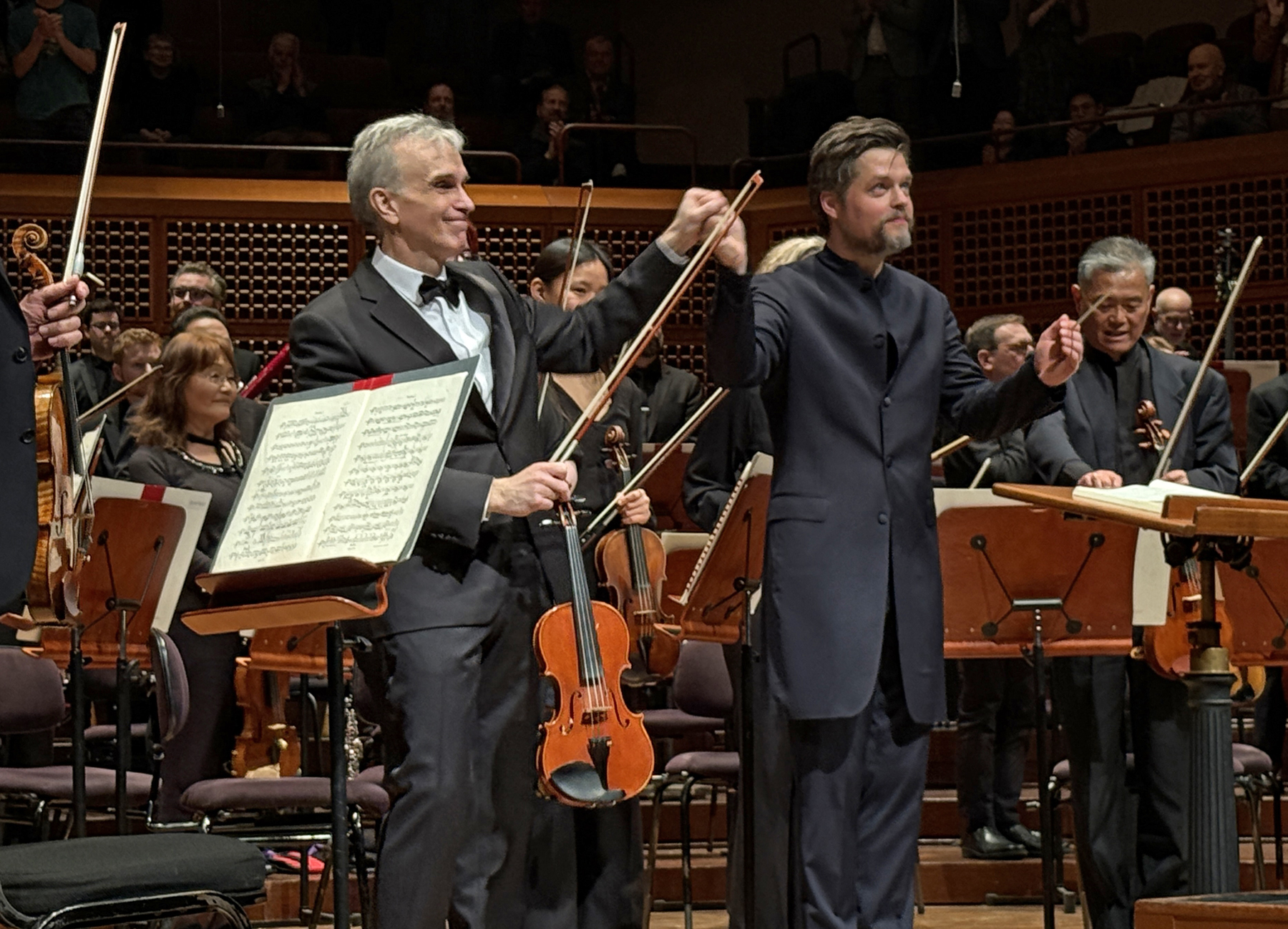
Last night, March 27, I attended a San Francisco Symphony concert featuring Gil Shaham as soloist in the Brahms Violin Concerto and, after intermission, Shostakovich's Symphony No. 10. Shaham, Valčuha, and the Symphony performers were in fine form. I had never heard of Valčuha before. According to the program notes, from 2016 to 2022 he was the music director of the Teatro di San Carlo in Naples and he has been the music director of the Houston Symphony since 2022. I liked his approach. He elicited a rather clipped, precise phrasing from the orchestra in both pieces on the program that gave the performances a crispness I rather liked without sacrificing feeling in the more lyrical passages. A very enjoyable evening.
Friday, March 28, 2025
Saturday, February 8, 2025
Music I'm Listening to: Paavo Järvi and Kirill Gerstein with the San Francisco Symphony
Last night (February 7) I attended the San Francisco Symphony concert at Davies Symphony Hall. Paavo Järvi conducted Shostakovich's Piano Concerto No. 2 and, after intermission, Mahler's Symphony No. 7, a long but engaging program. Gerstein really attacked the piano. It was an aggressive performance. At times I felt like I was listening to a recording with too much of the mics on the piano mixed in. It was enjoyable nevertheless. After the main event, he played a Chopin waltz as an encore that the symphony performers, particularly concertmaster Alexander Barantschik, really seemed to enjoy – as did the audience.
Among Mahler's symphonies, Nos 2, 7, and 8 are the ones I've never really understood or appreciated. I know No. 2 is particularly revered by many, but it's never appealed to me. Someday, perhaps, I will make headway toward better understanding it. I've felt the same way about No. 7, but the performance last night was eye-opening for me. The piece is complex and long and it's never really held my attention all the way through, but Järvi and the San Francisco Symphony made it come alive and I found myself enjoying every detail. I had no idea that there was a guitar part in the piece or that the mandolin makes an appearance. Hearing it live brings out nuances easily lost in a recording.
I have only two recordings of No. 7, one with Maurice Abravanel conducting the Utah Symphony (Vanguard – VSD 71141/2), one with Georg Solti conducting the Chicago Symphony (London CSA2231). Although I love the Abravanel/Utah recordings of some of the other Mahler Symphonies (particularly No. 3), I can't say their presentation of No. 7 has ever done much for me. This morning, the day after, I'm listening to the Solti recording, which I think is much better and, having just heard the piece live last night, I'm suddenly hearing a great deal that I never noticed before – and enjoying it. I seem to have made a breakthrough.
Saturday, October 5, 2024
Music I'm Listening to: Sayaka Shoji with the San Francisco Symphony
Last night (October 4) I attended a San Francisco Symphony concert at Davies Symphony Hall. On the program were, somewhat unusually, only two pieces (typically classical concerts open with a short piece to allow stragglers to be seated right afterward). Esa-Pekka Salonen conducted Shostakovich's Violin Concerto No. 1 and, after intermission, Brahms's Symphony No. 4, both very familiar pieces.
The soloist in the Shostakovich was Sayaka Shoji, a violinist I had never heard of before despite all my years in Japan. That said, according to the program, while she was born in Tokyo, her family moved to Italy when she was a small child and today she appears to be based in France. I looked her up. She's recorded a fair amount, mostly for Deutsche Gramophon, but online availability suggests most of what she's done hasn't been marketed much in the US.
I was a bit skeptical at first. In the opening movement, she seemed a bit tentative and I thought she overdid the vibrato a bit initially, but, by the end of the piece I was quite persuaded. Despite her small stature, she plays with real vigor and I noticed that her violin seems to have an inherently powerful voice. I'm no expert in violin acoustics, but clearly some instruments project more than others and this one seemed particularly muscular. According to the program, she plays the "Recamier" Stradivarius (c. 1729), on loan to her from Ueno Fine Chemicals Industry. These historical instruments have become so expensive that it's now quite common for corporate owners or foundations to own them but place them with deserving artists to use, as in this case. I did a little Internet sleuthing and it appears that the Recamier was once owned by Napoleon Bonaparte and, before Shoji, played for many years by violinist Mischa Elman.
The audience was very appreciative. She received a long standing ovation and was finally persuaded to do an encore that featured rapid variations and some powerful left-handed pizzicato at the end. It was not familiar. Unfortunately, she didn't identify the piece*.
It's always fun to hear a live performance of music familiar from recordings. I enjoy watching the way the music moves physically through the orchestra as different sections take up their cues. The Brahms Symphony No. 4 is particularly good for this as so much is going on simultaneously in different sections – in the strings, in particular. At the end of the performance, Salonen recognized various performers, including the triangle player, who gets quite a workout in this one, but also the entire cello and bass sections – which is quite unusual. It's rare for any of the string players to be acknowledged at the end unless there's been a prominent solo, but Salonen evidently wanted to recognize the heavy lifting the low strings do in the Brahms No. 4. Very enjoyable all around.
*I later asked on her official website and got a reply. The encore on the night I attended was the last variation from Paganini's Nel cor piu non mi sento.
Saturday, June 22, 2024
Music I'm Listening to: Sheku Kanneh-Mason plays Shostakovich
I attended the Friday, June 14, concert at Davies Symphony Hall in San Francisco. Esa-Pekka Salonen conducted the San Francisco Symphony doing Shostakovich's Cello Concerto No. 1 in E-flat Major, Op. 107. Sheku Kanneh-Mason was the soloist. After intermission, the program continued with a short piece by Sofia Gubaidulina called Fairytale Poem for Orchestra and then Tchaikovsky's Francesca da Rimini.
Kanneh-Mason was interesting to watch. He seemed almost to be in a trance as he played, but he projected confidence and played with great precision that did not sacrifice expressiveness. He finished seemingly exhausted, but played a short encore that I didn't recognize and he didn't say anything about it from the stage.
On the other hand, Salonen spoke quite extensively after intermission, telling the story behind the Gubaidulina piece, which was written as the score for a children's TV show broadcast in 1971 in the Soviet Union. The protagonist of the story is a piece of chalk bored with the grammar and mathematics it's used for and longing to be used to draw gardens and flowers and castles and the like. Eventually, the chalk is worn down to a stub and thrown away. The chalk stub is picked up and plunged into darkness and the chalk thinks its fate is sealed, but it turns out that it is in the pocket of a young boy, and soon the boy takes the chalk out into the light and starts using it to draw the fanciful scenes the chalk has dreamed of. The chalk is so happy, that it doesn't mind being used up entirely and disappearing. The music was interesting, using a great deal of percussion and of varied textures. I rather enjoyed it.
In contrast, Francesca da Rimini was an unfamiliar piece that didn't leave much of an impression on me. The Shostakovich, although played at the beginning, was the centerpiece of this concert. In the upper balcony, behind the orchestra, a couple of people in the audience brought signs. One said "We love Salonen." Another simply said "STAY!" Many are hoping Salonen with reconsider his apparent decision to leave as music director at the end of next season.
Tuesday, May 7, 2024
Music I'm Listening to: San Francisco Symphony
I had never heard the Shostakovich before – Funeral March from The Great Citizen, Op. 55 and I can't say it was especially memorable, but both the Walton and Prokofiev pieces were familiar. Whenever a member of the Symphony appears as a soloist I'm reminded of just how high the overall level of musicianship is on the stage at every concert in San Francisco. Off hand, I can remember concerts over the years featuring soloists from among the Symphony's own ranks including Alexander Barantschick (violin), Peter Wyrick (cello), Mark Inouye (trumpet), and Scott Pingel (bass) – and now Jonathan Vinocour– all top notch. The Prokofiev symphony is not among my favorites. It's rather abstract and, despite some comparatively accessible sections that are quite fun, I'm not surprised that it's not often performed. Still, it's always interesting to hear pieces familiar from recording live for the first time.
Thursday, October 29, 2015
Music I'm Listening To: Christian Tetzlaff with Susanna Mälkki Conducting the San Francisco Symphony
Dawn on the Moscow River from Khovanshchina, Shostakovich's Violin Concerto No. 1, and Prokofiev's Symphony No. 5. Guest conductor Susanna Mälkki led the orchestra. Christian Tezlaff was the soloist in the Shostakovich concerto. Mälkki was in control throughout, delivering a good, precise reading of the Prokofiev. I especially enjoyed the second movement. Tetzlaff was wonderful, going at the concerto with great energy. An excellent way to begin the 2015-2016 concert season.
Saturday, May 26, 2012
Music I'm Listening To: Hilary Hahn with Osmo Vänskä Conducting the San Francisco Symphony (May 25, 2012)
Minea, debuted by the Minnesota Orchestra in November 2009, has not yet been released as a commercial recording. I heard it last night for the first time. The opening was memorable--a sustained tone held by many of the instruments on stage seemed to float over odd sounds produced on the brass instruments that suggested waves beating against a beach. The woodwinds were very much present, especially the flutes and bassoons, fluttering in long scale-like passages using many half steps evocative of Arabic or Arab-influenced Spanish music--something oriental anyway. Minea kept building through the addition of more instruments and a faster tempo. Eventually, the very large percussion section seemed to take the lead. By the time the piece was coming to a climax it had something of the relentless forward motion of Ravel's Boléro. Every section of the orchestra seemed to get a turn, which reminded me of Bartok's Concerto for Orchestra. Difficult to describe, but a lot of fun.
Hahn was wonderful in the Prokofieff. Although she seemed to lose her concentration momentarily near the beginning of the second movement, it was a brief lapse (if it wasn't my imagination), and the rest of the performance was fairly riveting. I especially enjoyed the way she very clearly articulated the raspy, chopped notes that punctuate the concerto and the wonderful metallic quality she gave to the sections played close to the bridge. Just watching her rather fierce concentration was mesmerizing. It helped to be in seat C106, virtually right in front of her, and no more than about three yards away. The whole orchestra sounded rather good from that position--with an unusual clarity for Davies Symphony Hall. Some of the members of the orchestra seemed as entranced as the audience. Hahn, meanwhile, while tightly focused, found time to look over her shoulder from time to time to take in the view of the orchestra, clearly enjoying herself--which seems to be her habit. I noticed her doing the same thing last time I heard her play live, when she performed the Tchaikovsky Violin Concerto in San Francisco, with James Gaffigan conducting, in November 2008. Last night Hahn wore a beautiful tapered black silk taffeta gown with starkly contrasting splashes of flowers and leaves in gold embroidery and appliqué. The performance was very warmly received.
Hahn delighted the audience by playing two encores, one modern, one not. She first played The Blue Curve of the Earth, which she herself commissioned from composer Tina Davidson--a scintillating piece of restrained energy with much use of pizzicato playing that I rather enjoyed. Hahn seemed almost apologetic when she took up her violin a second time, eliciting a laugh, this time to play a portion of the Bach A minor Sonata No. 2 for solo violin. "They gave me permission to play another one," she announced, and she played it very sweetly indeed. Hahn signed autographs after the performance. I asked her to date mine. She said matter-of-factly, "You'll have to tell me what the date is," no doubt a symptom of much travel.
I don't think I've heard a better reading of the Shostakovich. The ensemble was focused and tight. Vänskä elicited a memorable performance. All in all, perhaps the best concert this season--although I'd be hard-pressed to choose between this one and the December 8, 2011 performance with guest conductor Esa-Pekka Salonen and soloist Leila Josefowicz. Happily, there's no need to choose.
Photo of Hilary Hahn by Peter Miller. Photo of Osmo Vänskä by Ann Marsden. Both photos courtesy of the San Francisco Symphony web site.
Friday, October 7, 2011
Music I'm Listening to: Joshua Bell with Vasily Petrenko Conducting the San Francisco Symphony (October 6, 2011)
Vasily Petrenko was new to me, but I very much enjoyed his readings of the Shostakovich and the Glazunov pieces. Tall, thin, and with very long, expressive arms and hands, Petrenko looked sometimes like a large ocean-going bird gesturing with wings. At other times, during slow or delicate passages, his indications became something quite the opposite--minimalist (a slight nod of the head, a subtle gesture with one finger, or simply a look), but the performers seemed highly engaged and in top form throughout the concert. Petrenko--young, confident (almost cocky) was a pleasure to watch. According to the program notes, Petrenko has studied with Mariss Jansons, Yuri Temirkanoff, and Esa-Pekka Salonen, among others. He will become the Chief Conductor of the Oslo Philharmonic Orchestra starting in the 2013-2014 season, but is currently Principal Conductor of the Royal Liverpool Philharmonic Orcehstra.
Shostakovich's Festival Overture is not one of my favorite pieces by that composer, but it's familiar and fun and rousing. It's not a bad way to open a concert, as it gets both the audience and the performers warmed up. Actually, it was a lot of fun to hear, even if it's not very challenging music to listen to (I'm not sure how the orchestra feels about playing it). The Tchaikovsky piece was not exactly my style either, but it was a lovely selection to show off the sound of Joshua Bell's violin, which is the 1713 Stradivarius known as "The Gibson."* This is the second time I've heard Bell play in person. It's almost enough just to listen to the tone of his instrument.... Also in the Glazunov, much of the pleasure was hearing the violin with the clarity of a live performance. I'm used to this concerto in the form of two rather old LPs in my collection, a Nathan Milstein record on Capitol, with William Steinberg conducting the Pittsburgh Symphony Orchestra (Captiol SP8382) and an RCA Gold Seal Heifetz recording (RCA Gold Seal AGL1-4929). The latter is rather worn and fuzzy. Petrenko seemed particularly good at accentuating the various accents in the orchestral part, especially toward the end of the final movement. His reading gave the whole thing a very attractive sparkle. I recently happened to hear what seemed to me a rather idiosyncratic but highly persuasive performance of this concerto on the radio, with Gil Shaham playing the violin (it appears to be a Deutsche Grammophon recording with Mikhail Pletnev conducting the Russian National Orchestra). I suppose it's time to acquire this concerto on CD. The Gil Shaham interpretation may be a good choice. Bell was given a warm standing ovation for both of his performances, but he wasn't sufficiently moved to play an encore.
After intermission, the Sympony played the Elgar piece, which I can't say I enjoyed a great deal. Petrenko succeeded in eliciting a crisp, energetic performance, but the music itself is rather repetitive and much longer than I'd say it needs to be to explore the ideas it presents. Simply put, it was dull and taxing. This is not Elgar at his best. I can't understand why the piece was chosen for a program of music that was otherwise Russian. Something Russian (and shorter) would have been more appropriate. Several people near me fell asleep. The audience was palpably restless by the end of the performance. That said, I very much enjoyed the evening just to hear Joshua Bell play the Glazunov concerto.
*For more about the violin, see my thoughts on one of Joshua Bell's 2010 performances with the San Francisco Symphony here.
[Update: I happened upon an online review of this concert today (November 26, 2011) by Jeff Dunn in "San Francisco Classical Voice." Dunn suggests the Elgar sounded so ponderous because of Petrenko's too-rigid tempos. While the work is undoubtedly rather long, it may have been unsuccessful in this case more because of the conducting than because of any fault in the music itself. I'll have to listen to this piece again....]
Photo of Vasily Petrenko by Mark McNulty, courtesy of the San Francisco Symphony.
Sunday, September 26, 2010
Music I'm Listening to: New Century Chamber Orchestra with Edgar Meyer
I just got home from a concert by the New Century Chamber Orchestra (NCCO) in San Rafael, a group that I've been trying to hear for some time. My next door neighbor, a season ticket holder, had extra tickets to this performance and finally I was free at the right time to go along. I'm very glad I did. To say I was impressed is an understatement. I'm about to effusively praise this group. I apologize in advance to everyone that already knows how good they are.
The featured performer was bassist Edgar Meyer. The program included Giaocchino Rossini's Sonata in G Major, Giovanni Bottesini's Concerto for String Bass No. 2 in B Minor, Chamber Symphony in C Minor (opus 110a) by Dimitri Shostakovich (arranged by Rudolf Barshai), and the adagio from Mahler's Symphony No. 5. I rarely come home from a concert so excited that I don't know where to begin. I suppose the beginning is as good a place as any--the Rossini.
The Rossini was not a piece familiar to me, and I've never particularly warmed to Rossini, so I can't speak from any prior experience here, but I enjoyed this. The music is not in any way profound, but it's full of energy and charm. The first movement relies (quite successfully) on a generous helping of light-hearted breeziness. The middle movement is a bit weightier and a trifle introspective. The bass part stands out here, and that's why it was chosen for the program on an evening featuring the string bass. The group's Principal Bassist Anthony Manzo handled the part with aplomb. The final movement, a fast-paced rondo has an almost comic feel in places--it's a romp that makes you want to giggle at the end just as much as you want to applaud. The ensemble seemed a trifle rough in spots playing the Rossini, but this was a warm-up piece and that's about the worst thing I have to say about the entire evening.
The Bottesini concerto was equally unfamiliar--more so, actually; I can't say I'd even heard of Bottesini until tonight. But what does that matter? The tightness of the ensemble was phenomenal. Meyer was breathtaking. I can't imagine a better performance of the piece. Much as I love the Shostakovich Chamber Symphony (a piece of music I do know), I'd have to say the Bottesini was the highlight of the evening. "Effortless perfection" is the phrase that kept popping into my mind. Too often one sees performers just going through the motions. What a pleasure it is to see a group of musicians so intensely concentrated and having so much fun at the same time. The NCCO performers seemed telepathically connected with Meyer and with one another. How thrilling to watch musicians that so clearly care about getting it right. One can easily imagine Bottesini in his grave as moved I was to hear so successful an interpretation of his ideas. This is the sort of concert one remembers for a lifetime. The Bottesini alone was worth the extremely reasonable price of admission.
Meyer played an encore as well--his own composition, entitled Pickles. I can't begin to describe it, but watching him play it was as entertaining as the piece itself. Meyer is tall and imposing. I kept thinking that he looked like a cross between conductor James Levine and actor Peter Boyle. (Probably just me.) In his crisp white shirt and bow-tie, he suggested a big city bartender with a wickedly wry sense of humor. Even during the more serious Bottesini, I half expected him to break out laughing, unable to contain the inner joy. During the encore, this playful side of the man got a chance to show through. Watching him undulate like a snake as his fingers slid up and down the fingerboard, I was mesmerized. The NCCO performers on stage seemed as rapt as the audience (during this encore as well as during the solo passages in the Bottesini). Pickles was a very entertaining end to the first half of the program. The audience was palpably excited in the lobby during admission.
Modern music, because it is so abstract, has to be executed with great precision to be successful--or so it seems to me. The Shostakovich Chamber Symphony in C Minor seems a case in point. The NCCO handled it brilliantly. The music was furious where it must be furious, and, where it needs to be, it was underlaid with stretched, seemingly endless, linear notes. The hand-offs from one section of the strings to another were seamless, with director Salerno-Sonnenberg making only the subtlest of indications. For the most part, the string sections were "talking" to one another on their own, weaving a wonderfully coherent whole, and that is just how it ought to be, with a perfect tension between the details and the long lines of the piece.
I have four recordings of the Mahler 5th on CD, and at least one on LP--Rattle, Barbirolli, Sinopoli, Solti, and Abravanel conducting--but I've always been partial to the Maurice Abravanel recording I own. The performance of the Adagio this evening was every bit as good as any of these. What can I say except that it seemed virtually perfect? The Abravanel Mahler recordings with the Utah Symphony were made in the 60s, I believe, in the Mormon Tabernacle (released on the Vanguard label; I bought my copies as cut-outs, or remainders, in the late 70s and early 80s). The sound of the Tabernacle is part of their great appeal. I didn't expect the auditorium at the Osher Marin Jewish Community Center to be especially good acoustically, but, remarkably, the sound seems quite true--despite having been designed as an auditorium rather than a concert hall (or perhaps events such as these were taken into account in the original planning?--I don't know). My seat, at Table 31, near the middle, may have had something to do with it. Nowhere did the sound seem muddy. Every instrument was clearly audible and each seemed to come from exactly where it ought to have been coming from. I heard no distortion. The Mahler was a wonderful end to a wonderful evening.
If only the audience had been better behaved. My neighbor tells me that tonight was atypical. I hope that's true. Velcro here, cellophane there. People talking. Dropped glasses, purses opening, coughs, suppressed sneezes, and kicked cans all made their appearances (the seating is at tables; patrons are allowed to bring in food and drink, which is a good thing). But, please, is quiet really that hard to achieve? Needless to say, the somewhat undisciplined audience was no reflection on the performers. I'm very glad I went tonight. I look forward to going again soon.


+smallcmt.jpg)