Showing posts with label Esa-Pekka Salonen. Show all posts

Monday, June 2, 2025

Music I'm Listening to: Recent San Francisco Symphony concerts

Unusually, I recently had three San Francisco Symphony concerts on three successive Friday nights, May 16, May 23, and May 30. It's always hard to write about music but particularly hard to after the fact, so just a few highlights here, as a couple of weeks have passed already.... 

On May 16, cellist Johannes Moser joined the SF Symphony for the world premiere of Before We Fall, a cello concerto by Anna Thorvaldsdottir. It was a rather abstract piece – the sort that's difficult to process on first hearing – but rich in texture and I thought it interesting enough that I'd enjoy hearing it again or finding a recording of it. As always, Moser was superb. 

The program began with Fantasia on a Theme of Thomas Tallis, by Ralph Vaughn Williams. Conductor Dalia Stasevska handled it beautifully, I thought, without rushing but also without letting it get too lush. It was as satisfying as any recording I've ever heard of it. This was the second time I've had the privilege of attending a concert with Stasevska conducting. She seems to have established a real connection with the San Francisco musicians despite being an occasional guest conductor. She's precise, in control, and on top of things. After intermission, the Symphony played Sibelius's Symphony No. 5.

The following Friday, Isabelle Faust was the guest soloist in the Berg Violin Concerto. Esa-Pekka Salonen conducted. Also on the program were Chorale, by Magnus Lindberg, and, after intermission, Stravinsky's The Firebird. This was a concert I got tickets to by trading in an unused ticket for an earlier performance, so the seat was not especially good. When there's a soloist, I like to be right up front and just left of stage right, so I'm right in front of the soloist (D104 is my usual seat), but this time I was well off to stage left, which was a little disappointing. I did, however, enjoy Salonen's reading of The Firebird. He got a very warm welcome when he first appeared on stage and, as at other recent concerts I've attended with Salonen conducting, calls from the crowd for him to stay in San Francisco. 

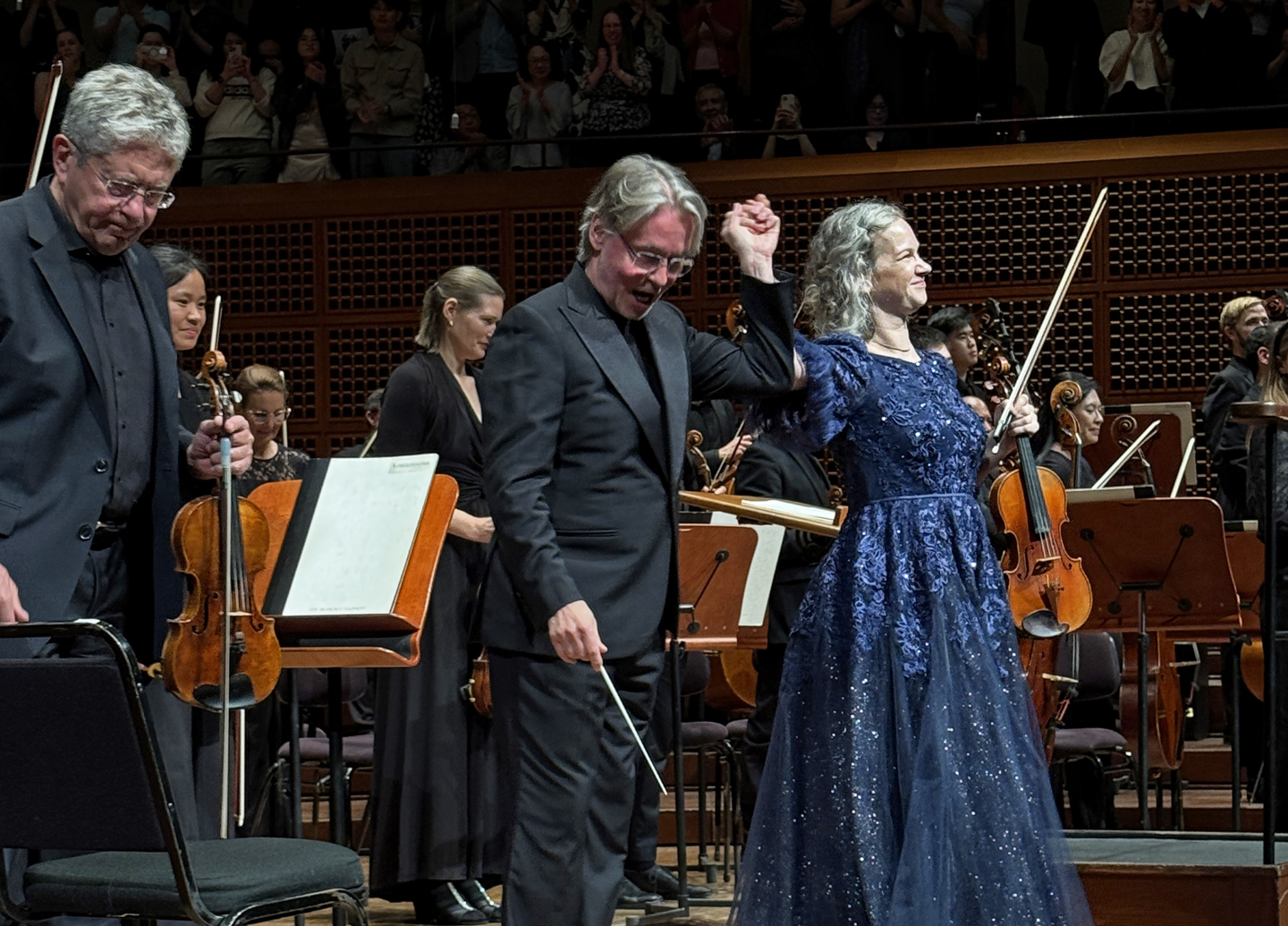
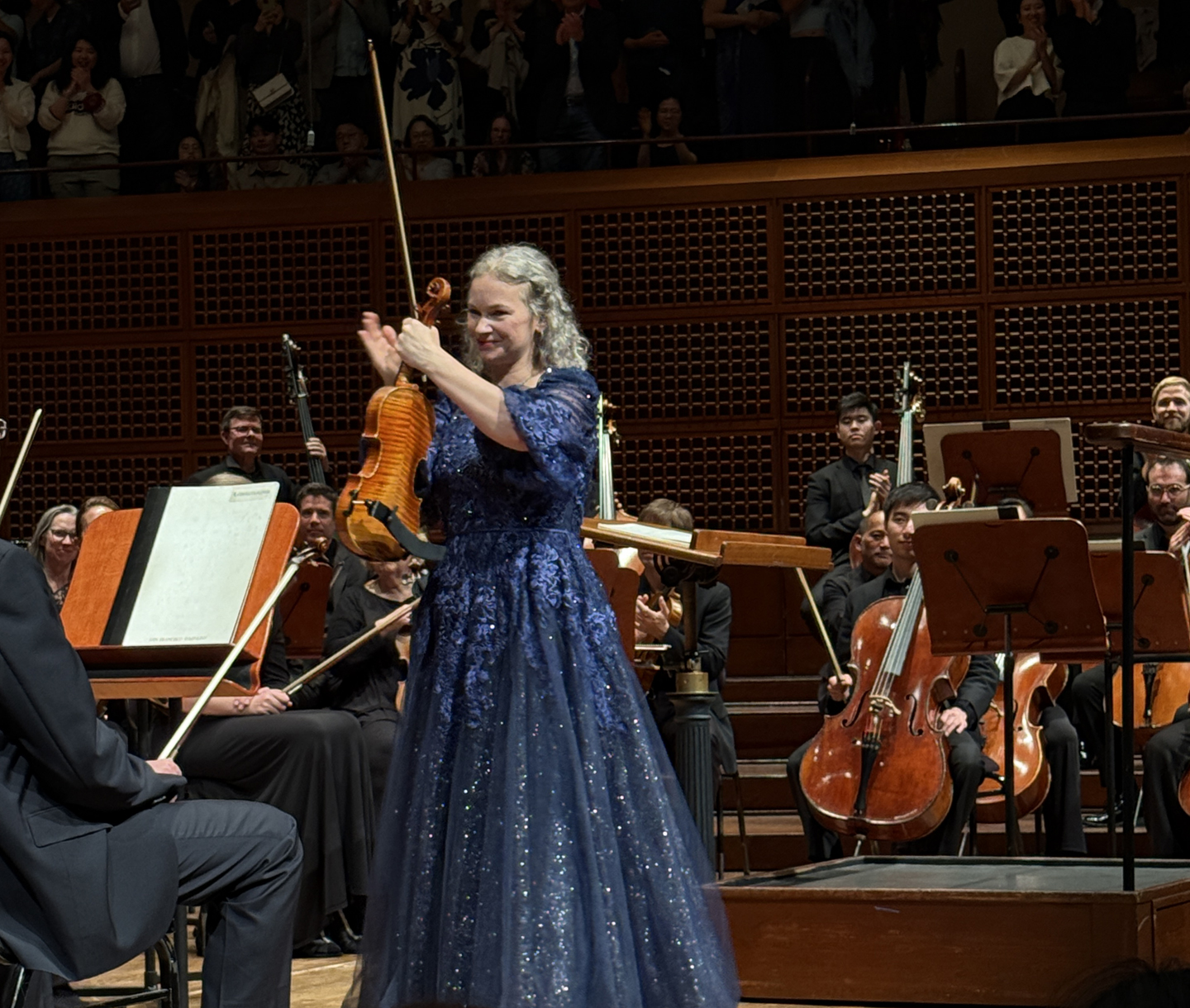
On the 30th, it was an all-Beethoven program. Beethoven's Symphony No. 4 came before intermission, his Violin Concerto was performed after intermission with Hilary Hahn as soloist. Elsa-Pekka Salonen conducted. The highlight was the concerto. Hahn was in top form. Precise, with each note articulated, and with nearly perfect intonation, but never cold or distant-seeming. A very full house gave her a long standing ovation. She came back for an encore (something from the Bach solo partitas and sonatas) and then came back for a second encore, doing a piece I didn't recognize. It's always fun to watch her during rests because she often turns her back to the audience to watch the orchestra herself and really seems to enjoy listening from what is perhaps the best 'seat' in the house. I've noticed also that she always applauds for those who accompany her. A memorable performance. 


Saturday, February 22, 2025

Music I'm Listening to: Daniil Trifonov with the San Francisco Symphony

Last night (February 21, 2025) I had the pleasure of attending the San Francisco Symphony concert at Davies Symphony Hall. On the program were a new piece, Strange Beasts (a San Francisco Symphony Commission and World Premiere) by the appropriately named composer Xavier Musik, Prokofiev's Piano Concerto No. 2 (with soloist Daniil Trifonov), and, after intermission, Stravinsky's The Rite of Spring

Strange Beasts was interesting for its wide range of aural textures and the sense of unease it created (in several places I was reminded of a Bernard Herrmann score), this heightened by angular photographs of Los Angeles projected above the orchestra, images taken by the composer. Muzik spoke before the performance, explaining that he suffers from anxiety, that, if left unchecked, tends toward catastrophic imaginings and that composing and photography help him to stay sane. He said he imagines the looming buildings in the slide show (many projected upside down) as being like monsters or the strange beasts of the title of his composition. While I thought the photographs mostly ordinary snapshots of no special interest in themselves, the way they were projected, rapidly changing, worked fairly well with the repeated crescendos of unsettling sound welling up in the music. I thought Strange Beasts was longer than it needed to be, but I'll be interested to watch this young man's career. I think in places it was very successful even if it seemed a bit rambling and without structure (at least without structure discernible to me). 

Prokofiev's Piano Concerto No. 2 followed with Trifonov at the keyboard. His manner on stage was serious but, at the same time, he gave the impression of being on the verge of spinning slowly out of control. He seemed nervous and awkward. At the piano, however, Trifonov was electric. I was very impressed by the clarity of his phrasing despite the very fast tempos in the concerto. He got an extended standing ovation and came back to play two encores, the first I think was from one of Prokofiev's piano sonatas, but it was not something familiar. The second I recognized immediately, a piece from Prokofiev's Cinderella, that seemed perfect to me. 

After intermission, Salonen conducted the orchestra members in a tight performance of The Rite of Spring. Overall, it was an excellent concert, but that second encore may have been the highlight of the evening. 

Monday, July 1, 2024

Music I'm Listening To: Esa-Pekka Salonen conducting Mahler's 3rd Symphony

I attended the Friday, June 28 performance at Davies Symphony Hall in San Francisco. The San Francisco Symphony played Mahler's Symphony No. 3. Esa-Pekka Salonen conducted. The soloist was mezzo-soprano Kelley O'Connor. The San Francisco Symphony Chorus was led by Jenny Wong. The Pacific Boychoir Academy was led by Kevin Fox or Andrew Brown – I'm not quite sure which from the program. The symphony was the only thing on the program and it was played straight through with no intermission. 

This is my favorite of all the Mahler symphonies. If I were to play the game of ranking them in order of preference my top three would probably be No. 3, No. 1, and No. 6, followed by No. 4 and No.5, and then by No. 9, and then No. 7 and No. 8 (which I don't know well). No. 2 has never appealed to me. I do, however, like what we have of No. 10. It was a treat to hear Symphony No. 3 live. I think this is the first time, unless I'm forgetting a performance.

Salonen was his usual reliable self and I really liked O'Connor's voice, although she had a habit of slightly over-emphasizing the final syllables of the German she was singing. A weak soloist can ruin the whole thing, but, overall, this was a very enjoyable performance. The audience was very appreciative giving the ensemble an extended standing ovation. Salonen looked exhausted at the end but touched by the outpouring of support, including calls for him to re-think his decision to leave at the end of next season. After the last notes had died away, the conductor walked back to the brass section and gave the principal trombone a big hug before returning to the podium to acknowledge other brass players, the woodwinds, the percussion, the harps, and others. Afterwards, dinner at Monsieur Benjamin, which, sadly is closing down. The following night was the last service. I guess it's back to Absinthe for after-concert dining. 

Saturday, June 22, 2024

Music I'm Listening to: Sheku Kanneh-Mason plays Shostakovich

I attended the Friday, June 14, concert at Davies Symphony Hall in San Francisco. Esa-Pekka Salonen conducted the San Francisco Symphony doing Shostakovich's Cello Concerto No. 1 in E-flat Major, Op. 107. Sheku Kanneh-Mason was the soloist. After intermission, the program continued with a short piece by Sofia Gubaidulina called Fairytale Poem for Orchestra and then Tchaikovsky's Francesca da Rimini

Kanneh-Mason was interesting to watch. He seemed almost to be in a trance as he played, but he projected confidence and played with great precision that did not sacrifice expressiveness. He finished seemingly exhausted, but played a short encore that I didn't recognize and he didn't say anything about it from the stage. 

On the other hand, Salonen spoke quite extensively after intermission, telling the story behind the Gubaidulina piece, which was written as the score for a children's TV show broadcast in 1971 in the Soviet Union. The protagonist of the story is a piece of chalk bored with the grammar and mathematics it's used for and longing to be used to draw gardens and flowers and castles and the like. Eventually, the chalk is worn down to a stub and thrown away. The chalk stub is picked up and plunged into darkness and the chalk thinks its fate is sealed, but it turns out that it is in the pocket of a young boy, and soon the boy takes the chalk out into the light and starts using it to draw the fanciful scenes the chalk has dreamed of. The chalk is so happy, that it doesn't mind being used up entirely and disappearing. The music was interesting, using a great deal of percussion and of varied textures. I rather enjoyed it. 

In contrast, Francesca da Rimini was an unfamiliar piece that didn't leave much of an impression on me. The Shostakovich, although played at the beginning, was the centerpiece of this concert. In the upper balcony, behind the orchestra, a couple of people in the audience brought signs. One said "We love Salonen." Another simply said "STAY!" Many are hoping Salonen with reconsider his apparent decision to leave as music director at the end of next season. 

Sunday, October 24, 2021

Music I'm Listening to: The San Francisco Symphony, with Pekka Kuusisto

I attended a live San Francisco Symphony concert Friday night (October 22)—the first live performance I've been to since February of 2020. Vaccination card and ID checked at the entrance. I was happy to comply. It was good to know that everyone in the building was vaccinated. Generally, the orchestra members did not wear masks (there were one or two exceptions), neither did conductor Esa-Pekka Salonen or the soloist in the US premiere of Bryce Dressner's Violin Concerto, Pekka Kuusisto, a Finn like Salonen. 

The concert opened with Beethoven's Second Leonore overture, which was both familiar and unfamiliar. It's not the one (of the four, I think) that we most commonly hear.

According to the program notes, the Dressner Violin Concerto got its world premiere on October 1 this year, in Frankfurt. The performances in San Francisco this weekend have been the first in the United States. It's hard to put into words the feelings that music evokes—which is why writers of notes to recordings and concerts frequently resort to descriptions relying heavily on music theory that I suspect goes over the heads of most readers, including me. Suffice it to say that it was a gripping performance. The Dressner concerto grabs you by the throat and rarely loosens its grip until the very end. The soloist gets a real workout. The score involves a lot of extended technique such as bowing very close to the bridge or rubbing the bow along the strings the long way to produces novel sounds (which is not to say the piece is gimmicky). Despite a few lyrical passages and an extended cadenza toward the end (that appeared to be improvised; Kuusisto played from the score on a tablet with a foot switch to turn the pages and during the cadenza he was no longer looking at the screen), the general impression was one of driving forward movement based on extended near-repetitions that evolve through continuous small variations. Percussion plays a large role. At the pre-concert talk, the composer said "You could almost call it a concerto for violin and percussion." He also said that he thought the San Francisco Symphony percussion section "the best in the world." He seemed to mean it, saying that he'd worked with orchestras all over the world and that the SF section was the best he'd ever worked with. Very enjoyable. I hope Kuusisto records this soon. It's music that will bear repeat listening. 

As an encore, Kuusisto played a sarabande from one of the Bach solo partitas/sonatas—very familiar, but out of context I can't say which one it was from. Kuusisto played it in a rather tender, fluid way that was a sharp contrast to what preceded it. He relied heavily on rubato, which some people think has no place in the music of Bach, but it was a persuasive interpretation. About a third of the way through, someone's phone rang. He took it in stride. He stopped playing momentarily and said "That's the wrong key", laughed (and the audience laughed with him), and went back to playing. 

After intermission, the orchestra gave us Schubert's Symphony No. 5, my favorite (everyone's favorite?) of the Schubert Symphonies. After the concert, finding good food was a challenge. Because of pandemic restrictions, our go-to place, Absinthe, is now closing its kitchen at 9:00PM, even on Friday and Saturday. Ended up at a Mexican–French place that sounded much better than it tasted. Some research will be required ahead of the next SF Symphony concert—to which I'm looking forward. It was a real pleasure to hear live music again.


Saturday, February 29, 2020

Music I'm Listening To: Leila Josefowicz and Esa-Pekka Salonen with the San Francisco Symphony

Last night (February 28) I attended the San Francisco Symphony concert at Davies Symphony Hall in San Francisco. On the program were a Beethoven overture (King Stephen), Esa-Pekka Salonen's Violin Concerto, and, after intermission, Nielsen's Symphony No. 5. Salonen conducted. Leila Josefowicz was the soloist in the violin concerto.

I first heard Josefowicz at a concert in 2011, likewise at Davies Symphony Hall, likewise with Salonen conducting his own violin concerto. It was impressive then. It was even more impressive last night, with all my impressions of the first performance magnified. Everything I said about the piece then, going on nine years ago, remains true, but Josefowicz seemed even more deeply engaged with the piece, her longer experience with it now evident. In 2011, the work was only two years old. In 2011, I said the following (and virtually all of it still applies--but, as I say, somehow magnified):

"It would be difficult to try to describe something so complex as Salonen's Violin Concerto in detail, but I can start by saying how impressed I was that Josefowicz played it from memory. The more abstract music becomes and the less dependent on devices such as themes and variations and development of themes, the more difficult it must be to remember. They say muscle memory takes over, but the feat of recall involved here was nearly as impressive as Josefowicz's playing, which was impressive indeed.

"The Violin Concerto opens with the soloist unaccompanied and it starts as if already in progress. The intensity is high from the get-go and the music feels relentless until the more pensive middle sections. Josefowicz played the early portions with a look of fierce determination on her face, at times seeming possessed, at other times looking somewhat more relaxed--even smiling--but there was a palpable tension even in the quietest passages. Particularly interesting was the use of a very rich percussion session that included numerous gongs and much else that was hard to see seated in the concert hall. 


"The music seemed highly originalmodern without being modern in the sense of being stylistically linked to what we think of as modern music when the word "modern" brings the early 20th century to mind. Surely this music has antecedents. Some sections reminded me of Khatchaturian's violin concerto. Some sections had the portentous feel of a dramatic film score. Some sections put me in mind of Shostakovich. In the later movements, there are passages that introduce the feel of pop music. Yet, the overall impression was of music new and different.When I hear stories about Mahler conducting early performances of his own symphonies or of Beethoven premiering a new piano concerto, I wish I could have been present. What's more exciting than the thought of being in the presence of genius as it presents new ideas to the world? I had the feeling that I witnessed a bit of history on Thursday--that I was present at the sort of performance that will be talked about in the future by people looking back, wishing they'd been able to see Salonen himself at the podium conducting his own compositions. The music seemed like a cantilevered beam reaching into the future, even if it's too soon to know exactly what might lie beyond the reach of that beam--what it might be creating a bridge to. This was one of the best concerts I've attended in a long time."

Muscular is the right word. Her arms look powerful and Josefowicz projects strength; she is an athletic performer. As before, I was astounded by the prodigious feat of memory playing a piece like Salonen's Violin Concerto involves. I was astounded by the speed, precision, and sheer energy of Josefowicz's playing. It was an exciting performance. At one point, Salonen got so carried away that his baton flew out of his hand and landed in front of the first row of seats. At the first break between movements, an audience member handed it back to him; he received it with a nod of gratitude and a slightly sheepish smile. The audience had a laugh.

It was a privilege to have heard the concerto a second time played by the man who wrote it and by the woman he wrote it for (and wrote it with; Josefowicz, like Joachim working with Brahms on that composer's only violin concerto, apparently provided a lot of input). After the concerto, she played an encore piece, also by Salonen, but she failed to identify it and none of the ushers knew exactly what it was.

The Beethoven overture is one I'd never heard before, or at least I don't remember hearing it. It was much as you might expect from Beethoven, along the lines of his other overtures. It was interesting for a pronounced back and forth between light dance-like sections and some dark and stormy passages with much sawing of the cellos and the double basses. The energy so notable in the concerto was there from the start of the concert. Salonen looked involved, in charge, happy to be on the podium, and the musicians seemed equally happy to be working with him. I'm so glad he'll be replacing MTT.

Speaking of energy, the Nielsen symphony is a somewhat sprawling, complex piece of music with some very energetic sections indeed. It's not a piece I know well and I felt there were extended sections that were rather amorphous and congested, but I enjoyed it nevertheless. I think I have at least one recording of it somewhere. I'll have to give it another listen.

Looking back at my concert notes here, I see that this was the fourth time I've seen Josefowicz in concert—on: December 8, 2011 (playing the Salonen concerto with Salonen conducting); on October 4, 2013 (Stravinsky's violin concerto with Pablo Heras-Casado conducting), on February 24, 2017 (Scheherazade.2, by Adams); and then last night' all in San Francisco.

Sunday, December 11, 2011

Music I'm Listening to: The San Francisco Symphony with Esa-Pekka Salonen and Leila Josefowicz

I attended the Thursday, December 8 performance of the San Francisco Symphony with guest conductor Esa-Pekka Salonen and soloist Leila Josefowicz. The program opened with Pohjola's Daughter, by Sibelius, followed by Violin Concerto, by conductor Esa-Pekka Salonen himself. After intermission, soprano Christene Brewer joined the symphony in excerpts from Wagner's Götterdämmerung. I enjoyed the Sibelius and even liked the Wagner, but the main reason I wanted to attend this concert was to hear the Violin Concerto and see Salonen conduct, particularly as he was conducting a composition of his own--and what a thrilling performance it was. Salonen is dynamic on the podium, using broad gestures with both hands to communicate.

It would be difficult to try to describe something so complex as Salonen's Violin Concerto in detail, but I can start by saying how impressed I was that Josefowicz played it from memory. The more abstract music becomes and the less dependent on devices such as themes and variations and development of themes, the more difficult it must be to remember. They say muscle memory takes over, but the feat of recall involved here was nearly as impressive as Josefowicz's playing, which was impressive indeed.

The Violin Concerto opens with the soloist unaccompanied and it starts as if already in progress. The intensity is high from the get-go and the music feels relentless until the more pensive middle sections. Josefowicz played the early portions with a look of fierce determination on her face, at times seeming possessed, at other times looking somewhat more relaxed--even smiling--but there was a palpable tension even in the quietest passages. Particularly interesting was the use of a very rich percussion session that included numerous gongs and much else that was hard to see seated in the concert hall.

The music seemed highly original--modern without being modern in the sense of being stylistically linked to what we think of as modern music when the word "modern" brings the early 20th century to mind. Surely this music has antecedents. Some sections reminded me of Khatchaturian's violin concerto. Some sections had the portentous feel of a dramatic film score. Some sections put me in mind of Shostakovich. In the later movements, there are passages that introduce the feel of pop music. Yet, the overall impression was of music new and different.When I hear stories about Mahler conducting early performances of his own symphonies or of Beethoven premiering a new piano concerto, I wish I could have been present. What's more exciting than the thought of being in the presence of genius as it presents new ideas to the world? I had the feeling that I witnessed a bit of history on Thursday--that I was present at the sort of performance that will be talked about in the future by people looking back, wishing they'd been able to see Salonen himself at the podium conducting his own compositions. The music seemed like a cantilevered beam reaching into the future, even if it's too soon to know exactly what might lie beyond the reach of that beam--what it might be creating a bridge to. This was one of the best concerts I've attended in a long time.

Doing a little research, I see that Salonen's Violin Concerto had its premiere in April 2009, with Josefowicz as the soloist, and that it was written for her. I won't be surprised to see it enter the standard violin repertoire; it's likely to be played for many, many years to come. I was also able to confirm that Josefowicz is about four months pregnant, as she appeared to be--what it must sound like to the baby in there....

Photo of Esa-Pekka Salonen by Sonja Werner. Photo of Leila Josefowicz by Henry Fair. Photos Courtesy of the San Francisco Symphony.
Related Posts with Thumbnails