Showing posts with label Germany. Show all posts

Sunday, July 8, 2018

On the Road: Dresden

Frauenkirche, Dresden
Only one corner of the building
survived the Allied bombing in 1945
I had planned to do much more in Dresden than I ended up doing. I needed a break from walking. I ended up spending most of my time resting in cafés and walking about the town only a little. I did, however, see the Frauenkirche, eventually reconstructed after it was almost entirely destroyed in 1945 and left in ruins during the Communist period. What stands today, although entirely faithful to the original design, is essentially a brand new church. Only a small section of one corner of the building and random stones here and there were salvageable. Because the old stones were not cleaned, it's easy to see what's old and what's new. If you've ever seen fragments of an ancient pottery vessel with its missing sections filled in with synthetic material in a museum case, you know what the Frauenkirche looks like. Perhaps in a couple hundred years it will all look old again. The inside of the church appears entirely new. All the columns are plain stone painted to look like marble. I wonder if the old church was marble inside or originally done in this way.

I also enjoyed a good dinner in the new section of town at a place called Lila Sosse, in a courtyard decorated with mosaics of imaginary beasts. On my way back to my hotel, I stopped at a wine bar called Barceloneta, and had a conversation about wine with the owner. I had a cheese and sausage plate while tasting some modern German wines. Since I last spent much time with German wine, they seem to have got the trocken style right finally. Trocken (dry) German wines once tended to be rather thin and acidic. These were more like their counterparts from Alsace—quite dry but with some character and without the sharp acidic bite I remember.

A medallion showing the
famous Habsburg lip
I did have a quick look at the Green Vault, but this house of treasures would take a week to see properly. What isn't here? There are rooms full of armor and weapons, rooms full of things made of ivory, rooms full of things made of amber, rooms full of things made of silver and gold, rooms full of Turkish treasures—rugs and other textiles, more weapons, jeweled daggers, a Janissary cauldron—, rooms full of medals and decorations, rooms full of gems, rooms full of coins.... I could have spent a day in the coin rooms alone, which include coins from all over the world and from antiquity to the present day—but much more than that. Every aspect of coin making is covered. There are minting presses, examples of engraving tools and dies, samples of ores of the metals coins are made from and examples of coins made from metals unusual for coinage, such as aluminum and titanium. There is even a section on counterfeiting with examples of counterfeit coins from antiquity to the present day alongside the real coins they copy. It was overwhelming really.

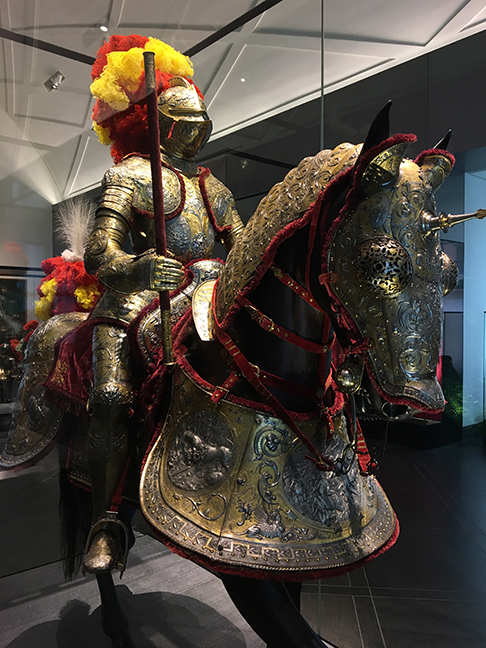
Parade armor made for
King Erik XIV of Sweden, 1563
Years ago, I saw the collection of armor at Les Invalides, in Paris. The armor in the Green Vault is just as impressive. The collection is rich in fancy parade armor (as opposed to armor intended for actual combat). To take just one example, the armor I've shown here was made in connection with King Erik XIV of Sweden's suit for the hand of England's Queen Elizabeth I. The decoration in gold was commissioned in 1563 from a goldsmith in Antwerp and done on a suit of semi-finished armor that had been made in Sweden and sent to Antwerp. Apparently, the finished work never made it back to King Erik, having been captured by Danish troops and sent to Copenhagen. The decoration shows scenes from the legend of Hercules and the Trojan War. There were many pieces like this.

Maurice, Elector of Saxony
and his Wife Agnes
Lucas Cranach the Younger 1559
At the very end of my stay I found a room full of paintings, many by Lukas Cranach the Younger, that I would have liked to have seen in more detail, including a number of interesting portraits and an Adam and Eve that's well known.

I left early, but, as noted in my previous post, I missed my train to Prague nevertheless. I had to wait nearly two hours for the next train—time I wish I had had at the Green Vault.

The first third of the journey followed the course of a river—the Elbe, I assume. At some unmarked point we left Germany and entered the Czech Republic. There was no checkpoint or even an indication of the border. The transition was apparent only because the names of the stations we passed through were suddenly in a script I don't know how to pronounce.

Scenery along the Elbe, south and east of Dresden
It was pretty countryside, the river valley flanked by sheer bluffs of blackened stone that looked very much like the sandstone so common in the buildings—a sandy beige where fractured and a new surface is visible. As we left the river, the landscape flattened into farmland, mostly wheat again, but also something that looked like corn (but wasn't corn) and occasionally hops. After arriving in Prague, I had a hard time finding my lodgings again, this time because the one direct subway line to my destination is under construction for the three days I'll be in Prague. There is a bus link in operation, but I couldn't find the stop anywhere. I finally had to take an Uber, which left me near to my destination but lost again with a phone about to lose power.... I did eventually make it.

Friday, June 29, 2018

On the Road: Munich (June 29, 2018)

Chandelier in the main building of Nymphenburg Palace
Today is my first day traveling alone after ten days as a chaperone with a youth orchestra touring Central Europe. I had hoped to continue reflecting my travels with the orchestra here in my personal blog, but blogging for the tour group left me no time. Now I find myself in Munich, staying walking distance from the Nymphenburg Palace, which turned out to be well worth the time it took to visit.

I spent about three hours seeing the main palace building and the extensive gardens around it, crisscrossed by paths and canals, with ponds large and small, the famous garden pavilions, and a museum of carriages and sleighs housed in what once were the palace stables. It's worth it to buy the ticket that gives access to all the sights on the grounds.

A Chinese-inspired wall decoration
The palace was built in the early 18th century as a summer retreat from court life for Bavaria's royal family, but was later expanded and modified. The rooms of the main building are interesting for their interior decorations, often using textiles or tiles in what was known as the "Chinese style," reflecting fanciful notions of life in China and a mishmash of Asian influences. Some of the decorations appear to have been authentically made in China, but they were made for the European export market rather than for domestic consumption and they have been tailored to European tastes, in some places incorporating Western-style linear perspective, for example.

Portrait of Katerina Botsari by Joseph Karl Steiler,
one of the 36 beauties in the Gallery of Beauties
I very much enjoyed seeing the famous Gallery of Beauties—36 portraits, painted between 1827 and 1850 (mostly by court painter Joseph Karl Stieler) for Ludwig I of Bavaria, reflecting the king's taste in women. I'd say he had a good eye; many are indeed beauties. I was rather taken by a number of them but perhaps liked Katerina "Rosa" Botsari best. According to Wikipedia, she was a member of the Souliot Botsaris family in the service of Queen Amalia of Greece and "admired throughout the European courts." King Ludwig also had a quite democratic outlook. Most of the portraits are of royalty or other nobility, but some of the women depicted are commoners.

Royal horse carriage
Carriages and sleighs may sound dull, but the Marstallmuseum houses a fabulous collection of royal conveyances that has to be seen to be believed. The one pictured here is among the simplest in the collection. Others are so heavily decorated with cherubs and sphinxes and all manner of other gilded ornament that it's a wonder they were able to move. The largest of them required a team of eight horses to pull. In addition to sleighs and carriages, the museum displays a wide variety of horse trappings, including a horse blanket with hundreds of bells attached used on horses that pulled sleighs through the snow. The horse must have been audible long before it arrived. A sign points out that one of the carriages cost the equivalent of about 140 times a baker's annual salary at the time, which, if my calculations are correct, would be the equivalent of going on $6,000,000 in today's money. These were the custom-built super-luxury yachts of their day.

Detail of ceiling decoration
in the Amelienburg
Each of the garden pavilions is interesting in its own way. The earliest, the Pagodenburg (1717-1719), is decorated inside with blue and white Dutch tiles. The design is supposed to evoke blue and white Chinese porcelain. The Amalienburg (1734-1739), decorated with mirrors and in silver and blue, the colors of the Bavarian royal family was a gift from Elector Karl Albrecht to his wife Amalia, who was a daughter of Emperor Joseph I. My online research suggests that many consider it to be the finest extant example of a European pleasure pavilion in the rococo tradition.

The Badenburg is remarkable for its tiled pool. According to the Munich Tourist Office, Josef Effner built the pavilion between 1719 and 1721, although it was later remodeled. The pool was heated. The walls on the upper level are made of faux-marble (stucco painted to look like marble). We saw a fair amount of this stucco marble on the orchestra tour, but none was as well done as this. Finally, the Magdalenenklause (Magdalene Hermitage) is a rather bizarre church built on the palace grounds between 1725 and 1728 as a place for religious reflection. It is decorated inside as a grotto with stone and shells. The effect is rather gloomy, but worth seeing once just because the place is so strange.

Interior of the Magdolenenkrause
The gardens themselves are very pretty. It was a pleasure just to stroll in the woods and meadows of the extensive grounds. Birds were singing everywhere, but I was unable to see many or identify any in the woods beyond the common Blue Tit and what I believe are Chaffinches. In the ponds and canals were European Coots, several types of geese (including Barnacle Goose, Canada Goose, and Greylag Goose), Tufted Ducks, and a couple of varieties of Grebe, one of which was a Great Crested Grebe (pictured)—among others.

A grebe in a canal at The Nymphenburg Palace


Wednesday, June 20, 2018

Arrived in Europe (June 20, 2018)

Chaperoning the 2018 Europe Tour of the Santa Rosa Symphony Youth Orchestra, I arrived yesterday, June 20, in Munich and went with the group from there by bus to Salzburg. Today, June 21 will be the first full day of the tour. Departing San Francisco and the outbound flight went smoothly. Entering Germany was likewise without major incident. Although three of the young musicians managed to get off the aircraft without their passports, all were found.

Most of the musicians slept after the first in-flight meal service, but the 10.5-hour journey from San Francisco took us north and east over Nevada, just north of Boise, Idaho, and then into Canadian airspace. For those who stayed awake, a cluster of tall buildings glowing in the dark below the aircraft about three hours after departure was Saskatoon. We passed over Hudson’s Bay and Greenland, crossing the North Atlantic between Scotland and Norway after skirting the northeastern corner of Iceland.

From there it was only an hour or so before land again appeared—the German coast. What we could see of Germany below was industrial in the north but increasingly a patchwork of green-black forest and chartreuse farmland as we approached Munich airport. On the ground, the crops proved to be potatoes, corn, and wheat.

There was no border control entering Austria. The border wasn't even marked, although a few miles across the frontier, police were randomly pulling over trucks and buses for inspection. Ours was spared scrutiny. So far, Bavaria and Austria look like their pictures.


Tuesday, March 13, 2018

Books I'm Reading: Heisenberg's War


I've read a number books about the development of the atomic bomb and a detailed biography of Robert Oppenheimer. These books focused on bomb development efforts in the US, only touching lightly on German efforts to build an atomic bomb during WWII. Heisenberg's War (Knopf, 1993) looks at German progress toward a nuclear device in detail by examining what Werner Heisenberg was up to during the lead-up to the war and during the conflict and what the allies thought he was up to.

During the war, Heisenberg was regarded by the allies and his peers as the most important scientist in Germany. If anyone could build a bomb for Hitler, it would be Heisenberg, and fear of Hitler with an atomic bomb was the primary motivation behind the Manhattan Project, the concerted US effort to beat Hitler to the punch, at least at the outset. It was unclear, however, whether Germany was attempting to create a bomb. A great deal of intelligence gathering was aimed at trying to piece together a picture of German bomb plans. That uncertainty was a spur in the flank of the allied bomb builders. Signs coming out of Germany were ambiguous. Clearly the Germans were interested in heavy water, but, oddly, German scientific journals following the discovery of fission (not long before the start of the war) continued to publish routine articles about nuclear theory as if it was of no immediate importance except as a potential source of energy. The US enforced a moratorium on articles about nuclear research of any kind; the government did not want to arouse suspicion that it was interested in the subject, nor did it wish to give away any useful information. But routine public activity among German scientists might have been part of a deception....

As for theory, there was disagreement among scientists around the world about the nature of the nuclear chain reaction we now know is required to produce an explosion and about how much fissile material would be required to sustain such a reaction and a detonation. If tons of uranium would be required, it would be impossible to make a bomb small enough to transport by air to any target destination (early on there was talk about exploding a large bomb on a boat in an enemy port). In the early days, there was disagreement about whether such a reaction was possible at all, although scientists in the US (many who had fled Europe) were fairly quick to understand that a bomb was possible and what it would require to build a bomb--either enriched uranium or plutonium.

Natural uranium consists of two isotopes, Uranium 235 and Uranium 238. The heavier isotope, U-238, predominates. If my understanding is correct, U-238 absorbs neutrons to the extent that it hinders the chain reaction while U-235 does less so. Therefore, a bomb can be made with a much smaller amount of U-235. With an enriched mix of the two isotopes (more U-235 than in a natural sample), critical mass, it was understood, would be about the size of a pineapple and even smaller using pure U-235. The problem is that separating the two isotopes is a slow, expensive process. Many physicists at the time concluded that a bomb would take many years to develop because of the time required to separate enough U-235 to do the job. Meanwhile some physicists surmised that certain reactor designs could be used to produce plutonium, an element that had been discovered only recently. Plutonium is much easier to produce in quantity than enriched uranium. It was a U-235 bomb the US dropped on Hiroshima, but the Trinity test detonation was a plutonium bomb, as was the bomb dropped on Nagasaki. That is, ultimately the Manhattan project succeeded in enriching uranium, in producing plutonium, and in developing explosive nuclear device designs that worked both with enriched uranium and plutonium, but, as history has shown, it was a massive effort involving more than 130,000 workers, multiple production sites, and the equivalent of about US$23 billion in today's money.    

Despite worry in the US about Hitler acquiring a bomb before the allies, German scientists appear to have believed the idea was impractical (essentially that it would have required far more money than was likely to be available) and that it would be impossible to build an atomic bomb quickly enough to win the war with such a device. They also clung much longer to the idea that tons of fissile material would be required. Scientists in Germany did understand that it might have been done if there had been a will to do it (as the allies proved), yet they never asked for funding or much other support from Hitler's government. Author Thomas Powers suggests persuasively that that was a reflection of moral compunction. Few German nuclear physicists wanted a weapon of mass destruction at the disposal of a man like Hitler. More pointedly, Powers suggests Heisenberg deliberately exaggerated the difficulties of making a bomb and never let on that he understood the physics as well as he did, giving the lasting impression of relative German incompetence. When asked, Heisenberg repeatedly said critical mass would be a ton or two of fissile material long after he appears to have understood that was not true. Heisenberg attracted suspicion and mistrust in the scientific community worldwide because he decided to remain in Germany after most others had fled the country and Nazi-occupied Europe. He remained in Germany throughout the war. There was much speculation then and later about his loyalties, but he appears to have been fiercely loyal to Germany rather than to the Nazi Party.

The book does not read like an apology. It seems even-handed. It appears to be well researched and meticulously documented. Its arguments are compelling. The book is interesting for the broad sweep of history it presents as much for the intimate details it offers of allied monitoring of German bomb development, often drawn from primary sources. Recommended, although Heisenberg's War may offer a little too much detail for a reader only casually interested in its subject matter, a problem compounded by the fact that it becomes clear fairly early in the narrative that the Germans had no hope of making a bomb before the end of the war, in large part because no one in Germany was trying very hard.
Related Posts with Thumbnails