Showing posts with label book review. Show all posts

Monday, January 12, 2026

Books I'm Reading: Michael Pollan's Cooked

I’ve just finished Michael Pollan’s Cooked (Penguin Books, 2013). At its core, the book is a look at how cooking transforms raw ingredients into something new, but it also looks at cooking from the perspectives of human culture and health. The book is organized into four sections, one each for the elemental forces of fire, water, air, and earth. 

Pollan puts himself at the center of each of his four exlorations. He approaches cooking as a curious amateur, documenting his successes and failures as he gradually gains a deeper understanding of cooking with fire (grilling and roasting), with water (braising and boiling), with air (baking), and with “earth” (fermentation), reinforcing the idea that cooking is a skill that most people have become distanced from but that anyone can reclaim. His hands-on experiences –whether mastering slow-cooked barbecue or keep a sourdough starter alive – ground the broader arguments in tangible, relatable moments. Along the way, he introduces us to a number of memorable characters, including Ed Mitchell, the barbecue master; Harry Balzer, who studies food eating habits among consumers; Samin Nosrat, who introduces the author to “grandma cooking;” the baker Chad Robertson; and fermenter Sandor Katz, among others.

Cooked is partly a critique of modern industrial food culture. Pollan argues that the decline of home cooking has had important consequences for public health, environmental sustainability, and social cohesion. He connects the act of cooking to a greater awareness of ingredients, portion sizes, and nutritional value, while also emphasizing the role of home cooking in fostering patience, mindfulness, and shared experience. The book is more than a culinary memoir. It is a work of cultural analysis.

Cooked is entertaining because it combines intellectual enquiry with genuine enthusiasm for food and the act of preparing food. Pollan presents cooking as a practical and deeply satisfying response to contemporary challenges around eating well. Finally, for those inspired by the prose, Pollan provides four recipes in an appendix at the end of the book, one related to each of the four sections of the book. Recommended. Pollan is always worth the time in my experience. 


Friday, August 8, 2025

Books I'm Reading: The Woman Who Smashed Codes

Jason Fagone’s The Woman Who Smashed Codes is an engaging biography that focuses attention on Elizebeth Smith Friedman (she spelled her name Elizebeth, rather than Elizabeth), a woman I had never heard of. I picked up the book recently for a dollar at a thrift store simply because I have some interest in codes and spycraft and it looked interesting. 

Friedman was a pioneer of American cryptology. She virtually established the field in the US along with her husband, William Friedman. Her work shaped modern codebreaking at a fundamental level. The book shows that her methods and successful code breaks influenced the outcome of both WWI and WWII. The book is carefully researched and written in clear, readable prose. I found it hard to put down. I read all 345 pages in only two sittings (427 pages including the notes). In her lifetime, her work and contributions to cryptology were frequently obscured by the requirements of government secrecy and often she was overshadowed by the accomplishments of her more famous husband, but the book makes a convincing case for thinking they were at least equals. 

The first part of the book focuses on Elizebeth’s serendipitous, somewhat bizarre introduction to pattern analysis when she accidentally lands a job with one George Fabyan (another character I had never heard of) as an assistant to one of Fabyan's hangers-on (Elizabeth Wells Gallup) who was obsessed with proving that Shakespeare's plays were actually written by Francis Bacon and that Bacon encoded secret messages in the texts of the plays, a pursuit that Fabyan supported and Miss Smith doggedly stuck with under Gallup's tutelage until it became clear to her that the idea was nonsense. It was at Fabyan's Riverbank compound in Geneva, Illinois that Miss Smith got her start in codebreaking and also where she met William Friedman. 

From these beginnings working side-by-side with Friedman, she became a crack codebreaker working on her own to take down rum-running gangs during prohibition and later breaking Nazi codes and helping to lay the foundation for the National Security Agency. Author Fagone combines historical detail with personal narrative, showing in detail how her work dismantled domestic smuggling operations and exposed Axis espionage networks in South America during WWII. Her feats of codebreaking made significant contributions to Allied successes during the war but they could not be publicly acknowledged. Among the book’s strengths is how it challenges the male-dominated narrative of intelligence history in the US, in particular, showing how much of the work she and her teams did (working mostly for the US Coast Guard) was attributed to others when shared with agencies such as the FBI. J. Edgar Hoover appears to have routinely passed off Coast Guard cryptanalysis as work done by the FBI. Because of the need for secrecy in many cases, Elizebeth was never in a position to set the record straight. Here, Fagone has done that. He not only restores her legacy but also explores the emotional toll on both her and her husband of lives spent in secrecy, dealing with the pressures of wartime service, and of the personal sacrifices they made (William Friedman was largely responsible for breaking Japan's "Purple" code during WWII, a code generated by Japanese code machines similar to the Nazi Enigma machines).

I rarely read reviews of books I've read, but, for some reason, I looked at reviews of The Woman Who Smashed Codes at Goodreads and found a wide spread of reviews. Most were four stars. Slightly fewer were five-star reviews. Clearly, the book has been well received by readers. However, there were also many two-and one-star reviews. These were mostly based not on the content of the book or the research but aimed at the presentation. Many complained that the narrative is not strictly chronological or that it gets mired in detail about subjects these readers thought unimportant to the story (for example, not a few of the reviews object to the large amount of space devoted to George Fabyan and the main character's time working for him). Others felt there was too much space devoted to William Friedman and that the book buries Elizebeth's story in his story, once again shrouding her life behind that of her spouse. 

In contrast, I found these sections interesting, important in elucidating Elizebeth's character, and not out of proportion. The book, in my view, makes a convincing case for the importance of Elizebeth Smith Friedman's life to US and world history and it seems a worthwhile book for having done that. I suspect (although I have no evidence to support this guess) that many of the negative reviews were written by younger readers who have lost the capacity to take in a story at its own pace, to savor details, to enjoy tangential explication. These may be the same people who can't sit through an older movie because it requires them to pay attention to dialogue and character development – people who require entertainment to incessantly bludgeon them with stimulation. It would be interesting to see a graph of the ratings on one axis and the ages of the reviewers on another. Maybe I'll post this review on Goodreads. I'd give the book five stars. 


Tuesday, October 29, 2024

Books I'm Reading: The Dada Painters and Poets

As one with an interest in art and art history, I have, of course, long been aware of Dada. I had seen photos of the fur-lined teacup and the clothes iron with spikes, and of Duchamp's everyday objects presented as art. I was aware of the Dada celebration of the absurd, but, reading The Dada Painters and Poets (edited by Robert Motherwell; I read the second edition, in paperback by The Belknap Press of Harvard University Press, published sometime after 1979. The original publication was in 1951), I have gained a much richer understanding of just what Dada was.

I knew that Dada had its start in Zurich around 1916, but I see from reading this compilation of primary source material (apparently still the most complete collection of such material available in English), that while Dada spread quickly to Berlin, Cologne, Paris, other European cities, and eventually New York, Dada was short-lived, having mostly petered out by the early 1920s (one writer here sees Breton's 1924 Surrealist Manifesto as the end of Dada). 

What I didn't understand was how subversive Dada was. It tends to be seen as playful – and certainly there was an undercurrent of humor in Dada with bourgeois aspirations often the butt of the joke; the Dadaists loved to confuse and confound with nonsense, but that aspect of the movement appears to me to have been less central than it's been made to appear. The early Dadaists were hell-bent on creating chaos, happiest when their demonstrations led to riots and when riots and the indignation their antics caused were reported in the papers. Dada was meant to be disruptive. It was anti-art. It was not fundamentally intended to make art out of the ordinary, despite Duchamp's "ready mades". True Dada condemned art, literature, philosophy, and the "high priests" of those pursuits. 

I think it is often forgotten that Dada originally wasn't conceived as an art movement at all. Real Dada, pure Dada, was understood to be an attitude, a state of mind, a perspective for interacting with the world. The art we associate with Dada, both the visual art and the literature of Dada, were seen as incidental. Yet, Dada was nothing if not self-contradictory. While these productions were incidental, the art and literature of Dada were essential to Dada because they were the media through which the Dada sprit was presented to the world. This core contradiction within Dada ultimately led to its, perhaps inevitable, self-destruction from within. 

Years later, Pop Art and the Conceptual Art movements looked back to Dada for inspiration but neither were characterized by the same kind of darkness, it seems to me. 

Saturday, July 3, 2021

Books I'm Reading: On Foot to the Golden Horn

My son and I walked together to school almost every day when he was young, a distance of about a mile. The sidewalks were generally empty.  Families that lived a block or two away from the school drove their kids. To the average American (at least here in Santa Rosa, California) walking is not terribly popular. Author Jason Godwin, his girlfriend, and another friend (who drops out along the way) resolved to walk a much greater distance, about 2,400 miles, from Gdansk, in Poland, to Istanbul. According to Google Maps, you can make the trip by car in a little over 23 hours if you don't bother to stop. Godwin and his girlfriend took about six months to cover the distance on foot.

They decided to take this journey in 1990, shortly after the Soviet Union fell apart. Many advised them not to go or offered them only half-hearted encouragement along with vague warnings. But go they did. They slept in haystacks, churches, the homes of strangers, and dismal hotels in some of the poorest parts of Europe, where time seems to have passed more slowly than elsewhere in the world. They are met sometimes with indifference or incredulity, sometimes with hostility, but most often with surprisingly generous hospitality.  

Godwin's On Foot to the Golden Horn (Picador, 1993) is a dreamy travelogue written in evocative prose that seemed worth the time it took to read, although I was never entirely sure of the motive that prompted the adventure and the end seemed a bit anti-climactic; Istanbul was the end-point of the trip, but the story ends just as the travelers arrive there. Godwin's mystery series, featuring the eunuch Yashim as the detective, are more informative about the city itself—or at least about Istanbul as it once was. 

Tuesday, March 23, 2021

Books I'm Reading: Hogarth: A Life and a World

Jenny Uglow's biography of William HogarthHogarth: A Life and a World (1997, Farrar, Strauss and Giroux)—is a big, heavy book that took me a long time to finish, reading in spurts, but I eventually did finish it and I'm glad I plowed through it it to the end. It revealed to me how ignorant I was about Hogarth and that I had conflated in my mind some of the work of Hogarth with that of French artist HonorĂ© Daumier. I feel straightened out now. 

The book was slow going in large part because of the extraordinary detail it goes into about Hogarth the man, his work, his milieu, and the London that was the backdrop to his life, including a great deal about the politics of the day—a subject I always find hard to follow and retain. 

I had always thought of Hogarth (or my Hogarth/Daumier person?) as a printmaker and satirist. Perhaps the greatest revelation reading Hogarth was the realization that Hogarth was a fine painter, and rather more down to Earth than the best-known painters of the generation that followed him—Gainesborough and Reynolds—who always strike me as being somewhat too refined (a matter of taste, of course). I had never really thought about how Hogarth worked, but I suspect, if asked, I would have assumed his famous prints were conceived as prints, engraved from sketches, but it seems that Hogarth in most cases did full-blown oil paintings of the subjects that became his prints and that the prints were engravings of the paintings, often cut by Hogarth himself, who got his start apprenticed to an engraver (although as he got older and busier, some of his work was engraved for him by others). 

The complexity of the prints is extraordinary and because so much of the detail refers to contemporary events and people, a good portion of their meaning is likely lost on most modern viewers without some kind of annotation, and Uglow provides that, bringing each of the major works to life, pointing out the significance of the smallest details. 

She fleshes out Hogarth, the man, too—as the painter and famed satirical printmaker he became—but also as a supporter of native British artists facing what he thought was too much fuss over artists from the continent working in Britain, as a champion of the rights of engravers (he was in large part responsible for legislation that helped protect engravers from piracy), and as a philanthropist (he was very much involved in the founding of London's first institution to protect abandoned babies, which, shockingly, Uglow points out, were common at the time, often left by the side of the road or somewhere equally exposed, to die. The book's subtitle—A Life and a World—is apt. Recommended as a portrait of a man, of a great city, and of a bygone age.

Thursday, September 24, 2020

Books I'm Reading: Double Exposure: Fiction into Film

A somewhat more scholarly read than I was expecting, but Joy Gould Boyum's Double Expsoure: Fiction into Film (Mentor, 1985) is written well enough that I enjoyed reading the book for the pleasure of it. Boyum argues that an adaptation, done well, is entirely capable of translating into film not only the storyline in the writing that underlies it but the mood and effect of literature and even a great deal of a writer's style. 

Boyum looks at a series of films more or less current at the time of writing, using them as examples of adaptions well done, adaptions that failed, and adaptations that she contends outdo the original.

Examples include The Innocents, The Great Gatsby, The French Lieutenant's Woman, and Apcalypse Now, which she examines from the point of view of perspective. She looks at Women in Love, Ragtime, Tess, and Daisy Miller in an examination of style and tone. In a chapter that considers metaphor, symbol, and allegory, she uses A Clockwork Orange, Lord of the Flies, Wise Blood, and Death in Venice as examples. Her final main chapter, which looks at the problem of communicating thought, dream, and inner action through film and takes as its examples Slaughterhouse-Five, Under the Volcano, The Day of the Locust, and Swann in Love, is followed by an essay on The Magnificent Ambersons. The author argues persuasively that, contrary to the received wisdom, film versions, while not always successful, can be works of art in every way the equal of their source material and that in some instances they are even improvements upon the original. She is a staunch defender of the adaptation.

Monday, April 27, 2020

Books I'm Reading: Brilliant Blunders

I belatedly note here that I recently finished Mario Livio's Brilliant Blunders (Simon and Schuster, 2013), a look at instances of error in the thinking of some of history's most brilliant scientists.

Livio looks at a logical gap in Darwin's theory on the evolution of species, which at the time of its publication, lacked a mechanism for natural selection; Darwin was ignorant of Mendel's research on inheritance which showed that traits are passed on to offspring in a way that allows natural selection to work. Darwin was right in spite of this failing.

The author looks at Lord Kelvin's mistakes in calculating the probable age of the Earth. He looks at the eggregious error Linus Pauling made in suggesting a structure for the DNA molecule, a particular interesting case as the error was so glaring. The book presents the curious case of Fred Hoyle who stubbornly attempted to refute the Big Bang theory of the origin of the universe, and finally examines Einstein's introduction to his equations of the so-called cosmological constant, which he later regretted, although recent research seems to be pointing in the direction of Einstein having been correct. An interesting look at the psychology of scientific thought and, in the current environment, five useful lessons in the importance of dispassionately examining facts with an open mind and a willingness to abandon conviction in the face of contradictory evidence.

Sunday, March 15, 2020

Books I'm Reading: The Man Who Stopped Time

I had known that Eadweard Muybridge emigrated to the US from England and settled in California, that he had had a studio on Montgomery St. in San Francisco, that he started making his famous sequences of animals and people in motion in association with Leyland Standford, and that Muybridge had murdered a man. However, I knew very few details. Brian Clegg's The Man Who Stopped Time (Joseph Henry Press, 2007), subtitled The Illuminating Story of Eadweard Muybridge–Pioneer Photographer, Father of the Motion Picture, Murderer, fills in a lot of those details and adds much else I was unaware of.

The first part of the book focuses on the murder and the trial that followed. Muybridge shot and killed his wife's lover. He made no attempt to escape afterwards or deny that he had done it. He was ultimately acquitted, the jury persuaded by his lawyer who appealed more to moral law than actual law, arguing that what Muybridge had done was understandable. Muybridge appears to have deeply loved his wife and to have been heartbroken.

In detailing Muybridge's work for Stanford at Palo Alto, on mostly empty land that would later become the Stanford University campus, we get the story of how a track was laid out with banks of cameras that used electrically activated shutters to stop motion, and a look at Muybridge the entrepreneur later tourning the country with his photographs and a complex mechanism, the zoöpraxiscope for projecting a series of them in quick succession to create what were the first moving pictures, even if what we today think of as movies relied on a strip of celluloid for projecting images in series. Author Clegg makes a strong case for Muybridge as the father of the motion picture, pointing out that his work pre-dates Edison's and that Muybridge essentially was operating the first commercial motion picture theater at the Chicago World's Columbian Exposition of 1893, even if his "movies" were very short by today's standards. He suggests that Edison's talent for self-promotion has played a large role in creating the impression that Edison made the first moving pictures. There is much, too, about Muybridge's later work at the University of Pennsylvania doing more extensive motion photography with improved techniques; and the bulk of the photos we know today of animals and people in motion were made in Pennsylvania, not in California for Stanford.

Unexpectedly, The Man Who Stopped Time almost incidentally provides one of the best overviews of the history of the development of still photography I've ever read in the course of explaining Muybridge's work. The book was worth reading just for that. But, as I say, this book has many merits: It touches on Muybridge's roots in England, his work as a still photographer and as a photographer of motion, the above-mentioned history of still photography technology, on Muybridge's trial for murder and the incident itself, on the stage coach accident that nearly killed Muybridge, and on Muybridge's falling out with Stanford, his financial troubles, and how Muybridge's reputation became unfairly sullied by confusion about his central role in the creation of the motion photographs and the tools and techniques used to make them, mostly reflecting jealousy and misinformation. Recommended.

Saturday, February 15, 2020

Books I'm reading: Strapless

While the focus of Deborah Davis's Strapless (Tarcher/Penguin, 2003) is on the contemporary popular and critical reaction to Sargent's famous painting today known as Portrait of Madame X, there is much here about Sargent the man, his career just before and after the scandal the painting caused, and about the woman who posed for the portrait, one Virginie AmĂ©lie Avegno, from New Orleans of Creole descent—later, as a married woman in Paris, Madame Pierre Gautreau—still later, better known as Madame X.

At this remove, it's hard to understand why the fallen strap in Sargent's painting caused such an uproar (oddly, the cover image of the book removes the strap entirely; in the painting, the strap was shown fallen or, later, on the shoulder, having been repainted there by Sargent). As the author points out, at the Salon of 1884, where the painting first appeared publicly, there would have been many nudes on display that ought to have been more controversial, yet these were virtually always in allegorical pieces or the nude figures were sanitized cherubs, nymphs, or other mythical beings. The suggestive strap fallen from the shoulder of Madame X appears to have caused a sensation because it had fallen from the shoulder of an actual person well known in Parisian high society for her unconventional beauty and lifestyle. Given her notoriety, Sargent had calculated that a stunning portrait of Madame Gautreau would attract portrait commissions, but the reception of the painting instead resulted in a temporary setback for Sargent and embarrassment for the sitter who, along with the painting, was mercilessly ridiculed in the press. The finished painting was refused by the sitter's husband and hung in Sargent's studio for decades before he eventually sold it to the Metropolitan Museum of Art, where it resides today.

Sargent called it perhaps the best thing he had ever done when he sold it. I'm not sure about that: Sargent did a lot of fine work, but, needless to say, it's very good indeed. In particular, the line of the arm resting on the table is perfect, it seems to me, its "profile" as arresting as the profile of Madame X herself. Recommended.


Saturday, November 2, 2019

Books I'm Reading: The Battle of Britain: Dowding and the First Victory, 1940

John Ray's The Battle of Britain: Dowding and the First Victory, 1940 (1994) is not about the Battle of Britain per se but about its leading figure, Hugh Dowding, Commander in Chief of Fighter Command, and issues of command and leadership in the RAF during the battle.

Although he had essentially won the battle by the end of September 1940, thwarting Hitler's plans to bring Britain to the negotiating table by achieving air superiority over Britain and then threatening an invasion, Dowding was dismissed from his position by November 1940 for failing to respond to changing circumstances. While Ray takes a mostly chronological approach, details of the actual fighting become mostly peripheral with the author instead focusing on how members of the RAF command structure, including the Air Ministry and Churchill's War Cabinet, interacted. Much of the interpersonal drama and the differences of opinion about strategy and tactics appear to have had their roots in the experiences of the lead actors during the previous world war, many of whom had been WWI fighter pilots.

The discussion revolves around disagreements about how best to counter German bomber raids over London, other major cities, and the air bases that hosted the Hurricanes and Spitfires that were, in fact, mostly successful in breaking up German daylight attacks. Dowding was perceived as a stubborn supporter of using no more than one or two squadrons together in a group, while others pushed for use of much larger groupings, or "big wings" of fighters. This controversy was news to me, but, apparently it has been much discussed by historians of the battle over the years, and this book assumes the reader already knows at least the outlines of the background history. The author appears to present new evidence objectively to argue that Dowding was not treated as badly as some sources have argued and that ultimately he was pushed out not so much because of the Big Wing controversy as because Churchill—at first a staunch supporter of Dowding—was eventually persuaded that new ideas were required at Fighter Command, especially new ideas for countering the night bombing the Germans had turned to, causing many civilian casualties. An interesting read, although it might be disappointing to a reader expecting the book to be an account of the battle itself. I read this book, sometimes by candlelight, during the blackouts associated with the wildfires here in Sonoma County in late October 2019.

Tuesday, July 23, 2019

Books I'm Reading: Godforsaken Grapes

The grapes author Jason Wilson discusses in his Godforsaken Grapes (Abrams Press, 2018) have not been forsaken by god, but by people. Wilson attempts to introduce the reader to some of the more interesting obscure varieties from around the world, but he has room to discuss only a small number. There are said to be as many as 10,000 known grape varieties in the world (although that may actually mean 10,000 known grape names, as many of the common, long-cultivated and widely distributed varieties have numerous synonyms: Pinot Noir apparently has more than 300 used around the world). In contrast, the back-cover blurb of the book suggests there are 1,400 grape varieties in the world, but that number seems far too low. Precisely how many there are probably is impossible to know and any number offered up will depend on choices about what constitutes a distinct variety; the wine grape vine (mostly Vitis vinifera) is notoriously prone to mutation, and where you draw boundaries will necessarily affect the number you end up with.

However many varieties there are, about two dozen of them account for nearly all of the wine made in the world. I would guess that Cabernet Sauvignon, Cabernet Franc, Merlot, Pinot Noir, Syrah, Gamay, Grenache, Carignan, Nebbiolo, Barbera, Sangiovese, Tempranillo, and Zinfandel, among red grapes, and AirĂ©n, Trebbiano, Riesling, Chardonnay, Sauvignon Blanc, Chenin Blanc, Pinot Gris, Pinot Blanc, GewĂ¼rtraminer, MĂ¼ller-Thurgau, Silvaner, Viognier, and the Muscat family among whites would account for most of it.

These grapes have dominated the world of wine for different reasons. Some have been cultivated for many centuries and have persisted because of their inherent quality—grapes like Cabernet Sauvignon and Riesling, for example. Others have been widely planted and persisted more because of habit or convenience (they happen to do well in a particular set of difficult conditions) or because they can be consumed in vast quantities in making base wines for distillation—AirĂ©n and Trebbiano come to mind. According to online sources, there are about 840,000 acres of Cabernet Sauvignon in the world (the world's most commonly planted wine grape), accounting for about 5% of all grapes planted for wine production. The grape varieties Wilson discusses sometimes exist in a single vineyard of no more than a few acres and nowhere else on Earth. Increasingly, rare varieties and the wine they make, are gaining attention among younger, less tradition-bound sommeliers, Wilson tells us, which has encouraged at least some growers to identify, preserve, and expand plantings of obscure varieties, some on the verge of extinction.

To chronicle all known grape varieties would require a project of encyclopedic proportions.* Wilson is necessarily selective even among the narrowed-down choice presented by grapes that might be considered obscure and forgotten. Any reasonably serious wine drinker will immediately be able to draw up a quick mental list of obscure varieties that don't even get a mention—and not all the grapes he discusses will be unfamiliar to readers with even a casual interest in wine. For example, there is a chapter on GrĂ¼ner Veltliner, which has become quite trendy in the US of late and is not especially obscure in the areas where it is widely grown, most importantly in Austria and Hungary;  but choices had to be made. Here and in several other places in the book Wilson takes the opportunity to point out how confusing and insane grape naming can be by noting that there is also a Roter Veltliner, a FrĂ¼hroter Veltliner, and a Brauner Veltliner—none of which are related to GrĂ¼ner Veltliner at all. And remember those 300-plus synonyms for Pinot Noir.

That said, each of the sections introduces grape varieties that mostly are obscure—Altesse, Diolinoire, Hondarrabi Zuri, Juhfark, Ramisco, Timorasso, and the like—in a kind of travelogue style through accounts of visits to some of the growers and winemakers that nurture such rarities. Along the way, there is a fair amount of discussion about the economics of producing these varieties, particularly about how a comparatively recent obsession with the rare among well-heeled wine drinkers and sommeliers has supported the revival of more than a few. More often than not, however, a respect for place and tradition and a sense of duty to future generations seems to motivate the growers who work to keep little-known wine grape varieties from slipping into oblivion. Reading this book left me grateful, as many of them sound well worth exploring. Recommended.

*One of the most comprehensive attempts, the 1,242-page Wine Grapes: A Complete Guide to 1,368 Vine Varieties, Including their Origins and Flavours, by Jose Vouillamoz, Jancis Robinson, and Julia Harding, as the title suggests, covers less than 1,400.

Tuesday, May 21, 2019

Books I'm Reading: Alone in the Kitchen with an Eggplant

This was a surprisingly pleasurable read. Alone in the Kitchen with an Eggplant, subtitled: Confessions of Cooking for One and Dining Alone (edited by Jenni Ferrari-Alder, Riverhead Books, 2007) is one of those books that's been in my library for years; I can no longer remember when or where I acquired it. It may have been one of those left behind by my father. But I wish I had read this collection of 26 essays about solo cooking and eating alone sooner.

The essays are independent. Some include recipes (always for one), some do not. They can be read in any order, I imagine, but I found the stories had a certain cumulative effect; by the end of the book, I felt like I'd had a moving lesson in the way human beings respond at the intersection of food and solitude—solitude sometimes welcome, sometimes not. This is as much (or more) about being alone than it is about food.

Some of the names were familiar—M. F. K. Fisher, Nora Efron, Mary Cantwell, and Haruki Murakami, for example—most were not.  The writing is somewhat variable. Although good on the whole, one or two of the selections seemed a trifle unnecessarily vulgar to me—but there are real gems here, too. I think my favorite is the essay about asparagus by Phoebe Nobles. I don't want to spoil the fun, so I will say nothing about it except that it had me laughing out loud, which was a touch embarrassing as I read it sitting at the counter of the Pangloss wine bar in the town of Sonoma after a day of work driving wine tasters around the Sonoma wine country.

If I had to complain about anything, it would be the lack of an index. It might be necessary to re-read the book to find a recipe again or a particularly pleasurable paragraph, but this is a quibble; I might re-read it again soon anyway. Recommended.

Monday, May 13, 2019

Books I'm Reading: My Name Escapes Me

Penguin asked Alec Guiness to keep a diary for a little over a year in the middle of the1990s. My Name Escapes Me (Penguin 1996) was the result. It's an idiosyncratic collection of daily jottings that, as the author himself puts it, reveal his "phobias, irritations, prejudices, childishness, and frivolity" (although he's a little hard on himself; he doesn't come across as terribly prejudiced, childish, or frivolous). It is mostly a dryly observed record of what Guinness was up to in 1995, by which time he had mostly retired from acting.

Apparently, he was an art lover. There are a number of pages about paintings he wished he could own. There is a fair amount of travel. There is a great deal of dining with friends and reminiscing about the theater and film. While Guinness drops names left and right, you never get the feeling he's doing it to impress. He simply knew many well known actors and actresses (although a fair number of the early British stage actors mentioned were unfamiliar to me).

Always intelligent, often quite funny (I especially enjoyed the several remarks that reveal he deeply regretted his connection to Star Wars). Not a challenging read, but entertaining and worth the time.

Sunday, April 28, 2019

Books I'm Reading: Gorgon


Generally, I find little to complain about when reading anything published by Penguin, and this is a quibble, I suppose, but Gorgon, by Peter D. Ward (Penguin, 2004), once finished, seemed somewhat deceptively titled. The rather long subtitle (The Monsters That Ruled the Planet Before Dinosaurs and How They Died in the Greatest Catastrophe in Earth’s History) might better have been something like “Deciphering the Greatest Catastrophe in Earth’s History” as the book focuses not on the animals per se but on the author’s involvement in work in South Africa researching the great Permian extinction (an earlier and more pervasive extinction than the better known and much later Cretaceous–Tertiary mass extinction that killed off the dinosaurs about 65 million years ago; the Permian extinction occurred about 250 million years ago). While fossilized gorgons and other animals play a role in the story as chronological markers, the book tells us little about what these creatures were like—failing to satisfy expectations raised by the title and by text on the back cover of the book. I also noted six or seven typographical errors, which is quite unusual in a Penguin publication. Penguin texts are generally perfect in a typographical sense.

The book is worth reading nevertheless—for its examination of the causes of the Permian extinction—including a new (at the time of publication) theory to explain it—and for its look at some of the men and women who endure hardship in remote places to try to find answers to questions about the biological history of our planet. At the same time, it includes some nicely wrought descriptions of South Africa’s Karoo desert region and of the political and social climate of South Africa shortly after Nelson Mandela’s release from prison and the end of Apartheid in the country he later presided over.

Research by Ward and others seems to point to a number of important conclusions. First, it refutes the idea that the Permian extinction was slow and gradual (until lately, a widely accepted notion). At the same time, the data seem to refute the idea that it was primarily the result of a massive meteor impact, now the generally accepted explanation for the later Cretaceous–Tertiary extinction. Ward lays out a theory suggesting that the mass extinction was caused by a rapid increase in atmospheric temperature and carbon dioxide and an attendant decline in oxygen levels, these changes the results of a number of factors, which may have included an asteroid impact, although not one big enough to have been responsible for the extinction on its own.

He suggests that the survival and later flourishing of the dinosaurs can be explained by pre-existing adaptations in precursor species that allowed them to acquire oxygen more efficiently than competitors, and this is consistent with the idea that birds (with similar adaptations: mainly complex lung systems with ancillary airsacs that extend even into hollow bones in some parts of the body) are the descendants of certain types of dinosaur. Essentially, he believes the Permian extinction reflects a wholesale failure of life on Earth to survive a sudden increase in heat coupled with a decline in available oxygen. He closes the book asking whether the period of abnormally low oxygen beginning around the time of the Permian extinction might have implications for the development of other adaptations—namely live birth and warm-bloodedness. I have yet to encounter any subsequent material that discusses these ideas (this book is already 15 years old, and based on research done as much as 25 years ago), so it’s hard for me to judge the reception they have found. I would be interested to learn what further evidence the scientific community has turned up (or not) since Ward’s conclusions were advanced.

Tuesday, April 2, 2019

Books I'm Reading: Laurie Lee—Red Sky at Sunrise

I wonder if Laurie Lee (1914-1997) is not better known in the US because his name sounds feminine. I imagine it confuses people to learn, if they ever do, that Laurie is a man, Laurie being short for Laurence in this case. It's the sort of thing the British are more at ease with than we are. It may also be that the British, on the whole, have better taste than we do and that they are better educated. Or is that an illusion? Whatever the case, our current president has shown what a fundamentally ignorant, insensitive, mean-spirited people we Americans are—on the whole. The writings of a man like Laurie Lee could never go mainstream here, but perhaps not anywhere. His writing is too pretty to go mainstream. His prose reads like poetry, often requiring the attention and concentration that poetry requires. It can be tiring—although never overwrought and burdensome like the prose of a D.H. Lawrence.

I thought this particularly so in the case of Cider with Rosie, one of the three autobiographical books (originally published separately) collected in this omnibus volume from Penguin (2004). Not surprisingly, Lee is best known as a poet aside from these books.

Cider with Rosie, memories of the author's childhood in the Cotswold countryside, originally appeared in 1959. It's a nostalgic remembrance of his early life in an isolated village before the First World War, before automobiles were common, before the encroachment of modernity. Lee writes beautifully of the countryside, life with his sisters, life with his distracted mother, life with his absent father—his experience of growing up there from the age of three (his first memories) until just before he steps out into the world on his own as a young man—by walking to London (a distance of about 110 miles) and then across Spain.

The opening is beautiful and memorable. He remembers the first time he was out of the house on his own, at age three. 

I was set down from the carrier's cart at the age of three; and there with a sense of bewilderment and terror my life in the village began.

The June grass, amongst which I stood, was taller than I was, and I wept. I had never been so close to grass before. It towered above me and all around me, each blade tattooed with tiger-skins of sunlight. It was knife-edged, dark, and a wicked green, thick as a forest and alive with grasshoppers that chirped and chattered and leapt through the air like monkeys.
The prose throughout is as vivid.

The very idea of leaving home by spending several weeks to walk to London and then to walk across Spain (the subject of the second book, As I walked Out one Midsummer Morning, originally published in 1969) is alien in this age. A young American setting out on his or her own would rarely think to walk anywhere today, much less the distance from Scranton, Pennsylvania to New York City to look for work and independence from family. We are coddled and separated from the physical world by our computerized vehicles and computerized devices. Today, walking such a distance simply to get somewhere, or walking across a foreign country is reserved for the well-heeled tourist (always with money and privilege to fall back on in a pinch) or it's an act of defiance, a conscious attempt to return to some kind of ill-defined authenticity. Lee starts out in life by walking to London because he has no other way to go. Later, he walks across Spain, supporting himself by playing his violin in the streets, for much the same reason; he wants to go and he has no other conveyance. He is ill-prepared in both cases and nearly expires on several occasions from heat stroke in Spain, but the kindness of strangers and plain dumb luck save him. Lee at the end of the book ends up in jail and very narrowly escapes getting himself shot. His experience illustrates just how important happenstance often is in determining the path of an individual through life.

At the end of As I walked Out one Midsummer Morning, Lee is in a Spain on the brink of civil war. In the third and final book, A Moment of War (originally published in in 1991), he decides to go back to Spain (having once returned to England) with the idea that the Spanish Republicans deserve his help. Once again, hopelessly ill-prepared, he walks into Spain from France to join the cause, nearly freezing to death in the process. During his time in the Republican army he is met with suspicion and incompetence in a swirl of doomed enthusiasm among his peers that quickly deteriorates into a pool of squalid disillusionment. In the confusion of the early stages of the Spanish Civil War,  in far greater danger of being shot as a spy or dying of hunger and exposure than he is of receiving a mortal wound in the little combat he sees, he absorbs the random cruelty, waste, stupidity, and oppressive boredom that war always brings. In the end, he's sent home, lucky to have come away with his life intact, once again saved by coincidence. We should be glad of it. Had he died, none of these three books would have been written. Recommended. 

Monday, February 25, 2019

Books I'm Reading: Five Equations that Changed the World

Dr. Michael Guillen, in his book Five Equations that Changed the World (Hachette, 1995) succeeds in making five important equations easy to grasp and even entertaining to read about. None of the  equations he's chosen is especially difficult to understand, and the book might be faulted by some for trying to make things a little too approachable, but Guillen's writing only occasionally feels condescending. 

The book is divided into five sections, one for each of the equations. Each essay is itself divided into five parts—a prologue that relates an incident in the life of the man at the center of the story (and they are all men) intended, as the author says, to "set the tone for what is to follow;" sections headed Vini, Vidi, and Vici; and an epilogue. The vini (I came) sections describe how the hero of the story recognizes the problem that his theory solves. The vidi (I saw) sections attempt to explain why the problem was important. The vici (I conquered) sections describe how the protagonist arrived at the equation that solved the central problem developed in each section.

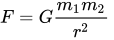
The hero of the first essay is Sir Isaac Newton. The equation discussed is his Universal Law of Gravitation, written as , where F stands for the gravitational force acting between two objects, m for mass (of the two objects in question), r for the distance between their centers of mass, and G for the gravitational constant, an example of an inverse square equation. The law was revolutionary in that it flew directly in the face of the idea that different rules applied to the earthly and heavenly realms. Guillen draws a direct line from Newton's realization that gravity acts the same way throughout the Universe to the landing of astronauts on the moon about 300 years later.

The second essay discusses Daniel Bernoulli's Law of Hydrodynamic Pressure, which deals with the pressure in a flow of liquid. It was Bernoulli's insight that as a fluid moves more quickly, its pressure declines and vice versa. While Bernoulli was concerned with liquids, airplanes (and birds) fly because the shape of an airfoil (whether natural or a man-made) causes air (in essence a very thin liquid) to flow more quickly over its curved upper surface than along its lower surface. Accompanying the speed differential is a pressure differential. Wings produce lift because the slower air flowing below them exerts more pressure than the faster air flowing over them.

The third essay tells the story of Michael Faraday's rise to prominence from humble beginnings and his Law of Electromagnetic Inductance, which Guillen writes as  . According to other sources that is actually a modified form of Faraday's original law, this version known as the Maxwell-Faraday Equation, and I noticed that in other instances the forms Guillen uses are not necessarily those most familiar to us (for example, he gives E = mc2 as E = m x c2). However stated, the core idea and Faraday's insight was that magnetism and electricity are two sides of the same coin—that electric currents produce magnetic fields and that, conversely, a changing magnetic field generates electric current in a conductor. Essentially, he recognized the principles behind dynamos and electric motors, and, once large reliable supplies of electricity became available, electric motors performed work far more efficiently than steam engines, important as steam engines had been. This essay dwells in some detail on the difficulties Faraday faced as a member of the lower classes (originally apprenticed as a book binder) in the English science establishment of his day dominated by wealthy gentleman scholars.

Rudolf Clausius, the subject of the fourth essay, is a less familiar figure than the others, but his Second Law of Thermodynamics is well known. Heat fascinated him. His breakthrough was understanding that cold things normally never become cold on their own, that natural temperature flows always go from warmer to colder—or, more formally stated: "heat always flows spontaneously from hotter to colder bodies, and never the reverse, unless external work is performed on the system" (from the Wikipedia article "Second Law of Thermodynamics"). By extension, he realized that energy changes and temperature changes were, again, two sides of one coin: they were changes in entropy.

The final essay, on Einstein's E = mc2 was particularly interesting, I thought, as it explained why Einstein started thinking along the lines that eventually led him to his conclusion about the interchangeability of energy and matter. According to Guillen, Einstein had understood that if you could travel as fast as sound waves emanating from a certain spot (only about 767mph) that you would cease to hear them because you would be moving away from their point of origin as quickly as they were; they would never reach you. Einstein apparently wanted to know what light would look like if you could travel at the speed of light away from a light source (almost 671 million mph, but more commonly given as 300,000m/sec). Ultimately, he concluded that the gravitational effects associated with travel at that speed would make it impossible to move so quickly and that light performs the feat because the photon is the only known particle believed to be pure energy and thus mass-less (and therefore not subject to gravity). Einstein decided that space and time are forced to change in such a way that the speed of light never changes—in short that space and time are mutable and everything, except light, is relative. An entertaining read if the history of science lights your lamp.

Tuesday, February 5, 2019

Books I'm Reading: On Photography

Having just read Susan Sontag's Against Interpretation and Other Essays, I felt inspired to finally read her collection called On Photography. I read an old Delta paperback edition (1978—apparently the first paperback edition) that I picked up used somewhere ages ago; although I thought I had a newer edition somewhere. No matter, the content is the same, although newer editions may have worthwhile ancillary material attached. It's a shame that Sontag didn't live long enough to add thoughts in the age of smartphones, Facebook, and Instagram.

This was much easier going than Against Interpretation—not because it is somehow lacking in depth, breadth, or rigor of thought—but simply because the subject matter is so much more familiar to me. I'm able to immediately see in my mind virtually all the images she mentions, none of which are shown in the text (I wonder if there's an illustrated edition?). I know the photographers she mentions. I know most of the history. But this is not about the history of photography or about the work of specific photographers except as useful for the purposes of supporting an argument.

The essays (six of them, although together they read as a single narrative) are mostly about the function of photography within human culture, and virtually every page has something worthwhile to say about the subject. Sontag talks about how photography relates to painting, to travel and tourism, about the way photography levels all events by transforming them into physical records, about ethical issues faced by documentary photographers and war correspondents, about the paradoxical way photographs can shock by exposing what is normally unseen while at the same time anesthetizing us to the shocking through repeated exposure, and about the way photography has come to shape the way we view and understand environments, both natural and man made.

Ultimately, she suggests that photography has usurped reality--that we have become more comfortable relating to images of the world than to the world itself. She was prescient. She had this insight when images were more pervasive than they'd ever been yet still far fewer and far more difficult to create than they are today. In 1977, making a photographic image usually involved film  sent out for processing. There was typically a lag of at least several hours--sometimes as long as a week--between composing a photograph and seeing it. Polaroid cameras were available, but even at the height of their popularity and availability, most images were not made with instant cameras (and a Polaroid image took several minutes to appear). Today, virtually any phone handset can produce an image in seconds and that image can be made visible to hundreds of millions of viewers just as quickly. What would Sontag have had to say?

[A few days later I found the more recent edition I was pretty sure I had (Picador, 1990). The text is identical to the text of the version I read. No illustrations have been added, and there is no additional content. ]

Thursday, January 31, 2019

Books I'm Reading: Susan Sontag's Against Interpretation and Other Essays

I finally got around to reading Susan Sontag's Against Interpretation and Other Essays, which appears to have remained in print since its initial publication in 1966. I read a Picador paperback edition of uncertain date (pictured). It looks like 1990, but it's hard to tell from the front matter. Whatever the year, my copy is from the 21st printing in this format.

It's easy to see why this collection continues to interest readers—why the publishers continue to make it available: although the essays here are from 1961 to 1966, making even the most recent more than 50 years old, they've held up well. While they are clearly of their time (and, in part, fascinating for that reason), they do not feel dated in the sense of no longer having much relevance or of being outmoded in style. Sontag writes charmingly, her familiarity with a wide range of philosophy, literature, theater, and film is impressive, and her thinking is lucid. On top of that, she had pretty good taste. I found the essays engaging even when they dealt with writers I've never read (or never even heard of in a couple of instances) and films I've yet to see. Reading Against Interpretation and Other Essays has given me another reason to delve into classic French cinema and to get around to reading Sartre, Camus, and their ilk. So many books, so little time, as they say. I most enjoyed the title essay, "Against Interpretation," her discussion of science fiction films, the piece about "happenings," and the collection of thoughts entitled "Notes on 'Camp'." Next, I plan to read Sontag's On Photography, a book I've been meaning to read for years.

Coincidentally, I recently (just this week) stumbled upon kanopy, an online film-streaming service that gives free access to a large selection of high-quality films through the public library system. All that's required is a public library card to get a pass to watch up to 10 films a month free (at least with a San Francisco Library card; limits differ from library to library apparently). Once you select a film, you can watch it as many times as you want for three days. I've already added most of the classics of French cinema Sontag discusses to my watch list.

Monday, January 21, 2019

Books I'm Reading: The Monuments Men

First book of the new year. The Monuments Men (2009, Little, Brown and Co.), by Robert M. Edsel, with Bret Witter, is the book from which the recent film was made. It tells the story of the German looting of art treasures in Europe during WWII. This is the same story told in Lynn H. Nicholas's 1994 book The Rape of Europa, but from the perspective of the men and women charged with finding, protecting, and repatriating the loot.

An extraordinary tale in many ways. First, it vividly demonstrates (yet again) the Nazi capacity for organized and meticulously documented criminal activity—activity condoned and encouraged from the very top. Extraordinary that treasures of the caliber of The Ghent Altarpiece were carted away and stowed in salt mines. Extraordinary that Hitler directed all of the looted art to be destroyed at the end of the war, when it had become clear that the war was lost. Extraordinary to think that, at the same time— almost until the day he killed himself—Hitler still had visions of a great museum in Linz where all the stolen art would go. Extraordinary that so few people on the Allied side accomplished so much with so little support from the governments they were serving. The writing is workmanlike, but the tale itself is well worth the time.    

Thursday, January 10, 2019

Books I'm Reading: A Beautiful Question

The last book I read in 2018, Nobel Prize winner Frank Wilczek's A Beautiful Question (Penguin, 2015) is one of those books that you immediately want to re-read the moment you're finished with it because it handles such difficult subject matter.

I periodically subject myself to these books on physics, because I want to understand what human beings so far understand about the universe, but I never seem to make much progress. The fault is mine, not the author's.

Wilczek lays out the now-familiar history of the development of quantum physics but approaches the story from a somewhat unusual perspective. His focus throughout the book is on beauty and idealizations of reality and the relationship of these to actual reality as we understand it. His greatest pleasure is in pointing out how human intellect, inspired by notions of the ideal, has arrived at solutions to basic problems that in large part conform to expectations—and in this symmetry, this conformance of real to the ideal, he sees great beauty. He looks at the universe as envisioned by Pythagoras, Socrates, Galileo, Newton, Maxwell, Einstein, and then by physicists of the modern era, pointing out along the way how our understanding of the universe points to a positive answer to the question he initially posits "Does the universe embody beautiful ideas?"

I see that I read only 14 books in 2018, which seems a shamefully small number. That's a book every 3.7 weeks. I'd like to be near one every two weeks, at the very least.... So many books. I will have to try harder in 2019.
Related Posts with Thumbnails