Showing posts with label books. Show all posts

Monday, October 13, 2025

Books I'm reading: Simon Winchester's "Knowing What We Know"

In his Knowing What We Know: The Transmission of Knowledge from Ancient Wisdom to Modern Magic (Harper Perennial, 2024), Simon Winchester guides us with his usual skill (blending biography, intellectual history, and anecdote in lucid prose) through a broad and complex topic – human knowledge and the transmission of that knowledge – with a focus on a central question: How have we come to know what we know?

He sets out to explore the means by which knowledge (in the broadest sense) has been passed from generation to generation, covering everything from the earliest oral traditions and the emergence of writing to Wikipedia and AI language models. The digressions are many and always interesting, but sometimes the subject seems too big for a single volume. 

What emerges is a recurring concern with the vulnerability of knowledge – throughout history (for example, the risk of fire destroying an ancient library), but particularly in an age of information overload based on digital storage, and he ends the book with musings about the ease with which information about virtually anything is available today with the push of a button or a spoken request directed at a handheld device. He sounds a bit nostalgic about hard-won knowledge, relating a story about navigating on the open sea before GPS systems became available and I have long wondered how London cabbies must feel about GPS navigation considering the time and effort they have traditionally had to put into acquiring "the knowledge" (referring to map-perfect memorization of the streets of London). He never really answers the question of whether this availability of knowledge represents a loss or if we should see it as freeing our minds for other things, and so the end of the book left me hanging a little, but engaging storytelling throughout the book made it very much worth the time it took to read. From Winchester, I would have expected nothing less. 

Sunday, November 24, 2024

Books I'm Reading: The Imagery of Surrealism

In the past year, my reading has been focused on art history. My interest in art history is nothing new, but this spate of reading was set off by a show at Modern Art West, in the town of Sonoma, back in September of 2022 focused on female Abstract Expressionist painters working on the West Coast in the 1950s and 1960s. Reading about these women (I recommend Ninth St. Women, in particular) led me to reading specifically about Lee Krasner and Helen Frankenthaler. Reading about Frankenthaler led me to reading about Motherwell, which led me to reading the anthology of Dadaist writing he edited and that led me to The Imagery of Surrealism (first edition, Syracuse University Press, 1977) by J. H. Matthews, a dense, difficult read that required concentration and perseverance to get through.  

I suspect that many people think primarily of painting or collage when they think of surrealism, but, as this book makes clear, like dada, surrealism was as much a literary movement as a movement in the visual arts, and, again like dada, true surrealists looked at surrealist imagery (whether verbal or pictorial) as secondary to action, in this case the act of creating while separating the mind from the constraints of convention to tap into what was variously termed "inner need," "the inner model," or sometimes just "desire." Kandinsky, though not a surrealist, called it "inner necessity." Surrealists believed that rational thought was the enemy of the creative impulse and that some means was necessary to bypass rational thought to access the inner model (as a side note, I find it frustrating that it's hard to find practical suggestions as to what that means exactly was or should be). 

As the jacket blurb notes, Matthews "asks why and with what consequences surrealism denies values on which our education in art and literature have taught us to rely." The author points out that because words are our means of articulating our understanding of reality, literary images that defy common sense are particularly confounding and they are at danger of being dismissed as simply nonsensical, while painted or drawn images can be easier to accept if we allow ourselves to hold at bay our instinctive reaction, which is to analyze and attempt to find a rational explanation for what we are seeing based on our everyday experience of the real world. On the other hand, he points out that in painting and drawing, it is easy to fall into hackneyed symbolism, and he accuses Dalí of having done just that. He has high praise for Magritte, Tanguy, and Miró among better known surrealist artists, but the book is remarkable for the wealth of examples it presents by a wide range of lesser known artists, which (again according to the jacket) are mostly from the collection of the author and from other private collections and published in this book for the first time. A challenging read, but worth it if you want to deepen your understanding of surrealist thinking throughout its history, from the 1920s well into the 1960s or 1970s. 

Wednesday, March 1, 2023

Books I'm Reading: The House on the Strand; Light Years

I haven't been reading lately as much as I customarily do. Too many distractions, I suppose. I've been much more deeply engaged in listening to music recently. It could be that – although the two aren't necessarily incompatible. 

My mother died in January. In the last ten days or so of her life I spent a lot of time in the hospital at her bedside. I brought a couple of books with me, picking up whatever was to hand. I'm not sure why, but I chose a copy of Daphne Du Maurier's classic The House on the Strand (a 1974 University of Pennsylvania Press paperback edition) that was on one of my bookshelves (as it happens, a copy my father left behind at the time of his death). I first read The House on the Strand in high school when I was going through a phase of reading a great deal of fiction by English writers, many of whom were suggested by my grandmother and my mother (school teachers both, my grandmother a teacher of English literature in high school; I read a great deal of Thomas Hardy at the time), so it is was perhaps an appropriate choice. 

I didn't remember much about the book, but it's held up pretty well, I'd say. Although a certain suspension of disbelief is required to accept the idea of a potion that transports people back in time, the transitions are written rather deftly and I enjoyed reading it again. The only Thomas Hardy novel I've re-approached as an adult is Return of the Native, which seemed rather naïve to me on re-reading. I recently re-read Moby Dick, which I enjoyed as much the second time around as the first. 

The other book I read during my mother's final days was Light Years (Icon Books, 2015), by Brian Clegg. I have a habit of subjecting myself from time to time to books about physics in the hope of better understanding some of the great peculiarities of the quantum world, but there always comes a point at which the mind boggles and I'm left feeling worn out and confused and like I've made no progress. Still, I like to keep trying. This was among the easier such books I've read, though, because it was essentially a survey of the history of human thinking about light and it was only at the very end of the book that the ideas became challenging. It was engagingly written and worth the time, I thought. It was at the very least a useful distraction. So far, these are the only books I've read in 2023. I will try to do better in the coming months....

Saturday, December 21, 2019

Books I'm Reading: The Jazz of Physics

Yet another book about physics that I read with interest but found hard to process. Stephen Alexander's The Jazz of Physics (Basic Books, 2016) is well written and engaging, but I never got the feeling that I was reading a focused argument aimed at supporting the thesis suggested by the subtitle (The Secret Link Between Music and the Structure of the Universe). The book seemed more diffuse than that.

The Jazz of Physics claims to shed light on difficult issues in physics by taking a serious look at the idea that music (broadly defined—in fact, here thought of as vibration) is at the core of the structure of the universe. One of those books that I immediately want to read over again from cover to cover in an effort to really understand, but I suspect I'll never get back to this one as there are so many other books to read.

These paragraphs are intended more as a record of my having read The Jazz of Physics than as something that might properly be called a review. Having said that, anyone with an interest in physics and music would probably enjoy reading this book.

Monday, February 25, 2019

Books I'm Reading: Five Equations that Changed the World

Dr. Michael Guillen, in his book Five Equations that Changed the World (Hachette, 1995) succeeds in making five important equations easy to grasp and even entertaining to read about. None of the  equations he's chosen is especially difficult to understand, and the book might be faulted by some for trying to make things a little too approachable, but Guillen's writing only occasionally feels condescending. 

The book is divided into five sections, one for each of the equations. Each essay is itself divided into five parts—a prologue that relates an incident in the life of the man at the center of the story (and they are all men) intended, as the author says, to "set the tone for what is to follow;" sections headed Vini, Vidi, and Vici; and an epilogue. The vini (I came) sections describe how the hero of the story recognizes the problem that his theory solves. The vidi (I saw) sections attempt to explain why the problem was important. The vici (I conquered) sections describe how the protagonist arrived at the equation that solved the central problem developed in each section.

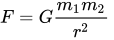
The hero of the first essay is Sir Isaac Newton. The equation discussed is his Universal Law of Gravitation, written as , where F stands for the gravitational force acting between two objects, m for mass (of the two objects in question), r for the distance between their centers of mass, and G for the gravitational constant, an example of an inverse square equation. The law was revolutionary in that it flew directly in the face of the idea that different rules applied to the earthly and heavenly realms. Guillen draws a direct line from Newton's realization that gravity acts the same way throughout the Universe to the landing of astronauts on the moon about 300 years later.
The second essay discusses Daniel Bernoulli's Law of Hydrodynamic Pressure, which deals with the pressure in a flow of liquid. It was Bernoulli's insight that as a fluid moves more quickly, its pressure declines and vice versa. While Bernoulli was concerned with liquids, airplanes (and birds) fly because the shape of an airfoil (whether natural or a man-made) causes air (in essence a very thin liquid) to flow more quickly over its curved upper surface than along its lower surface. Accompanying the speed differential is a pressure differential. Wings produce lift because the slower air flowing below them exerts more pressure than the faster air flowing over them.

The third essay tells the story of Michael Faraday's rise to prominence from humble beginnings and his Law of Electromagnetic Inductance, which Guillen writes as  . According to other sources that is actually a modified form of Faraday's original law, this version known as the Maxwell-Faraday Equation, and I noticed that in other instances the forms Guillen uses are not necessarily those most familiar to us (for example, he gives E = mc2 as E = m x c2). However stated, the core idea and Faraday's insight was that magnetism and electricity are two sides of the same coin—that electric currents produce magnetic fields and that, conversely, a changing magnetic field generates electric current in a conductor. Essentially, he recognized the principles behind dynamos and electric motors, and, once large reliable supplies of electricity became available, electric motors performed work far more efficiently than steam engines, important as steam engines had been. This essay dwells in some detail on the difficulties Faraday faced as a member of the lower classes (originally apprenticed as a book binder) in the English science establishment of his day dominated by wealthy gentleman scholars.

Rudolf Clausius, the subject of the fourth essay, is a less familiar figure than the others, but his Second Law of Thermodynamics is well known. Heat fascinated him. His breakthrough was understanding that cold things normally never become cold on their own, that natural temperature flows always go from warmer to colder—or, more formally stated: "heat always flows spontaneously from hotter to colder bodies, and never the reverse, unless external work is performed on the system" (from the Wikipedia article "Second Law of Thermodynamics"). By extension, he realized that energy changes and temperature changes were, again, two sides of one coin: they were changes in entropy.

The final essay, on Einstein's E = mc2 was particularly interesting, I thought, as it explained why Einstein started thinking along the lines that eventually led him to his conclusion about the interchangeability of energy and matter. According to Guillen, Einstein had understood that if you could travel as fast as sound waves emanating from a certain spot (only about 767mph) that you would cease to hear them because you would be moving away from their point of origin as quickly as they were; they would never reach you. Einstein apparently wanted to know what light would look like if you could travel at the speed of light away from a light source (almost 671 million mph, but more commonly given as 300,000m/sec). Ultimately, he concluded that the gravitational effects associated with travel at that speed would make it impossible to move so quickly and that light performs the feat because the photon is the only known particle believed to be pure energy and thus mass-less (and therefore not subject to gravity). Einstein decided that space and time are forced to change in such a way that the speed of light never changes—in short that space and time are mutable and everything, except light, is relative. An entertaining read if the history of science lights your lamp.

Thursday, January 31, 2019

Books I'm Reading: Susan Sontag's Against Interpretation and Other Essays

I finally got around to reading Susan Sontag's Against Interpretation and Other Essays, which appears to have remained in print since its initial publication in 1966. I read a Picador paperback edition of uncertain date (pictured). It looks like 1990, but it's hard to tell from the front matter. Whatever the year, my copy is from the 21st printing in this format.

It's easy to see why this collection continues to interest readers—why the publishers continue to make it available: although the essays here are from 1961 to 1966, making even the most recent more than 50 years old, they've held up well. While they are clearly of their time (and, in part, fascinating for that reason), they do not feel dated in the sense of no longer having much relevance or of being outmoded in style. Sontag writes charmingly, her familiarity with a wide range of philosophy, literature, theater, and film is impressive, and her thinking is lucid. On top of that, she had pretty good taste. I found the essays engaging even when they dealt with writers I've never read (or never even heard of in a couple of instances) and films I've yet to see. Reading Against Interpretation and Other Essays has given me another reason to delve into classic French cinema and to get around to reading Sartre, Camus, and their ilk. So many books, so little time, as they say. I most enjoyed the title essay, "Against Interpretation," her discussion of science fiction films, the piece about "happenings," and the collection of thoughts entitled "Notes on 'Camp'." Next, I plan to read Sontag's On Photography, a book I've been meaning to read for years.

Coincidentally, I recently (just this week) stumbled upon kanopy, an online film-streaming service that gives free access to a large selection of high-quality films through the public library system. All that's required is a public library card to get a pass to watch up to 10 films a month free (at least with a San Francisco Library card; limits differ from library to library apparently). Once you select a film, you can watch it as many times as you want for three days. I've already added most of the classics of French cinema Sontag discusses to my watch list.

Monday, January 29, 2018

Books I'm Reading: The Drunken Botanist

Amy Stewart's  The Drunken Botanist (Algonquin Books of Chapel Hill, 2013), is a versatile book likely to be of interest to anyone with even a passing interest in the things we drink and the plants we grow. The main text is divided into three sections: a look at fermentation and distillation; a look at the main plant ingredients of the liquors and liqueurs that go into alcoholic beverages; and then a look at various plants used in mixers and garnishes. Within these sections, short briefs (one to four pages each) treat the plants covered. Interspersed are cocktail recipes that use ingredients described and even short notes on how to grow some of the plants mentioned. Thus, the book is part plant dictionary, part cocktail recipe book, and part a grower's guide. The main sections are subdivided by type of plant. For example, section two is divided into herbs and spices, flowers, trees, fruit, and nuts and seeds. That arrangement, alphabetical listing within sections, and a good index make it easy to use the book as a reference, but it's engaging enough to read straight through.

Tuesday, January 16, 2018

Books I'm Reading: The Forger's Spell

Edward Dolnick's The Forger's Spell (Harper Perennial, 2008) is the story of one of the biggest art hoaxes of the 20th century, the story of how Han van Meegeren, a disillusioned, unappreciated Dutch artist duped a host of collectors, connoisseurs, and wannabe connoisseurs, including rapacious Nazi art thief Hermann Goering. Van Meegeren turned to forgery largely to get back at an art world that neglected him. He specialized in creating fake Vermeers—a comparatively easy target given that artist's small output and only sketchily documented life.

The book reads in places like a whodunnit, compelling for details of how forgers work (particularly, how Van Meegeren discovered he could quickly dry and harden fresh oil paint by mixing it with Bakelite and baking his new paintings in a slow oven); for the story it tells of competitive art looting between Hitler, Goering, and other top Nazis; and for its detailed chronicling of Van Meegeren's initial success as a forger, his unmasking, trial, and downfall, and his later rehabilitation in the popular mind as he came to be seen as a hero for fooling Goering. Having said all that, The Forger's Spell is perhaps most rewarding for the answers it suggests to perhaps the most interesting question about forgeries that have been revealed; how do clearly bad paintings take in people who really should know better?

As the author points out, many of the paintings by Van Meegeren that fooled scholars and collectors alike were clearly bad. His biggest success was perhaps his sloppiest. Van Meegeren's Christ at Emmaus, pictured above, was a crude attempt to suggest what Vermeer might have done with this Biblical subject under the influence of Caravaggio. The experts wanted to believe in the authenticity of the work because many believed Vermeer had been influenced by Caravaggio and that, in some sense, there ought to be such a painting. What is startling is that the obvious Vermeer-esque touches in this generally crude painting were enough to convince so many people. They include the single window to the left with light raking in from the side (although Christ's face ought to be in deeper shadow); the use of blue and yellow; the composition itself (roughly taken from a Caravaggio depicting the same subject); the placement of the hand on the table (a reference to a genuine Vermeer, The Astronomer, in the Louvre); and the jug on the table, an element in several genuine paintings by Vermeer. Van Meegeren's forgery is an object lesson in the power of playing on what people want to believe, and, in some instances, need to believe to preserve their standing among professional peers once committed to an assessment. Author Dolnick persuasively suggests that forgery done well (in the sense of forgery done successfully--setting aside the quality of the work) usually involves the people fooled doing most of the work for the forger. A committed believer will work hard to preserve his reputation.

Well researched and well written. Recommended.

Friday, November 10, 2017

Books I'm Reading: Wine, Giant Squids, and a Yellow Diamond

I normally write about the books I'm reading one at a time, but so much time has been lost by dealing with disruptions caused by the recent fires that I have three to note here in order to catch up. I've recently finished Todd Klimann's The Wild Vine (Clarkson Potter, 2010), the tale of one of North America's most interesting native grape varieties, Norton, also known as Cynthiana. Years ago, driving across the country, I stopped in the Missouri wine country where a lot of Norton is still grown and tasted Norton wines. They seemed the most familiar among the many wines I tasted on my trip made using non-vinifera grapes (Norton is believed to be Vitis aestivalis or a hybrid including a large aestivalis component). I thought the Norton wines I tried competently made and drinkable but not very exciting. Port-style wines made from Norton seemed the most successful. The book discusses Norton's history in Missouri and elsewhere, its origins, a rise to domestic prominence (and even some surprising successes overseas), and then its subsequent fall into obscurity. An interesting, if rather narrowly focused read.

I followed that with a rather different book, Richard Ellis's The Search for the Giant Squid (Penguin, 1998) a highly readable look at the rather mysterious, poorly studied, poorly understood, largest members of the squid family. Much of the book is an attempt to bring some clarity and objectivity to historical reports of giant squid from around the world--often reports of "monsters" that probably were squid. One section looks at squid biology. Another looks at the giant squid in literature and film. An entire section is devoted to known models of giant squid, mostly in museums around the world. In short, everything to know about the giant squid is here. That's a lot, but the take-away from reading the book is actually that we know very little about the biology and habits of these largest of the invertebrates.

In another switch, I then turned to reading the latest mystery from Andrew Martin, The Yellow Diamond (Faber and Faber, 2015). I'm not usually a fan of mysteries, but my mother introduced me to Martin's Jim Stringer series of mysteries a few years back and I enjoyed those very much for the good writing, the masterful evocation of period (early 1900s), and of place (various parts of England, France, and later one in India), but especially for the vividly described railroad culture in them; Jim Stringer is a detective on the railroads, formerly an engine driver. The books are steeped in the language of the railroads, which makes them both a little challenging to get into at first but rewarding. The Yellow Diamond is the first in a new series that takes place in more modern times and with a new detective, one Blake Reynolds, investigating the super rich in London. The ending leaves one wondering what's next for the main character. I suspect another Reynolds adventure is on the way--if one hasn't been published already. Reading this after the fires was a welcome escape.

While waiting out the progress of the recent fires I also read The Janissary Tree, by Jason Goodwin (Picador, 2006), the first in another series of mysteries recommended by my mother. This one features Yashim, an investigator in the late days of the Ottoman Empire. Yashim is a eunuch, which gives him access to the harem and other inner chambers of the Sultan's palace in Istanbul, usually off limits to outsiders. He has an interest in cooking, eating, solving mysteries, and—because Yashim became a eunuch  after puberty—in women. In this tale, a series of gruesome murders--linked, we learn, to the disgruntled remnants of the Sultan's Janissaries--keeps Yashim in the streets of Istanbul, in the harem, and in trouble.  Like most good mysteries, the pleasure here is as much in the atmosphere and detail Goodwin achieves as in the plot.  I'm not usually a mystery reader, but I liked this well enough that I'm curious to find out what Yashim gets up to in the next book in the series.

Sunday, May 7, 2017

Books I'm Reading: Libation, A Bitter Alchemy

I don't remember how I acquired Dierdre Heekin's memoir Libation, A Bitter Alchemy (Chelsea Green Publishing, 2009), but it's been on my bookshelf for some time. I wasn't entirely sure what it was about when I picked it up a few days ago. Having read it, I'm still not sure I can say. It doesn't really go anywhere. The only linear narrative is supplied by a series of vignettes that deal with the author's decision to plant a vineyard in Vermont and her progress toward making her first wine from her grapes. These vignettes are interspersed between chapters of a wide-ranging text that is held together loosely by its focus on the making of things alcoholic, including wines, but also absinthe, vodka, and Irish whisky, as well as distillation of perfumes and other subjects. Reading it felt like an aimless but pleasant walk through an interesting town. Despite it's rambling structure, it's nicely written (with one or two exceptions—a glaringly questionable fact; she repeatedly refers to the cochineal insect as a "ladybug*" and there are a few unconventionally used words) and enjoyable if taken at its own pace and without expectations.

*Unless, I'm mistaken, the ladybugs (or ladybirds) are true beetles, while the cochineal insect is a scale insect and ladybug larvae, in fact, prey on scale insects.

Thursday, October 9, 2014

Books I'm Reading: Inventing Wine

Two developments in the history of wine and winemaking are largely responsible the quality of the wine we drink today and for the range of choices we have: the development of sturdy glass bottles with reliable cork seals (a combination that banishes oxygen); and temperature-controlled vats for fermentation and storage. These two innovations set the stage for what Inventing Wine author Paul Lukacs rightly refers to as wine's "second golden Age."

Inventing Wine (Norton, 2012) is a history of winemaking from ancient times to the present with an emphasis on how wine was transformed from a highly perishable, short-lived, near accident to a highly sophisticated creation of the human imagination, benefiting from the choices winemakers are afforded today by innovations like temperature-controlled fermentation. Lukacs makes it clear that the global selection of high-quality wines we take for granted today is a very recent development.

Winemaking is believed to have begun as long as 8,000 years ago, but wine is highly susceptible to the effects of oxygen and spoilage caused mainly by the strains of bacteria that convert wine into vinegar. Most wine through history has been short-lived. While amphorae allowed quantities of wine to be sealed against oxygen and stored for long periods if unopened, most wine was stored in casks that, once breached, allow the contents to quickly turn sour if not topped up. Wine was often transported in animal skins (which imparted scents and flavors few would tolerate in wine today). It was typical to add spices, herbs, and resins to wine to mask off flavors and spoilage. Wine has not always been the sophisticated, natural drink it has become. What we think of as wine is comparatively new. Inventing Wine takes the reader on a journey through the history of winemaking with an emphasis on how we got from sour, adulterated wines of little distinction to the highly particular, carefully handled fresh-grape creations we enjoy today.

Tuesday, September 30, 2014

Books I'm Reading: Just My Type

We look at letters every day, often all day long. We see them on signs; on computer screens large and small, fixed and mobile; in books, magazines, and newspapers. But more often than not, we ignore their form, choosing instead to concentrate on the meanings they convey--and a good typeface (a good reading typeface, that is, as opposed to a display or advertising typeface) is often praised when it's seen as being "transparent," which is to say that it draws no attention to itself. Just My Type (Gotham Books, 2012) author Simon Garfield is far more sensitive to the shapes of letters.

Garfield takes the reader on a grand tour of typography. The book is an entertaining, often witty look at typefaces--where they come from and what they do for us. You may never look at street signs, billboards, print advertising, or book pages the same way again. Particularly fascinating is the way Garfield puts fonts into historical context. Next time you're watching a movie, you may find yourself looking for examples of lettering set in typefaces that didn't exist at the time of the film's setting--a new dimension in movie error trivia to explore.

Sunday, June 3, 2012

Miscellaneous: Bookshelves Full (June 2, 2012)

I recently wrote a short post about the bookshelves I built with my brother's help in my office/studio (here). I said that I expected the new space to fill quickly, as it seems to be a rule that new shelves appear only long after they've been sorely needed for some time. Here's a photo of the finished project--completely full already after only a week, as predicted.

Now, I need some new bookshelves....

Tuesday, May 22, 2012

Miscellaneous: Bookshelves and Manifest Destiny (May 22, 2012)

Reading--once infected with it, there's no real cure. At least the symptoms are pleasant: Reading is a happy virus. Reading and acquiring books don't always go hand in hand--we have libraries--but I like to own the books I read, even if I sell them, trade them, or give them away once finished. I never know when I'll get around to the many books that interest me, but I like always to have something ready to go. It's a luxury, perhaps, to be able to walk into a room with bookshelves full of choices when it comes time to start something new, but it's a luxury I allow myself. It seems, however, that there's never enough space. Bookshelves fill quickly. Then books get slipped sideways into the gaps between the shelves and the tops of books below (the crack fillers). Books begin to pile up on the floor....

I decided recently the time had come to build a wall-mounted bookshelf behind the desk in my office/studio. I've been working on the project for about a week with the help of my brother, who is much better at these things than I am. It was he who suggested using European birch plywood rather than the pine I had had in mind. Pine, it turns out, tends to be poorly seasoned these days. It's usually young and wet and therefore lacking in dimensional stability. So I designed a simple bookcase seven feet wide and two feet deep, with a shelf in the middle, providing room for two long rows of books, the middle shelf supported by a divider. In the end, I decided I liked it better with only one divider (in the bottom), so I will fill the slot we made in the upper side of the middle shelf where an upper divider was to have gone.

Now that the bookcase is mostly built, I've begun to mentally fill it with the books that already need a home. I can see most of the new space disappearing almost immediately--as soon as the paint's dry. What's left of the empty space will call to me as the land of the American West called to settlers looking for living space in the 19th century. Manifest destiny.

It will be only a matter of time--and not much time--before all the new space has been filled. The crack fillers will begin to appear again. Then little stacks of books will rise here and there on furniture and on the floor, and very little will have changed.

Of course, the cat has been helping. He said something about inspecting the drop cloth....

[Update: Go here for a shot of the finished project.]

Books I'm Reading: Once Upon a Town

I've been to North Platte, Nebraska. I've driven along its quiet streets, looked at the grassy park near the center of town, and visited the Union Pacific Railway's classification yard there. I went to North Platte on a little detour during a drive across the country a few years back--an impulsive act resulting from my realization that I'd never really seen much of the United States between Lake Tahoe and St. Louis, Missouri, and by a certain restlessness. I had purchased a book called Road Trip USA (Jamie Jensen, Avalon Travel, 5th Edition, 2009) just before leaving home that recommended lesser known points of interest along some of this country's lonelier roads. I was surprised to read in the section on Nebraska that the southwestern part of the state, along Highway 80, was a beautiful place. In my mind, there had been little to distinguish any part of Nebraska from the image of unrelenting flatness I associated with its southern neighbor, Kansas. The area right around Highway 80 proved rather boring, in fact, but at Laramie, Wyoming I turned off the interstate and headed north on Highway 71 to Scottsbluff, Nebraska and the countryside there was very beautiful, indeed (photo below).

North Platte is known as the hometown of Buffalo Bill Cody. Here you'll find Buffalo Bill State Historical Park, site of Buffalo Bill's Scout's Ranch. There's a Buffalo Bill Rodeo in the summer. Railroad enthusiasts go to North Platte to visit the rail yard used to configure freight trains coming across the country (below), the biggest classification and switching yard in the world. As I noticed on my trip across country a few years back, today's interstate highways often follow paths cut across the country many years before the automobile. North Platte was a stop on the Oregon Trail and it was a Pony Express stop. The Lincoln Highway, America's first transcontinental road, followed the Oregon Trail in this part of the country. North Platte was part of that road as well.

I must have been close to the location of what became known as The North Platte Canteen, but I saw no sign of it and didn't think to look, although I had heard something of the story before. Bob Greene's Once Upon a Town (Perennial, 2003) tells that story in detail.

During the Second World War, hundreds of thousands of soldiers moved across the country on troop trains to their deployments, usually on the coasts. Many troop trains went through North Platte. Some soldiers passed through on their way back home on leave or after the war ended. Someone local got the idea of handing out food and drinks to the servicemen on their brief stops in the town (usually 10-15 minutes at most). It was an idea that took hold. Once started, the informal canteen provided a steady stream of refreshments, encouragement, gratitude, and friendly words to young men on their way to war--many of them having left home for the first time. It's remarkable that the canteen was open without fail from 5:00AM until after midnight on every day of the year in every year of the war (and for a period afterwards, greeting men coming home), staffed and supplied entirely by volunteers. Every train was met, without fail. All the food and drink was donated by the citizens of North Platte and surrounding communities. It was an act of love.

The North Platte Canteen disappeared when it was no longer needed. The building that temporarily housed it has been torn down. North Platte--then and now a place known mainly as somewhere on a road to somewhere else--for a few years was an overflowing well of the most generous hospitality. Once Upon a Town, based mainly on interviews with people who volunteered at the canteen and of the soldiers that found brief solace there becomes somewhat repetitive because of the use of personal accounts (many of which are necessarily similar), but the cumulative effect of the many little stories is to create a vivid picture of one corner of the home front during WWII--a picture that seems worth handing on to future generations.

Tuesday, April 17, 2012

Miscellaneous: Coincidence--Libraries Left Behind (April 17, 2012)

"Coincidence."A simple word that, taken at face value, means simply two events occurring simultaneously--or nearly so.

"Denotation." "Connotation." These are among the English words that I distinctly remember learning. There are comparatively few; I mostly remember grasping new words in foreign languages I've studied, where conscious effort is involved, but I can recall the moment I first heard those two English words.

The connotations of the word "coincidence" seem particularly rich. We appear incapable of accepting the word's baldest meaning. A coincidence always seems to portend something. A coincidence is a palimpsest. We write our own meanings onto the pale face of coincidence instinctively, virtually without thought. I try to resist the urge. To give in to it seems like intellectual laziness.

A recent coincidence suggested to me another kind of intellectual laziness and it set me to thinking, and ultimately to writing this little essay--although "essay" is far too important a word for it. My father, a rather distant man, died in February. He had an extensive library. When it became clear that my brother and I would be the ones to go through his books and dispose of the unwanted ones, I saw it as an opportunity to learn something about my father. I jumped to the conclusion that his books would tell me something meaningful, not really thinking. Intellectual laziness.

Last week, ahead of a concert my son was to play in (one of the Gerald Finzi Bagatelles for Clarinet) he had a rehearsal at the house of his accompanist. I would have taken a walk around her Oakmont neighborhood while waiting for him to finish his practicing, looking at the well-kept gardens, the wildly contorted oaks, the subtly colored pebbles embedded in the pavements, but it was raining--hailing, in fact. The accompanist invited me into the house. I sat on a sofa. She handed me a couple of issues of The New Yorker to pass the time. Much as I love The New Yorker, I don't subscribe--I'd never be able to keep up. I don't see the magazine often enough.  In the issue she handed me (November 7, 2011) I found an essay--yes, an essay--by James Wood called "Shelf Life: Packing up my Father-in-Law's Library." Coincidence. Here was another man thinking about the same things I was thinking about.

Wood comes to the conclusion in his essay that it's natural but perhaps wrong to think that a man's library tells us much about the man. I haven't decided whether he's right or wrong. But perhaps what he says doesn't apply here. There are more than just books in my father's library. He was an obsessive note-writer: Nearly every volume has in it a slip of paper or two--sometimes many more--lists, comments, questions, reminders jotted down. Surely this collection of paper--bound and unbound--means something?
Related Posts with Thumbnails