Showing posts with label music. Show all posts

Saturday, December 21, 2019

Books I'm Reading: The Jazz of Physics

Yet another book about physics that I read with interest but found hard to process. Stephen Alexander's The Jazz of Physics (Basic Books, 2016) is well written and engaging, but I never got the feeling that I was reading a focused argument aimed at supporting the thesis suggested by the subtitle (The Secret Link Between Music and the Structure of the Universe). The book seemed more diffuse than that.

The Jazz of Physics claims to shed light on difficult issues in physics by taking a serious look at the idea that music (broadly defined—in fact, here thought of as vibration) is at the core of the structure of the universe. One of those books that I immediately want to read over again from cover to cover in an effort to really understand, but I suspect I'll never get back to this one as there are so many other books to read.

These paragraphs are intended more as a record of my having read The Jazz of Physics than as something that might properly be called a review. Having said that, anyone with an interest in physics and music would probably enjoy reading this book.

Sunday, December 1, 2019

Music I'm Listening To: New (Old) Classical LPs


Having recently upgraded my sound system, I'm having SO much fun combing the used record and thrift stores for interesting LPs. It's a great time to be a classical music fan and interested in LPs. You can find some astounding things for a dollar or two. Here are some recent acquisitions--median price $2.

I love the size and impact of the LP cover--so much more room than a CD booklet for showcasing the talents of graphic designers. I know the trend in high-end audio now is FLAC and other digital formats, but from a visual perspective, that's no fun at all. I enjoy the cover art almost as much as the music.

Monday, August 12, 2019

Music I'm Listening to: Reorganizing a CD Collection (August 2019)

This is what happens when you start to reorganize your CD collection. For quite a while I've been thinking about how best to organize a CD collection that is mostly classical, but one spanning from Gregorian chant to contemporary music by living composers and including not only classical but also world music, Japanese pop music, rock, blues, and jazz.

I've decided on the following: First, the classical--these chronologically roughly by death date of composer, divided by composer and within each composer by type of music, with chamber music, concertos, and symphonies each getting a separate section. Within classical, I've recognized sections for organ music, for guitar music, and for strongly national music. For example, I have a section that's mostly late 19th and early 20th century French music, with works by Debussy, Ravel, Frank, Poulenc, Milhaud, Satie and the like. I have a Spanish music section as well.

Then, at the end of the chronological classical section, I've grouped all classical CDs that are collections by artist or some other criteria (by instrument, or period--anything that's a mixture of pieces). Following these are three sections of classical vocal music--one for full operas and opera aria collections, one for art songs, and then one for choral music. Within art songs (and sections generally), I've made sections for individual artists if I have a significant number of CDs featuring one artist. In art songs, for example, Elly Ameling gets her own section. I have a Radu Lupu section, a Kyung-wha Chung section, a Melvyn Tan section, etc. Following the vocal music, I have my world music section. This includes everything from the Nenes (an Okinawan vocal group) to Mary O'hara (Irish harp), to gamelan music, and flamenco. Flamenco gets its own section. 

Next I have a jazz section (within this a Monk section and a Jackie McLean section), then a blues section (divided roughly into modern Chicago-style blues and Delta blues), and then the pop music, with the pop divided into Western pop and Japanese pop. It's now much easier to find things. I'm revisiting my entire CD and LP collection....

This seems to work. How do you organize your CDS or LPs?

Tuesday, April 2, 2019

Music I'm Listening To: Gil Shaham, Christian Tetzlaff, and Elena Urioste

Gil Shaham after the concert
Three recent concerts, two in San Francisco, one in Santa Rosa. I attended the February 8 performance of the SF Symphony at Davies Symphony Hall. On the program were Steven Mackey's
Portals, Scenes and Celebrations (a Symphony commission and world premiere), Prokofiev's Violin Concerto No. 1, and Tchaikovsky's Symphony No. 4. Michael Tilson Thomas conducted. Gil Shaham was soloist in the Prokofiev. This is a belated report. I can't say I remember the first piece at all, which shouldn't really count against it, but, by definition, it wasn't memorable. Shaham was his usual, highly competent self. MTT's rendition of the Tchaikovsky was on the slow side but quite enjoyable. It was particularly fun to see the substantial pizzicato sections live. This is a very familiar piece of music but not one I'd seen in person before.

Christian Tetzlaff takes a bow
On March 15, I was at Davies Symphony Hall again, this time to hear Christian Tetzlaff play Mozart's Violin Concerto No. 3. He played some unfamiliar cadenzas, which added interest. Also on the program were Ravel's Le Tombeau de Couperin and Sibelius's Symphony No. 2. MTT conducted. Although I generally find MTT bland, I must admit he does the very late romantic stuff well. I very much enjoyed his handling of the Sibelius. So, that's twice that I've found him really engaged and putting a distinctive stamp on the music—this and a recent performance of Mahler's Fifth Symphony

Violinist Elena Urioste
The following day, it was the Santa Rosa Symphony at the Green Music Center under the baton of Conductor Emeritus Jeffrey Kahane. On the program were Gershwin's An American in Paris in its original version (as Gershwin orchestrated it), Barber's Violin Concerto, and Copland's Symphony No. 3. Elena Urioste was the soloist in the Barber concerto. I was impressed by Urioste's performance and she was very gracious backstage. It was fun to see Kahane again, too. The Gershwin in the original orchestration sounded rather different than the version we're used to, which, according to Kahane, was cleaned up substantially by a Hollywood orchestrator. Gershwin apparently had little experience writing for full orchestra at the time. The Copland is not a favorite. It's rather ponderous, but it's interesting to hear the sections of Fanfare for the Common Man (1942) that were written into the symphony, which followed Fanfare by a year or two.

SR Symphony Conductor Emeritus Jeffrey Kahane

Wednesday, April 27, 2016

Music I'm Listening To: A Week of Music

I heard Midori in recital at the Green Music Center on April 23 and Hilary Hahn in recital at Davies Symphony Hall on the 26th. On the 29th, I'll be in San Francisco again to hear a concert conducted by Pablo Heras-Casado featuring Shostakovich's Symphony No. 9.

It's sad a name as big as Midori can't fill the Green Music Center. Filling the hall seems to have been a persistent problem since its opening, about four years ago. The first two seasons, I was delighted to subscribe to reasonably priced San Francisco Symphony concerts at the Center, but that program was abandoned—because the hall was usually no more than two-thirds full. Is Rohnert Park too far to drive if you live in San Francisco? I suppose people who live in San Francisco don't feel the need, no matter how good the sound, and it appears the native (Sonoma County) audience for classical music isn't big enough to support the venue unaided. I've heard it suggested that the Center hasn't been well enough advertised in San Francisco. Perhaps attendance will pick up if Bruno Ferrandis is replaced by a better, more charismatic conductor at the Santa Rosa Symphony (his contract runs out at the end of this season and will not be renewed).

At the Midori recital on the 23rd, I sat in the seats behind the stage for the first time. They are closer to the performer than I realized, but it's easy to forget how directional the sound projection of a violin is. I remember noticing sharp changes in dynamics at concerts by Kyung-wha Chung (who virtually dances while playing, frequently turning from side to side). Midori, mostly facing away from my vantage point, was sometimes hard to hear, especially during the opening piece, a Bach sonata for violin and piano that lacked impact. However, I very much enjoyed her performance of Schubert's C Major Fantasy for Piano and Violin (although it always seems a little longer than it needs to be) and her performance of the Brahms Piano and Violin Sonata No. 1, in G Major). Two pieces by Tchaikovsky rounded out the program—The Valse Sentimentale and the Valse-Scherzo. Midori also played an encore, a song by Grieg, as she told us in the lobby after the performance. She was accompanied on stage by pianist Özgur Aydin.

I've heard Hilary Hahn twice before in San Francisco, playing the Tchaikovsky violin concerto, with James Gaffigan conducting, and playing one of the Prokofieff concertos, with Osmo Vänskä conducting. I'd never heard her in recital before. It was an excellent opportunity to listen closely to the sound of her violin (according to the Wikipedia article on Hahn "an 1864 copy of Paganini's Cannone made by Vuillaume"), which seems particularly sweet in the mid-register and rather nicely balanced throughout its range, unlike some violins that seem to favor either the low or the high end.

The program was varied, earlier music in the first half, more modern music after intermission. It began with Mozart's Sonata in G Major for Violin and Piano (Cory Smythe accompanying) followed by the Bach Sonata No. 3 in C major for Solo Violin. Hahn played the Bach absolutely purely, absolutely correctly—every note articulated and right where it was supposed to be—without sounding in the least cold or distant, somehow being  utterly confident and charismatically present yet almost transparent, the music seeming to flow through and out of her. Her performance was mesmerizing—probably the most convincing performance of one of the Bach solo violin pieces I've ever heard, its only possible rival in my experience being one by Itzhak Perlman I heard as a college student in the early 1980s in Columbus, Ohio. Hahn was deeply moving. The entire audience immediately rose to its feet after she finished and brought her back on stage to acknowledge the applause several times before letting her go and starting the mid-concert leg stretch. She wore a beautiful floor length skirt—black with embroidered metallic discs.

She was equally impressive in a selection from Anton Garcia Abril's Six Partitas for Solo Violin (which I'd like to hear more of), in the Copland Sonata for Violin and Piano that followed, and in Tina Davidson's Blue Curve of the Earth, which is one of the 27 pieces Hahn commissioned for her recording In 27 Pieces (Hahn played this as an encore at the May 25, 2012 concert with Osmo Vänskä that I attended, so I've heard her perform it twice now).

For an encore, Hahn played the world premiere, she said, of Catch, by Aaron Severini, one of the honorable mentions among the 400 or so pieces she received as entries in her encore competition. She spoke directly to the audience in introducing the piece. After the concert, signing autographs for the longest line of people I've ever seen at Davies Symphony Hall waiting for a signing, she kindly wrote the name of the piece in my program for me. She gives the impression of being an extremely gracious, down-to-Earth person. When I asked her to date the CD cover she signed for me, she didn't know what day it was. It must be hard to keep track sometimes when you travel as much as a touring performer does.

[Update: The concert on the 29th was wonderful. Heras-Casado was overflowing with energy and so was the music. The program included Dance Suite by Bartok, the world premiere of Auditorium, by Mason Bates, Ravel's Le Tombeau de Couperin, and Symphony No. 9, by Shostakovich. ]

Photo of Midori courtesy of the Green Music Center website. Photo of Hilary Hahn courtesy of the San Francisco Symphony website.


Sunday, March 13, 2016

Music I'm Listening To: Charles Dutoit Conducting the San Francisco Symphony, Nikolai Lugansky Soloist

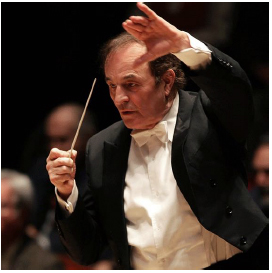
Renowned Swiss conductor Charles Dutoit is serious and precise on the podium (I'm sure he accepts no nonsense) but behind the seriousness, he seems to have a healthy sense of humor. He usually has an impish half-smile on his face and an air of amiable unflappability before and after he works. He almost dances when he conducts, seeming not so much to coax as to command music from the performers, and, apparently, they can't help playing at their best when he's in charge. At Friday night's concert (March 11, 2016), he drew forth some of the best music I've heard in a long time anywhere. Dutoit is something of a magician. On the program were Ravel's Mother Goose, Rachmaninoff's Rhapsody on a Theme of Paganini and, after intermission, Fauré's Pelléas et Mélisande Suite, and Stravinsky's Firebird Suite—a longer program than usual.

Mother Goose is rather amorphous, but it has a lot of color and interesting detail. It was well played and a good warm-up for the Rachmaninoff.

The  Rhapsody must be challenging. It frequently alternates long passages of notes that seem impossibly fast with strings of widely spaced single notes that mostly accent the orchestral part yet have to remain melodically coherent. Timing is critical to keep things together. Lugansky was nothing short of phenomenal, the orchestra behind him, equally superb. I can't imagine a better performance of this piece and have never heard a better one. Despite an enthusiastic standing ovation of several minutes, Lugansky declined to play an encore, suggesting with a gesture that his fingers weren't up to it. It was easy to forgive him. He had already done more than his duty.

Dutoit and the Symphony gave us more magic in the second half of the concert. I thought the Fauré particularly well done—lush and intense, but not overdone. Dutoit seems especially good at pushing boundaries of tempo and dynamics just enough to make familiar music exciting and fresh without going too far.

Photograph of Nikolai Lugansky by Marco Borggreve, courtesy of the San Francisco Symphony website. Photograph of Charles Dutoit, courtesy of the San Francisco Symphony Website.

Sunday, February 9, 2014

Music I'm Listening To: Hélène Grimaud with the San Francisco Symphony, conducted by Lionel Bringuier (February 7, 2014)

I had the pleasure of attending the February 7 San Francisco Symphony concert with guest conductor Lionel Bringuier and pianist Hélène Grimaud. The program opened with Grimaud at the piano to perform the Brahms Piano Concerto No. 1. After intermission, Bringuier led the Symphony in  Métaboles, by Henri Dutilleux, and then Ravel's La Valse. Bringuier, now associated with the Tonhalle Orchestra in Zurich and formerly with the Los Angeles Philharmonic, was entirely new to me. I'd never heard his name before. He took the first movement of the Brahms concerto rather more slowly at first than I'm used to, but not so slowly as to lose the flow of things. Other parts of the performance seemed to be on the verge of getting out of hand. In places, the conductor let the orchestra overwhelm the piano a little, although Grimaud's playing was big--almost brash (although always precise). Still, I enjoyed hearing the concerto, a very familiar composition but one I'd never heard live before, and Mr. Bringuier seemed to have things very much in hand in the second half of the program. Bringuier is one to keep an eye on.

Ms. Grimaud, from what I've read about her, is something of a maverick. I haven't heard enough of her recordings to have a real sense of her style, but on stage she seemed the no-nonsense sort--both in her dress (wearing a simple knitted top in silver and flared satin pants in a warm silvery grey rather than something more flamboyant) and in her approach to the music. The impression she gave was of being simultaneously focused and overflowing with energy. She rewarded a very appreciative audience with an encore, but didn't say what it was. I questioned several ushers and a couple of the musicians on stage during intermission, but no one recognized the piece. One of the bass players suggested it might have been something by Scriabin….

Henri Dutilleux is a fairly obscure composer, but one I've always had a fondness for, mainly because of his Cello Concerto (in part owing to a wonderful old EMI recording I have of it with Rostropovich on the cello, paired with Lutoslawski's concerto for the same instrument). Dutilleux's highly abstract music always seems to reflect a much greater interest in texture, time, and timbre than in melody or harmony. Although the program notes for the concert emphasize his interest in musical structure and forms, I suspect he was motivated in a significant way by the sheer joy of experimenting with sound. He seems to paint with sound. I find it easy to imagine his music in the visual language of someone like Kandinsky. Métaboles was typical in that sense. It was a delight to listen to--to listen to in the way that you listen to sounds like frogs in the night, rain on the roof, waves against the shore, the clicking of a cricket, or the tinkling of a wind chime--with your attention attuned to the quality of the sound as much as to the direction it's going.

The concert ended with what seemed an impeccable rendition of La Valse.

Photo of Mr. Bringuier courtesy of the San Francisco Symphony (uncredited); photo of Hélene Grimaud by Mat Hennek, courtesy of Deutsche Grammophon. 

Thursday, November 21, 2013

Miscellaneous: Signs of the Times (literally)


In Sebastopol, California I recently saw this sign in front of a small shopping center. I had to look at it carefully to decipher it. In fact, I had to stop and get out of my car to get a good look at it and to understand what it was trying to tell me (I've isolated it from its background here, but this is a photo of the actual sign at roadside).

I mention it mainly because it's new (I've never seen this type of sign before) and because it uses a symbol (top, center) that underscores how important computers and wireless technology have become.

But is this a good sign? The knife and fork are easy to see--and easy to interpret: Food available here. The coffee cup, indicating a coffee shop, I assume, makes sense too. The icon at the top is relatively familiar now to anyone who uses the Internet--wi-fi available here--but the dot and waves would have mystified many people not too many years ago. The glass started me wondering. I've decided it's specifically a beer glass (because it's squat and appears to have a head) but that it's probably intended to indicate alcoholic beverages generally, without suggesting hard liquor (which presumably would have called for a cocktail glass icon).

The bass clef seems an odd choice. It suggests music, naturally, but are we to understand this as indicating a place to buy recorded music, a place to listen to music, a place to make music? And why a bass clef? Is the music here typically of a low pitch? I suspect the G-clef is much more familiar to most people. I remain uncertain about the intention here, and I wonder if this sign is a Sebastopol thing? It appears to be a bona fide road sign, as opposed to a privately commissioned advertisement for the shopping center or its tenants. Has anyone seen one of these anywhere else? Let me know in the comments below.

The sign above seems very modern, the locomotive sign pictured at left, in contrast, is a vestige. This sign may on rare occasions alert drivers to a possible encounter with an actual steam locomotive, but mostly signs like this one persist at rail crossings that for many years have seen nothing but diesel engines (or no engines at all). The steam locomotive sign is a kind of fossil, a leftover that reminds us of obsolete technology. Nevertheless, we interpret the image as a warning about possible train traffic, even if it's a more modern kind of train traffic we're likely to encounter.

Monday, April 11, 2011

Music I'm Listening To: San Francisco Symphony (April 9, 2011)

I attended a very enjoyable concert by the San Francisco Symphony on Friday night (April 9). Osmo Vänskä, Music Director of the Minnesota Orchestra, conducted. San Francisco Symphony concertmaster Alexander Barantschik was the featured soloist, playing the Mendelssohn Violin Concerto in E Minor. The program opened with a new composition by Austrian composer Thomas Larcher entitled Red and Green. The second half of the program, after intermission, was taken up by a performance of Ralph Vaughn Williams' London Symphony.

Some people hate it, but I have a taste for modern music, and I particularly enjoy explorations of rhythm, texture, and timbre--including those that use unconventional instruments, non-instruments made into instruments, and extended techniques on traditional instruments. It's the sound of the music that fascinates me. Is that nonsensical? A better way to put it might be to say, it's the quality of the sound that I enjoy. Larcher's Red and Green was right up my alley. As the program notes point out, Larcher has more or less abandoned melody and harmony in this piece. Red and Green is concerned with rhythm, texture, and timbre--the quality of sound. The program notes obligingly list all the unusual "instruments" in the ensemble. I won't repeat it here, but it includes things like tin foil. The six-man percussion team (not including a couple more performers manipulating a piano and playing a celesta) was kept very busy. In the one place that a semblance of a melody did emerge, it had the feeling of something external--a snippet of some other composition fleetingly recalled. Trying to describe music like this--or any music, really--in words is a hopeless task (that's what we have music for). Suffice it to say that it was consistently interesting and I very much look forward to the release of a recording that includes Red and Green.

The piece was completed only in November of last year, as a commission for the San Francisco Symphony. The Thursday, Friday, and Saturday concerts this past weekend premiered the piece. Composer Larcher--a strikingly tall, awkward-looking man--appeared on stage after the performance and seemed very pleased--as he should have been. The orchestra was extraordinarily focused and responsive to Vänskä, who conducted without a baton, using his entire body to communicate--bending low with a cramped hand at his chest asking for more, or making broad gestures with his arms, or pointing energetically in anticipation of an entry. The San Francisco Symphony seemed in top form. Mr. Larcher may have been awkward on stage, and his comments about the music in the program notes didn't quite make sense, but who needs words when you can create music like this? Larcher is a composer I will be looking out for in the future.

The Mendelssohn Violin Concerto got off to a very rocky start, I thought. Was it just me? For the first few bars, Barantschik sounded out of synch with the orchestra. It was a short while before soloist and orchestra seemed to be conscious of each other's presence. I got the impression that conductor Vänskä started before Mr. Barantschik was quite ready. The playing overall was rather too deliberate for my taste. Competent, surely, but somehow lacking in fire. I thought the early cadenza and the slow middle movement the most effective parts of the performance. The orchestra didn't have the concentration so evident in the opening piece. Do performers go on auto-pilot when they play something as familiar as this concerto? Still, it was fun to learn that Mr. Barantschik played the violin on which the Mendelssohn concerto is believed to have been premiered by Ferdinand David, in March 1845, a 1742 Guarnerius del Gesu on loan exclusively to Mr. Barantschik from the Fine Arts Museums of San Francisco and that Jascha Heifetz had owned the violin from 1922 until his death, when he bequeathed it to the Fine Arts Museums. I probably own Heifetz recordings of this instrument.

I thought Vänskä led the symphony in a generally good reading of the London Symphony by Vaughn Williams, another very familiar composition, but one I'd never heard live before. By the end of this very long piece, however, the audience was getting restless. Still, all in all a very enjoyable evening.

(Photo of conductor Osmo Vänskä by Ann Marsden, photo of Alexander Barantschik uncredited. Both photos courtesy of the San Francisco Symphony)
Related Posts with Thumbnails