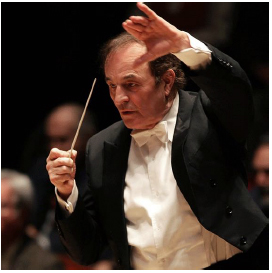
Renowned Swiss conductor Charles Dutoit is serious and precise on the podium (I'm sure he accepts no nonsense) but behind the seriousness, he seems to have a healthy sense of humor. He usually has an impish half-smile on his face and an air of amiable unflappability before and after he works. He almost dances when he conducts, seeming not so much to coax as to command music from the performers, and, apparently, they can't help playing at their best when he's in charge. At Friday night's concert (March 11, 2016), he drew forth some of the best music I've heard in a long time anywhere. Dutoit is something of a magician. On the program were Ravel's Mother Goose, Rachmaninoff's Rhapsody on a Theme of Paganini and, after intermission, Fauré's Pelléas et Mélisande Suite, and Stravinsky's Firebird Suite—a longer program than usual.
Mother Goose is rather amorphous, but it has a lot of color and interesting detail. It was well played and a good warm-up for the Rachmaninoff.
The Rhapsody must be challenging. It frequently alternates long passages of notes that seem impossibly fast with strings of widely spaced single notes that mostly accent the orchestral part yet have to remain melodically coherent. Timing is critical to keep things together. Lugansky was nothing short of phenomenal, the orchestra behind him, equally superb. I can't imagine a better performance of this piece and have never heard a better one. Despite an enthusiastic standing ovation of several minutes, Lugansky declined to play an encore, suggesting with a gesture that his fingers weren't up to it. It was easy to forgive him. He had already done more than his duty.
Dutoit and the Symphony gave us more magic in the second half of the concert. I thought the Fauré particularly well done—lush and intense, but not overdone. Dutoit seems especially good at pushing boundaries of tempo and dynamics just enough to make familiar music exciting and fresh without going too far.
Photograph of Nikolai Lugansky by Marco Borggreve, courtesy of the San Francisco Symphony website. Photograph of Charles Dutoit, courtesy of the San Francisco Symphony Website.
Showing posts with label Charles Dutoit. Show all posts
Sunday, March 13, 2016
Music I'm Listening To: Charles Dutoit Conducting the San Francisco Symphony, Nikolai Lugansky Soloist
Sunday, February 3, 2013
Music I'm Listening to: Charles Dutoit Conducts the San Francisco Symphony, with James Ehnes
On Thursday, January 31, I attended my second San Francisco Symphony concert at the new Green Music Center. Charles Dutoit was the guest conductor. On the program were Ravel's Rhapsodie Espagnole, Lalo's Symphony Espangole, and Elgar's Enigma Variations.
Dutoit never really disappoints. The entire concert was clean and enjoyable and enhanced by the beautiful clarity of sound in the new hall (apparent particularly in a passage in the Enigma Variations that involves extended low notes in the violas; and it's worth mentioning that the solo work by the principal viola elsewhere in the variations was notably fine).
James Ehnes was soloist in the Lalo. He gave a precise, energetic performance that was hard to fault except that it came across as rather too tame. The Symphony Espagnole, it seems to me, requires a bit of fire to be really successful, and that was lacking. The violin Ehnes plays (according to the program notes) is the 1715 "Ex-Marsick" Stradivarius, lent by the Fulton Collection. It's a rather delicate, sweet-sounding instrument with little throatiness in the low range, and I suspect that added to the impression. It's always a pleasure to hear the fine musicians of the San Francisco symphony, but, on the whole, this concert lacked excitement.
Photos of Charles Dutoit and James Ehnes courtesy of the San Francisco Symphony.
Dutoit never really disappoints. The entire concert was clean and enjoyable and enhanced by the beautiful clarity of sound in the new hall (apparent particularly in a passage in the Enigma Variations that involves extended low notes in the violas; and it's worth mentioning that the solo work by the principal viola elsewhere in the variations was notably fine).
James Ehnes was soloist in the Lalo. He gave a precise, energetic performance that was hard to fault except that it came across as rather too tame. The Symphony Espagnole, it seems to me, requires a bit of fire to be really successful, and that was lacking. The violin Ehnes plays (according to the program notes) is the 1715 "Ex-Marsick" Stradivarius, lent by the Fulton Collection. It's a rather delicate, sweet-sounding instrument with little throatiness in the low range, and I suspect that added to the impression. It's always a pleasure to hear the fine musicians of the San Francisco symphony, but, on the whole, this concert lacked excitement.
Photos of Charles Dutoit and James Ehnes courtesy of the San Francisco Symphony.
Friday, March 2, 2012
Music I'm Listening To: Charles Dutoit Conducts the San Francisco Symphony, Arabella Steinbacher Soloist (March 1, 2012)
Last night I had the pleasure of hearing one of the best concerts I've heard in years. Guest conductor Charles Dutoit led the San Francisco Symphony in the first of three concerts featuring soloist Arabella Steinbacher playing the Tchaikovsky Violin Concerto. Also on the program were Stravinsky's Le Chant du Rossignol and Bartok's Concerto for Orchestra. The program will be repeated tonight, Friday March 2 and again on Saturday, March 3.
The concert opened with a clean, crisp rendition of Le Chant du Rossignol. The performers and the conductor seemed wonderfully connected from the outset. Dutoit conveyed his thoughts with the subtlest of movements--sometimes just by changing his position on the podium, sometimes with an arched eyebrow or with a smile and a nod. A fourth-row seat made it easy to see him work.
After intermission, I switched to an empty seat at the back of the first floor, thinking it would be more interesting to hear and see the Bartok with a full view of the players. The more distant seat made it easy to watch themes as they moved from section to section--and the sound is more balanced from such a seat. I thoroughly enjoyed the Bartok. Dutoit seemed to bring out the best in the performers. As is often the case in San Francisco, the woodwinds were outstanding. The oboe, in particular, has a lot to do in this piece.
The highlight, however, was Steinbacher playing the Tchaikovsky. I very much wanted to hear her again, having attended her debut concert with the San Francisco Symphony, in March last year, with conductor Herbert Blomstedt. While that performance was solid, it was really the CD I purchased at halftime that evening that opened my eyes to the talents of Ms. Steinbacher. Her recording of the Bartok Violin Concerto No. 2 is wonderful--and now among my favorites (Pentatone Classics, PTC 5186 350). I had high hopes for a strong performance last night, and that's what we got.
After the first movement, the audience burst into applause. The Tchaikovsky concerto easily persuades those that don't know it well that it's over when in reality it's just getting up a good head of steam, but I got the feeling that a good measure of the applause was spontaneous and coming from people that knew very well that only the first movement had ended. They simply wanted to show their appreciation. And why not? It was a luscious but beautifully controlled performance. Despite a gritty throatiness to her violin in the mid-register (which I rather like; Ms. Steinbacher plays the "Booth" Stradivarius of 1716, on loan from its owner, the Nippon Music Foundation), the sweetest parts of the concerto sounded wonderfully sweet without ever becoming maudlin. Ms. Steinbacher gave the impression of being in complete control. Her phrasing was self-assured and distinctive without being idiosyncratic. The connection between the soloist and the orchestra seemed especially tight. Dutoit masterfully kept the balance about as nearly perfect as I can imagine. This was one of the best live--or recorded--performances I've ever heard of the piece. It was greeted with an extended standing ovation at its conclusion.
Memorable. I wish I could go again tonight and tomorrow. I look forward to following Ms. Steinbacher's career over many years in the future, and I hope she comes to San Francisco often.
[Photographs of Arabella Steinbacher and Charles Dutoit courtesy of the San Francisco Symphony.]
The concert opened with a clean, crisp rendition of Le Chant du Rossignol. The performers and the conductor seemed wonderfully connected from the outset. Dutoit conveyed his thoughts with the subtlest of movements--sometimes just by changing his position on the podium, sometimes with an arched eyebrow or with a smile and a nod. A fourth-row seat made it easy to see him work.
After intermission, I switched to an empty seat at the back of the first floor, thinking it would be more interesting to hear and see the Bartok with a full view of the players. The more distant seat made it easy to watch themes as they moved from section to section--and the sound is more balanced from such a seat. I thoroughly enjoyed the Bartok. Dutoit seemed to bring out the best in the performers. As is often the case in San Francisco, the woodwinds were outstanding. The oboe, in particular, has a lot to do in this piece.
The highlight, however, was Steinbacher playing the Tchaikovsky. I very much wanted to hear her again, having attended her debut concert with the San Francisco Symphony, in March last year, with conductor Herbert Blomstedt. While that performance was solid, it was really the CD I purchased at halftime that evening that opened my eyes to the talents of Ms. Steinbacher. Her recording of the Bartok Violin Concerto No. 2 is wonderful--and now among my favorites (Pentatone Classics, PTC 5186 350). I had high hopes for a strong performance last night, and that's what we got.
After the first movement, the audience burst into applause. The Tchaikovsky concerto easily persuades those that don't know it well that it's over when in reality it's just getting up a good head of steam, but I got the feeling that a good measure of the applause was spontaneous and coming from people that knew very well that only the first movement had ended. They simply wanted to show their appreciation. And why not? It was a luscious but beautifully controlled performance. Despite a gritty throatiness to her violin in the mid-register (which I rather like; Ms. Steinbacher plays the "Booth" Stradivarius of 1716, on loan from its owner, the Nippon Music Foundation), the sweetest parts of the concerto sounded wonderfully sweet without ever becoming maudlin. Ms. Steinbacher gave the impression of being in complete control. Her phrasing was self-assured and distinctive without being idiosyncratic. The connection between the soloist and the orchestra seemed especially tight. Dutoit masterfully kept the balance about as nearly perfect as I can imagine. This was one of the best live--or recorded--performances I've ever heard of the piece. It was greeted with an extended standing ovation at its conclusion.
Memorable. I wish I could go again tonight and tomorrow. I look forward to following Ms. Steinbacher's career over many years in the future, and I hope she comes to San Francisco often.
[Photographs of Arabella Steinbacher and Charles Dutoit courtesy of the San Francisco Symphony.]
Subscribe to:
Comments (Atom)