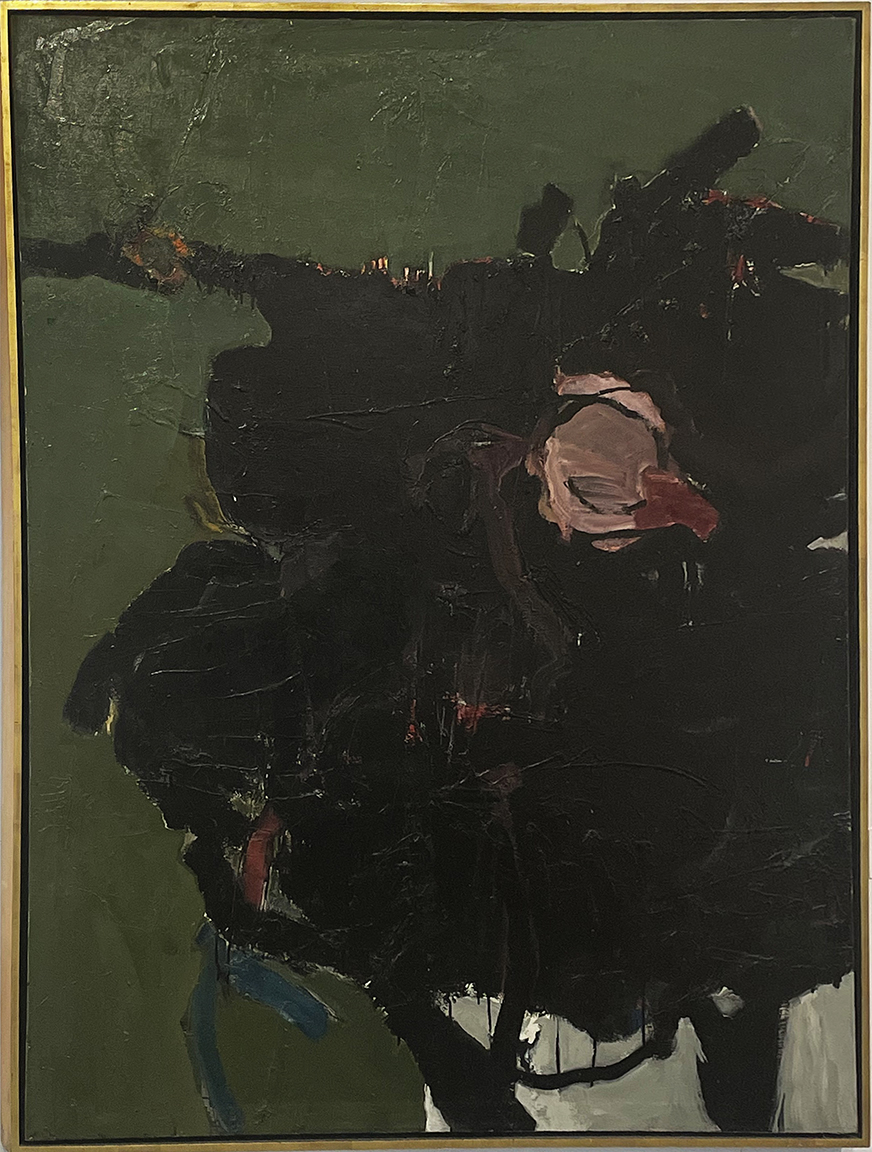
Showing posts with label abstract expressionism. Show all posts

Friday, December 20, 2024

Books I'm Reading: Night Studio

Musa Mayer's Night Studio: A Memoir of Philip Guston (Knopf, 1988) has been in my bookshelves for years - more than 25 years. When I took it down recently to finally read it, the sales slip was still in it. I bought it on September 2, 1989 at a store in Nihonbashi, in Tokyo. I paid $5,900 for it, which in those days was about $40 (¥146/$). I tended to buy whatever looked of interest and was willing to pay what it cost because interesting English-language books were comparatively hard to find in Tokyo at the time.  

Musa Mayer, born Musa Guston, is the painter's daughter. While she is not otherwise a writer, as far as I know, she writes very well, painting a vivid picture (unavoidable pun?) of what it was like to grow up in the shadow of a famous man and particularly of her stained relationship with her father who appears to have been more attentive to his painting than he was to his family – which is not to say that he was cruel or manipulative. He was simply devoted to his work. 

Additionally, the book was interesting on a personal level because it turns out that the author left New York and her parents as a young bride and lived and worked in Yellow Springs and Dayton, Ohio – both locations I know well. It's odd how often Yellow Springs seems to pop up. Among my artist friends here in Sonoma County, two have lived in Yellow Springs, and one, like Musa Mayer, worked at Antioch College, in Yellow Springs. According to the book, Mayer became a counsellor and worked with youth patients at Good Samaritan Hospital, in Dayton. I walked past Good Samaritan every day on my way to high school, although my school is no longer standing and I've heard that Good Samaritan is gone too. 

Saturday, August 24, 2024

Books I'm Reading: The Collected Works of Robert Motherwell

I've been on a reading spree lately – reading focused on New York in the 1950s, the abstract expressionists, and, in particular, the women that were associated with the New York School – that was my starting point at least. One book has led to another, most recently to The Collected Writings of Robert Motherwell (Oxford University Press, 1992, edited by Stephanie Terenzio). It's been on a bookshelf in the living room for years. I don't recall when or where I purchased it. I saw it somewhere used and thought it might be interesting to read. I finally started it a couple of weeks ago as it suddenly seemed particularly appropriate to do so in the context of the other reading I'd been doing and I've just finished it. As it's a collection of shortish pieces, it's ideal for dipping into for short spells as time allows, but I found myself reading it for long stretches. 

This recent reading has been educational. Most of the artists I've been reading about have long been familiar to me and I've seen their work in person numerous times in museums all over the world, but I realize that, until now, I've known little about their personal lives, about who they associated with, about their views on making art or what they thought about the art of others. Motherwell, it turns out, was an erudite man who, over a long career, wrote quite a lot about making art and about the art of others. For the most part, he writes very clearly, although his use of a few terms took some getting used to (more about that below). The book includes writings from 1941 through 1988 (he died in 1991). It includes essays, contributions to exhibition catalogs, scripts for and transcripts of public talks, introductions to volumes that he was involved in publishing, miscellaneous notes, and letters. Each selection is introduced by editor Stephanie Terenzio to give context and these introductions are often detailed and as enlightening as the writings they precede.

I didn't know that Motherwell had been a philosophy student at Harvard before becoming a painter, that early in his career he associated closely with the surrealists that fled Europe in the lead-up to Word War II, that he was active as a teacher and an editor, or that he is such an excellent source of information and deep thought about the early years of the abstract expressionist movement (he came to be seen as the intellectual of the movement, although he doesn't appear to have liked that label). 

Throughout his writings he emphasizes how important the ideas of the surrealists were in the early days of abstract expressionism and focuses on the concept of "psychic automatism," which he sees as the seed from which abstract expressionism grew. In his famous manifesto of 1924, AndrĂ© Breton coined the word "surreal" (above real, or beyond real) and first articulated the idea of psychic automatism, if my understanding is correct. He defined surrealism in terms of psychic automatism, saying surrealism is "pure psychic automatism through which it is intended to express, either verbally or in writing, or in any other manner, the true functioning of thought," the idea here being that the surreal emerges directly from some pre-conscious realm and the idea of "action painting," a term that came to be used as a synonym for abstract expressionism, developed out of this kind of idea. Action painting emphasized the physical act of painting itself from which the art that emerged was understood to be primarily a record of the action. Jackson Pollack's drip paintings were the quintessential action paintings. Abstract expressionism developed ultimately in many directions, but, reading Motherwell, I've understood for the first time this early connection between surrealism and abstract expressionism. Motherwell notes, importantly, that surrealism itself was anti-abstract art. 

Another idea Motherwell repeatedly emphasizes is that modern art (he is speaking in the 1950s here) is international and historically inclusive. He says the modern artist stands apart from community and tries to connect directly to the universe in contrast with the traditional artist; traditionally, he says, the artist has been part of the community and expressed the values of the community from within. He says in one piece that modern art is universal, drawing on the entire history of art and that it seems radical (that is, it seemed radical at the time of its emergence) only because most people know only the tradition of realism handed down "from Greece and Rome and the Renaissance and modern modes of illustration." Much of his early writing is aimed at trying to help a baffled public understand what modern (= non-representational) painting was.  

Several terms, I must admit, I had a little trouble with. I lacked confidence at first (and to some extent still do) that I was precisely understanding his intended meanings. "Plastic" is one of these. As an adjective, "plastic" has always meant to me something close to "formable" or "malleable" (aside from the more obvious meanings "made of plastic" or, figuratively, "cheap.") By the time I had finished the book, I decided he was using it more or less to mean "creative" and I am somewhat relieved to see that the Oxford English Dictionary lists that as among the meanings of the word when used as an adjective – a usage that first appears in 1662 – although it was unfamiliar to me.  

Another of these is "feeling." Naturally, I know the word, but Motherwell uses it in a specific way, to mean "sensitivity" or "ability to feel" and he goes to some trouble in one of the selections collected in this volume to contrast it with "emotion" and to say the two are not synonymous, although they commonly are used interchangeably.  He says feeling is "the objective response to what externally is" (his training in philosophy is frequently evident in his writing), while "emotion" is something internal. His view is that most surrealist work is emotional as is the work of German expressionists like Ludwig Kirchner. He seems to think "felt work" is superior to "emotional work" while admitting at the same time that he loves the emotional work of Goya. 

In addition, his writing has adjusted my understanding of the word "abstract." I see now that when I have used it, I probably really meant "non-representational." He points out that "to abstract" means "to select" and that that implies referencing reality; an abstraction is a selection from and simplification of the real. If we say "non-representational" we can eliminate the idea of starting with an image (a mental image) of reality and arriving at a simplified form of that image that emphasizes its essence. A non-representational work bypasses the selection and simplification – the selective emphasizing of aspects of – a reality-based image. There's a great deal of confusion even among artists about the meaning of words. I imagine that's why visual artists are visual artists and not writers. 

In a nutshell, The Collected Writing of Robert Motherwell is a rich collection of primary source material related to the world of art in the US, particularly New York, between the 1940s and the 1980s and of thinking about art. There's really too much here to absorb in a single reading. This is a book I may have to re-read in a year or two. Before I do, however, I have several others to read on the subject of modern art – books I've become aware of through reading the present volume. The first of these is The Dada Painters and Poets, an anthology edited by Motherwell himself. Then there's The Imagery of the Surreal (by J. H. Matthews) and  Abstract Expressionist Painting in America (by William C. Seitz and Dore Ashton with contributions also from Motherwell). By the time I finish those, I'll probably need a break to try to digest it all.

Wednesday, July 3, 2024

Books I'm Reading: Lee Krasner: Living Colour

I've just finished reading Lee Krasner: Living Colour, edited by Elaine Niarne (US paperback edition, Thames & Hudson, 2024), a monograph accompanying a 2019 exhibition of Krasner's work that showed first at the Barbican Art Gallery in London (later traveling to Germany, Switzerland, and Spain) – a continuation of my recent deep dive into the history of the women painters among the Abstract Expressionists. This is a richly illustrated show catalog but it also includes a number of essays about Krasner's work, a 1970 interview with her, and a chronology. An excellent overview. 

Friday, June 21, 2024

Art I'm Looking At: Arthur Monroe at Sonoma Valley Museum of Art

Arthur Monroe, Untitled, circa 1980
I recently visited the Sonoma Valley Museum of Art (551 Broadway, Sonoma, CA 95476 (707.939.7862)). Currently showing is "Arthur Monroe: A Tow to Carry," a retrospective look at the work of the late Oakland-based artist Arthur Monroe – an artist I had never heard of. Apparently he had a long career, first in New York, later in the Bay Area. He worked mainly in an Abstract Expressionist style strongly influenced by jazz. According to the wall text, among his friends in New York were saxophonist Charlie Parker, drummer Max Roach, and Thelonius Monk. He studied with Hans Hoffman – as so many advanced abstract painters In New York did (and it's hard to overemphasize the influence of Hofmann on an entire generation of painters in New York). Monroe was among those who frequented the famous Cedar Bar and he is known to have visited the studios of some of the most prominent Abstract Expressionists, including Willem de Kooning, and Franz Kline. The exhibition raises the question of why there weren't more black artists associated with the movement, particularly considering the affinities between jazz and action painting, both improvisational forms of art.

Arthur Monroe, Cluster, 1980
After a stint in the service during the Korean War, he moved to San Francisco, eventually settling in Oakland, working at what became the Oakland Cannery, a live-in studio building that he converted from an industrial warehouse. He also worked for 30 years as the registrar at The Oakland Museum of California. He thus became a kind of bridge between the New York School and the West Coast Abstract Expressionists. The show, which  runs through September 8, 2024, includes 23 works, mostly large canvases characterized by the use of patches of bright colors that seem to hover over underlying layers. There's some very strong work here. Well worth a visit.   

Arthur Monroe, Untitled, 1990-1995


Tuesday, June 18, 2024

Books I'm Reading: Ninth St. Women and Women of Abstract Expressionism

A show I saw in September 2022 at Modern Art West, in the town of Sonoma, that focused on female Abstract Expressionist painters working on the West Coast in the 1950s and 1960s was my introduction to quite a few artists I'd never heard of at the time. Among women associated with Abstract Expressionism, I was aware of a few names like Jay DeFeo, Lee Krasner, Helen Frankenthaler, and Joan Mitchell, but didn't know a great deal about the work of the first three of these and it was only by seeing an extensive Joan Mitchell retrospective at SF MOMA in October of 2021 that I gained any familiarity with her work. The show in Sonoma piqued my curiosity about other women abstract painters and prompted me to do some reading. A small show of work by Bernice Bing at the Asian Art Museum in San Francisco shortly after the Sonoma show further stimulated my interest in these artists. 

Recently, I've read New Art City (Jed Perl, Vintage 2007) and Fierce Poise (By Alexander Nemerov, Penguin, 2021), the latter about Helen Frankenthaler, and have just finished Ninth St. Women (Mary Gabriel, Back Bay Books, 2018) with the very long subtitle Lee Krasner, Elaine de Kooning, Grace Hartigan, Joan Mitchell, and Helen Frankenthaler: Five Painters and the Movement that Changed Modern Art. I've also just finished Women of Abstract Expressionism (Edited by Joan Marter, Denver Art Museum and Yale University, 2016,  the catalog for a show of the same name at the Denver Art Museum from June to September, 2016, traveling then to the Mint Museum, in Charlotte, North Carolina (October 2016–January 2017) and the Palm Springs Art Museum (February–May 2017)).

This latter, being an exhibition catalog, is mostly reproductions of work by the artists included in the show –  three to five pieces each by 12 artists (Mary Abbott, Jay DeFeo, Elaine de Kooning, Perle Fine, Helen Frankenthaler, Sonia Gechtoff, Judith Godwin, Grace Hartigan, Lee Krasner, Joan Mitchell, Deborah Remington, and Ethel Schwabacher) supplemented by a handful of essays, a brief interview with Irving Sandler, a chronology, and short biographies of the women in the show and of other women that were active at the time and working in the Abstract Expressionist style. Among these other women are Bernice Bing,  Zoe Longfield, whose work I was particularly impressed by at the Modern West show, Betty Parsons (who I knew from Ninth St. Women more as a gallerist, but I see that she was a painter as well), and Gertrude Greene. 


I was surprised when I read the short Gertrude Greene biography. I had never heard of her, but then it dawned on me as I read that she was the wife of John Wesley Greene (known as Balcomb Greene). Balcolmb Greene is a name I did know because my parents were acquaintances of the Greenes, having visited them at their home in Montauk on Long Island on at least one occasion in the company of Joseph W. and Marjorie Groell and Philip Pearlstein. Marjorie was my mother's best friend from college. They both attended Carnegie Tech (today Carnegie Mellon University) at the same time as Andy Warhol and Pearlstein (although they were a few years younger). Both Joseph W. Groell and Pearlstein later taught art at Brooklyn College. Jospeh W. Groell is the brother of the painter Theophil Groell (who also went by the name Theophil Repke early in his career and who my mother and the Groells I knew always referred to as "Teddy"). My mother told me that I occasionally played with one of Pearlstein's daughters (although I was too young to remember) and that she (the daughter) once gave me the flu. Among things my father, Stuart Talcroft, left behind after his death is a set of photographs he took of Balcomb Greene and others at Greene's home during that visit, with the Groells, Pearlstein, and my mother present. In the photo here, Balcomb Greene is at right and Pearlstein (center left) sits sideways to the table. The woman at left may be Philip Pearlstein's wife, Dorothy (Cantor) Pearlstein. The younger man (center right) I have not been able to identify (photo © Stuart Talcroft). This was September 1957.

The essays include an "Introduction to the Exhibition," by Gwen F. Chanzit, "Missing in Action," by Joan Marter, that addresses the question of why the women painters have been neglected in histories of Abstract Expressionism, "Biographies and Bodies: Self and Other in Portraits by Elaine and Bill de Kooning," by Ellen G. Landau, "The Advantages of Obscurity: Women Abstract Expressionists in San Francisco," by Susan Landauer, which points out that attention focused on the New York painters and the comparative neglect of the West Coast painters (and women in particular) allowed the latter a great deal of freedom to explore, and "Krasner, Mitchell, and Frankenthaler: Nature as Metonym," which suggested that the male painters tended to use metaphor, while the women used metonym, but the writing was rather hard to follow in this last essay. Despite that, Women of Abstract Expressionism is a useful and attractive reference work. 

Ninth St. Women focuses on the five artists in its subtitle (Krasner, de Kooning, Hartigan, Mitchell, and Frankenthaler), but, perhaps inevitably, the book takes in the whole scene; it runs to over 700 pages, nearly 900 with notes and bibliography. There is much about the men who were painting at the same time, about the critics, the teachers, the poets, and the gallerists associated with what came to be known as the New York School. The conditions advanced painters in New York worked under at the time, often in barely furnished, unheated spaces with no hot water, were as rough as the lives they lived which, until some of them began to find commercial success, were characterized by artistic struggle, dealing with misogyny in the case of the women (who felt compelled to adopt an approach to life perceived as masculine in order to be taken seriously), poverty, hard drinking, raucous partying, and unconventional romantic relationships (although it should be noted that both Joan Mitchell and Helen Frankenthaler came from well-to-do families and had resources most painters didn't). 

The book traces the early influence of Hans Hoffman as a teacher and the appearance on the scene of European surrealists and others as they fled Nazi Germany in the late 1930s (mostly older, conservative men that appear to have been particularly misogynistic), the sudden fame of Jackson Pollock and the destructive alcoholism that eventually led to his artistic impotence and  death (and how that affected Krasner and others), the shift in the mood of conversation at places like the Cedar Bar and the Five Spot as recognition and wealth accrued to painters like Pollock and De Kooning, with the talk in the bars going from "art over beers to galleries over bourbon". The book makes it clear that it was a spectacular but surprisingly short-lived rise to fame for Abstract Expressionism (at least for the men), lasting from about 1950 to about 1965; by the mid-sixties, attention had shifted toward painters like Rauschenberg and Johns and later Warhol as Pop Art emerged. 

I had never understood that Frankenthaler is arguably the mother of color field painting. While that's entirely logical once it's pointed it out, I had never made the connection between her work and the work of painters like Kenneth Noland and Morris Louis, who apparently were emboldened to pour thinned paint onto unprimed canvas after seeing the work of Frankenthaler, just as Frankenthaler felt freed to experiment by seeing the work of Pollock, which vastly altered her conception of what painting could be (Frankenthaler was not alone). I hadn't understood how small and tight the core group of painters was. Everyone seems to have known everyone, they visited each other's studios, they met nightly in the bars, they talked, they painted, they wrote and read about each others work, they drank, they arranged shows, they went to openings, they had parties, they had sex, and they painted. The cross-fertilization appears to have been broad and intense. I hadn't known that Elaine de Kooning became an influential writer about art, mostly in the pages of Art News or that she did a great deal of portraiture and had a period during which she focused on canvases inspired by watching sporting events. I wasn't aware of Krasner's central role in trying to keep Pollock from his violent, alcohol-fueled excesses and to keep him productive (to the detriment of her own work) – or really anything about their relationship, or her career. I hadn't known that she later turned very successfully to collage. The book was an introduction to dozens of lesser-known peripheral characters and even a small lesson in the geography of Long Island. The detail is vivid. The pages are overflowing with insights not only about how the woman made their way as painters in a style that has long been seen as quintessentially masculine, but about what it is to be an artist at all. There's an entire course in advanced abstract American painting at mid-century in these pages. Ninth St. Women, is a remarkable bit of scholarship, deeply researched, meticulously notated, rich in detail, and engagingly written. Highly recommended. 


Thursday, December 28, 2023

Books I'm Reading: New Art City

2023 has not been a great year for reading. There was a time, when, living in Tokyo, when I had a long commute, that I read a book a week or more using my time on the train to and from work. Since returning to the US, 22 years ago now, I've been reading a book a month or so, but this year, with the death of my mother in January and all the responsibilities that stemmed from that, I've been able to get through only a handful of titles. 

I most recently finished Jed Perl's New Art City (Vintage, 2007), which was an interesting look at New York in the 1940s, 1950s and 1960s, but rather dense and I was slow to get through it. It starts off with a chapter that underscores the importance of Hans Hoffman as a teacher in New York in the 1930s before moving on to look at the major artists of the period based in New York – Joseph Cornell, Jackson Pollack, Robert Rauschenberg, Ellsworth Kelly, Willem de Kooning, Joan Mitchell, and others – as well as the critics who were writing about these men and women. Inspired, I'm now reading a book about Helen Frankenthaler, and I have another on deck specifically about the women who were working as artists in New York during the period. So many books, so little time....

Wednesday, September 7, 2022

Art I’m Looking at: The Long View: California Women of Abstract Expressionism 1945-1965, at Modern Art West, Sonoma

I write about the art I see in Santa Rosa and elsewhere in the Bay Area mostly because it helps me to digest what I’ve seen, because it gives me something to go back to when I want to remember what I saw, where I saw it, and when I saw it, and also because it allows me in some small way to help promote what seems good art to me that friends and others reading my comments might want to see, but rarely do I start from such a place of ignorance as the place from which I write here about the show on now at Modern Art West in Sonoma (521 Broadway, Sonoma, CA 95476, (707) 210-5275, by appointment only*). I had never heard of the place until last weekend when I stumbled upon a mention of Modern Art West on Hyperallergic. The gallery appears to have opened just before the pandemic hit and my visit on Monday (5 September) was the first time I’ve been to the town of Sonoma in about three years. Modern Art West sprang up during that absence. The gallery is owned and operated by Mr. David Keaton.

Untitled (1949), Zoe Longfield
Not only was I ignorant of Modern Art West. I speak also of my ignorance about women artists identified with Abstract Expressionism—the theme of the show now up, entitled The Long View: California Women of Abstract Expressionism 1945-1965. If asked about female Abstract Expressionist painters, I could have come up with Lee Krasner, Jay DeFeo, and Helen Frankenthaler (although Frankenthaler does not appear to have considered herself an Abstract Expressionist), and Joan Mitchell. The Long View, however, features work by 25 less prominent Abstract Expressionist painters active on the West Coast between the end of WWII and 1965. Only one name was familiar, and that (Adelie Landis Bischoff) is because, as the wife of painter Elmer Bischoff, she is talked about more than other female painters of the period. For the record, artists included in the Modern Art West show are: Ruth Armer, Katherine Barieau, Emarie Bartelme, Bernice Bing, Pamela Boden, Dorr Bothwell, Joan Brown, Sonia Gechtoff, Nancy Genn, Leah Rinne Hamilton, Marie Johnson, Adelie Landis (Bischoff), Hilda Levey, Zoe Longfield, Emiko Nakano, Irene Pattinson, Margaret Peterson, Deborah Remington, Joyce Rezendes, Nell Sinton, Frann Spencer, Juliette Steele, Lenore Vogt, Ruth Wall, and Katherine Westphal. I reproduce this list because, judging from the work I saw on Monday, every one of these painters deserves to be better known.

I freely admit that my ignorance doesn’t mean everyone else is equally ignorant, but I’d be willing to bet most of these names are, in fact, comparatively obscure to even comparatively well-read art lovers. Why the neglect? I imagine the standard arguments apply. Media coverage, gallery representation, access to collectors, and museum shows were always more available to male artists than female artists. Women in the 1940s to 1960s in the US had to commit to what was considered an unconventional lifestyle in order to concentrate on making art. Blurbs at the show also point out that media attention on Abstract Expressionism then (and even now) was very much aimed at the East Coast—at New York City—not at the West Coast.

It’s a shame, because there is some very fine work to see here. The gallery’s website has a link to an essay about the show that gives an overview, links to artist biographies, and a link to the Hyperallergic article I found on line, so I won’t attempt to duplicate what’s available there, but I do want to note some of my favorite pieces in the show, which, I should say, is very tastefully presented.

Zoe Longfield's Untitled (above), from 1949, immediately caught my eye. It's use of pale blue and ochre immediately put me in mind of some of Richard Diebenkorn's work of around the same time or a little later, but I was also reminded of some of the early work of Mark Rothko before he settled into the large colored-lozenge paintings he's best known for. It's natural to see affinities, but this painting stands very well on its own. 

Zoe Longfield
Untitled, Biomorphic Abstraction (1948)
I was also very impressed by Longfield's 1948 Untitled, Biomorphic Abstraction, which, as the title suggests, uses more organic shapes. Again, a juxtaposition of blue and ochre is at work here (likely a coincidence). The use of black is particularly interesting—the way it's given the same weight as the other colors in the painting. In addition, the painting achieves what I like to call "dynamic stasis"; it achieves movement while seeming solidly grounded at the same time. 

Lenore Vogt
Bird (1961)
Among the most imposing paintings in the show is Lenore Vogt's large Bird (1961). Because of reflections, it was difficult to photograph in situ, but seen in person it has a sensuous, painterly surface and there are great subtleties in the dark central mass. 

Nell Sinton
Dark Landscape (1958)
Also of particular interest to me were two small pieces on paper by Joyce Rezendes (not pictured here), who was associated with 6 Gallery in San Francisco, a large painting by Bernice Bing (not pictured), and Nell Sinton's Dark Landscape (1958), among others. Dark Landscape can be read as a landscape, but it comes across equally strongly (or more so) as an abstraction. There is something about it that—despite the dark palette—reminds me of those transitional Kandinsky pieces in which he is clearly moving into an abstract mode of work but hasn't been able to give up representation entirely. 

I aim to look into these and other artists in the show further (I'm awaiting the arrival of a copy of Women of Abstract Expressionism, edited by Joan Marter, which appears to be an excellent reference work on the subject of women in Abstract Expressionism). I’m very pleased to have found Modern Art West. It’s a welcome addition to the area. I look forward to seeing future shows there. I’m tempted to say this and Calabi Gallery in Santa Rosa are now the two most interesting galleries in the county. I highly recommend both (and The Red Brown Collection in Bodega Bay and Hammerfriar Gallery, in Healdsburg!).

*You can send an e-mail to Mr. Keaton to schedule a visit. However, the show runs only through the end of this week, until September 11. The next show at Modern Art West will be INDICATORS: Nature in Flux, a solo exhibition of work by Peter Hassen (September – November 2022).

Related Posts with Thumbnails