Showing posts with label Sonoma. Show all posts

Sunday, August 4, 2024

Art I'm Looking At: Palo Alto

Last month, I went to Palo Alto to see the big glass and ceramics show they do there every year in the summer. It's always a pleasant way to spend a couple of hours outdoors. Didn't buy anything this year, but there were some interesting pieces. 

A visit to Palo Alto wouldn't be complete without a stop at the two excellent art museums on the Stanford Campus, The Cantor Center for the Arts and The Anderson Collection. The Cantor has a diverse collection. The Anderson Collection is mostly 20th century art with a good core of abstract expressionist works. I always enjoy seeing a few favorites in each of the collections. The Cantor has a good Sargent portrait and a good Hopper, among others. The Anderson Collection has a Louis Morris, a De Kooning, a Motherwell, and a Frankenthaler that I like and both collections have good examples from Diebenkorn's Ocean Park series. 

On the way home, dinner at La Salette, the Portuguese restaurant of long standing in the town of Sonoma. I particularly enjoyed the cold cucumber soup with shrimp and doing one of the Portuguese wine flights they offer. 


Sunday, August 6, 2023

Places I'm Visiting: Pomme Cider Shop and Tap Room in Sonoma

On a recent visit to the Sonoma Valley Museum of Art and the nearby Modern Art West gallery, I noticed a cider bar a few doors down that I'd not seen before. (It had been several years since I'd been to the town of Sonoma, my last visit having been pre-pandemic). I stopped in to Pomme Cider Shop and Tap Room for a look around the clean, simply furnished interior boasting 18 taps at the bar and was impressed to find in addition to the offerings on tap a surprisingly large selection of ciders in cans and bottles from all over the world (although many are local). Co-owners Rick Tranchina and Jessica Olson-Ealy told me the Cider Shop and Tap Room opened in May 2022.

I struck up a conversation with Rick behind the bar and in passing mentioned I had made cider in 2013 from fresh apples and discovered recently that I still had several bottles of it unopened. I asked if cider develops in the bottle as many wines do. Rick was skeptical, but, he said "bring some in and we'll see" – which I agreed to do. 

The cider I made in 2013 I fermented using Pink Lady apples from the tree in our garden, Golden Delicious apples from a friend's tree, and a small, astringent, unidentified apple variety from a tree on the property where my brother lives. De-stemming, peeling, pulping, and pressing the apples was a chore, as was picking up and returning an apple press rented from The Beverage People. A few years later I made another batch of cider (in 2018) from local, unpasteurized apple juice, which was considerably easier. I fermented the fresh apple batch using an English cider yeast from White Labs sold refrigerated in a stoppered glass tube, purchased at Whole Foods. For the later batch I used a Mangrove Jack cider yeast in powder form. 

On my second visit to Pomme, several weeks later, I brought a chilled bottle of each of the two ciders with me. Both had retained their carbonation, letting out a satisfying mist of gas when Rick popped the caps from behind the bar. He poured out a glass of each for me, and for himself, and I encouraged him to let the woman seated beside me at the bar try them as well as she had joined the conversation. 

The older cider turned out to be in perfect condition and rather tasty. Apparently ten years in bottle had done no harm at least. It seemed nicely balanced to me, with attractive apple scents on the nose and, on the palate, it offered a good dose of apple sweetness tempered by some tartness and with a darker, liquorous quality on the finish with suggestions of caramel. Rick was impressed. He asked if he could share it with a couple of cider enthusiasts seated at a table near the front door that he said were regulars at Pomme and they, too, were impressed. Upon leaving, one of the patrons who had tasted the 2013 batch said she thought it among the best ciders she had ever tasted, which, I must admit, resulted in a little flush of pride in me. 

The 2018 cider made from pressed apple juice was not bad, but it didn't have the nuance and length of the older batch made from fresh apples. Rick speculated that using the wild apples from my brother's yard added tannin to the 2013 cider that was the key to its presence and longevity. I suspect he is right. 

A week later, I visited again to sample some of the ciders on tap and learned that cider today is being handled far more creatively than I had imagined. There are straight apple ciders and pear ciders as well as ciders co-fermented with a percentage of grapes to create cider–rosé hybrids. Some of the ciders are flavored with other fruits – a cherry–pear cider was popular on the day I visited. Some are fermented or aged in oak barrels for additional flavor enhancement. You could spend a lot of time here trying the more than 100 varieties on offer. Recommended. Well worth a visit.

Pomme Cider Shop and Tap Room is at 531 Broadway, Sonoma, CA, 707-343-7155) and Pomme has more than just cider, offering more than 20 Pét-Nats, grower Champagnes, rosés, and orange wines by the bottle. Some taps are kept just for beer and wine, and locally-made bites, charcuterie, and other nibbles are available as well. Open Sunday-Tuesday & Thursday 12-6, Friday 12-8, Saturday 11-8. Closed Weds. 21 and over.


Wednesday, September 7, 2022

Art I’m Looking at: The Long View: California Women of Abstract Expressionism 1945-1965, at Modern Art West, Sonoma

I write about the art I see in Santa Rosa and elsewhere in the Bay Area mostly because it helps me to digest what I’ve seen, because it gives me something to go back to when I want to remember what I saw, where I saw it, and when I saw it, and also because it allows me in some small way to help promote what seems good art to me that friends and others reading my comments might want to see, but rarely do I start from such a place of ignorance as the place from which I write here about the show on now at Modern Art West in Sonoma (521 Broadway, Sonoma, CA 95476, (707) 210-5275, by appointment only*). I had never heard of the place until last weekend when I stumbled upon a mention of Modern Art West on Hyperallergic. The gallery appears to have opened just before the pandemic hit and my visit on Monday (5 September) was the first time I’ve been to the town of Sonoma in about three years. Modern Art West sprang up during that absence. The gallery is owned and operated by Mr. David Keaton.

Untitled (1949), Zoe Longfield
Not only was I ignorant of Modern Art West. I speak also of my ignorance about women artists identified with Abstract Expressionism—the theme of the show now up, entitled The Long View: California Women of Abstract Expressionism 1945-1965. If asked about female Abstract Expressionist painters, I could have come up with Lee Krasner, Jay DeFeo, and Helen Frankenthaler (although Frankenthaler does not appear to have considered herself an Abstract Expressionist), and Joan Mitchell. The Long View, however, features work by 25 less prominent Abstract Expressionist painters active on the West Coast between the end of WWII and 1965. Only one name was familiar, and that (Adelie Landis Bischoff) is because, as the wife of painter Elmer Bischoff, she is talked about more than other female painters of the period. For the record, artists included in the Modern Art West show are: Ruth Armer, Katherine Barieau, Emarie Bartelme, Bernice Bing, Pamela Boden, Dorr Bothwell, Joan Brown, Sonia Gechtoff, Nancy Genn, Leah Rinne Hamilton, Marie Johnson, Adelie Landis (Bischoff), Hilda Levey, Zoe Longfield, Emiko Nakano, Irene Pattinson, Margaret Peterson, Deborah Remington, Joyce Rezendes, Nell Sinton, Frann Spencer, Juliette Steele, Lenore Vogt, Ruth Wall, and Katherine Westphal. I reproduce this list because, judging from the work I saw on Monday, every one of these painters deserves to be better known.

I freely admit that my ignorance doesn’t mean everyone else is equally ignorant, but I’d be willing to bet most of these names are, in fact, comparatively obscure to even comparatively well-read art lovers. Why the neglect? I imagine the standard arguments apply. Media coverage, gallery representation, access to collectors, and museum shows were always more available to male artists than female artists. Women in the 1940s to 1960s in the US had to commit to what was considered an unconventional lifestyle in order to concentrate on making art. Blurbs at the show also point out that media attention on Abstract Expressionism then (and even now) was very much aimed at the East Coast—at New York City—not at the West Coast.

It’s a shame, because there is some very fine work to see here. The gallery’s website has a link to an essay about the show that gives an overview, links to artist biographies, and a link to the Hyperallergic article I found on line, so I won’t attempt to duplicate what’s available there, but I do want to note some of my favorite pieces in the show, which, I should say, is very tastefully presented.

Zoe Longfield's Untitled (above), from 1949, immediately caught my eye. It's use of pale blue and ochre immediately put me in mind of some of Richard Diebenkorn's work of around the same time or a little later, but I was also reminded of some of the early work of Mark Rothko before he settled into the large colored-lozenge paintings he's best known for. It's natural to see affinities, but this painting stands very well on its own. 

Zoe Longfield
Untitled, Biomorphic Abstraction (1948)
I was also very impressed by Longfield's 1948 Untitled, Biomorphic Abstraction, which, as the title suggests, uses more organic shapes. Again, a juxtaposition of blue and ochre is at work here (likely a coincidence). The use of black is particularly interesting—the way it's given the same weight as the other colors in the painting. In addition, the painting achieves what I like to call "dynamic stasis"; it achieves movement while seeming solidly grounded at the same time. 

Lenore Vogt
Bird (1961)
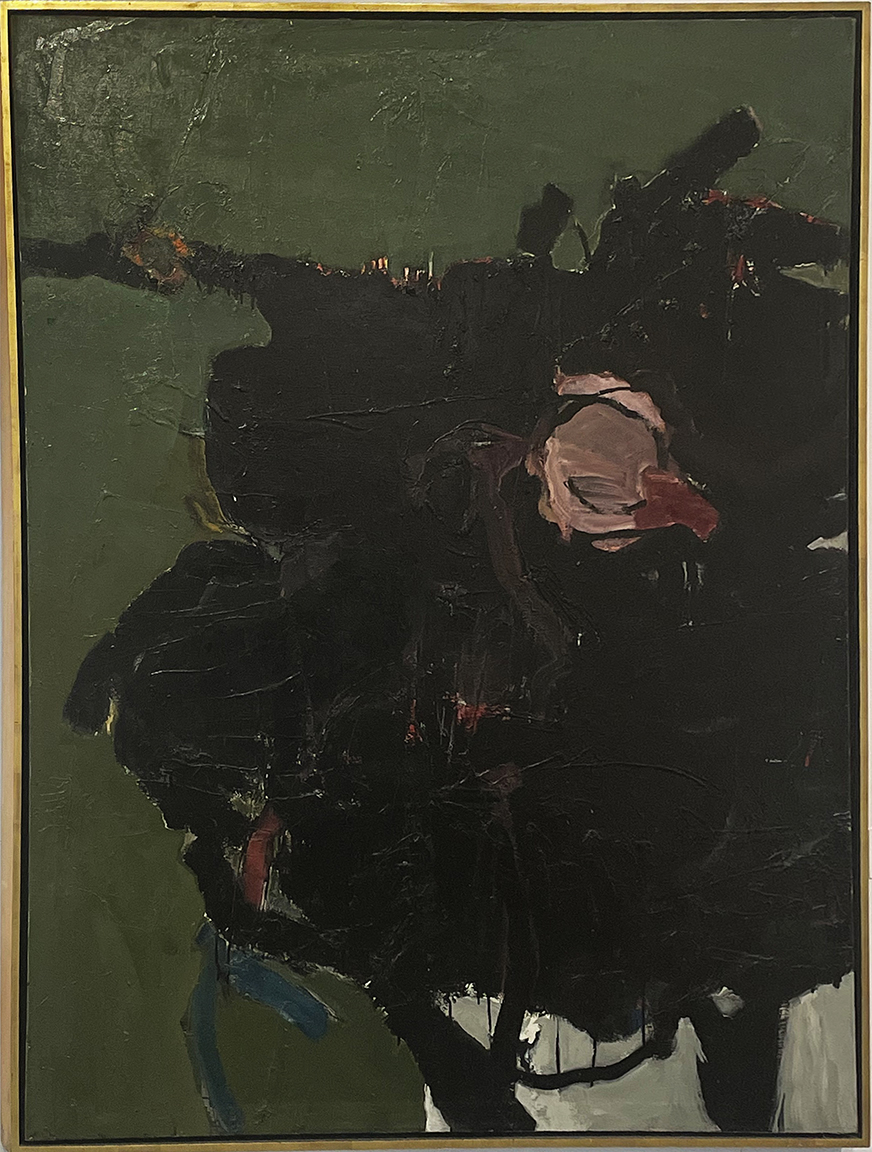
Among the most imposing paintings in the show is Lenore Vogt's large Bird (1961). Because of reflections, it was difficult to photograph in situ, but seen in person it has a sensuous, painterly surface and there are great subtleties in the dark central mass. 

Nell Sinton
Dark Landscape (1958)
Also of particular interest to me were two small pieces on paper by Joyce Rezendes (not pictured here), who was associated with 6 Gallery in San Francisco, a large painting by Bernice Bing (not pictured), and Nell Sinton's Dark Landscape (1958), among others. Dark Landscape can be read as a landscape, but it comes across equally strongly (or more so) as an abstraction. There is something about it that—despite the dark palette—reminds me of those transitional Kandinsky pieces in which he is clearly moving into an abstract mode of work but hasn't been able to give up representation entirely. 

I aim to look into these and other artists in the show further (I'm awaiting the arrival of a copy of Women of Abstract Expressionism, edited by Joan Marter, which appears to be an excellent reference work on the subject of women in Abstract Expressionism). I’m very pleased to have found Modern Art West. It’s a welcome addition to the area. I look forward to seeing future shows there. I’m tempted to say this and Calabi Gallery in Santa Rosa are now the two most interesting galleries in the county. I highly recommend both (and The Red Brown Collection in Bodega Bay and Hammerfriar Gallery, in Healdsburg!).

*You can send an e-mail to Mr. Keaton to schedule a visit. However, the show runs only through the end of this week, until September 11. The next show at Modern Art West will be INDICATORS: Nature in Flux, a solo exhibition of work by Peter Hassen (September – November 2022).

Monday, August 22, 2016

Miscellaneous: A Photograph that Sums Up the Sonoma/Napa County Experience

In the past, when people have asked me what life is like in Sonoma County, I've tried to explain the dichotomy between the wealth here—much of it generated by the wine industry—and the rural character that lingers. I've called Sonoma County the land of Porsches and pick-ups. Recently, in Napa, I came across this parked Mercedes in front of an upscale hotel, fully loaded with hay. It seemed to sum up the same idea nicely.

Sunday, July 5, 2015

Art I'm Looking At: Diebenkorn Around the Bay Area (July 5, 2015)

We're privileged right now to have two shows of rarely seen work by Richard Diebenkorn on view simultaneously in the Bay Area, a show of prints at the De Young in San Francisco and a show of small-scale drawings, collages, and watercolors at the Sonoma Valley Museum of Art, in the town of Sonoma, a venue that has only recently come to my attention--and that accidentally: I happened to come across a reference to the Sonoma show in one of three books published by Kelly's Cove Press in conjunction with the exhibition, which is subtitled "The Intimate Diebenkorn."

In keeping with that subtitle, the Sonoma show presents a selection of smaller works, the largest being no more than about 24 x 36 inches (most considerably smaller) in various media. None of the images was included in the large show of Diebenkorn's work in the summer and autumn of 2013 at the De Young Museum (Richard Diebenkorn: The Berkeley Years). Some Bay Area viewers may have seen the bulk of the Sonoma show at the College of Marin (September-November 2013) or San José State University (March-May 2014), but the selection of works now at the Sonoma Valley Museum of Art has been augmented by about 12 pieces not included on earlier stops. The show next travels to the University of Montana (September-December 2015).

The De Young show of Diebenkorn prints highlights the museum's "latest significant acquisition of [Diebenkorn's] prints, made possible by the Phyllis C. Wattis Fund for Major Accessions and the generosity of Phyllis Diebenkorn," the artist's late widow--to use the words of the introductory gallery panel. I believe the De Young Museum now has the largest collection of Diebenkorn's prints in the world aside from the collection of the Diebenkorn Foundation, from which the traveling show now in Sonoma has been assembled.

The Sonoma show provides an intimate overview of the various styles in which Diebenkorn worked. There is a good selection of representational work including still life subjects, nudes, and landscapes as well as abstract work, both in the fluid, organic style of the Berkeley and earlier periods and the more rarified, highly linear style best known from the large paintings of the later, Ocean Park period.

The works are arranged thematically rather than chronologically, which allows a comparison of similar types of work from different periods, although it somewhat obscures Diebenkorn's journey from abstraction into figurative work and still life and then back to abstraction--part of what makes looking at the whole of his artistic career fascinating. Despite the diversity of subject matter, Diebenkorn was always concerned with formal compositional problems. An interior view of a posed model or a landscape was for Diebenkorn always as much about dividing up space on a flat plane as any abstraction was. The works as shown demonstrate both the breadth of his subjects and the compositional concerns that unite his work. The 1962 figure drawing in ballpoint pen shown here (above) is an excellent example--a highly economically rendered pair of nude figures but, at the same time, a composition consisting in large part of blank rectangular or squarish areas of paper separated by thin lines. The legs of the male figure at the left side of the page are particularly ambiguous. The 1958 untitled oil landscape on paper shown below likewise blurs the line between the abstract and the descriptive.

The Sonoma venue is divided into four areas: the main exhibition space, a permanent art library off to one side, a space at the front of the building where visitors are offered a place to play with paper and drawing tools if inspiration has hit them, and a darkened area behind a wall at the rear, where two videos about Diebenkorn run in a loop. One of these was made at the time of a major retrospective of the artist's work at the Los Angeles County Museum of Art, in 1977. The other shows Diebenkorn at work at Crown Point Press, in Oakland, collaborating with master printers Marcia Bartholme and Hidekatsu Takada, in 1986, photographed by Kathan Brown, the founding director of Crown Point Press. The former is short (22 minutes) and interesting mainly because it shows Diebenkorn politely, somewhat shyly interacting with an adoring public at the opening reception for the Los Angeles exhibit. The latter video (35 minutes) is of greater interest and well worth the time it takes to watch. It offers a rare look at the artist in the studio, showing him proofing prints, working on copper plates, consulting with the printers about changes, and finally coming to decisions about finished versions of a number of pieces (one of which he ultimately decides to abandon after much frustration).

Diebenkorn's work process was interactive, restless, and experimental--involving interaction between the artist and his materials. Each new piece was a kind of conversation with the medium: an idea proposed, considered, approved of or rejected--the artist always listening and responding to the voice of the evolving work--the cycle beginning again, repeating until an equilibrium was achieved. It's a process especially well suited to collage, so it's not surprising that collage enters into many of the smaller works on display in Sonoma. Some of the drawings are on joined pieces of paper. One small abstract work from 1992, the year before his death (shown here), consists of pieces of what appears to be a drawing cut up and arranged on a second blank sheet (coincidentally, highly reminiscent of some of the work of Basque artist Eduardo Chillida (1924-2002)). The Crown Point Press video shows Diebenkorn cutting up proofs and pasting them together to rework a composition--essentially designing a print by collage.

The De Young Exhibit focuses on Diebenkorn as a printmaker. He seems to have been interested in printmaking of various types throughout his long career, and many of the last works he made--when ill health had made it impossible to tackle the large canvases he favored as a younger man--were prints. Most were etchings and drypoints, but the De Young show includes a fair number of lithographs and you get a sense looking at the early examples that he was testing the limits of what appears to have been a new medium for him at the time. Some of these early lithographs are essentially line  drawings in crayon, others look like puddled ink drawings. Later color lithographs from the 1980s are more mature, looking very much like Diebenkorn the painter. Again, the subject matter in the De Young exhibit is diverse, including figure studies, landscapes, still life subjects, and abstraction. Nearly all the pieces exude something essentially Diebenkorn despite that diversity.

The show at the Sonoma Valley Museum of Art (one half block from Sonoma’s historic Town Plaza: 551 Broadway, Sonoma CA 95476, (707) 939-7862) runs through August 23, 2015. The show at the De Young Museum in San Francisco (Golden Gate Park, 50 Hagiwara Tea Garden Dr., San Francisco, CA 94118, (415) 750-3600) closes October 4, 2015.

Tuesday, October 14, 2014

Art I'm Making: Sonoma County Art Trails 2014 First Weekend

I opened my studio as part of the 2014 Sonoma County Art Trails event on October 11 and 12 (the event continues next weekend, October 18 and 19) and enjoyed talking about art and making art with the many visitors who stopped by. It was a pleasure to get feedback on work I've never shown publicly before. During lulls, I had time to do a little work and finished a couple of pieces using paper I made to demonstrate my working process, which involves painting on paper or mono-printing on paper and then using the papers I make to create collages.

Pictured above is Untitled Collage No. 75 (Santa Rosa), which uses some paper elements printed using Sennelier's Naples yellow and incorporates some scraps of a sheet of paper with pastel marks on it that a fellow collage artist brought me.

Sonoma County Art Trails 2014 continues next weekend (October 18 and 19). My studio is No. 125. Stop by to see my work in person. I'm also showing photography and printmaking.


Click on the images for larger views. For more, use the Art I'm Making tab to the right or visit my collage website at http://ctalcroft.wix.com/collage-site/ (requires Flash Player).

Untitled Collage No. 76 (Santa Rosa) also uses a scrap of the pastel-marked sheet and some of the Naples yellow paper, but also incorporates older raspberry-colored papers and a peach-colored paper with round shapes.

Friday, July 4, 2014

The Cocktail Glass Collection: La Casa Bar and Restaurant, Sonoma, California

Walking around the plaza in the town of Sonoma last week I spied a neon sign with a cocktail glass in front of La Casa Bar and Restaurant (121 East Spain St.). It was daylight, but the sign was lit. This one has a very simple, stylized glass with no stirring stick, but a circle of citrus fruit appears to adorn the edge of the glass.

To see more in this series of photographs, click on the "cocktail glass collection" label at right.

Wednesday, July 10, 2013

Food I'm Eating: El Molino Central--a Mexican gem (July 10, 2013)

On a fairly random drive to Sonoma the other day, I found myself hungry just as I was passing El Molino Central, on Highway 12, heading south and east toward Sonoma from Santa Rosa (11 Central Avenue, Sonoma, 95476, (707) 939-1010).

I'm sure the place has been there for years, but I've never been inspired to stop before. What was different this time? I don't know. Perhaps it was the 4th of July bunting, the recently repainted building, or the outdoor patio area with new umbrellas. Mostly, however, I think it was the large number of people in the outdoor dining area. I figured there had to be a reason. I happened to see a convenient parking spot, so I pulled over for lunch. I'm glad I did.

The long line at the counter and the appetizing descriptions of the food on the menu board were both good signs. This place appears to serve truly authentic Mexican fare with an emphasis on fresh ingredients. I had a delicious pair of Swiss chard enchiladas. The man next to me on the patio let me taste the mole sauce on his tamales--complex and with rich chocolate flavor, but not too sweet--and spicy enough to make you sit up and notice. Next time, I look forward to trying the beer-battered fish tacos or the chile relleno de elote con crema (poblano chiles stuffed with corn cream and cheese, with cherry tomato salsa, refried beans and tortillas), or the salmon ceviche with avocado. The tortillas at El Molino Central are made from organic Nebraska-grown corn, stone ground daily on the premises. According to the restaurant's website, the public is welcome to come watch the grinding "any morning around 11:00AM." A real find. I'll be back.

Thursday, October 13, 2011

Places I'm Visiting: Napa and Sonoma Winery Visits (October 2011)

Last weekend I accompanied a visitor from Japan on visits to a number of wineries in Napa County (on Saturday) and in Sonoma County (on Sunday). I rarely visit the Napa wineries on my own because the tasting rooms are generally expensive tourist traps, but it's interesting to see what's going on from time to time (the Sonoma-side tasting rooms tend to be smaller, more personal, and friendlier--not to mention much cheaper, often free). In Napa, we visited Rubicon Estate in the morning (the historical Inglenook winery, until recently the Niebaum-Coppola winery; not long ago the high-end Rubicon Estate wines were brought together at the Inglenook property, while the mass-produced Coppola wines were transferred to a new location in Geyserville). We moved on to Opus One (pictured above), where we tasted the 2006 and 2008 wines before an excellent lunch at Domaine Chandon, in Yountville, that began with raw oysters with a yuzu, cucumber, and fennel garnish. I generally like raw oysters with nothing more than freshly-squeezed lemon, but yuzu, cucumber, and fennel was tasty and subtle enough that it didn't detract from the delicate flavors of the oysters. I had a duck confit main dish with a fig-based sauce that was delicious, washed down with a glass of the Étoile Brut. After lunch we stopped at Étude, in the Carneros region, which is one of my favorite Carneros producers of Pinot Noir. We tasted Pinot Noir but also a delicious Pinot Blanc in the very friendly tasting room.


On Sunday, we began the day at Wellington, where we tasted the entire range of available wines, which included some interesting port-style dessert wines. A newly released 2009 Chardonnay was a standout along with the current vintage of the Morhardt Ridge Cabernet Sauvignon. I like this winery for its high-quality wines, reasonable prices, and unpretentious tasting room staffed by genuinely friendly people. The 1920s Carignane vines in front of the tasting room were heavy with fruit and beginning to show autumn color in the leaves. We tasted next at Enkidu before having lunch at Café Citti. After lunch we tasted at Chateau St. Jean. On the way back to the airport, we detoured to do some quick shopping at Dean and Deluca (a small part of the cheese selection is shown below) and then stopped briefly at Gloria Ferrer just to take in the view (bottom photo). The deck was packed with visitors taking in the same view along with some sparkling wine. It's always a pleasure to show visitors our beautiful wine country.


Saturday, August 20, 2011

Music I'm Listening To: Neil Buckley Octet at Plaza Bistro (August 19, 2011)

Last night I went to the hear the Neil Buckley Octet at Plaza Bistro, in Sonoma--right on the Plaza, as you might expect. The restaurant has a large back room where jazz bands of consistently high caliber play on Friday and Saturday nights, often booked by the Sonoma Jazz Society. The restaurant serves full meals in the back room but there is a second bar there as well (the restaurant's main bar is out front). The Octet plays 1950s cool jazz using arrangements by the late Neil Buckley, a well-known West Coast performer. This band is always good but they were in especially good form last night. Each of the eight performers (drums, guitar, bass, trombone, trumpet/flugelhorn, and three sax players) is top-notch, but we heard really tight ensemble playing as well. There was some particularly powerful but controlled trumpet work and a lot of sexy solos on the saxes. Thoroughly enjoyable. The restaurant has solid if not stellar food and an interesting wine list. My son drew his own crowd out on the patio with his yo-yo tricks. (Note that the photo above is from a different gig. Uncharacteristically, I didn't have a camera with me....).

Monday, June 13, 2011

Art I'm Looking At: 2011 Art at the Source

Art at the Source is one of two major open studio events that allow artists working in Sonoma County to show and sell art directly to the public from their places of work.  Both events are held annually on a pair of weekends. Today, Sunday, June 12 was the last day of Art at the Source showings. Art Trails, the other local open studio event is held on two weekends in the fall, in October.

As usual, I got a late start on the last day, so only got to see about 15 artists--and that many mostly because I headed first for The Barracks, which brings a large number of artists together under one roof (in buildings that once were barracks at a naval air station on the western edge of Santa Rosa).

I particularly enjoyed the assemblage work of Maris Peach (www.marispeach.com), paintings by Suzanne Edminster (www.saltworkstudio.net) and by Karina Nishi Marcus, and the hat block collection of hatmaker Amy Smith at Flying Color Studios. These open studio weekends are wonderful for the way they bring artists and the public into direct contact, but also for the chance meetings among art lovers they may engender. In Maris Peach's studio, I enjoyed talking with the artist about her work, about a little girl that found these doll parts frightening, and with a man--whose name I didn't catch--about  T. E. Lawrence and The Seven Pillars of Wisdom; later I enjoyed meeting a young photographer (a visitor, not an exhibitor) named Gwen that shared my eye for unintended art. An excellent way to bring art to the community and to bring the community to art.

The photo above is part of Maris Peach's extensive collection of the odds and ends she uses to make her assemblages; the strings of doll appendages immediately caught my eye. The bottom photo is part of the large collection of hat forms I found in the studio of Amy Smith--unintended art, but beautiful nonetheless. But Ms. Smith is not just a collector of hat blocks, she's a hatmaker that puts the forms to excellent use making all manner of interesting headgear.

Saturday, April 2, 2011

Birds I'm Watching: Crane Creek Regional Park (April 2, 2011)

I joined a morning hike with the Madrone Audubon Society today at Crane Creek Regional Park, which is only about 25 minutes from home, but I'd never been there before. It's a beautiful park with pretty walks through rolling hills studded with oaks and along small streams with the sort of brush that attracts many birds. At this time of year, the grass is lush green. Even the new poison oak leaves were pretty. I got some good photos of a female Red-winged Blackbird (above).

The highlights for me were first-of-season sightings of: Red-breasted Sapsucker, Pacific-slope Flycatcher, Western Kingbird, Orange-crowned Warbler, Western Meadowlark, Lincoln's Sparrow (last of season, perhaps, but first of 2011), and Bullock's Oriole--this last was fabulously bright. Some of the Yellow-rumped Warblers were also in very bright, attractive plumage, as were the male American Goldfinches.

I saw 47 species: Canada Goose, Mallard, Wild Turkey, Double-crested Cormorant, Great Egret, Turkey Vulture, White-tailed Kite, Cooper's Hawk, Red-shouldered Hawk, Red-tailed Hawk, Eurasian Collared Dove, Mourning Dove, Great Horned Owl (on a nest), Anna's Hummingbird, Acorn Woodpecker, Red-breasted Sapsucker, Nuttall's Woodpecker, Northern Flicker, Pacific-Slope Flycatcher, Western Kingbird, Western Scrub Jay, Common Raven, Tree Swallow, Violet-green Swallow, Oak Titmouse, Bushtit, White-breasted Nuthatch, Bewick's Wren, Western Bluebird, American Robin, European Starling, Orange-crowned Warbler, Yellow-rumped Warbler, Spotted Towhee, California Towhee, California Quail, Song Sparrow, Lincoln's Sparrow, White-crowned Sparrow, Golden-crowned Sparrow, Red-winged Blackbird, Western Meadowlark, Brewer's Blackbird, Bullock's Oriole, House Finch, Lesser Goldfinch, and American Goldfinch.

For more about bird watching in Sonoma County, see my Website Sonoma County Bird Watching Spots.

Saturday, January 8, 2011

Birds I'm watching: Lake Ralphine, Spring Lake (Jan. 8, 2011)

Having recently decided it prudent to get more exercise, I'm now attempting to take a walk of at least half an hour a day every day. This morning I went birding around Lake Ralphine and then walked the perimeter of Spring Lake. You see, I thought I'd kill two....never mind.

Lake Ralphine had its usual winter mergansers (I counted 36) and about half as many ring-billed gulls (pictured above). There was nothing uncommon, although I did see an orange-crowned warbler, which is unusual at this time of year. Other birds I saw were: Bufflehead, Ruddy duck, Double-crested cormorant, Great egret, Snowy egret, Black-crowned night heron, Coots, Belted kingfisher, a female scaup, and Crows.

At Spring Lake, I saw 37 species--not especially good for Spring Lake, but not bad. Most interesting was another Orange-crowned warbler. I also saw a nice Lincoln's sparrow--first one I've seen in quite a while--and the Osprey. Otherwise, I noted: Canada goose, Mallard, Bufflehead, Common merganser, Ruddy duck, California quail, Pied-billed grebe, Double-crested cormorant, Great egret, Snowy egret, Turkey vulture, Osprey, Sora, Common moorhen, Coots, Ring-billed gull, Mourning dove, Anna's hummingbird, Acorn woodpecker, Nuttall's woodpecker, Northern flicker, Black phoebe, Scrub jay, Crow, Western bluebird, Raven, Oak titmouse, Ruby-crowned kinglet, Robins, Yellow-rumped warblers, Spotted towhee, California towhee, Golden-crowned sparrow, Dark-eye junco, and House finch.

For more information about Spring Lake Park, Lake Ralphine, and bird watching in Sonoma County generally, see my Website Sonoma County Bird Watching Spots.

Wednesday, December 15, 2010

Birds I'm Watching: Spring Lake (December 15, 2010)

I joined a Madrone Audubon Society bird walk around Spring Lake in Santa Rosa today. I saw 45 species, the group about 50. The highlight was a Pacific loon on the water--a very unusual bird for this location. Otherwise, mostly the usual suspects, although Eared grebe is also fairly unusual here and the Goldeneyes were females, making it hard (for me anyway) to tell if any of them was a Barrow's goldeneye (a much less common bird, but one of these has been reported in the past couple of days). Birds sighted were: Canada goose, Mallard, Bufflehead, Common goldeneye, Ruddy duck, Pacific loon, Pied-billed grebe, Horned grebe, Eared grebe, Double-crested cormorant, Great blue heron, Great egret (pictured), Snowy egret, Black-crowned night heron, Green heron, Turkey vulture, Red-shouldered hawk, Sharp-shinned hawk (probable), Virginia rail (heard), Common moorhen, American coot, Ring-billed gull, Anna's hummingbird, Belted kingfisher, Acorn woodpecker, Black phoebe, Steller's jay, Scrub jay, Crow, Raven, Bushtits, Bewick's wren, Ruby-crowned kinglet, Western bluebird, Yellow-rumped warbler, Spotted towhee, California towhee, Song sparrow, White-crowned sparrow, Golden-crowned sparrow, Dark-eyed junco, Slate-colored junco (single bird, probable), House finch, Lesser goldfinch, and American goldfinch.

For more information about bird watching in Sonoma County, see my Website Sonoma County Bird Watching Spots

Tuesday, December 14, 2010

Miscellaneous: Rain (December 14-16)

Drizzle over the past few days and real rain last night added another 0.50 inches to our 2010-2011 precipitation total. We have now had 12.45 inches of rain this season. The historical average for this date (December 16) is about 8.3 inches in Santa Rosa, so we remain solidly ahead of schedule. Average annual rainfall in Santa Rosa has historically been 31.01 inches.

Saturday, November 27, 2010

Miscellaneous: Odd Facade

I walk by this row of houses on the way to my son's school on mornings we get up early enough to walk--it's more than a mile each way. They've always struck me as odd. Here, the garage has completely taken over from the front door. No attempt has been made to create a sense of welcome. Guests aren't a consideration. Even the people who live here have been subordinated to their cars. Practical perhaps, but these houses always make me uncomfortable.

Planted along the street are several tall palm trees. I've always wondered if they were part of the development or leftovers from earlier landscaping. I've heard it was fashionable here in Victorian times to plant a pair of palm trees in front of your house and that the plantings were intended as a sign of welcome. I've never been able to confirm this, but I believe it's true because old houses in the area (especially in towns like Sebastopol and St. Helena, and in the older sections of Santa Rosa and Petaluma) often do have a pair of palms in front, usually straddling the driveway, and because in open country, an old house is sometimes discernible a very long way off because of its paired palms. I've seen a pair of palm trees, or just one, at the head of empty lots in positions that make it easy to imagine where a long-gone house once stood.

And so, I wonder about the palm trees that are planted seemingly haphazardly along the street here. They don't seem to have any relationship to the garage facades that now dominate the view. Perhaps they mark the entrances of a line of older houses that once stood along this street. I don't know. But I wonder about it.

Tuesday, November 23, 2010

Miscellaneous: More Autumn Color

Walking today, I looked down to find this pretty leaf at my feet, plastered to the pavement still wet with last night's rain. I looked around but couldn't find the tree, a tulip tree, anywhere. Where did this drop in from?

Miscellaneous: Autumn Color

Not far from my house is a winding, hilly street lined with trees that turn to brilliant red and orange every autumn. The trees have red berries much relished by bluebirds (which otherwise aren't around much). Even wild turkeys fly up into the trees to get these berries. Late in the afternoon, the setting sun can make the whole street seem like it's lined with torches. Beautiful.

Tuesday, October 26, 2010

Birds I'm Watching: Sierra Arroyo Dr./Strawberry School Park, Santa Rosa (October 26, 2010)

I've done so much bird watching recently--in the past two years. I'm not sure why all of a sudden. Partly it's been because work has been slow; I've had more free time than usual. But that's not the only reason. My parents were occasional bird watchers, and they always pointed out anything interesting that might be flying around when we were traveling or when we visited the Brooklyn Botanical Gardens or Central Park (I lived in Brooklyn until I was seven). Once in a while we made trips specifically to see birds--to places like Greenwich, Connecticut and Jamaica Bay. So, I grew up with a sense that birds were something worth looking at, and these things stick with you.

Not all the associations are pleasant. My father was (and remains) a short-tempered man that was incapable of making concessions to the attention span of a child. The trips at times were excruciating, to tell the truth. My brother and I were always being yelled at for scaring the birds away. We were expected to walk quietly and attentively in a way that we weren't capable of at that age. It was at times frightening to be with my father when he was focused on seeing something and we were in the way. Still, I enjoyed seeing unusual birds even at that age--when everything went right, when we found something worth seeing that my brother and I had managed to keep from scaring away, when my father was in an agreeable mood.

Still, I didn't take much of an interest until years later, in Ohio, during my summers at Glen Helen, in Yellow Springs. Even then, though, I would have been a casual bird watcher at best. But things rub off on a child.

Partly it was the names. I loved the sound of names like "Purple Gallinule" and "Greater Yellowlegs" and "Scarlet Tanager" and "Ruby-crowned Kinglet." What was a tanager? I had no idea, but I loved seeing its flaming red form flitting in the trees in Greenwich--one of the very early sightings I clearly remember. I would have been about six. And then there were the Rand McNally flash cards we played with. I can still see the the red, blue, and yellow box they came in. My parents believed in educational toys, and they were fun--so many fewer things to be distracted by in those days. The names of the birds I could enjoy without having to worry about scaring anything away.

We had a box of bird flash cards and a box of animal cards. Each of the bird cards had a picture on the front with the name of the bird on the back. Again, the names seemed magical. They were mostly exotic birds on the cards that didn't show up in New York City. There was the Roller, a mostly blue European bird (I was thrilled to finally see real Rollers during my two months in France this summer); the Hornbill, with its absurdly big bill; and the Cuckoo, among many others. These birds and birds like the Scarlet Tanager are imprinted in my brain in a peculiarly distinct way. The names even today send me tumbling back in time in a wave of associations that can be momentarily disorienting.

The birds from Glen Helen form another group with strong associations--the Eastern Wood Pewee in particular, for reasons that are obscure to me--again, I think I just liked the name. These were birds pointed out on hikes through the woods with camp friends. I don't know how much I was paying attention, but it was around that time that I began to get a sense of the great diversity of birds, and that's probably what I find most interesting today. It's freshly astonishing to me every time I go out to be able to see 40 or sometimes 50 or 60 distinct species in a single day of walking in the woods or at the ocean's edge, little more than half an hour from home.

And so I have begun to look for birds in the past couple of years, as if remembering a forgotten habit, as if I've been doing it regularly in all the intervening years. This morning I took a walk from Hoen Ave. to Summerfield Rd., along Sierra Creek, the creek that runs alongside Strawberry School Park. It was comparatively quiet, but I saw 26 species in the course of about an hour. Many Western bluebirds were around, attracted by ripe berries (they looked like hawthorne berries to me) and there were quite a few yellow-rumped warblers as well (photo).

Birds I saw today were: Yellow-rumped warbler, Mourning dove, Crow, Western bluebird, California towhee, Black phoebe, Song sparrow, White-throated sparrow (first of the season), Golden-crowned sparrow, Nuttall's woodpecker, Scrub-jay, Northern mockingbird, Chestnut-backed chickadee, Northern flicker, Anna's hummingbird, Ruby-crowned kinglet, Canada goose (about 60 in a beautiful V-formation), Bewick's wren, Bushtit, White-breasted nuthatch, Dark-eyed junco, Robin, Acorn woodpecker, Starling, Spotted towhee, Turkey vulture, and Oak titmouse.

For more information about bird watching in Sonoma County, see my Website Sonoma County Birding Spots

Saturday, October 16, 2010

Birds I'm Watching: Spring Lake (10/16/10)

Joined a Madrone Audubon Society group this morning for a quick walk around Spring Lake, in Santa Rosa. It was cold and foggy, but Spring Lake never disappoints. I saw 45 species, the group as a whole about 50.

Birds I saw were: California towhee, Oak titmouse, Bushtit, Crow, Scrub jay, Spotted towhee, White-breasted nuthatch, Acorn woodpecker, Nuttall's woodpecker, Yellow-rumped warbler (18), Dark-eyed junco, Red-winged blackbird, Steller's jay, Canada goose, California quail, Anna's hummingbird, Chestnut-backed chickadee, Downy woodpecker, Belted kingfisher, Townsend's warbler, Red-tailed hawk, Snowy egret, Lesser goldfinch, Double-crested cormorant, American coot, Black-crowned night heron, Green heron (3), Great blue heron, Northern flicker (4), Mallard, Wood duck (3), Pied-billed grebe, Great egret, Cedar waxwing (50), Brown creeper (3), Turkey vulture, Common moorhen, Black phoebe, Greater scaup, Song sparrow, Orange-crowned warbler, Black-throated gray warbler (2), Golden-crowned sparrow, Ruby-crowned kinglet, European starling. (Numbers indicate unusual numbers for a given species.) I got an excellent shot of one of the Black-throated gray warblers--a very handsome bird (above)--and of a Golden-crowned sparrow. Ditto.

For more information about bird watching in Sonoma County, see my Website Sonoma County Bird Watching Spots

Related Posts with Thumbnails