Showing posts with label art review. Show all posts

Wednesday, September 7, 2022

Art I’m Looking at: The Long View: California Women of Abstract Expressionism 1945-1965, at Modern Art West, Sonoma

I write about the art I see in Santa Rosa and elsewhere in the Bay Area mostly because it helps me to digest what I’ve seen, because it gives me something to go back to when I want to remember what I saw, where I saw it, and when I saw it, and also because it allows me in some small way to help promote what seems good art to me that friends and others reading my comments might want to see, but rarely do I start from such a place of ignorance as the place from which I write here about the show on now at Modern Art West in Sonoma (521 Broadway, Sonoma, CA 95476, (707) 210-5275, by appointment only*). I had never heard of the place until last weekend when I stumbled upon a mention of Modern Art West on Hyperallergic. The gallery appears to have opened just before the pandemic hit and my visit on Monday (5 September) was the first time I’ve been to the town of Sonoma in about three years. Modern Art West sprang up during that absence. The gallery is owned and operated by Mr. David Keaton.

Untitled (1949), Zoe Longfield
Not only was I ignorant of Modern Art West. I speak also of my ignorance about women artists identified with Abstract Expressionism—the theme of the show now up, entitled The Long View: California Women of Abstract Expressionism 1945-1965. If asked about female Abstract Expressionist painters, I could have come up with Lee Krasner, Jay DeFeo, and Helen Frankenthaler (although Frankenthaler does not appear to have considered herself an Abstract Expressionist), and Joan Mitchell. The Long View, however, features work by 25 less prominent Abstract Expressionist painters active on the West Coast between the end of WWII and 1965. Only one name was familiar, and that (Adelie Landis Bischoff) is because, as the wife of painter Elmer Bischoff, she is talked about more than other female painters of the period. For the record, artists included in the Modern Art West show are: Ruth Armer, Katherine Barieau, Emarie Bartelme, Bernice Bing, Pamela Boden, Dorr Bothwell, Joan Brown, Sonia Gechtoff, Nancy Genn, Leah Rinne Hamilton, Marie Johnson, Adelie Landis (Bischoff), Hilda Levey, Zoe Longfield, Emiko Nakano, Irene Pattinson, Margaret Peterson, Deborah Remington, Joyce Rezendes, Nell Sinton, Frann Spencer, Juliette Steele, Lenore Vogt, Ruth Wall, and Katherine Westphal. I reproduce this list because, judging from the work I saw on Monday, every one of these painters deserves to be better known.

I freely admit that my ignorance doesn’t mean everyone else is equally ignorant, but I’d be willing to bet most of these names are, in fact, comparatively obscure to even comparatively well-read art lovers. Why the neglect? I imagine the standard arguments apply. Media coverage, gallery representation, access to collectors, and museum shows were always more available to male artists than female artists. Women in the 1940s to 1960s in the US had to commit to what was considered an unconventional lifestyle in order to concentrate on making art. Blurbs at the show also point out that media attention on Abstract Expressionism then (and even now) was very much aimed at the East Coast—at New York City—not at the West Coast.

It’s a shame, because there is some very fine work to see here. The gallery’s website has a link to an essay about the show that gives an overview, links to artist biographies, and a link to the Hyperallergic article I found on line, so I won’t attempt to duplicate what’s available there, but I do want to note some of my favorite pieces in the show, which, I should say, is very tastefully presented.

Zoe Longfield's Untitled (above), from 1949, immediately caught my eye. It's use of pale blue and ochre immediately put me in mind of some of Richard Diebenkorn's work of around the same time or a little later, but I was also reminded of some of the early work of Mark Rothko before he settled into the large colored-lozenge paintings he's best known for. It's natural to see affinities, but this painting stands very well on its own. 

Zoe Longfield
Untitled, Biomorphic Abstraction (1948)
I was also very impressed by Longfield's 1948 Untitled, Biomorphic Abstraction, which, as the title suggests, uses more organic shapes. Again, a juxtaposition of blue and ochre is at work here (likely a coincidence). The use of black is particularly interesting—the way it's given the same weight as the other colors in the painting. In addition, the painting achieves what I like to call "dynamic stasis"; it achieves movement while seeming solidly grounded at the same time. 

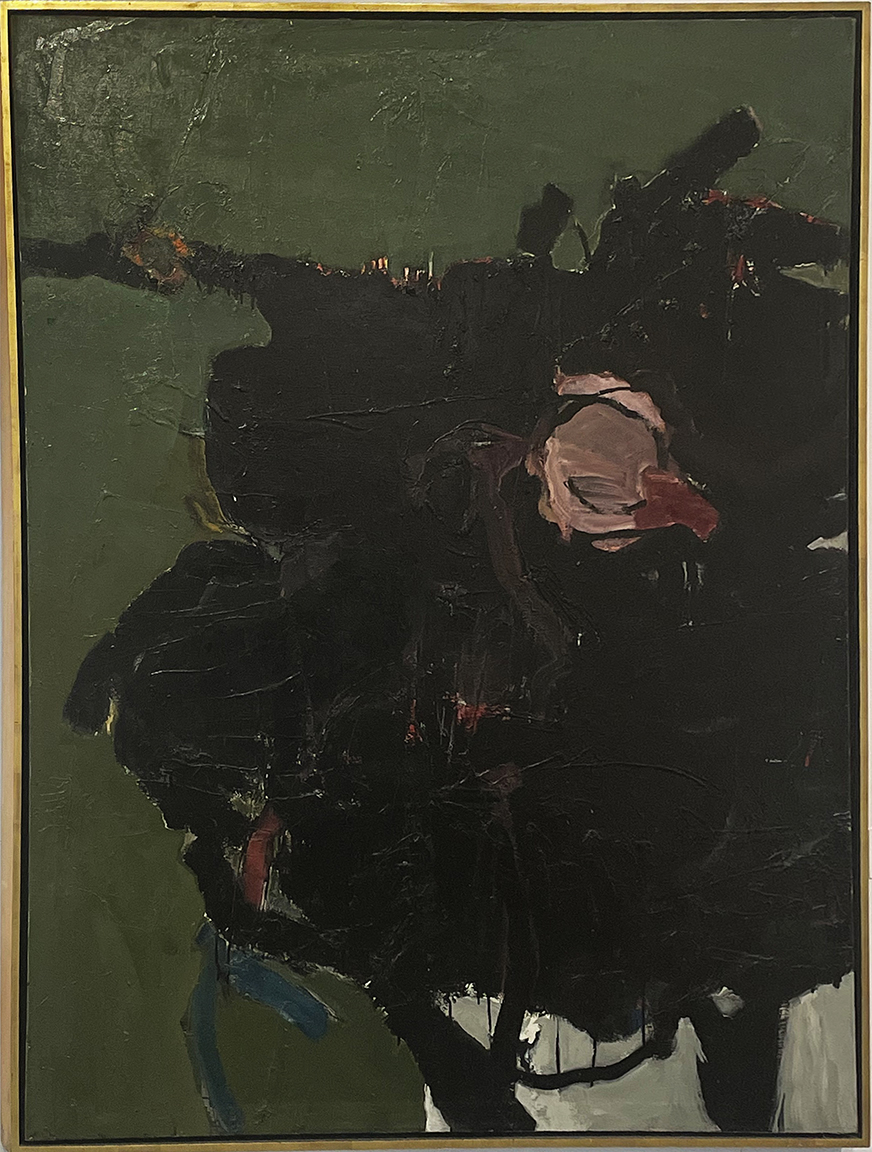
Lenore Vogt
Bird (1961)
Among the most imposing paintings in the show is Lenore Vogt's large Bird (1961). Because of reflections, it was difficult to photograph in situ, but seen in person it has a sensuous, painterly surface and there are great subtleties in the dark central mass. 

Nell Sinton
Dark Landscape (1958)
Also of particular interest to me were two small pieces on paper by Joyce Rezendes (not pictured here), who was associated with 6 Gallery in San Francisco, a large painting by Bernice Bing (not pictured), and Nell Sinton's Dark Landscape (1958), among others. Dark Landscape can be read as a landscape, but it comes across equally strongly (or more so) as an abstraction. There is something about it that—despite the dark palette—reminds me of those transitional Kandinsky pieces in which he is clearly moving into an abstract mode of work but hasn't been able to give up representation entirely. 

I aim to look into these and other artists in the show further (I'm awaiting the arrival of a copy of Women of Abstract Expressionism, edited by Joan Marter, which appears to be an excellent reference work on the subject of women in Abstract Expressionism). I’m very pleased to have found Modern Art West. It’s a welcome addition to the area. I look forward to seeing future shows there. I’m tempted to say this and Calabi Gallery in Santa Rosa are now the two most interesting galleries in the county. I highly recommend both (and The Red Brown Collection in Bodega Bay and Hammerfriar Gallery, in Healdsburg!).

*You can send an e-mail to Mr. Keaton to schedule a visit. However, the show runs only through the end of this week, until September 11. The next show at Modern Art West will be INDICATORS: Nature in Flux, a solo exhibition of work by Peter Hassen (September – November 2022).

Saturday, June 18, 2022

Art I'm Looking at: Alice Neel at the De Young

Hubert and Rita (1954)
With an open mind and largely ignorant about the career and work of Alice Neel, I visited the De Young Museum yesterday to see the Alice Neel retrospective. 

David Bourdon and Gregory Battcock (1970)
What struck me most forcefully was how comfortable she appears to have been with work that appears unfinished. I was reminded of some of the paintings of Edvard Munch, which likewise feature bold, unmodified brushstrokes and areas of unpainted canvas. I was also reminded of Gilbert Stuart, who is probably best known for his portraits of George Washington. I've read that Stuart loved to paint faces but found painting backgrounds and clothing tedious. As a result, he sometimes left portraits unfinished.

Richard in the Era
of the Corporation (1978-1979)
I wonder if Neel felt the same way? I doubt it. That's not the impression I got from looking at her riveting portraits. I felt rather that, having so skillfully captured the essence of her sitter, she may have felt the rest was simply superfluous. The paintings suggest not laziness but an uncanny ability to capture a look, a gesture, or a posture, that says everything that needs to be said. The palpable presence of the sitter in these paintings is unsettling because it so strongly contrasts with the economy of the brushwork, particularly in the later paintings. The paintings, as I've said, often look unfinished. They sometimes look cartoonish (an effect heightened by the creamy whites and pastel hues she sometimes uses that reminded me of Wayne Thiebaud confections). Some of the work is reminiscent of Van Gogh in its directness and almost naive use of paint. Some reminded me of David Hockney—a painter I don't much care for because his simplicity of style too often suggests vapidity to me rather than  anything substantial, in sharp contrast with the impression I get from Neel. Despite these characteristics, the sitter is always there in Neel's portraits. These paintings seem to be alive. 

Cindy Nemser and Chuck (1975)

Seeing the Alice Neel show at the De Young Museum was a very worthwhile way to spend a few hours. Recommended. The show closes on July 10. 

Pregnant Woman (1971)


Monday, May 29, 2017

Art I'm Looking At: Chris Beards—Sculpture at Paul Mahder Gallery in Healdsburg (through July 15, 2017)

Chris Beards And After opening reception, Paul Mahder Gallery
The Paul Mahder Gallery in Healdsburg opened an impressive show of new sculptural work by Santa Rosa artist Chris Beards last night (May 27). The artist was in attendance, along with many of the North Bay’s best artists, gallerists, and curators. I say sculptures—and they are sculptures—but all the pieces are wall-hung rather than freestanding, and they are dramatically lit, casting complex shadows on the white walls almost as interesting as the art itself.

Chris Beards, Siege (2017), detail
The show comprises about 12 pieces made from steel—mostly formed from sinewy, twisted strips or wrinkled sheets of steel—mummified in paper. Beards works by encasing steel armatures in multiple layers (sometimes as many as 20 layers) of paper bonded to the metal with thinned glue and other media. The paper and glue layers are then heavily worked. The layers are sanded, overlaid with more paper and glue, re-sanded, painted or shellacked or gessoed, sanded again and then further overlaid and finished in a laborious process that results in remarkably refined, sensuous, satiny surfaces, suggestive not of the raw steel underneath but of other metals—well-used bronze, smooth-worn iron, patina-green copper—or even softly eroded marble. The underlying steel is present in that it defines form here, but the surface finishes Beards achieves are as important as form. The sculptures have a skillfully crafted look in an age of art that often celebrates the opposite, and they are refreshingly appealing for that. There is something decidedly seductive about the work. You’ll want to touch it—caress it, even. Happily, the artist gives permission to touch the work a little.

Chris Beards in front of Within/Without (2016)
Beards has titled the show And After. A statement on the wall explains that the work is about how memory transforms experience—in particular, about the way time distils raw experience into something softer. The work, Beards says, is about the way our “narrative of the past becomes smoother,” the way the “sharp edges and thorns are softened and dulled.” He speaks of his sculptures not as depicting specific memories but rather as addressing the idea of memory itself. The finished pieces are presented as the softened remains of their underlying rough metal selves. He likens these sculptures to “time-tumbled driftwood or bones” and the metaphor is apt.

Chris Beards, After the Last (2013-2015)
Among my favorites pieces were Within/Without (2016, steel, paper, glue, spray paint, acrylic paint), After the Last (2013–2015, steel, paper, glue, spray paint, graphite, soft pastel, shellac), and Tiered (2017, steel, tracing paper, glue, gesso). The first of these suggests an unearthed artifact—a scrap of an obsolete, abandoned farm vehicle, perhaps—rusted but its surfaces polished as if long-caressed. After the Last is evocative of more organic forms. It kept suggesting to me part of the mummified remains of a frilled lizard, perhaps squashed flat on a roadway, or a fragment of a grasshopper—but the sculpture is again transformed into something sensuous by its satiny surfaces.


Chris Beards, Tiered (2017)
Tiered, my favorite piece in the show, reminded me of centuries-old stone steps worn smooth by the foot traffic of generations of pilgrims (the interior staircase of the leaning tower at Pisa, the steps inside Haghia Sophia, in Istanbul, came to mind) or the much-touched drapery of a recumbent figure on a white marble sarcophagus lid. These are only a few impressions, but Beards’s work is beautiful to look at and richly evocative.  And After will continue at Paul Mahder Gallery (222 Healdsburg Ave, Healdsburg, CA 95448, (707) 473-9150) through July 15, 2017 (although Paul Mahder now represents Beard and will therefore continue to handle his work after the show). Highly recommended.

Sunday, February 28, 2016

Art I'm Looking At: Bonnard at The Legion of Honor

Pierre Bonnard, The Table (1925)
Tate Gallery, London
The Legion of Honor, in San Francisco, is now exhibiting a large group of works by Pierre Bonnard (1867-1947), the first major show of the artist's work on the West Coast in 50 years, according to the Legion's website. The show is Pierre Bonnard: Painting Arcadia.

The layout is roughly, although not strictly, chronological. The first spaces focus on early work, generally from around 1890—the artist's Nabi period. The latest pieces are from the mid-1930s or so, but most of the work is arranged thematically. One grouping is mostly nudes, another mostly interiors. Later rooms focus on large mural-like pieces Bonnard painted for patrons.

Pierre Bonnard, Table Corner (1935)
Bonnard's career was a long one. In terms of artistic movements, his working life spanned late Impressionism, Post-Impressionism, Pointillism, Art Nouveau, Symbolism, Expressionism, Fauvism, Futurism, Surrealism, the rise of pure abstraction in the Western artistic tradition, Art Deco, and Cubism, not to mention coinciding with a period of great evolution in photography. Yet, Bonnard always did his own thing. Although his work is clearly of its time (sometimes reminiscent of Matisse or Dufy), although his instincts were aligned with those of the Post-impressionists and the Symbolists, and despite a strong impact on his sensibilities from Japanese art, he never was tempted to experiment with Cubist deformation or to embrace abstraction, even as those two trends began to dominate modern art in the West. His favorite subjects remained richly colored interiors, somewhat mysterious nudes in interiors, and landscape and lush vegetation. Although some of Bonnard's work has strong abstract qualities—in this show, notably Table Corner (1935)—he never completely gave in to the abstract impulse. Ultimately, he was a sensualist.

Pierre Bonnard Nude Before the Mirror (detail; 1931)
Galleria Internazionale d'Arte Moderna at Ca' Pesaro, Venice
The brushstroke is always evident. There is no attempt at strict realism, there is no attempt to hide the hand of the artist, to create an illusion of reality. His technique is thoroughly modern if we understand modern to have begun with Impressionism. His technical proclivities could be quite contradictory; he was at once fond of thin washes that let canvas show through the paint and of leaving areas of canvas entirely untouched—this transparency creating an effect suggestive of watercolor—while happily applying heavy dabs of paint right from the tube in other areas, or applying thick, creamy layers of paint for effect. Nude Before the Mirror (1931), on loan from Galleria Internazionale d'Arte Moderna at Ca' Pesaro, in Venice, provides an excellent example of the transparency. Shown here is a detail of what appear to be curtains at a window behind the nude figure (above). In contrast, in The Table (1925), on loan from the Tate Gallery, London, (top of this page), Bonnard's impasto nicely suggests slabs of creamy cheese and shrimp on crackers and his lemons glow with thick oval smears of cadmium yellow. The slatherings of Wayne Thiebaud come to mind.
      
Pierre Bonnard, Woman Dozing on a Bed (1899)
Musée d'Orsay, Paris
The nudes are somewhat unsettling. They are always ambivalent—simultaneously a celebration of the female body and expressive of uneasiness. Woman Dozing on a Bed (1899), from the Musée d'Orsay, depicting the artist's lover (and later wife) Maria Boursin (also known as Marthe de Méligny), stretched out on a bed, is something of an exception. It seems a comparatively straightforward record of post-coital indolence (the painting is also known as The Indolent Woman). The painting captures lust renewed by the sight of lust temporarily slaked. It is the most purely erotic painting among the nudes. It brings Modigliani to mind in its apparent motivation, if not in style. Yet this painting, too, has deeper nuances. Stylistically, it evokes Edvard Munch, and no 20th century artist was better at expressing anxiety about sex and desire than Munch. A cat is curled up in the shadow of the model's hair. Everywhere there are cats.

Pierre Bonnard, Nude in the Bathtub (1925)
Tate Gallery, London
Some of Bonnard's later nudes seem more relaxed, as if the artist decided it's better in the end to celebrate sensuality (Woman Dozing on a Bed is an early work—among Bonnard's first nudes) even if he can never allow himself (or us) to be entirely at ease. Although the unsettling effects I speak of are real—created by veiled faces, turned-away poses, odd perspectives, and startling truncations—simultaneously there is much beauty in the nudes and their settings. In some of these paintings, color, surface pattern, and the female form manage to appear more important than oddities of composition, and, subordinated to the figure, they enhance rather than detract from sensual qualities. In others, however, it's harder to make a case for pure sensuality. Bonnard is paradoxical. Nude in the Bathtub (1925), from the Tate, London, is a case in point. The figure is cut off at the hips, partially submerged in a bathtub that appears lifted several feet off the floor—in the room but not of the room. Another figure, apparently male, perhaps the artist, enters from the left. Time seems to have stopped. It is a pregnant pause. The Bathtub (below), also from 1925 and in the Tate London collection, is similar.

Pierre Bonnard, The Bathtub (1925)
Tate Gallery, London
Pierre Bonnard, Marthe in the Bath, (c. 1908-1910)
Other highlights of the show include a group of rarely seen self-portraits and photographs by Bonnard, mostly small (about  2 x 2.5 inch) snapshots of friends and family, including travel photos. These small photos are modern prints from the original negatives. They're probably contact prints (printed at the same size as the negative), although enlarged in the exhibition catalog (and here). Wall text gives no information about size, but goes out of its way to point out that these were snapshots, that Bonnard would not have considered them artistic work. Nevertheless, a clear sense of composition is apparent in all the images, and one, Marthe in the Bath, a nude of Marthe de Méligny, with its ambiguous foreground and motion-blurred face, has all the qualities of the painted nudes.

The large mural-sized works that close the show include two of special interest, a pair of works commissioned by art critic George Besson for his Paris apartment. The first, completed in 1912, is a daytime scene. The second, from 1928, a full 16 years later, is a night scene (shown here). Both depict La Place Clichy, in Paris, as seen from inside a brasserie. Bonnard certainly loved cadmium yellow—and cats.

Pierre Bonnard, La Place Clichy (1928)
A large number of the paintings on display are from The Musée d'Orsay, in Paris, the Tate, London, and the National Gallery, in Washington D.C., and from other museums I've visited on multiple occasions. Despite that, and, although I've always admired Bonnard's work, I can't remember seeing a single piece in this show before. Everything seemed fresh. There are more than 70 works on display, but the galleries have been generously allocated. Nothing seems crowded. There is just enough to be deeply satisfying without causing fatigue. Notable for the quality of the work and for its breadth, going well beyond Bonnard's Nabi period, Pierre Bonnard: Painting Arcadia runs at the Legion of Honor through May 15, 2016.

Wednesday, July 15, 2015

Art I'm Looking At: Degas and Friends in Petaluma

It was with some skepticism that I recently visited the Petaluma Arts Center to see Edgar Degas: The Private Impressionist, Works on Paper by the Artist and his Circle, on view there through July 26, 2015. An important Degas show? In Petaluma? Before my visit, I couldn't help feeling there'd probably be one or two good pieces to look at and then much of inferior quality padding out the gallery spaces.

I was wrong. Quite the opposite is true. There's almost too much to look at comfortably here, and the art on display is of a high caliber, with only a handful of exceptions (the pieces by Ingres and Toulouse-Lautrec, for example, are disappointing).

The works in Degas: The Private Impressionist are all from the collection of Robert Flynn Johnson, Curator Emeritus of the Achenbach Foundation for Graphic Arts at the Fine Arts Museums of San Francisco. The exhibit was curated by Mr. Johnson and Louise Siddons Ph.D., Assistant Professor and Curator of Collections at Oklahoma State University, Stillwater.  Each piece is accompanied by an unusually long explanatory label. Reading these is time consuming, but you'll want to read them. I recommend allowing two-three hours to give the show its due.

The Petaluma Degas show is worth seeing for a number of reasons. First, it's notable for its breadth. It includes more than 100 pieces, about 40 by Degas himself. The latter include very early drawings, some of which are copies made in the Louvre and other museums, often with one sketch overlapping another. Several sheets have drawings on both sides of the paper (mounted here so that front and back are visible)--images Degas made for practice rather than as finished works. Thus, the early part of the show gives us an unusual glimpse of Degas learning to draw.

Second, the show includes work by Degas in less common media. There are several early monotypes (one-off prints made by drawing with ink or paint on a hard surface--usually glass--and then transferring the image to a sheet of paper). Reproduced here is Heads of a Man and Woman (circa 1877-1878), notable for its combination of spontaneous execution and acute observation. There are etchings and drypoints, many of which are interesting for being late impressions from cancelled plates.  There are prints made in collaboration with publishers that reproduce some of Degas' pastels and paintings as lithographs. There are photographs by Degas.  In a combination of photography and printmaking, Degas in a couple of examples has worked on used Daguerreotype plates to make aquatints. Again, the breadth of the selections is impressive. It attests to Mr. Flynn's expansive taste and explains the show's subtitle referring to the "private Degas": Degas himself publicly showed work other than paintings and pastels only very rarely.

If you're interested in the history of photography, the show is worth seeing just for the eight photographs included (two of these show composers Debussy and Chausson). While Degas' interest in photography is well known and it's easy to see how photography influenced his cropping of compositions in other media, I don't remember ever having seen photographs made by Degas himself--although he was an avid photographer, at least for a short period of apparent obsession with the medium. It seems there ought to be more of his photographs around. Apparently, there aren't. So, this is a rare treat. One of the wall labels on the photographs is rather funny, describing Degas breaking up a dinner party by bringing out his camera and coercively posing reluctant guests in fastidiously composed scenes that then required long exposures.

Third, the show puts Degas clearly into the context of his artistic milieu by including so many works by and of artists that Degas knew and himself collected. Not all of these people will be well known to a general audience, but they include Tissot, Fantin-Latour, Moreau, Gérome, Desboutin, Aryton, and Jeanniot, among others. Better known names include Cassat, Ingres, Cézanne, and Toulouse-Lautrec. Also included are some modern takes on Degas and his work, including a very funny drawing of Degas from 1964 that David Levine made for The New York Review of Books that poses Degas in a tutu standing in the ballet dancer's fourth position, alluding to the artist's sculptures of young dancers.

Some of the highlights of the show among the Degas works include: the lovely portrait of Mademoiselle Dembrowska used on the cover of the catalog and in the show's advertising (circa 1858-1859); a beautiful pencil drawing of a plough horse from 1860-1861; several prints executed in 1934 by Maurice Potin using photogravure, aquatint, and etching to reproduce monotypes of brothel scenes Degas made between 1878 and 1880 but never exhibited; and the above-mentioned monotypes and photographs. Among the work by other artists, there is an intriguing Portrait of a Working Girl (circa 1880) by Annie Aryton (shown below)--which, as the label points out, depicts a woman who looks remarkably like the girl who modeled for a couple of the dancer sculptures Degas made; A bold drypoint self-portrait by Marcellin Desboutin (circa 1875); a portrait of Degas as an older man by Pierre-Georges Jeanniot;  a very fine red chalk drawing entitled Portrait of an Officer (1853) by Jean-Léon Gérome--an uncharacteristic subject for an artist best known for his paintings of mythological subjects; the circa 1854 Portrait of a Man (pictured above) by Gustave Moreau, a graphite drawing that looks more like an Ingres than the small Ingres head on display; a pair of small self-portraits by Jeanniot; and, among my favorites in the show, a circa 1870 graphite drawing by Adolph von Menzel of his sister asleep in a railway carriage (bottom). Fans of the sitcom Seinfeld may find it amusing that one piece in the show is on a piece of paper watermarked "Vandelay."


If I had to nitpick, I was disappointed that no photography is allowed in the galleries, which is frustrating, as it makes it very difficult to later talk about individual works without relying on sometimes-faulty memory, and the catalog is available only as an expensive hardcover edition I didn't feel I could afford. It appears to reproduce all the wall labels verbatim, so it will make an excellent resource, but I had to pass. I noticed that while the drawings and prints are generally well reproduced, the Degas photographs have been given an odd orange tinge not present in the originals on display, which is a shame. Otherwise, I can recommend Edgar Degas: The Private Impressionist wholeheartedly--but make sure you allow plenty of time to take in the full sweep of this remarkable collection. General admission is $10 (free for Petaluma Arts Center members). Thursday through Monday (closed Tuesday and Wednesday) 11AM to 5PM. Open on Saturdays until 8PM. (All photographs from the online catalog.)

Friday, January 9, 2015

Art I'm Looking At: Houghton Hall at The Legion of Honor

After seeing the Keith Haring show at the De young Museum, it took a moment to adjust to the very different mood of the Legion of Honor's show of work from Houghton Hall, in England, a large house originally built by Sir Robert Walpole, in 1776, generally considered a masterpiece of Palladian architecture. The show includes a large number of paintings from the Houghton Hall collection displayed along with furniture, dinner ware, silver, rugs, and other objects laid out in several large rooms. The walls have been covered from floor to ceiling with photographic reproductions of the original rooms, which give a fairly good sense of how the various object on display would look in context.

There's an entire room of Sargents--probably the highlight of the exhibition--paintings that rarely travel. They included a painting Sargent did to document World War I damage to a cathedral. His painting of gassed WWI soldiers is well known, but the captions in the Houghton Hall show suggest he was commissioned to do a lot of this type of work, which I hadn't known. There are a couple of full-length Sargent society portraits of note and several attractive charcoal portraits of Houghton Hall residents, but I especially enjoyed a quickly sketched head of a gondolier (c. 1878) from a visit to Venice (pictured).

In the room with the Sargents, I was surprised to see a very familiar-looking head of Pope Innocent X, clearly related to the famous Velazquez portrait. Approaching a little closer, I read the label. The painting turned out to be a Velazquez study for the larger painting.
I also enjoyed a portrait of Catherine Shorter, Lady Walpole (c. 1710) by Swedish artist Michael Dahl. The wall tag mentions that she was extravagant--"frequently attending the opera and buying expensive clothes and jewelry," although she is fairly modestly attired in the portrait. The Dahl portrait is shown in a facsimile of the Houghton Hall library, with walls covered in faux books--large photographic wall coverings like the ones mentioned above. The room displays several pieces of furniture and an interesting wool rug described as English, but I noticed that triangles, apparently cut from the borders of oriental carpets, have been worked into its four corners.

Among the most beautiful objects in the entire show are two large rolls of handmade Chinese wallpapers (detail below). It wasn't exactly clear, but these appear to be actual leftovers from papers made for bedrooms in Houghton Hal, papers that presumably still cover the walls in some rooms today. The many birds on the papers are exquisitely drawn. The foliage, rocks, and other background elements are highly stylized, in some places becoming almost entirely abstract, while somehow retaining the power to evoke environments the birds might have been found in. The blue is especially striking. The show was worth seeing just for these wallpapers. The Houghton Hall exhibit runs through January 18, 2015 at the Legion of Honor.


Friday, December 12, 2014

Art I'm Looking at: San Francisco--Keith Haring: The Political Line at the De Young

Two sharply contrasting exhibits are now featured attractions at the main venues of the Fine Arts Museums of San Francisco--the De Young Museum and the Legion of Honor. I visited both recently, starting at the De Young to see Keith Haring: The Political Line, a show  highlighting Haring's political activism. I enjoyed seeing the very large sample of work presented but kept wondering what fraction of his production might be called political. A little more context would have been helpful. Given the short period he was active (about twelve years, from 1978 to 1990) and the large number of works on display, my guess is that most of his work was politically motivated, particularly toward the end of his life, when his AIDS diagnosis spurred him and his growing fame had given him an international platform.

Motivation and message aside, what's clear from looking at this art is that Haring lived his short life at a fast pace. The work exudes energy. The zig-zag lines children use to depict lightning or electricity when they draw would not be out of place here. Garish, unmodulated hues; clashing colors set side by side; strong contrasts; angular, heavily outlined shapes; and "lines of motion" borrowed from the vocabulary of comic book artists all contribute. Influences are numerous and diverse. Mayan art, quilts, aboriginal art, graffiti art, the Nazca lines, comic books, advertising art, the chalk corpse outlines of Hollywood movies, writhing Boschian hells, and technological hells where demonic robots reign over electronic gadgets come to mind when looking at Haring's work. Yet, the work is always immediately identifiable as Haring's. This dialectical component is apparent also in the way his images operate on the level of pictographs--simple, symbolic, overtly didactic, and quickly absorbed on the one hand--yet remaining cryptic and baffling at the same time. Haring's is a language encountered in an anxiety dream; we feel we should know the language--and we recognize some of its words--but don't fully understand the meaning. The result is a lingering unease. Although there are political messages embedded in much of the work, Haring rarely gave his work titles--again leaving the viewer somewhat off balance. Without the direction provided by a title, it's often difficult to be entirely sure what Haring intended, despite his use of direct, icon-like pictorial elements (sometimes evocative of pictorial road signs or Olympic event symbols). That said, the work is not entirely without humor. There is joy in some of the dancing figures, a vitality in the glowing babies, and Andy Mouse (which does have a title) simultaneously pokes fun at Walt Disney and Andy Warhol; it made me laugh out loud (1985, private collection; detail above). A panel full of cartoon-like penis drawings from a sketchbook, many accompanied by diary-like entries indicating where the artist was when he made them, was funny too.

Haring's line is deft but un-nuanced. It sometimes leaves me cold, but I was impressed by the consistent confidence of its execution, whether in ink on paper, chalk on expired subway ad space, or in vinyl paint on a tarpaulin. I examined the works very closely. Nowhere is there any evidence of preparatory work--no sketching, no planning. Each piece appears to have been an unrehearsed improvisation, drawing on an ever-evolving vocabulary of signs and symbols, many recurring over and over again--barking dogs, crawling babies, snake-like creatures, robots, angular dancers, angels, crosses, bats, figures with holes in them, flying saucers, penises, electronic gadgets, and figures with Xs instead of brains.

The early subway drawings in the show were intriguing. These are perhaps the quintessential Haring. It was the subway drawings in chalk that earned him his first widespread recognition. They seem the most genuine expression of his gift. They were done quickly, as ephemeral performance pieces, in the platform time between connecting trains. They were done knowing the activity was technically illegal and might result in a fine (drawings on the blank panels were considered graffiti) and, like a graffiti artist, Haring made them knowing they wouldn't last, that they might be quickly covered by a new ad or wiped away. I was not alone in wondering how the examples in the show (presumably quite rare) were preserved, as they appear to be in the original metal frames that surrounded the subway advertising spaces they were made in, the whole in each case apparently lifted off the wall. Done in soft chalk, the subway drawings have an affinity with brush-and-ink calligraphy in that the artist has only one chance to get it right. Every hesitation is preserved. There is no going back to make corrections. Remarkably, there is virtually no evidence of hesitation. Perhaps our view of the subway drawings is a necessarily distorted one, based only on a few well-executed extant examples, but other work in the show suggests Haring didn't often hesitate. While some of the later work seems a little too practiced, a little too obvious in its message, a little complacent, I was generally impressed by the show.

Saturday, November 23, 2013

Art I'm Looking At: Anders Zorn at The Legion of Honor (November 23, 2013)

Anders Zorn (1860-1920) is a name I've long been dimly aware of. On travels in Europe I've seen a few of his paintings and I've been impressed by them, but until today I'd never had the opportunity to see a full range of his work. It was a treat to see a representative selection of his early efforts – mostly extraordinary watercolors –, of his society portraits, of his nudes (oils, watercolors, and etchings), and also of his later works, which are mostly oils depicting rural scenes in his home country of Sweden, to which he retired after periods of living in London, Paris, and elsewhere, and doing a great deal of traveling around the world, including seven trips to the United States (which included a visit to San Francisco in 1903).

According to the large, wall-mounted text panels at the show, Zorn studied mostly oil painting as an art student, but a chance meeting with an English watercolorist shortly after graduation inspired him to take up watercolors, and he seems to have applied himself with singular concentration. The early watercolors on show at the Legion of Honor in San Francisco (Anders Zorn: Sweden's Master Painter runs through February 2, 2014) are nothing short of breathtaking technically, if somewhat idiosyncratic; Zorn uses watercolors more like oil paints, employing thickeners and adding touches with gouache to create heavy (but by no means clumsy) layers with less transparency, less wetness, than is usual. Zorn must have been an especially meticulous and patient man, at least in his youth. The detail of the water surface in a painting like Summer Vacation (1886) shown here is hard to believe. The figure in the boat is almost photographically rendered. If Zorn had lived in a later period, it's tempting to think he might have become a photorealist.

Zorn took up etching fairly casually, at the suggestion of an artist friend, the panels tell us. He seems to have mastered it in a very short time. His ability to capture light effects – so ably demonstrated in the watercolors – is apparent here, and again Zorn's approach is somewhat unorthodox. On the Sands (1916) pictured above (although not in the Legion of Honor show) is a good example of the style he developed as an etcher, using very long, parallel hatching to conjure startlingly life-like figures out of what look like hastily worked backgrounds (the freedom of line here and in some of the oil paintings is surprising when juxtaposed with the painstaking watercolor work). Remarkably, some of the lines are a third or even half as long as the long side of the plate. The woman on the beach looks as if she's been carefully carved out of a jagged stone matrix. Looking at other work in the show, this contrast between loving attention to a central figure and a less-meticulous rendering of a background began to seem typical as I walked through the galleries. The "floated" effect created by a figure rendered so surely as to look almost alive surrounded by a markedly more sketchily approached background is apparent in some of the oil paintings as well--notably Herdsmaid (1908) in which a young female cowherd (partially obscured by pine saplings and other low vegetation) is seen through a gap in the plants around her; the figure seems uncannily present, but what surrounds her is ever-so-slightly blurred – again suggestive of photography and lens effects (more below).

Zorn was immensely successful as a society portrait painter, both in Europe and on his trips to the United States. Looking at Zorn's work in the genre, the paintings of nearly contemporary painters John Singer Sargent (1856-1925) and Valentin Serov (1865-1905) immediately come to mind. These painters all had an uncanny ability to capture something about sitters that make their portraits look absolutely authentic while using brushstrokes that call great attention to themselves if viewed from close to the canvas. An entire room in the Legion of Honor show is devoted to portraits like this one of Elizabeth Sherman Cameron (1900).

The orange-red of the sofa in the Cameron portrait is a color Zorn appears to have liked very much. This (or a similar shade – the raw flesh of a Coho Salmon and the red sandstones of Arches National Park, in Utah, come to mind) is present in every one of the paintings in the portrait room – in the red bow in a sitter's hair, in the glowing, rusty curtains behind the former president in Zorn's portrait of Grover Cleveland (1899), or in a piece of furniture or clothing. In his Self-portrait in Red (1915), at the top of this page, Zorn took his predilection to an extreme.

Being a photographer, I was particularly interested to see the show touch upon how Zorn used photography as a resource in at least some of his later work. The etching called Cabin, of 1917, has its own display case. An example of the print is set alongside the original plate from which it was pulled and a set of five snapshots Zorn made of the two models depicted descending into the cabin of what is described as "Zorn's yacht" (his society portraits appear to have made him very rich). The photos are fascinating in themselves. The women are laughing. They seem to be having a great deal of fun. It's easy to imagine Zorn joking with the models, getting them to take the positions he was trying to visualize, in the right light, without making them unduly self-concious. Seeing the snapshots makes me wonder how often Zorn was drawing on photographs earlier in his career and exactly how he may have used them, if he did.

This work and the other nudes in the show (there are many, mostly oils) makes apparent the artist's love of the female form. He appears to have been especially fond of rear ends, and in the Legion of Honor show are some of the most lovingly rendered backsides you're ever likely to see in paint. Look for the one Zorn slashed to pieces and discarded because he was dissatisfied with it (a fellow artist rescued the pieces and sewed it back together).

Zorn retired to his home town of Mora and spent his last years mainly painting the country life of Sweden's Dalarna region – paintings that appealed to me less than some of the other pieces in the show (although everything was worth looking at). Here I've posted just a few impressions based on a single viewing of a selection of Zorn's work, but Zorn is a painter I'm now interested in learning more about.

Tuesday, July 24, 2012

Art I'm Looking At: Mel Ramos Retrospective at the Crocker Museum of Art (July 24,2012)

Mel Ramos is a name I must have heard before. I looked him up in the textbook I used in college in a history of American art class (Hunter and Jacobus, American Art of the 20th Century, Abrams, 1973) and there he was, with penciled-in margin notes nearby. I can't say that I remembered him, though, so I approached the current Ramos retrospective at Sacramento's Crocker Museum of Art with no baggage--either positive or negative ("Mel Ramos: 50 Years of Superheroes, Nudes, and Other Pop Delights," through October 21, 2012).

The work is certainly eye-catching. The canvases are big. They are bright. The compositions are stark--usually a single large figure against a plain background. The superheroes lack the commercial artifacts that accompany most of the nude figures (a typical nude combines a Playboy Playmate-style woman in, on, or next to something like a box of candies, a package of Cracker Jacks, a cigarette pack, or a martini glass), but even the nudes are rather simple compositions, and their backgrounds tend to be garish--flat planes in colors like mauve and apricot.

According to the gallery labels, Ramos became serious about painting while under the spell of the Abstract Impressionists, especially Willem de Kooning. Ramos, we are told, disgusted with his own slavish copying of de Kooning's style, eventually decided to paint what interested him, and that appears to have been comic book characters. The show begins with some of these early superhero paintings. It's a shame that at least a few of the painter's Abstract Impressionist works are not included. I left the exhibition curious to see what Ramos was doing in that earliest phase of his career.

"Wonder Woman No. 1" (1962, oil on canvas, Rochelle Leininger Collection. © Mel Ramos/Licensed by VAGA, New York, NY) is among the early superhero paintings. It has a naive simplicity, as do the other comic book heroes in the show. The comic-influenced works look precisely like what you'd expect from a man who enjoyed comic books and had recently decided in a moment of artistic frustration to simply paint what he wanted to without worrying about what others were doing. Having said that, I sense a certain disingenuousness here. Already at this period the Abstract Impressionists were moving away from a purely painterly style and beginning to add bits and pieces of the real world to their canvases; artists were already showing a fascination with the visual clichés--including comic book images--that became central to Pop Art. I suspect Ramos still had his eye squarely on trends among his contemporaries.

Whatever his precise thinking, "Phantom Lady" of 1963 (Oil on canvas, Leta and Mel Ramos Family Collection, © Mel Ramos/Licensed by VAGA, New York, NY) appears to have been a turning point--as the wall text in the galleries points out. With "Phantom Lady," Ramos combines the comic book hero with the airbrushed pin-up girl, a step toward the nude work that appears to have occupied him most consistently since this period.

With the nudes, Ramos would seem to have embraced the artistic mainstream again. The nudes show all the typical characteristics of full-blown Pop Art. They are not portraits of real women. They are portraits of photographs of women photographed in a style that already makes them a commodity. The addition of commercial artifacts as props adds a surreal note, but essentially they are a send-up of the American obsession with commercialism and with an artificial, smoothed over, enhanced notion of feminine beauty.

"Five Flavor Frieda: The Lost Painting of 1965 No. 47" of 2005 is a good example of the later nudes (2005, oil on canvas, Collection of Don Sanders, courtesy of McClain Gallery, © Mel Ramos/licensed by VAGA, NewYork, NY). The nudes are rather funny. A couple of the titles made me laugh out loud. I particularly liked "Monterey Jackie," a pin-up girl sitting on a large block of cheese, presumably Monterey jack. There is a light-hearted irreverence in the parody of the party stripper in several images in which the nude is emerging from a package of candy or from inside a banana, but I wonder if Ramos's jokes are funny enough to sustain decades of retelling, decades of variations on a theme. I enjoyed seeing the Ramos show, but most of the work seemed only superficially attractive without much to sustain long interest. The paintings (and one or two sculptures) reminded me of the sort of gaudy woman that is superficially attractive--a head turner--but with no personality, the sort of woman that doesn't sustain interest, the sort of woman that Ramos perches on his packages of candy and drops into his martini glasses like pickled olives.

More about paintings at the Crocker Museum of Art.

Images used by permission, courtesy of the Crocker Museum of Art.  
Related Posts with Thumbnails