Showing posts with label exhibition. Show all posts

Thursday, November 13, 2025

Art I'm Looking At: Manet & Morisot at The Legion of Honor

I recently saw ‘Manet & Morisot’ now on at the Legion of Honor in San Francisco. I thought it well worth a visit for two main reasons. First, it offers an unusual opportunity to see a large number of paintings by Berthe Morisot all together and, second, it offers an equally unusual opportunity to see three of Manet’s most famous paintings (‘The Balcony,’ ‘Boating,’ and ‘The Railway’), which are usually widely dispersed. In addition, the show highlights the relationship between Manet and Morisot both on a personal level and as painters, which, of course, is the central theme of the exhibition. ‘Manet & Morisot’ runs through March 1 next year in San Francisco before moving to the Cleveland Museum of Art  for a run from March 29 through July 5.

I had not seen a lot of work by Morisot before, although I am well aware of her and knew that Manet and Morisot were close friends. Manet painted her several times (there are two or three of his portraits of her in the show) and eventually they became family when Morisot married Édouard’s brother Eugène. In 2010 I had the privilege of spending a week in Paris staying in the apartment of friends. It was a short stroll away from the Cimetière de Passy (the Passy Cemetery) where I saw the side-by-side graves of Édouard, Eugène, and Morisot, among other celebrity graves, including those of the composers Gabriel Fauré and Claude Debussy.

I was impressed by Morisot’s bold, loose brushstrokes. Unlike Manet, Berthe Morisot belonged to the Impressionist group, having been invited to exhibit in the first Impressionist show by Edgar Degas. She exhibited in all but one of the subsequent Impressionist shows. Her brushwork brought several painters to mind, including Munch, Joan Mitchell, and Sargent, although I don’t mean to make any sort of direct comparison; Mitchell, was, of course, a mostly abstract painter and it has to be said that nobody has ever matched Sargent’s ability to evoke a texture or capture a highlight in a single, perfectly placed abstract smear of paint from a loaded brush, but these painters are all notable for their very obvious brushwork. I’ve included here a couple of details of Morisot up close. The show suggests that it was the influence of Morisot that led to Manet adopting a looser style over time, becoming more willing to let the brushwork show. 

I have seen both ‘The Balcony’ and ‘Boating’ in person in their normal homes (respectively the Musée d’Orsay in Paris and the Metropolitan Museum of Art in New York) but neither recently. It was particularly interesting to see ‘Boating’ again and in this context. The wall label notes that it was started in 1874 but that Manet worked on it repeatedly for at least a couple of years after that. What I thought striking was the background (essentially, the water), which appears to have been heavily reworked in the top third of the painting. I was left wondering whether he had started with obvious brushstrokes in all of the areas corresponding to water and then softened the brushwork in the top third of the image or if he had later added more painterly strokes in the lower two-thirds. Whichever is the case, the two sections appear rather starkly different and there isn’t much of a transition between them – something I’d never noticed before. It would be natural to blur the upper part of the background gradually to suggest distance, but the contrast between the two areas is quite noticeable once you notice it. It may be that he toned down the brushwork in the upper portion because it distracted from the face of the male figure. Who knows? In any case, there was much of interest to see in this show. Recommended.

Wednesday, January 17, 2024

Art I'm Making: Show at Hammerfriar Gallery

I'm pleased to announce that I'll be participating in a show of collage and mixed media work along with Molly Perez and Deborah Salomon at Hammerfriar Gallery, in Healdsburg, from February 24 to May 11, 2024. There will be an opening reception on Saturday February 24 (3PM-6PM) and I will be doing a collage demonstration at the gallery on Saturday, April 13 at noon. I hope to see you there.


Sunday, August 13, 2023

Art I'm Looking At: Drawing the Line at the Legion of Honor

I went into San Francisco on Friday to see what was on at the Legion of Honor. I posted yesterday about the spectacular Holbeins in the Tudor show there through September 24. Today I'm posting about a small, easy-to-miss exhibition in the Achenbach Foundation gallery that's down one of the side hallways downstairs at the Legion, which was an unexpected pleasure. Entitled "Drawing the Line: Michelangelo to Asawa," a selection of work from the museum's collection of works on paper. 

According to the museum, the show is intended to highlight drawings that emphasize the use of a prominent outline. I'm not sure all of the selections make sense from that perspective, but everything on the wall is worth looking at. 

To quote from the Legion of Honor/De Young Museum website,"The selection ranges from minimal line drawings by Michelangelo and Andy Warhol to fluid figure studies by Pablo Picasso and Ruth Asawa. One of our most treasured works, Paul Gauguin’s large-scale portrait L’Arlésienne (Madame Ginoux) (1888) is on display for the first time in more than a decade." 

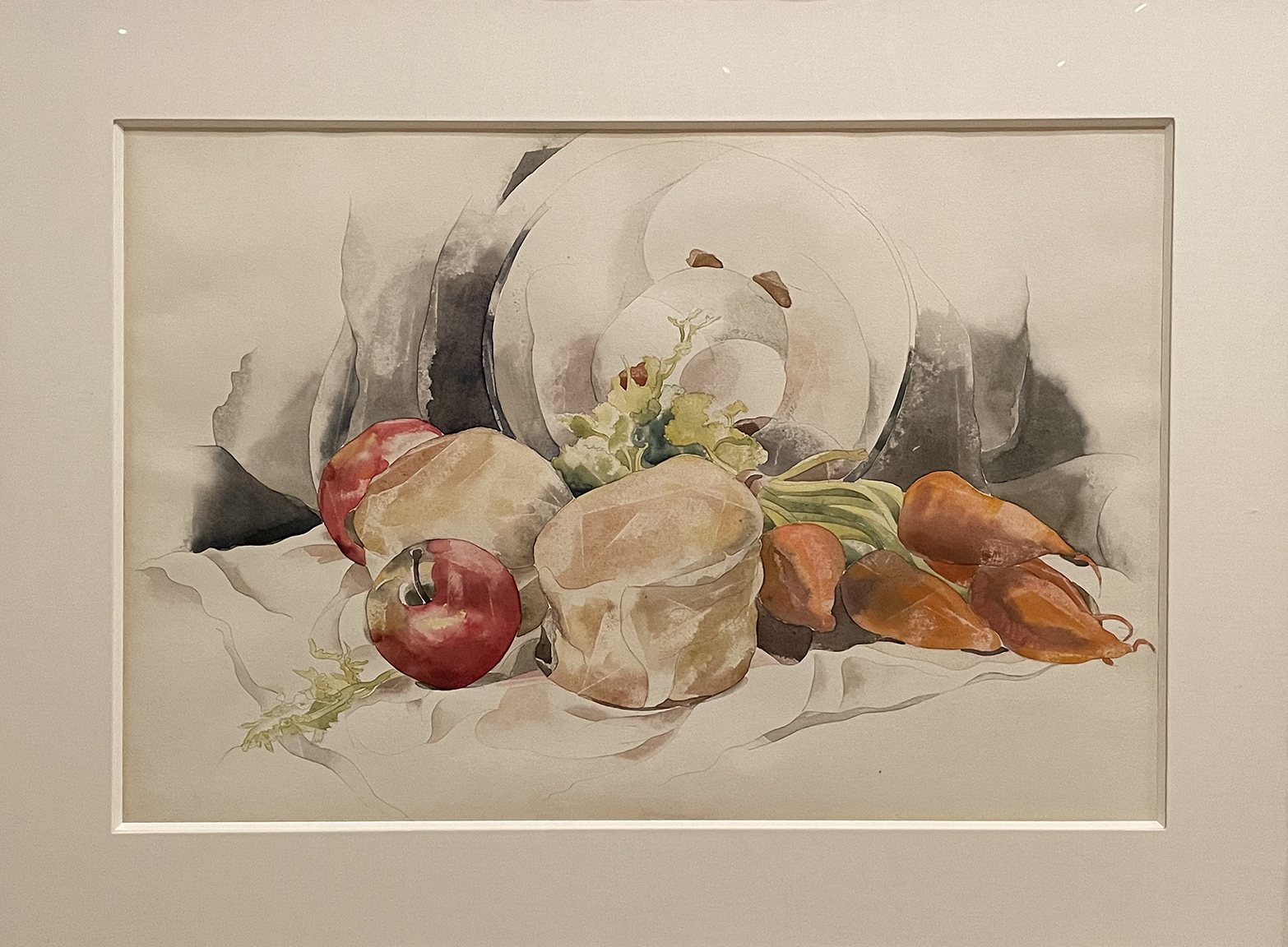
If you enjoy the art of drawing, the Legion of Honor is worth a visit right now just for the chance to see this group of gems. "Drawing the Line" will be on view through February 25, 2024. I've chosen some of my favorites here, but these represent only about a small fraction of what's on view.

Pictured here, top to bottom: 

1. Charles DeMuth, Apples and Carrots, c. 1926. Watercolor

2. Auguste Rodin, Nude with Legs Spread, c. 1900-1914. Graphite and watercolor on wove paper

3. William Blake, The Complaint of Job, c. 1786. Brush with wash over graphite

4. Willem de Kooning, Untitled (two figures), c. 1947. Paint, watercolor, charcoal, graphite

5. Tsukioka Yoshitoshi, Young Couple Praying by a River and Young Woman Looking to Her Right, c. 1860. Brush with red and black ink


Tuesday, April 2, 2019

Art I'm Looking At: The Art Wall at Shige Sushi Closes (April 2019)


The Art Wall at Shige Sushi is no more. The restaurant owners have decided to permanently close the Cotati location to focus on their new location in Sonoma. It was a really fun four-plus years. As curator, I feel like I was able to show a great deal of really good local art in that time. I sincerely thank everyone who helped to make The Art Wall possible.

The first show was in December and January 2014-2015. Only one person came to the opening reception. It was pouring with rain, no one had heard of the place (except as a restaurant) and it was right before Christmas. In the end, that was a good thing. There would have been room for no more. We held the reception while the restaurant was open—a mistake in such a small space. I quickly learned to have the receptions on Mondays, when the restaurant was closed. I will always be grateful to Claude Smith and Sherrie Parker for agreeing to participate in the first show.

I curated 26 shows of 8 weeks each with a couple of exceptions—one was six weeks, one ten weeks. I showed the work of 28 artists, 27 living, one deceased (Lewis Bodecker). There were 23 solo shows, three group shows (collage work by Claude Smith, Sherrie Parker, and me; Lisa Beerntsen and Deborah Salomon had a show together, and we did a show of contemporary photography that included work by nine artists). Of the 23 solo artists, 17 or 74% were women. Several artists participated in more than one show, including Janis Crystal Lipzin, Sherrie Parker, Claude Smith, and Deborah Salomon.

We sold at least one piece in (or as a result of) seven of the shows, not including work I bought myself. Including that, we sold at least one piece in 11, or 42% of the shows. Katie McCann sold the most in one show, with three of her collages going to an enthusiastic collector. The most expensive piece sold was a piece in Sherrie Lovler’s show, which sold for over $800. As I took only a 25% commission on sales, The Art Wall at Shige Sushi was not a profitable venture in monetary terms. It would not have been possible at all if the owners at Shige Sushi had not allowed me to use the space at no cost. It was profitable in terms of other, more important things. 

Please join us next Monday, April 8, 2019 for a final closing party from 6:00PM to 9:00PM. Everyone's invited. If you never made it to one of our shows, this will be your last chance. Wine and beer will be provided, but please bring a little something to eat to share with friends. Pot luck. Bring your own bottle, too, if you care to. But come, even if you come empty-handed. I'd really like to personally thank everyone who was involved—the artists and the art lovers—with making The Art Wall at Shige Sushi a success.

The photo above shows postcards for each of the 26 shows I curated, in chronological order.

Monday, April 23, 2018

Art I'm Looking At: Kerry Vander Meer on The Art Wall at Shige Sushi (May 1 through July 1)

I'm pleased to announce the upcoming show on The Art Wall at Shige Sushi. I'll be showing mixed media work by Kerry Vander Meer, who works in Oakland. She's an inspiring colorist and has an exquisite sense of composition. Her work incorporates drawing, printmaking, and collage, using paper, fabric, and other found materials. Beautiful work. Artwork will be viewable during the restaurant's normal business hours from May 1 through July 1. Opening reception Monday, May 7, from 5:30 to 7:30PM. Come see the work, have a glass of wine, and meet the artist. 8235 Old Redwood Highway, Cotati, CA 94931

Kerry has recently done a wine label for Imagery Estate Winery as well. She'll be at the winery for one of their "Gallery Days" events, Sunday, May 20, 1:00-3:00PM. Her label will be on the 2017 Albariño. (Stay tuned for information about my own Gallery Days event later in the year. One of my pieces will appear on the Imagery 2017 Viognier label.)


Wednesday, February 21, 2018

Art I'm Looking At: Robert Rauschenberg and Walker Evans at SF MOMA

Robert Rauschenberg, Collection (1954/1955)
San Francisco Museum of Art
I recently saw the Robert Rauschenberg retrospective now on view at SF MOMA (November 18, 2017 through March 25, 2018). I think the most striking thing about the show is the impression it gives that Rauschenberg was, essentially, a collage artist. Often his work actually was collage (or assemblage, the three-dimensional version of collage), but even when he was not making collages or assemblages, his sensibility remained that of a collagist to a remarkable degree; it was his instinct to juxtapose fragments of things.

Robert Rauschenberg, From
34 Illustrations for Dante's Inferno (1958-1960)
He came into his own at the height of abstract expressionism and matured as pop art emerged, but, looking at his work, he seems to be of neither movement. He worked large, but I don't feel he was concerned about the idea of the heroic painter. Although he incorporated commercial images and everyday objects into his work, I doubt his intent was to comment on consumerism and consumption or on how the media represent the world. He was an aesthete. What seems revolutionary was that he succeeded in created so much visually engaging work without using pretty materials. Up close, many of the pieces are messy (sometimes made out of actual trash), but ultimately they always seem to be about composition. Radical approaches and materials never trump composition.

Walker Evans
Garage in Southern City Outskirts, Atlanta Georgia (1936, printed 1972)
I also saw the large Walker Evans retrospective (closed February 4)—one of those shows that puts the best known work of an artist into perspective, teaching that the most familiar work is not necessarily the most representative. I had seen mostly Walker's familiar depression-era photographs before, but not a lot else, I realize now.

Walker Evans
Tin Snips by J. Wiss and Sons Co. (1955)
The exhibition looked at Walker's career from the perspective of his interest in the everyday, his implicit rejection of the formal, highly aestheticized conception of photography in the work of photographers like Stieglitz. Walker was interested in the things around him and in revealing them as they were. I think it was Ansel Adams who once said you don't "take" a photograph, you "make" a photograph, emphasizing the control of the photographer over the viewed world that resides in the finished image; the photographer is seen as a manipulator of the seen world, but Walker would have rejected that idea. His interest was in recording the present, taking what was there for what it was. A comparison with Atget is an obvious one, but I wasn't aware that Walker was conscious of and inspired by Atget. Apparently he was. Walker had seen and studied Atget's photographs (several of which appear in the show near similar views by Evans). I especially enjoyed a series of photographs of everyday objects shot almost as if intended for a sales catalog, such as the tin snips shown here. An enlightening show that was well worth seeing.  

Wednesday, January 3, 2018

Art I'm Looking At: Linda Yoshizawa on The Art Wall at Shige Sushi (through February 25, 2018)

Linda Yoshizawa, on the Art Wall at Shige Sushi. Through February 25, 2018. Opening reception, Monday, January 22, 2018, 5:00PM to 7:00PM (open Monday for the reception only).

I've just finished hanging the latest show on The Art Wall at Shige Sushi--evocative, layered monotype collages of botanical subjects by Linda Yoshizawa.

Born and raised in Los Angeles, Linda graduated with a BA in studio art from Pomona College in 1978. She studied silkscreen printmaking at the UCLA extension and produced editions at a serigraph workshop run by Evelyn B. Johnson in Southern California. In 2007, she built a studio in San Ramon, expanding her work to include solarplate etchings, collagraphs, and mixed media prints. Her artwork is in personal and corporate collections across the country including the Library of Congress, Kaiser Permanente, Eden Medical Center, and El Camino Hospital Foundation. She shows at Valley Art Gallery in Walnut Creek and Andrea Schwartz in San Francisco. She is a member of the California Society of Printmakers and the Los Angeles Printmaking Society.

Friday, December 15, 2017

Art I'm Looking at: The Minnesota St. Project, San Francisco

Last week I finally had an opportunity to visit the new arts complex on Minnesota St., in San Francisco. There is a large, two-storey warehouse-like building (1275 Minnesota St.) divided into gallery spaces and a second building that houses offices and a more museum-like space (1150 Minnesota St.). The La mère la mer (the mother the sea) show at the latter, presented by the McEvoy Foundation for the Arts was of interest. To quote the publicity materials:

[The show] "highlights the breadth of the McEvoy Family Collection, from Nion McEvoy and his mother Nan Tucker McEvoy (1919-2015). It features a variety of artists including Richard Diebenkorn, Roe Ethridge, Carsten Höller, Ragnar Kjartansson, Ed Ruscha, and Wayne Thiebaud.

The exhibition is organized around a principle of poetic assonance; works from the collection of the mother (la mère) resonate with works from the collection of the son and many depict the sea (la mer). The combination reveals commonalities and divergences across two related but singular creative minds."

In the main 1275 Minnesota St. building, however, I saw comparatively little that interested me. The exceptions were the works at the Jack Fischer Gallery, where I met Byron Ryono, now showing some small bronze sculptures that I enjoyed for their beautiful surfaces, and the show of works by Seiko Tachibana at Themes+Projects. At the latter, I especially enjoyed looking at three books this gallery has published of work by Hong Kong photographer Fan Ho, an artist I had never heard of before, but a master of light--someone I look forward to learning more about.

As sometimes happens, I liked some of the unintended art I found in the building best--for example, the composition shown here that I found on one of the steel girders supporting the building. Unintended art.

Monday, November 13, 2017

Art I'm Looking At: Edvard Munch in San Francisco


Edvard Munch, Puberty, 1894.
Munch museum, Oslo. Photo by the author.
It's been weeks now
since I saw the recently closed Edvard Munch show at SF MOMA (which ran from June 24 to October 9, 2017). I had intended to visit a second time and to write something, but time slipped away and then the fires hit (on the day the show closed). I did want to record a few impressions, however, even if belatedly. Mainly, I was struck by two things: the extraordinarily loose brushwork in many of the later canvases and a boldness of color that I have never associated with Munch. The latter, in particular, was a surprise. Munch is best known for two or three distinctive images: primarily The Scream and Madonna (in their various forms), and perhaps Vampire and Puberty (both of which exist in a number of versions as well). These are all angst-ridden, psychologically dark works rendered mostly in somber colors. This is the Munch I suspect most people know. The SF MOMA show brought together a large number of less familiar works, an extraordinary number from the Munch Museum in Oslo, that, seen together, fundamentally changed my view of the artist.

Edvard Munch, The Death of Marat, 1907.
Munch museum, Oslo. Photo by the author.
His brushwork often was bold—daring even. Many of the canvases look barely finished. They give the impression of roughed-in sketches to be completed later. Faces are mask-like, skull-like, or cartoonish. The Death of Marat (1907), for example, is a loose lattice of lines in thinned paint that allows the canvas to show through.

Edvard Munch, Self-portrait with Bottles, 1938.
Munch museum, Oslo. Photo by the author.
There is no denying that Munch was fairly obsessed with the death of his older sister Sophie, obsessed with sickness and death in general. His was a morbid mind, apparently, and many of the paintings are of morbid subjects. Yet, what was most striking about stepping into the galleries at the SF MOMA show was the color. If Munch was psychologically dark, he was by no means always dark in a literal sense. Munch was a strikingly distinctive colorist, as some of the examples here show, even if he often used slightly garish, starkly contrasting color combinations mainly to heighten a sense of unease.

Edvard Munch, Model by the Wicker Chair, 1919-21.
Munch museum, Oslo. Photo by the author.

Edvard Munch, The Artist and His Model, 1919-21.
Munch museum, Oslo. Photo by the author.

Sunday, November 5, 2017

Art I'm Looking At: "Somewhere Else" at Blasted Art Gallery, Santa Rosa

Bill Shelley and Chris Beards have launched a new art space in the Backstreet Building, in Art Alley, in Santa Rosa's SOFA Arts District. I attended the grand opening of the new space on Friday night (November 3), not knowing what to expect from the outset and then feeling a bit baffled by the curtain closing off the space when I arrived for a look. There was no door, just the curtain. The entry was reminiscent of a curtained-off side gallery in a museum reserved for a video installation, projected film, or a piece of neon or other lighted art--and that was what I had expected to find.

When I poked my head in, I was disappointed. First, neither Bill nor Chris was in the space, and I had come in part to say hello and lend support, but I was disappointed more because the space was simply an empty room with black-painted walls onto which a series of empty white frames of varying sizes had been hung--or, I should say, a series of framed white blanks, the frames painted white as well. My heart sank. I like these people. I wanted to like what they had done, but it seemed there was nothing much to see. The show seemed a hackneyed conceptual art piece that was immediately graspable and therefore of little interest. I left almost immediately to look at some of the other studios. I found Chris (pictured above) in a hallway. I said something polite and later was able to greet Bill on a second foray into the space. I had a little wine (and they were serving some decent wine). I talked with a few of the people visiting, mostly acquaintances. I looked at the empty frames on the walls.

Before long, the framed blanks seemed not entirely white any more. They had a slight blue-green cast, as if someone had got the color balance wrong in Photoshop. I thought that a little strange.

A few minutes later, I suddenly saw that the frames and the spaces they enclosed were not white at all, nor were they a pale, slightly blue-green sort of white, but a vivid, saturated aqua, the color approximated in the photo of Chris above. Chris later told me the color is called "Poolside Blue." I was genuinely shocked. I began to doubt my own eyes, but it became increasingly clear that it was no illusion. The "paintings" were, indeed, a blue-green reminiscent of the bottom of a swimming pool. I realized something else. When I first saw them, I had expected the mounted pieces to be white. Because of that and because my eyes took some time to adjust to the darkness in the room, I had seen them as white. It was only as my eyes became accustomed to the darkness that I was able to see the color. It wasn't long before I was doubting not the color, but that I had at first been capable of not seeing the color. And so it turns out that there was much more to see and think about in that black room than I first thought. I feel a little embarrassed that I was initially so quick to give up, but, in my own defense, I went back. I kept looking.

On one level, there really isn't much to see in the room--it's just a series of uniformly colored, framed spaces on a black wall, but during the past two days I've found myself thinking about what I saw almost constantly. The installation raises many questions about how we see, how expectations can color (literally) our perception, and how two people can see identical images very differently (there were quite a few people discussing what color they were seeing and not all agreeing). I keep asking myself: what color were the "images" on the wall? The answer depends on who you ask and when you ask.

Adding a layer of complexity, the chosen color is somewhere between blue and green. The blue/green distinction is notoriously slippery in many languages. In Japanese, for example, my second language, the word ao often stands for both the English words "blue" and "green." In Japanese the sky is ao but so is a "green" traffic light. Foliage, too, is ao. Chris and Bill chose the color deliberately for that ambiguity.

And then there is the problem of photography. When I got home to look at my photographs, they were dark and had to be adjusted. But adjust them to what? What color are those framed spaces on the wall at Blasted Art Gallery? I really can't say. When I first entered the space, they looked like the image below. When I left, they looked like the image above.

I look forward to seeing what Bill and Chris get up to in the future. The current show, "Somewhere Else" will be viewable again next weekend, November 11 and November 12, between 11AM and 3PM. Congratulations to both Bill and Chris on the new space and for presenting us with an entertaining intellectual exercise.

[Update: I later read some comments Chris wrote about the installation that mentioned the recorded highway sounds playing in the background. I didn't hear any sound. I have no recollection of a "soundtrack" to the show. I imagine I was so focused on what my eyes were telling me that I completely ignored what my ears were telling me.]

Tuesday, October 31, 2017

Art I'm Looking At: Susan Stover on The Art Wall at Shige Sushi October 31 to December 31

I'm pleased to announce the next show on The Art Wall at Shige Sushi, in Cotati. We'll be showing recent work by Susan Stover, known internationally for her textile-inspired encaustics. I put up the show yesterday. Looks great. Join us on Monday, November 6, for the opening reception from 5:30 to 7:30. See the work, meet Susan, enjoy nibbles and wine...

Saturday, September 2, 2017

Art I'm Looking at: Claude Smith, on The Art Wall at Shige Sushi

I'm pleased to announce the next show on the Art Wall at Shige Sushi will feature work by Graton-based artist Claude Smith. These are the last few days to see the exquisite work by Bob Nugent up on the Art Wall now (through tomorrow, Sunday, September 3). Claude's show will go up over the long weekend and open on Tuesday, September 5. The opening reception will be the following Monday, September 11, from 5:30 to 7:30PM. Drop by, meet the artist, have a glass of wine, take in the art.

Tuesday, May 2, 2017

Art I'm Looking at: Lusha Nelson at the Philbrook Museum

I wish I could go to see this show of photographs by a photographer I'd never heard of before—Lusha Nelson. The Philbrook Museum, in Tulsa, Oklahoma, is doing a retrospective of Nelson's work. Apparently, he died quite young—which is a shame, as his career appears to have been off to a very good start, judging from the photographs included. The exhibition catalog is online and worth a look. (Photograph of actress Jean Arther (c. 1935) by Lusha Nelson.)

Tuesday, April 25, 2017

Art I'm Looking At: Suzanne Jacquot on The Art Wall at Shige Sushi (May 2 through July 2, 2017)

This week is the last week to see the Contemporary Bay Area Photography show on The Art Wall at Shige Sushi (through April 30). Next up is a solo show of recent paintings by Suzanne Jacquot. Opening May 2. Opening Reception May 8, 2017 5:00-7:00PM. The show will run through July 2, 2017.

For more information, visit the Art Wall website.

Saturday, March 25, 2017

Art I'm Looking At: Matisse/Diebenkorn at SF MoMA

Yesterday (March 24) I went to see SF MoMA’s Matisse/Diebenkorn show (March 11 through May 29, 2017). The show has been open here for a couple of weeks. I was hoping crowds would be thin with an initial rush of interest already past, but the galleries were crowded, even on a weekday. Perhaps rain was to blame, as a ticket-taker suggested when I enquired. I sometimes had trouble getting an unobstructed view of the mostly large canvases, and I see that elsewhere in the museum they’ve made no effort to improve the signage since my last visit—wall lettering so small as to be mostly useless (and signs are much needed given the illogical, disconnected layout of the stairways). These complaints aside, I very much enjoyed seeing this close look at the influence of Matisse on the work of Richard Diebenkorn.

The exhibition begins with a timeline showing where and when the American artist had significant contact with Matisse’s work, both through visits to collections with important Matisse holdings and through reproductions (several display cases hold books about Matisse that Diebenkorn owned). The exhibition follows Diebenkorn’s career in broadly chronological fashion and thematically, starting with large abstractions from his Urbana period. A side room focuses on black and white drawings by the two artists. Many works by Diebenkorn are mounted beside works by Matisse that organizers and catalog editors Janet Bishop (SF MoMA Thomas Weisel Family Curator of Painting and Sculpture) and Katherine Rothkopf (Senior Curator of European Painting and Sculpture, The Baltimore Museum of Art) believe were particularly important to Diebenkorn or that they believe show obvious influence. Matisse/Diebenkorn presents more than 100 works by the two painters from private collections, the estate of Richard Diebenkorn, museum collections all over the US, from museums in Paris and London, and other sources, including SF MoMA’s own holdings—in total, about 40 by Matisse, 60 by Diebenkorn. San Francisco is the second of only two locations that will host the show. Matisse/Diebenkorn was at The Baltimore Museum of Art from October 23, 2016 to January 29, 2017.

Matisse: Studio, Quai St. Michel, 1916
The Phillips Collection
Richard Diebenkorn moved to Urbana, Illinois, in 1952 to take up a year-long teaching position there. He doesn’t appear to have liked the landscape much, but during his stay he produced some important large abstractions (these and the Berkeley-period pieces are among my personal favorites). The show includes Urbana No. 2, Urbana No. 4, Urbana No. 5, and Urbana No. 6 (all from 1953), pairing Urbana No. 4 with Matisse’s 1916 Studio, Quai St. Michel (shown above) and Urbana No. 6 with the French painter’s Goldfish and Palette (below). The show would be of interest just for the opportunity to see this group of Urbana paintings, but the pairings highlight similar color choices, a willingness to leave behind traces of process, and an approach to composition marked by an ever-present tension between opposing forces—tension between the abstract and the representational; between complex gestural areas suggesting motion on the one hand and static expanses of subtly modulated color on the other; between the linear and the un-delineated; between the patterned and the plain; between three-dimensionally rendered form and flatness.

This dialectical approach to composition (along with a distinctive use of color) is perhaps what most clearly makes Matisse recognizable, particularly in his highly experimental work of 1914–1916, and walking through the galleries I began to feel it may also have been the most fundamental lesson Diebenkorn learned from Matisse. Both painters were adept at creating a slightly disturbing ambiguity that generates the same feeling you get when looking at an optical illusion presenting two contradictory perspectives the brain struggles to reconcile. The real magic Matisse and Diebenkorn achieve, however, is in at the same time providing just enough solid ground to stand on that we aren’t compelled to turn away.

Matisse: Goldfish and Palette, 1916
Museum of Modern Art, New York
Goldfish and Palette is a good example of the ambiguity. It’s not at all clear what kind of space we're looking into here. The junction of the base of the blue trapezoid in the top half of the painting and the white in the bottom half suggests the meeting of a floor and a wall at the back of a room, two planes presumably meeting at a 90-degree angle, but the more-or-less centrally placed vertical black strip flattens the space—although not completely: the fine white lines on top of the black (both the two vertical lines above and apparently beyond the fishbowl and the less-assertive horizontal lines under the table-like surface that appears to support the fishbowl) argue again for a three-dimensional space (is that a door beyond the fishbowl?). The flat, supporting surface of the "table" grounds the fishbowl, but an interpretation of that surface as a table top is undermined by the incursion of blue at the left and by the black edge of the table-like plane doubling as part of what looks like a pattern on the blue wall beyond (which again flattens the space—if it is a wall; perhaps it is blue sky seen through a decorative balcony railing?). Thus, the “table top” apparently supports the fishbowl yet it threatens to fold down against the blue space at the same time, while, logically, it can’t do that because there appears to be a pair of legs under the table (or is it three?). The cross-like black lines in the upper right corner of the painting perhaps represent bars on a window, but, if there is a window there, the blue area must be a wall…and on and on.

Diebenkorn: Urbana No. 6, 1953
Modern Art Museum of Fort Worth 
Diebenkorn’s Urbana No. 6 may not be as directly indebted to Goldfish and Palette as the curators suggest, but Diebenkorn has used similar techniques to create ambiguity, even if the image is much more abstract than Matisse’s. In Urbana No. 6, we see a similar central black band, although here horizontal rather than vertical. In Diebenkorn’s painting it's this band of darkness that seems to create a flat, supporting surface; Diebenkorn’s black band functions like Matisse’s table top, supporting pale forms and red accents that suggest Matisse’s fish. The pale blue area in the upper right suggests a window, reinforcing the notion that the black area is in an interior space. The blue could also give the impression of looking through an open door at the far side of a room. In that case, the black band would seem more like a large carpet. But this is abstraction. I don’t mean to suggest one should struggle to interpret a work like Urbana No. 6 as representational. Yet the human brain inevitably interprets and Diebenkorn gives our brains just enough to keep us groping—following the example of Matisse.

Left: Matisse: Yellow Pottery from Provence, 1905, Baltimore Museum of Art
Right: Diebenkorn: Berkeley No. 47, 1955, SF MoMA
In pairing Diebenkorn's Berkeley No. 47 (1955) with Matisse's Yellow Pottery from Provence (1905), the curators look at how Diebenkorn experimented with unusual color combinations apparently inspired by Matisse. If Diebenkorn had Matisse's Yellow Pottery in mind when he painted Berkeley No. 47, he turned things on their side again, translating Matisse's representational color into horizontal bands of abstract color.

Throughout the exhibition, the color echoes are striking. Diebenkorn's Untitled, 1964, for example, showing a spray of flowers in a small blue bottle on a chestnut-colored table with a window beyond rendered in contrasting light and dark blues (not shown here) echoes the brown table and grey wallpaper (patterned in similar light and dark blues) in Matisse's Pansies (c. 1903, not shown). More generally, there's a range of blues in Diebenkorn that strongly echoes the blues Matisse favored. Following his autumn 1964 visit to the Soviet Union (now Russia) as part of a cultural exchange (where he toured the State Hermitage Museum, in St. Petersburg, and the Pushkin State Museum of Fine Arts, in Moscow, both with large Matisse holdings), Diebenkorn made the paintings in his oeuvre most obviously indebted to Matisse. Recollections of a Visit to Leningrad from 1965 and Large Still Life from 1966 (below) use the characteristic Matisse blues, overtly decorative flourishes filling spaces that read as walls, and, again, spatial ambiguity. It's appropriate that Recollections adorns the catalog cover (top of this page).

The Matisse paintings Diebenkorn saw in the Soviet Union include some of the French painter's largest canvases. I was set to wondering if the monumental quality of Diebenkorn's large Ocean Park paintings was also inspired by Matisse. Diebenkorn started painting the Ocean Park series in 1967, returning to abstraction on a large scale and in earnest following a period of mostly figurative work not long after his return from the Soviet tour.

Diebenkorn: Large Still Life, 1966, Museum of Modern Art, New York


Drawings on display in a side room are instructive. Devoid of color, they make it easy to see Diebenkorn using some of Matisse's compositional tricks—in particular, the use of decorative patterns and the juxtaposition of flat and three-dimensional treatments. Matisse loved interlocking areas filled with patterns, sometimes suggestive of tiling. (It's tempting to think Matisse's 1912 and 1913 visits to Morocco inspired the habit, but he was already using this device before his trips to Africa.) The most striking example of influence among Diebenkorn's drawings is perhaps an untitled 1964 drawing in graphite and ink on paper showing a coffee cup, a plate, and silverware on a richly patterned tablecloth (below).

Diebenkorn: Untitled, 1964, Collection of Leslie A. Freely, New York
To illustrate the juxtaposition of two- and three-dimensional treatments, the curators pair Matisse's Reclining Model with a Flowered Robe (c. 1923-1924, not shown here) with Diebenkorn's Untitled (Woman Seated in a Chair) of 1963 (not shown here), pointing out that Matisse depicted his figure with volume against a flat (again heavily patterned) background, while Diebenkorn used a patterned drape to flatten his figure against background elements handled three dimensionally. I thought Diebenkorn's 1962 Girl with Flowered Background among the paintings an even better example (below).

Diebenkorn: Girl with Flowered Background, 1962
Modern Art Museum of Fort Worth
The figure is simplified, but it is clearly three-dimensional. The knees protrude, the waist recedes. One hand is behind an elbow, the other is in front of the girl's face. There is shadow below her skirt and under her chin, and her forearm throws a shadow across her chest. She casts a blue shadow on the wall behind her. The background is completely flat, and Diebenkorn muddies the relationship between the girl and the background—and here he shows how completely he's absorbed Matisse's example. The red-tipped floral curve at the girl's left shoulder (on the right side of the painting) connects with the line of trim on her collar,  undermining her three-dimensionality. The way the "horizon" line behind her is broken by the blue shadow has a similar effect, as do the connections between the shadow and the blue line of her collar (this time at her right shoulder, on the left side of the painting) and the connection between that blue line and the darker linear element on the wall behind her, just above her shoulder. The effect is to make the red and blue trim of her collar appear part of the decoration on the wall behind her.

Left: Matisse: Seated Nude, Head on Arms, 1936, private collection
Right: Diebenkorn: Untitled (Seated Nude), 1966, SF MoMA
Also of interest were drawings by Diebenkorn that show substantial reworking (pentimenti), with heavy lines overlaid at the end to mark the artist's final decision about what ought to go where—a technique Matisse used in a number of his drawings. Shown above are the French artist's Seated Nude, Head on Arms from 1936 and Diebenkorn's Untitled (Seated Nude) of 1966.

I also thought it notable that one of the Matisse drawings had been augmented (made larger) with an additional strip of paper added at its top edge. A thumbtack hole is visible in each of the four corners of the original sheet. The artist appears to have run out of space and added the paper at the top, adapting his working space to the demands of a composition in progress. I mention this drawing in particular (Model Resting on Her Arm, 1936) because I have seen film of Diebenkorn working in this way, pasting strips of paper onto a piece in progress as the composition seemed to require. Again the influence of Matisse? (I saw the film at The Sonoma Valley Museum of Art in 2015 in conjunction with a show of Diebenkorn's works on paper. The film shows Diebenkorn at work at Crown Point Press, in Oakland, collaborating with master printers Marcia Bartholme and Hidekatsu Takada, in 1986, photographed by Kathan Brown, the founding director of Crown Point Press. A review of that show is here.)

Matisse: French Window at Colliure, 1914
Musée National d'Art Moderne, Paris
The Matisse/Diebenkorn show is a pleasure to walk through because it is a lucid explication by example of the way Diebenkorn learned from Matisse, but it's worth a visit simply because it's a collection of very fine work by both artists and work that we don't often have a chance to see. While I am very familiar with the Ocean Park series, for example, I'd never before seen any of the very early pieces in person, and the SF MoMA show includes Ocean Park No. 6 (1968), Ocean Park No. 12 (1968), Ocean Park No. 27 (1970) and Ocean Park No. 29 (1970). The early numbers look distinctly awkward. You can see Diebenkorn here struggling to find something he hasn't quite figured out yet. By Ocean Park No. 54 (SF MoMA) Diebenkorn has found his stride again. In the mature Ocean Park paintings, Diebenkorn reflects Matisse mostly in his palette and in the use of large, subtly varied planes of pale color broken up by linear elements, mostly lines parallel to the edges of the picture plane or at 45 degrees to those lines (although often ever-so-sligtly askew). Diebenkorn has now completely absorbed Matisse and removed the referential entirely, but, if seen beside Matisse's most experimental work, even these paintings are not so far removed from Matisse as they may at first seem—paintings like French Window at Collioure, from 1914, shown above, or his Seated Pink Nude (below).

There's a lot to see. Matisse/Diebenkorn is a show that will bear more than one visit—perhaps even three.

Matisse: Seated Pink Nude, 1935-36
Musée National d'Art Moderne, Paris

SaveSave

Wednesday, January 18, 2017

Art I'm Looking at: Marvelous!—An International Exhibition of Collage, Assemblage, and Construction at The Sebastopol Center for the Arts

Conversations with someone newly met nearly always get around to a question that means "what kind of work do you do?"—even if not worded precisely that way. When I tell people I'm an artist, I always feel a little guilty, because what they really want to know is "how do you make your living?" and it's my "real job" that I live on, not art. Next almost always comes "Oh, what kind of art do you do?" and I cringe inwardly. Then I cringe a little outwardly as I say I'm a "collage artist." I cringe not because of any shame. I cringe because I can see the image that pops into the questioner's mind as I speak: the collage they envision is messy and juvenile and made of torn-up pieces of glossy magazines or it's a mishmash of old magazine ads. To most people, collage is not serious art; collage is something you do in kindergarten with edible glue and scissors with no points. The truth is, a fair amount of collage is messy and juvenile and made of torn-up pieces of glossy magazines, but the Marvelous! show, now on at the Sebastopol Center for the Arts, shows finer stuff. Marvelous! comprises more than 100 pieces of collage, assemblage, and construction chosen from over 600 entries (12 countries and as many US states are represented) by jurors Sherry Parker, Cecil Touchon, and John Hundt—accomplished collage artists themselves. None of the chosen works is anything but serious art.

Among the goals of the show's organizers was to suggest that collage, assemblage, and construction form a diverse and vibrant segment of the art world and to point out a recent resurgence of interest in these pursuits among artists around the world. The show is certainly diverse (and it's a challenge writing about such a big show: its scope can only be suggested; inevitably, worthwhile work gets left out). Artists from Argentina, Canada, France, Germany, Greece, Japan, the Netherlands, Turkey, South Africa, South Korea, and Uruguay are represented. Although the majority of the work is collage (both traditional and digital), the show includes free-standing construction, table-top assemblage and construction, and wall-mounted assemblage and construction, as well as pieces harder to characterize: among these are altered books, an electrified mannequin (Spenser Brewer's Tesla Man), and something I personally would call a sculpture that looks rather like an exotic Southeast Asian fruit (shown here—beautiful, however you categorize it). Materials include everything from the detritus of human activity to porcupine quills. It's a large show likely to reward more than one visit.
Above: Octopus Egg, Susan Danis (Albany, CA), purple glass light bulb sockets and terracotta.

Collage (and its three-dimensional siblings assemblage and construction), usually is considered to have been born from the early Cubist experiments of Picasso and Braque (who together coined the term "collage" from the French word coller, meaning "to glue"). Although there are precedents (as far back as Western Han Dynasty China), collage as we know it today is of the 20th century. It is quintessentially modern—both in the sense of being of comparatively recent origin and in the art historical sense of association with Modernism as a movement in art.
Above: River Triptych, Lynn Skordal (Mercer Island, WA), inkjet images, found paper, ribbon, old book covers. 


At the same time, collage artists are a nostalgic bunch; while one school of collagists relies heavily on artist-made materials, another and perhaps the dominant school in terms of numbers of artists at work, seeks to evoke the past or the exotic by using found materials that point to centuries recently past or even to ancient times or by using materials that pre-date the medium itself. Antique stores and junk shops, discarded books illustrated with engravings, Asian calligraphy, and long-defunct magazines are favorite sources of raw materials for these collage artists. When done badly, collage of the nostalgic school looks forced and it relies on fetishizing the past. It is often fussy and busy-looking; it's easy to create chaos and noise with bits of the past. (Even in good work, the fetishizing tendency sometimes sneaks through in the way artists describe their work—taking care to tell us a book cover used is from 1875, for example, or that a bit of photo used is not just from an old magazine but from LIFE magazine, as if age itself or the reputation of the source necessarily transfers merit to the work of art.) When done well, however, collage artists using found materials create plausible new worlds or they project us into imagined pasts that are coherent and seemingly inhabitable or they at least keep their work focused, simple enough on the surface to allow us room to question what these bits of the past might mean in their new context. While the answers to the questions raised are not always clear, at least the questions themselves seem coherent, and the best collage work, whether nostalgic or not, always exhibits a sophisticated sense of composition.
Above: Tesla Man, Spenser Brewer (Redwood Valley, CA), vintage 19th and 20th century parts.

A good example of the nostalgic work in the Marvelous! show is Jane Murphy's Boy, in which a found photo of a young boy has been transformed into a playing card. We see the front of the card, but the lower third of the card seems to simultaneously show a design on the reverse. Below the playing card (which is framed by a pale duck's egg green, a color itself evocative of the past) is a piece of ruled notebook paper with illegible writing and a yellowed cellophane tape stain. Off to the left of the notebook page are scraps of map, other paper, cloth, and labels, that, taken together, look map-like, echoing the bits of actual map. In another echo effect, smudges in the two upper corners of the piece act like numbers in the corners of a playing card. Boy is quiet and contemplative and much more complex than it seems at first—without being busy.
Above: Boy, Jane Murphy (Petaluma, CA), found photo and paper, house paint, and pencil on vintage band card.


Lita Kenyon's Aerodynamics 3 uses an old magazine photograph to evoke a past era. The yellowed fragment of an engineering diagram, too, is evocative of the past, but the collage is at the same time utterly modern, relying as it does on a hard-edged, geometric composition comprising only three elements—a study in simplicity. There are echo effects again; three strong elements in the center of the page divide the sheet into three segments. The diagram fragment, the red shape, and the white space between them form another unit built of three elements. The red, the strip of white at its left, and the flanking triangle of black that encroaches on the photo form another triad. When I say "modern" here, I mean in the art historical sense. But modern art itself is now nostalgic. Modernism was born more than 100 years ago. Modernism is antique.
Above: Aerodynamics 3, Lita Kenyon (Edmonds, WA), mid-century fashion magazine cut-outs, clippings from discarded engineering manuals. 


The absurd forms another strong current in collage, a current that has its source ultimately in Dada and Surrealism. Jenny Honnert Abell's Book Cover No. 115, for example, drops us into a parallel universe where birds have human heads and perch on branches in deep space. An old book cover with stains (that uncannily evoke stars and a spiral galaxy) creates that space while simultaneously drawing our attention to its independent existence as a real-life object—again an object evocative of the past, an old book cover. Collage of what I'm here calling the nostalgic school is particularly good at reminding us that we are looking at artifacts. Lynn Skordal's River Triptych (pictured above) uses book covers to create a triptych that suggests a Christian altarpiece. Religious imagery is evoked not only by the arrangement of the panels but by the glowing light on the hands and their cradling of the image on the central panel in a way that suggests veneration, but where we would expect to see a holy figure, we instead see a dissected head floating over a sun-washed riverscape, with a halo not of light but of smaller heads on pins. River Triptych creates a view into an absurd but plausible world, while exposed edges of the book covers tug as back into the real world at the same time.
Above: Book Cover No. 115, Jenny Honnert Abell (Santa Rosa, CA), boar's hair, glass eye, gouache, collage on book cover.

When collage is in a more abstract vein, it still relies mostly on found paper or cloth—on real-world artifacts. Pieces in the show by Mark Eanes, Louise Forbush, Susan Friedman, and Molly Perez are good examples of this approach. Perez's Throttle, for example, combines ripped paper fragments with pieces of cloth, the paper sometimes blank, sometimes with writing on it, the cloth sometimes plain, like blank canvas, sometimes printed. Perez creates an abstract "painting" with colored paper and cloth as her paints. Cheryl Dawdy's Sunrise, Snowy Field, a small but beautiful piece, is easy to miss but well worth more than a quick look. Here the artist takes the idea of painting with paper in a slightly different direction; Sunrise, Snowy Field is highly abstract, but here collage is used to reference reality directly by picturing a real-life scene, even if the scene depicted may be imagined. Dawdy uses subtly colored paper and tissue to suggest a snow-covered field at dawn, a bank of heavy clouds in the distance.
Above: Throttle, Molly Perez (Healdsburg, CA), mixed media collage on board. Below: Sunrise, Snowy Field, Cheryl Dawdy (Ann Arbor, MI), colored and printed papers, tissue. 

Less common is abstract collage made entirely or mostly from artist-made papers rather than found materials. This type of collage stands in contrast to the nostalgic type. Its approach is more cerebral, focused on composition for its own sake, less reliant on the inevitable associations that attach to artifacts. There is no attempt to evoke another time or place. Collage of this sort creates non-referential abstract spaces that resist dialog with the real world (although human minds stubbornly insist on finding "pictures" in even the purest abstraction). Liliana Zavaleta's Displaced 7 is such a work, constructed as it is from painted papers of the artist's own making—although the title suggests the dark brown form split by the sky-like blue in the upper third is the displaced (or at least interrupted) "7" of the title. Perhaps a clearer example is my own piece in the show, Untitled Collage No. 157, made almost wholly from monotypes I create myself. The work is entirely non-referential.
Above: Untitled Collage No. 157, Colin Talcroft (Santa Rosa, CA), acrylic on paper, acrylic monoprint, found paper. Below: Displaced 7, Liliana Zavaleta (Milford, NY), mixed media collage on paper.


Diverse as it is, it's hard to say how representative the Marvelous! show is of collage, assemblage, and construction around the world today. The jurors had to pick from among the works submitted for entry. The sample was necessarily skewed toward the US and California simply because the show was best advertised close to home. That said, I noticed comparatively few pieces with any kind of political flavor (only three—the pieces by Serhan Turgut, Judy White, and Sally Briggs), although political commentary has been a prominent aspect of collage historically. The most overtly political piece in the show is by Turkish artist Turgut. In his Fear, we see a black and white photo of a man in a hat. On top of the hat, a workman builds a roof. A crew puts up walls in front of the man's mouth. Below the work crew, large white letters on a red ground spell FEAR. I noticed also that collage, assemblage, and construction appears to be a segment of the art world where women are conspicuously active. Of the 102 artists represented, 73 are women.
Above: Fear, Serhan Turgut (Ankara, Turkey), paper, collage.

There is not enough room to mention all the other interesting work in Marvelous! (although I especially liked the pieces by Olga Lupi, Barbara Wildenboer, Carol Dalton, Janet Jones, Koji Nagai, Peter Dowker, Deborah Salomon, Katie McCann, Antonia Rehnen, Rafael Bottino Pirez, Pål Misje, Michael Waraksa, Cynthia Collier, and Jef Arnold, among others—so many others). I've tried to give a sense of the diversity just within a small selection of the collage works presented, barely touching on the assemblage and construction in the show (with notable pieces by local artists Cat Kaufman and Rebecca Trevino), or on the altered books, or any of the pieces from the world of digital collage. Suffice it to say that the organizers have succeeded in bringing together a diverse body of high-quality work that achieves the goal of highlighting the creativity of artists working in collage, assemblage, and construction today. Highly recommended.
Above: Farewell, Antonia Rehnen (Groningen, the Netherlands), polymer print, collage. Below: Cutters, Peter Dowker (Lac Brome, Quebec, Canada), vintage papers, acrylic medium, collage.

Showing simultaneously at The Sebastopol Center for the Arts are Reflections Within—The Reliquary Series, a show of assemblage pieces by Valerie L. Winslow, in Gallery II, and Stranger Than Fiction, a show of exquisite collage work by two of the Marvelous! jurors, Sherry Parker and John Hundt, in Gallery III. Both shows deserve reviews of their own. In addition, two workshops associated with the Marvelous! show are planned. Cat Kaufman will lead an Assemblage Play Workshop on Saturday, January 28 from 10:00AM to 3:00PM. Jenny Honnert Abell will host a Wacky Portrait Collage Workshop for kids Sunday, January 22 from 1:30PM to 3:30PM.
Above: Mission Improbable, Sherry Parker, mixed media collage.

Marvelous!—An International Exhibition of Collage, Assemblage, and Construction is on view at The Sebastopol Center for the Arts, 252 S. High Street, Sebastopol, CA 95472 (707 829-4797) through February 12, 2017. Admission free. Tuesday through Friday 10:00AM–4:00PM, Saturday and Sunday 10:00AM–4:00PM. Closed Mondays.
Related Posts with Thumbnails