Showing posts with label drawing. Show all posts

Tuesday, July 1, 2025

Art I'm Looking at: Ruth Asawa, Paul McCartney, Kunié Sugiura, and Richard Diebenkorn

In the past six weeks or so, I've seen some of the major shows currently on view in San Francisco, mainly the Ruth Asawa show and work by Kunié Sugiura at SF MOMA, the Paul McCartney photographs at the De Young, and a small show of prints by Richard Diebenkorn at Crown Point Press. 

The Ruth Asawa show, which runs through September 2, brings together more than 300 pieces from all phases of Asawa's career. Like many people, I have been most familiar with her hanging wire sculptures. I was largely ignorant about the details of her career, however. The show, which is roughly chronological, offers an excellent opportunity to put the wire sculptures into context and to get a sense of the range of her activity. From the earliest work in the show, mainly from her time at Black Mountain College, to the last work she did, in San Francisco, where she eventually settled and raised a family of six children with her husband, architect Albert Lanier, it is evident that she had a deep interest in and understanding of natural forms, which appear to have been a constant inspiration. 

I particularly enjoyed seeing folded paper creations, early printed works, and some exquisite botanical contour drawings in the show, as well as drawings done using Screentone on matboard. Well worth a visit.  (Photos: Top – SF MOMA, installation view. Above, Mounted Paper Fold with Horizontal Stripes, ink on paper, 1952. Below, Photocopy of Ruth Asawa's Hand, not dated, photoelectric print.)

Also on at SF MOMA is a show of work by Kunié Sugiura, an artist I had never heard of, who appears to have been active mostly as a photographer. In the show are everything from small photomontages to very large photograms, but the show features what she refersto as "photopaintings." Sugiura's photopaintings are assemblages that combine photographic images with sculptural elements. Some of these put me in mind of Robert Rauschenberg's "combines." Others suggested Rothko with their simple pairings of diffuse, flat surfaces. I thought the photopaintings rather effective. The photographic elements function simultaneously as independent images and as abstract compositional elements within the whole of each piece. 

The show will be up through September 2025. If you're heading to SF MOMA to see the Ruth Asawa show, I recommend taking in the Sugiura show as well. (Photos: Above, SF MOMA installation view; below top, Introse BP3, toned silver gelatin print, 2002; below bottom Deadend Street, photographic emulsion and acrylic paint on canvas with wood, 1978.)

The Paul McCartney photographs now on view at the De Young
I found interesting for their historical value; they present an intimate look at life behind the scenes with the Beatles just as Beatlemania was taking off, but I found the show a bit disappointing. With a few exceptions, the photos are not especially fine as photographs. Those on view are almost all digital prints from the negatives rather than silver gelatin prints (and where negatives have been lost, digital prints from scans of contemporary contact sheets), which would have been more authentic, and many of the shots were poorly focused (which is not to say that all photographs must be in sharp focus to be worthwhile). They mostly read as incidental snapshots – which, I suppose, is what they are; McCartney makes no claims to art here. Finally, not all of the photos on display are by McCartney. A fair number include McCartney's image, taken not by him but with his camera handed to someone else, and a couple of the best shots in the show are by other photographers entirely. Color photos in Miami reveal McCartney responding as a tourist. That said, any Beatles fan will enjoy seeing the collection presented here. I thought the photo of John Lennon in Paris and a shot of Ringo and George, both shown below, among the better images.


When Yale University Press in association with The Fine Arts Museums of San Francisco and the Richard Diebenkorn Foundation, published the Richard Diebenkorn Catalog Raisonné in 2016, I acquired the set, as Diebenkorn is among my favorite artists, but I was disappointed to find that none of his many prints were included. I learned that a definitive catalog of the prints was to appear in a separate edition, and that has just appeared, almost ten years later. In honor of the publication, Crown Point Press in San Francisco (on Hawthorne St., a short walk from SF MOMA) is now doing a small show of some of the prints that Diebenkorn made at Crown Point Press. The show is small, with only about 25 pieces on the walls, but each is choice and one of the finished prints is shown alongside several proof versions, which allows a glimpse into the process of its creation. Worth a visit, but, checking the Crown Point Press website, it looks like this show may have just closed. I'd recommend calling in advance, but Crown Point Press is almost always worth a visit. 

Very close to Crown Point Press, walking along the sidewalk on Howard St., I noticed some pavement markings that looked very much like a Diebenkorn to me.  


Sunday, August 13, 2023

Art I'm Looking At: Drawing the Line at the Legion of Honor

I went into San Francisco on Friday to see what was on at the Legion of Honor. I posted yesterday about the spectacular Holbeins in the Tudor show there through September 24. Today I'm posting about a small, easy-to-miss exhibition in the Achenbach Foundation gallery that's down one of the side hallways downstairs at the Legion, which was an unexpected pleasure. Entitled "Drawing the Line: Michelangelo to Asawa," a selection of work from the museum's collection of works on paper. 

According to the museum, the show is intended to highlight drawings that emphasize the use of a prominent outline. I'm not sure all of the selections make sense from that perspective, but everything on the wall is worth looking at. 

To quote from the Legion of Honor/De Young Museum website,"The selection ranges from minimal line drawings by Michelangelo and Andy Warhol to fluid figure studies by Pablo Picasso and Ruth Asawa. One of our most treasured works, Paul Gauguin’s large-scale portrait L’Arlésienne (Madame Ginoux) (1888) is on display for the first time in more than a decade." 

If you enjoy the art of drawing, the Legion of Honor is worth a visit right now just for the chance to see this group of gems. "Drawing the Line" will be on view through February 25, 2024. I've chosen some of my favorites here, but these represent only about a small fraction of what's on view.

Pictured here, top to bottom: 

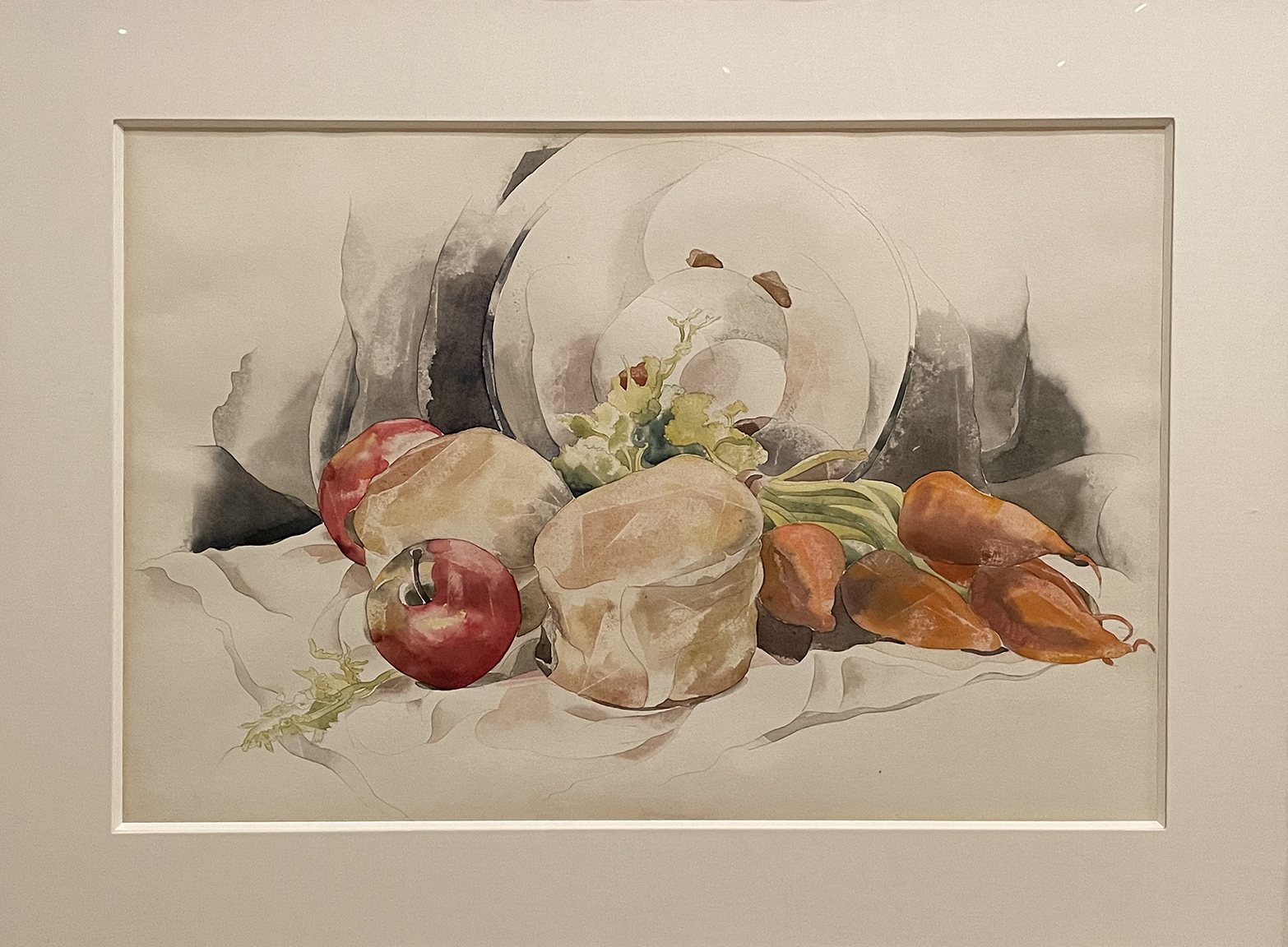
1. Charles DeMuth, Apples and Carrots, c. 1926. Watercolor

2. Auguste Rodin, Nude with Legs Spread, c. 1900-1914. Graphite and watercolor on wove paper

3. William Blake, The Complaint of Job, c. 1786. Brush with wash over graphite

4. Willem de Kooning, Untitled (two figures), c. 1947. Paint, watercolor, charcoal, graphite

5. Tsukioka Yoshitoshi, Young Couple Praying by a River and Young Woman Looking to Her Right, c. 1860. Brush with red and black ink


Thursday, December 13, 2018

Art I'm Making: "Go Figure" at The Sebastopol Center for the Arts

I'm pleased to say I got word today that two of the three pieces I submitted to the upcoming "Go Figure" show at The Sebastopol Center for the Arts were juried into the show. The show will feature representations of the human figure from more than sixty artists from all over the world.

One is this drawing of a young pregnant woman I did years ago, in Tokyo, using sanguine conté crayon. She had been disowned by her family and needed money, so had turned to modeling. She had become pregnant by her boyfriend, who she told me was a Greek sailor. The stuff of Victorian novels....

And here is the second of my two pieces that will appear in the upcoming "Go Figure" show at the Sebastopol Center for the arts.

An untitled nude. This is a traditional photograph (a gelatin silver print), a view of Kanako, the first model I ever hired. She had a habit of stretching before we began a session of drawing or photography. In this photo I caught her in side-light as she linked her hands behind her head and twisted a little to limber up her back.

The show opens Friday, January 11. It will run through Sunday, February 17 at the Sebastopol Center for the Arts, 282 S. High Street, Sebastopol, CA 95472. Telephone (707) 829-4797. Information also at info@sebarts.org The opening reception will be at the Center, on January 11 from 6:00PM to 7:30PM.

Sunday, January 8, 2017

Books I'm Reading: Aaron's Code

Dr. Harold Cohen and his creation, a computer program/drawing machine named Aaron, seem to be virtually unknown today, even among my artist friends. From my first personal encounter with Aaron (in early 1985), however, I thought him an extraordinary creation. Having just read Pamela McCorduck's well written, deeply researched book about Cohen and his machine, Aaron's Code: Meta-art, Artificial Intelligence, and the Work of Harold Cohen (Freeman, 1991), my admiration for Aaron and his creator has only grown.

Before reading the book, I knew little about Cohen's background. I had assumed he was a computer scientist. To the contrary, Cohen was a successful abstract painter in his native Britain before he ever began to dabble in computer programming in the late 1960s, a time when computers were primitive. In 1968, dissatisfied with the life of a painter, he left the UK to accept a position at UC San Diego, where he met Jeff Raskin (later of Apple Computer), who taught him how to write code.

Cohen's initial motivation appears to have been creating a machine that would help him make his own art, but he quickly became fascinated by fundamental questions about the process of artistic creation, the very definition of art, and how art generates meaning—about the cognitive processes that underly art-making and the experience of art. He started down a decades-long road that resulted at first in a program that created crude drawings, based on a complex set of general rules about line and spatial organization, but eventually evolved into a vastly more sophisticated program with "knowledge" not only about the process of filling a sheet of paper with marks that are meaningful to human beings but with knowledge about objects in the real world, including plants and the human figure. In its initial, mark-making phase, Aaron drew in black ink on white paper. Later Cohen gave Aaron color.

Aaron is infinite. Run the program and Aaron will create a unique drawing based on his knowledge about what makes an image. While Aaron has a distinct style, no two of his drawings are ever the same. Now that his creator, Dr. Cohen has died (in April, 2016, at the age of 87), Aaron will learn nothing new, but he will forever be capable of creating art, so long as the platform he runs on remains viable and there are people interested in seeing a new drawing.  

The existence of Aaron raises interesting questions about art, about intelligence, and about the meaning of art and the meaning of making art. Is Aaron intelligent? In some sense, yes. Is Aaron self-aware? No. Is Aaron expressing anything when he draws? No: Aaron is a computer program with no feelings, no motivations, no memory even of what he has drawn before. Yet, what Aaron creates generates meaning in the minds of those who see his work. And this is, perhaps, the most interesting idea McCorduck's book conveys: that Dr. Cohen saw art as generating meaning in the viewer rather than communicating meaning from the artist. Aaron is an excellent argument for the idea that the meaning in a work of art is almost wholly in the mind of the viewer. The book and its subjects are rich beyond my ability to express them. Suffice it to say, this is likely to be an exciting read for anyone with an interest in the human activity we call art-making. Aaron's Code is out of print, but I easily found a copy for a few dollars on line, and good libraries may have a copy*. Recommended.

*I just did an online search: In the Bay Area, there are copies in the libraries of UC Berkeley, UC Davis, Stanford, and in the San Francisco Public Library system.
SaveSave

Friday, May 29, 2015

Art I'm Looking At: Seiko Tachibana on the Art Wall at Shige Sushi, Cotati (June 2 through August 2, 2015)

In my role as a curator, I'll next be showing the work of Oakland-based artist Seiko Tachibana on the Art Wall at Shige Sushi in Cotati. The show opens this coming Tuesday, June 2 and will run through August 2. Artist reception Monday, June 8.

Seiko Tachibana completed her Master of Art Education degree at Kobe University, Japan. She received an MFA from San Francisco Art Institute and has since received many awards for the body of her work. She has had many solo and group exhibitions internationally. Her distinctive art balances Asian tradition with minimalist modernity. Her work shows an interest in a wide range of media, including drawing, painting, mixed media, and printmaking. Among printmaking techniques, she is a master of intaglio processes, particularly aquatint. Tachibana’s prints are in the permanent collection of the Los Angeles County Museum, The Fine Art Museums of San Francisco, and the Portland Museum of Art, among others. She is widely collected in the US, Europe, and Japan. In the Bay Area, Tachibana is represented by the Ren Brown Collection, in Bodega Bay.

Shows on the Art Wall at Shige Sushi are curated by me, Colin Talcroft. For information about artwork or artists, about purchasing art, or about showing art on the Art Wall, contact Colin at Shigecurator@yahoo.com. For more information, visit http://ctalcroft.wix.com/artwallatshige/

This week is the last week to see the current show: Suzanne Jacquot: Abstract Painting. For more information about what's going on on the Art Wall, visit http://ctalcroft.wix.com/artwallatshige/


Related Posts with Thumbnails