Showing posts with label The Legion of Honor. Show all posts

Thursday, November 13, 2025

Art I'm Looking At: Manet & Morisot at The Legion of Honor

I recently saw ‘Manet & Morisot’ now on at the Legion of Honor in San Francisco. I thought it well worth a visit for two main reasons. First, it offers an unusual opportunity to see a large number of paintings by Berthe Morisot all together and, second, it offers an equally unusual opportunity to see three of Manet’s most famous paintings (‘The Balcony,’ ‘Boating,’ and ‘The Railway’), which are usually widely dispersed. In addition, the show highlights the relationship between Manet and Morisot both on a personal level and as painters, which, of course, is the central theme of the exhibition. ‘Manet & Morisot’ runs through March 1 next year in San Francisco before moving to the Cleveland Museum of Art  for a run from March 29 through July 5.

I had not seen a lot of work by Morisot before, although I am well aware of her and knew that Manet and Morisot were close friends. Manet painted her several times (there are two or three of his portraits of her in the show) and eventually they became family when Morisot married Édouard’s brother Eugène. In 2010 I had the privilege of spending a week in Paris staying in the apartment of friends. It was a short stroll away from the Cimetière de Passy (the Passy Cemetery) where I saw the side-by-side graves of Édouard, Eugène, and Morisot, among other celebrity graves, including those of the composers Gabriel Fauré and Claude Debussy.

I was impressed by Morisot’s bold, loose brushstrokes. Unlike Manet, Berthe Morisot belonged to the Impressionist group, having been invited to exhibit in the first Impressionist show by Edgar Degas. She exhibited in all but one of the subsequent Impressionist shows. Her brushwork brought several painters to mind, including Munch, Joan Mitchell, and Sargent, although I don’t mean to make any sort of direct comparison; Mitchell, was, of course, a mostly abstract painter and it has to be said that nobody has ever matched Sargent’s ability to evoke a texture or capture a highlight in a single, perfectly placed abstract smear of paint from a loaded brush, but these painters are all notable for their very obvious brushwork. I’ve included here a couple of details of Morisot up close. The show suggests that it was the influence of Morisot that led to Manet adopting a looser style over time, becoming more willing to let the brushwork show. 

I have seen both ‘The Balcony’ and ‘Boating’ in person in their normal homes (respectively the Musée d’Orsay in Paris and the Metropolitan Museum of Art in New York) but neither recently. It was particularly interesting to see ‘Boating’ again and in this context. The wall label notes that it was started in 1874 but that Manet worked on it repeatedly for at least a couple of years after that. What I thought striking was the background (essentially, the water), which appears to have been heavily reworked in the top third of the painting. I was left wondering whether he had started with obvious brushstrokes in all of the areas corresponding to water and then softened the brushwork in the top third of the image or if he had later added more painterly strokes in the lower two-thirds. Whichever is the case, the two sections appear rather starkly different and there isn’t much of a transition between them – something I’d never noticed before. It would be natural to blur the upper part of the background gradually to suggest distance, but the contrast between the two areas is quite noticeable once you notice it. It may be that he toned down the brushwork in the upper portion because it distracted from the face of the male figure. Who knows? In any case, there was much of interest to see in this show. Recommended.

Sunday, December 1, 2024

Art I'm Looking at: Mary Cassatt at Work at the Legion of Honor

Earlier I posted some comments on the Tamara de Lempicka show at the De Young Museum (see below). Also on view right now in San Francisco is a large show of work by Mary Cassatt (1844–1926) at the Legion of Honor (through January 26, 2025) entitled "Mary Cassatt at Work" with, as that suggests, an emphasis on her working process. 

The highlight of the show for me was the great deal of material dealing with her early printmaking and particularly the section explaining her development of a technique to mimic Japanese multi-block woodblock printing using multiple, carefully registered etched and acquatinted copper plates rather than woodblocks. She was inspired by seeing a show of Japanese ukiyo-e. Here I post a few of my favorites from the show.


Thursday, August 15, 2024

Art I'm Looking At: Japanese Prints in Transition, at the Legion of Honor

I recently visited The Legion of Honor in San Francisco and saw a couple of worthwhile shows – "Japanese Prints in Transition: From the Floating World to the Modern World" (through August 18) and "Woodcut: Primary Printmaking" (through October 20) I'll write more about the latter in a separate post. 

The first of these two shows, As its title suggests, is a survey of Ukiyoe with an emphasis on how the medium responded to the very rapid changes that occurred in Japan with the opening of the country after about 250 years of self-imposed isolation and the Meiji Restoration in 1868. Visually, the most obvious change is from the use of natural pigments to the harsh reds, greens, and purples that suddenly appear with the introduction of synthetic aniline dyes. These garish colors became available with the opening of the country in the early 1860s and had become widely used within a decade or two. They were popular because they were inexpensive and vibrant, but I find it hard to avoid feeling that prints using these dyes are mostly inferior to the subtler work of earlier periods, although they are of historical interest. That said, the show has many examples of prints of this period depicting "modern" subjects, which to a large extent meant foreigners and the foreign artifacts and inventions that began to stream into the country along with the aniline dyes. In a complete reversal, the newest prints in the show, by Masami Teraoka (made starting in the 1970s) revert to the more subtle palate typical of the Edo Period, which is being parodied in his work. 

The aniline dyes were at least color-fast. An interesting earlier print shows a scene with an odd olive-yellow sky. The accompanying label notes that the sky would originally have been blue, but, printed with a fugitive, naturally-derived pigment made from Asiatic Dayflower (露草 Commelina communisa), the blue has completely faded away. 

There are some nice early prints, including two by Sharaku, whose work is scarce, although one of the two is not in very good condition. The best examples of his work I have seen have been in shows in Japan – although not necessarily from Japanese collections. The best-preserved examples of Ukiyo-e of any kind I've seen in Japan have been on loan from the collection of the Boston Museum of Fine Arts. 

The Legion of Honor Show includes examples of some of the most recognized Ukiyo-e images – notably The Great Wave, by Hokusai, which has been called the second-most famous work of art in the world after the Mona Lisa. The show also includes two prints that appear in paintings made by Vincent Van Gogh. Also of interest are  prints depicting places and events far from Japan that the wall labels point out were known to the print designers only from newspaper reproductions that were coming into the country. Exposure to foreign images is also evident in the way that Western perspective creeps into some of the later prints. 

At the end, I was a bit surprised to see that shunga (erotic prints) had been completely neglected until I exited through the inevitable gift shop to see that there was an entire, separate room devoted to these, including top-notch examples by Utamaro and Hokusai.  

As noted above, the show continues until this Sunday, August 18. The Legion of Honor is at 100 34th Avenue (at Clement St.), San Francisco, CA 94121, generally open from 9:30 to 5:15, closed on Mondays.

Tuesday, January 16, 2024

Art I'm Looking at: Botticelli at the Legion of Honor

I found a recent article on Hyperallergic about drawing on blue paper interesting (actually a review of a book on the subject) – particularly interesting having recently seen the show of Botticelli drawings now at the Legion of Honor, in San Francisco.

It was striking that so many of the Botticelli drawings were done in ink on tinted paper, mostly pink paper in this case, heightened with white chalk. 

While at the Botticelli show, I was startled when a living Botticelli appeared beside me, gazing at the drawings on the wall. Her hair was long and blonde, flowing in loose curls, and her doe-eyed face was dainty with a pointed chin. Had she not been dressed in modern, casual clothing, she could have emerged from Botticelli's Primavera. It was all I could do to keep myself from staring at her. I had to wonder whether it was pure coincidence or whether she had done her hair that way purposefully, to create a stir. If she hadn't been wearing headphones, listening to a taped tour of the show, I would have approached her and asked her to pose in front of one of the drawings. Surreptitiously, I photographed her. She gave me goosebumps. 


Sunday, August 13, 2023

Art I'm Looking At: Drawing the Line at the Legion of Honor

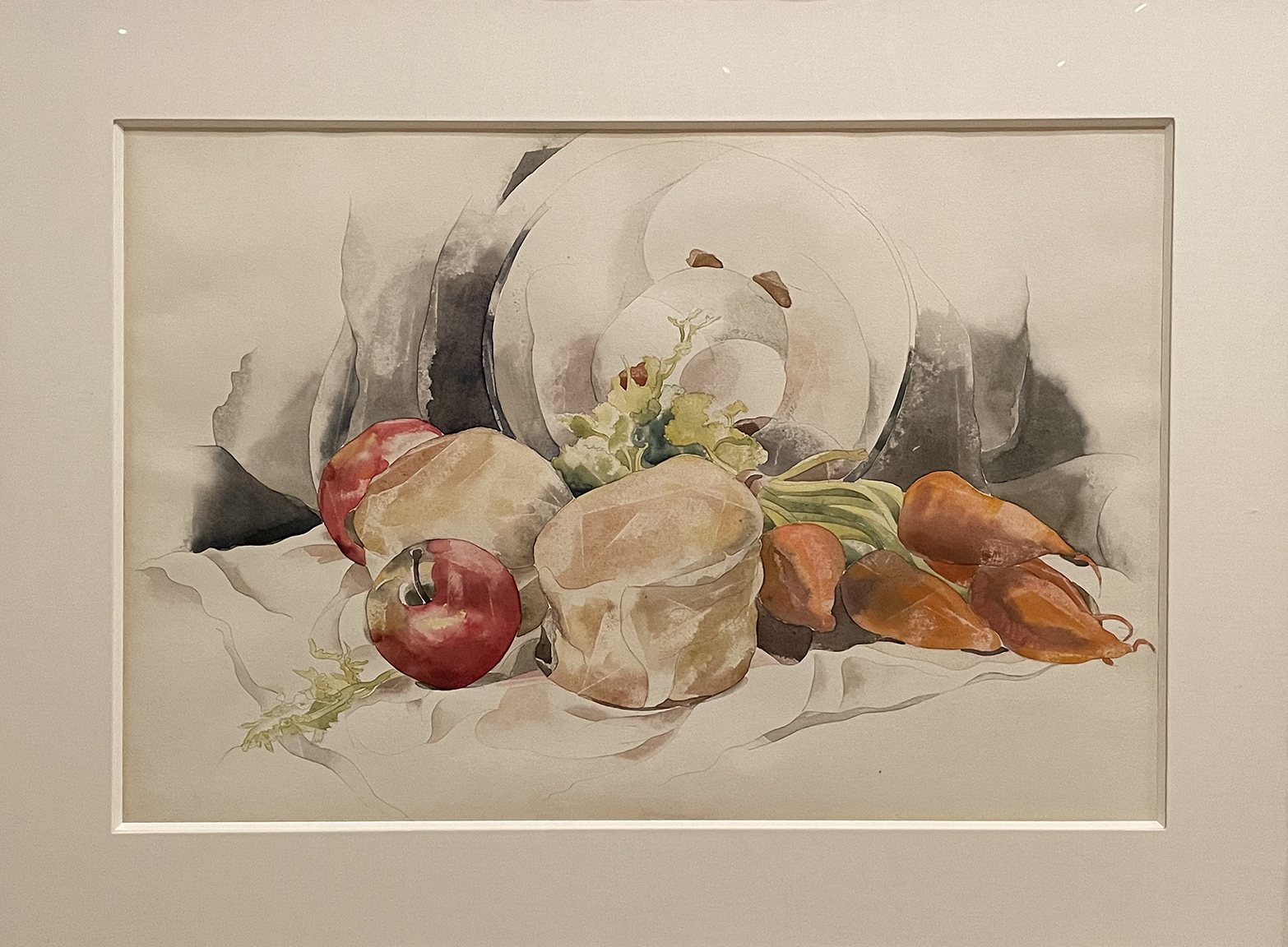
I went into San Francisco on Friday to see what was on at the Legion of Honor. I posted yesterday about the spectacular Holbeins in the Tudor show there through September 24. Today I'm posting about a small, easy-to-miss exhibition in the Achenbach Foundation gallery that's down one of the side hallways downstairs at the Legion, which was an unexpected pleasure. Entitled "Drawing the Line: Michelangelo to Asawa," a selection of work from the museum's collection of works on paper. 

According to the museum, the show is intended to highlight drawings that emphasize the use of a prominent outline. I'm not sure all of the selections make sense from that perspective, but everything on the wall is worth looking at. 

To quote from the Legion of Honor/De Young Museum website,"The selection ranges from minimal line drawings by Michelangelo and Andy Warhol to fluid figure studies by Pablo Picasso and Ruth Asawa. One of our most treasured works, Paul Gauguin’s large-scale portrait L’Arlésienne (Madame Ginoux) (1888) is on display for the first time in more than a decade." 

If you enjoy the art of drawing, the Legion of Honor is worth a visit right now just for the chance to see this group of gems. "Drawing the Line" will be on view through February 25, 2024. I've chosen some of my favorites here, but these represent only about a small fraction of what's on view.

Pictured here, top to bottom: 

1. Charles DeMuth, Apples and Carrots, c. 1926. Watercolor

2. Auguste Rodin, Nude with Legs Spread, c. 1900-1914. Graphite and watercolor on wove paper

3. William Blake, The Complaint of Job, c. 1786. Brush with wash over graphite

4. Willem de Kooning, Untitled (two figures), c. 1947. Paint, watercolor, charcoal, graphite

5. Tsukioka Yoshitoshi, Young Couple Praying by a River and Young Woman Looking to Her Right, c. 1860. Brush with red and black ink


Saturday, August 12, 2023

Art I'm Looking at: The Tudor show at The Legion of Honor

Portrait of Henry VIII of England, 1540
Hans Holbein the Younger
Galleria Nationale d'Arte Antica, Rome

Yesterday I had a day off from work, so I went into San Francisco to the Legion of Honor to see the Tudor show now on there (through September 24). There was much of interest to see, but it's worth going just for the paintings by Hans Holbein the Younger. There are no less than five on view – offering a rare opportunity to see a large group of works by one of the world's greatest portraitists all at once. 

Hermann von Wedigh III, 1532
Hans Holbein the Younger
The Metropolitan Museum of Art, New York

The paintings are on loan from the National Gallery of Art, in Washington D.C., the painting galleries of the Kunsthistorisches Museum, in Vienna, The Metropolitan Museum of Art, in New York, and the Galleria Nazionale d'Arte Antica, in Rome. I've reproduced the four full-sized paintings here (the fifth is a miniature that I was unable to photograph well), along with a fairly spectacular full-length portrait of Queen Elizabeth I, not by Holbein.

Jane Seymour 1537
Hans Holbein the Younger
Kunsthistorisches Museum, Vienna


Edward VI as a Child 1538
Hans Holbein the Younger
National Gallery of Art, Washington


Elizabeth 1, c.1599
Attributed to the workshop of Nicholas Hilliard
National Trust Collections, Hardwick Hall


Related Posts with Thumbnails