Sunday, July 25, 2010

On the road (Europe 2010): Florence (continued)

Having been out of touch with the Internet the past few days, I've been unable to update things. A little catching up is in order. First, more about Florence.

Spent two days in Florence visiting some familiar sites and going to a few new ones as well. Saw the Uffizzi again. Buying an advance ticket costs an extra €4, but it was well worth it to avoid the lines. Even so, it was crowded--and hot. I have never visited Florence in the heat of summer before. I was surprised to see how poorly the museum is ventilated. It was as hot in some of the galleries as it was outside. Still, it was good to see the place again. I enjoyed seeing the Botticellis, but also the wonderful Hugo van der Goes Portinari Triptych in the large Botticelli room that houses Venus and Primavera. To me, it's just as good as the Botticellis, but most people turn their backs to it, adoring Venus. There are several wonderful Bronzino portraits, and so much more--but no one needs me to catalog the wonders of the Uffizzi....

Took a quick look at Orsanmichelle. It's an interesting building, even knowing that the distinctive collection of sculptures in niches all around its exterior consists entirely of copies. The originals are in the Orsanmichele museum and a couple of other museums around the city. The building was originally a grain warehouse and market. It was turned into a church around the end of the 14th century. It became the chapel of Florence's trade and craft guilds. The statues on the facade were commissioned by the guilds, which competed with each other to impress. It has a very ornate tabernacle with a madonna and child by Bernardo Daddi, dating to around 1346. The ceiling is heavily decorated as well. You can still see large iron rings set into the ceiling that once were used to support ropes for moving heavy bags of grain (look closely at my photo here; the left-hand figure painted on the ceiling has one of these approximately at her belly button).

Saw some of the Church of San Lorenzo and its appendages. Because of the timing of closings (and more restoration work), I missed seeing the connected Laurentian Library, with its idiosyncratic staircase. I really don't understand why these places--visited by millions annually from all over the world--should close at all. The administrators charge an arm and a leg to let you see them. Surely the funds are available to pay staff to keep things going for a full day, rather than closing at odd hours like 11:30.

The Medici tombs in the Cappella dei Principi were half covered by scaffolding, but the huge space decorated in pietra dura (elaborately cut and fitted stone) was dazzling nevertheless. I'd forgotten how big and imposing the place is. The visitor does not leave without knowing very clearly how powerful and wealthy the Medici family was.

The New Sacristy (also connected to San Lorenzo) is interesting for what is and isn't in it. It was left unfinished when Michelangelo left Florence for Rome in 1534. I wonder why they never got someone else to finish at least the architectural elements, if not the sculptures? There are places on the blank walls that have been partitioned in pencil in preparation for installation of pilasters and other decoration that never materialized. Michelangelo's famous tomb sculptures--Day and Night and Dawn and Dusk are here. As is often pointed out, the figures are beautifully carved, but design is emphasized at the expense of anatomical and architectural sense--Day, the male figure to the right  in the photo, has impossibly small feet  (his face was left unfinished as well) and the pilasters on either side of the central figure support nothing. This is the tomb of Giuliano, Duke of Nemours, third son of Lorenzo the Magnificent. Opposite (adorned with Dawn and Dusk) is the tomb of Lorenzo, Duke of Urbino, Grandson of Lorenzo the Magnificent. From Florence, we began the long drive west, back to France, stopping off at Pisa, the Cinque Terre, Barbaresco and Barolo in the Piemonte wine country, and then made a final mad dash back to Pouzolles on the freeways through Monaco, Nice, Marseilles, Nîmes, and Montpellier (seeing none of these latter).

Tuesday, July 20, 2010

On the Road (Europe 2010): Florence

Arrived in Florence last night after dark. Saw the Duomo, with its campanile and dome--all lighted and looking like a decorated cake--for the first time in many years. Much of it has been cleaned since I was last here. The campanile, the main facade, and much of one side of the Duomo have been cleaned. The white marble is white, the pink marble pink, the green marble green. In contrast, the rest (as well as the adjacent Baptistery) looks quite dirty—as if covered with a layer of ash.

Went up in the dome today then walked around the city some and saw the Basilica of San Croce, which I’d never visited before. The church itself isn’t that interesting, but this is where Michelangelo, Gallileo, Machiavelli, Danté, and Rossini are buried—along with about 250 others, mostly under marble panels set into the terra cotta tile floor. Some of the panels have simple inscriptions with coats of arms, others have full figures carved in marble, but these have mostly been worn away by hundreds of years of foot traffic.

I particularly enjoyed seeing Gallileo’s tomb. Why are the resting places of the illustrious fascinating? I don’t know. Visiting a grave like that of Gallileo gives a sense of being in the presence of greatness, even if nothing is there but bones hundreds of years old—if the bones really are there.

There are some good paintings inside the church, for example, a good Bronzino pietá and another large Bronzino that I rather liked. There is also a very simple but interesting chapel, the Pazzi Chapel, designed by Brunelleschi, that is decorated with roundels by Luca della Robbia. According to my guide book (Blue Guide Concise Italy, Somerset, 2009). This is an early Renaissance use of the central plan (which refers to a round, square, or octagonal space topped by a dome) that was common in Roman architecture. It became part of the Christian architectural repertoire in the form of baptisteries and pilgrimage chapels. Brunelleschi is credited with introducing it to Florence. The latin tradition had hitherto favored the rectangular basilica form.

Visiting the main dome was a bit of a disappointment. Since I was last here they have raised a thick plastic barrier above the railings on the interior walkways, which obscures all views downward, obscures about half of the views up into the inside of the dome (the paintings have been restored since I last visited, too), and removes all sense of freedom; the walk around the interior of the dome used to be quite scary as the railing is no more than waist high and the drop below is a very big one. Still, it was nice to see the panoramic view of Florence from the top of the dome, to see the interesting brickwork inside the dome, and to see some of the timbers in the chain of large oak trunks that helps to hold the dome together.

Later, took a walk down to the Uffizzi to get advance tickets for tomorrow, which will avoid a wait in line. Took a detour down to the Arno to look at the Ponte Vecchio. When I was last here, the approach from the Uffizi side was closed because there had just been a bombing at the Uffizi (when was that? 1994  or so?). I wanted to see it from the Uffizi side as my photographer grandfather shot it from this side in the late 1920s or early 1930s. I walked along the bridge, looking at all the gold and jewels for sale. Hot, tired tourists were everywhere,  taking pictures of themselves, the sights, and seeking out cold water, sodas, gelato—anything cool. Now I remember why I always used to come to Europe in late September or  early October….

Walking home at the end of the day, I came across a red Alfa Romeo Spider parked in the street. Owning a 1978 Spider myself, I stopped to have a look. In the three or four minutes I spent looking at the car, about six people stopped to take pictures of it. A small crowd formed at one point. This appears to have been an earlier seventies car than mine, but it had a few anachronistic modifications (newer seat belts, newer antenna, missing something around the headlights). Still a very snappy-looking design, after all these years. 

On the Road (Europe 2010): Corsica to Livorno and Florence

On Corsica, visited the house where Napoleon was born, in Ajaccio. He lived there until he was nine and stayed there many times over the years. It isn’t clear exactly where Napoleon came into the world (in which room, that is), but it was interesting to see the place, although little of it remains as it was when he lived there. His mother completely refurbished and refurnished it once. Some of her furniture remains. It was later completely redone by Napoleon III and the house changed hands many times before becoming the national museum it is today. There are a few interesting paintings preserved (not least of which is a wall-sized map of Corsica), but it’s probably not worth a major detour unless you’re a serious Napoleon fan or just want to say you’ve been there. Having seen Napoleon’s tomb a few weeks ago in Paris, I feel like I should now go to Elba and St. Helena.

Corsica was impressive mainly for its mountainous scenery and the little villages clinging to the sides of the mountain roads in the center of the island, between Ajaccio and Rivosto. Stopped to cool off in the fast, cold waters of the Grevono river, where I soaked my feet for an hour or so while the rest of the family attempted to dam the river with the big rounded rocks everywhere.

Stopped in Bocognano, one of the picturesque mountain villages with a particularly good view. Much of the population appeared to be in the main café or watching a petanque match across the street. Two teams of women were competing. The men were all in the gallery following the action, occasionally offering advice or applauding a particularly good shot.


There was a delicious cold spring in the center of town pouring from a pair of brass faucets. People kept coming by to fill up water bottles. We filled ours and enjoyed a supply for a couple of days. It reminded me of Yellow Springs, Ohio. I don’t think I’ve tasted water so good from the source since then.

Saw three new birds in Corsica—or three that I was able to identify. One was the Greenfinch, the golden-green bird I had seen also in Spain and on Sardinia but not well enough to identify. Another was the Red Kite--a fairly large raptor with a distinctive trapezoidal red tail and pale “windows” in its wings near the base of the primaries. The third was the Blue Tit, a pretty, nervous little bird bigger than the Coal Tit but smaller than the Great Tit. I missed seeing a Corsican Citril Finch, which is to be found only in the mountains of Corsica, but the three new birds I did identify on the island brought my total of new birds so far on the trip to 43. I actually got four new birds if you count the Corsican race of the Spanish sparrow, which I also saw.

Crossed to Livorno from Bastia, in the northeastern corner of Corsica. It was a four-hour crossing, but it took nearly an hour to get off the ship because someone's trailer got stuck unloading from the boat. From Livorno, it was an hour's drive to Florence.

Monday, July 19, 2010

Wines I'm drinking: Cantina del Vermentino 2007 Vermentino di Gallura "Funtanaliras"

I am now in Corsica. Beautiful, rugged, mountainous terrain. There has been little time to sample the local wines, and it remains so hot that only well-chilled whites and rosés make any sense, but I did try a Corsican Vermentino that was tasty (although a little less crisp and higher in alcohol than the Sardinian examples I've had).

The best Vermentino I've tasted while traveling remains the 2007 Funatanaliras. I'm still enjoying (in memory) its exceptional perfume and excellent balance between fruitiness and fresh acidity. When I visited the producer in the little town of Monti (the local cooperative, the Cantina del Vermentino), they told me they have representation in New York and that the wine is distributed in California and other places. It may be available near you. Highly recommended. I paid only €5.9 euros (less than $7) a bottle at the producer (having seen it on menus for as much as around €20), but
it is likely to be considerably more expensive in the US.

On the drive to Monti, I passed a cork processing plant. There was a big warehouse with piles of cork outside and a truck or two piled absurdly high with cork.

Saturday, July 17, 2010

On the Road (Europe 2010): Sardinia to Corsica

Yesterday crossed from Sardinia to Corsica on a smallish ferry, a one-hour crossing. Corsica was easily visible from the port at Santa Theresa. The Corsican coast is impressive. The sea approach to Bonifacio is guarded by fortified walls, and the rocky cliffs themselves are imposing. The Moby Line ferry has a funny whale logo.

The drive through mountainous countryside from Bonifacio to Ajaccio, Napoleon's place of birth, gives a taste of the scenery here, which is much more rugged than the lower, softer hills of most of Sardinia. Arrived late at the hotel. Today will be spent visiting the museum at Napoleon's home before moving north and east. Tomorrow we will cross to Livorno, to begin the drive back to France, via Florence and the Italian coast.

Friday, July 16, 2010

On the Road (Europe 2010): Sardinia

Haven't had much time to write as we've been moving around almost non-stop, but arrived in Sardinia on the morning of the 14th via a very large Grimaldi Lines ferry from Barcelona. The boat left at 10:00 at night and arrived the following morning about 11:00 in Porto Torres, in the north. Slept poorly--or so I thought, but when I checked my watch, thinking it was probably about 3:00AM, it was already time to get ready to disembark.

Drove south along the west coast of the island, through Alghero (where it was fun to pass the vineyards and winery of Sella & Mosca, a name I know from drinking their wines in Tokyo). I found a funny T-shirt that says Cannonau in white script on a red background, imitating the Coca-Cola logo--a joke only a wine lover (and one that knows the wines of Sardinia) will understand.

In the rugged cliffs between Alghero and Bosa, I was lucky enough to get a look at three griffon vultures. They were circling high up and quite far away, but I could see them well enough to discern their distinctive features. A very big, impressive bird. So far, Sardinia has been good for birds. I've added ten new species to my life list. I finally got to see bee eaters--amazing-looking birds that fly fast like swifts one moment and then seem to stop in mid-air the next. They are unmistakable with their bright blue bellies, rufous and gold backs, golden throats, and angular, kite-like wings and tails.

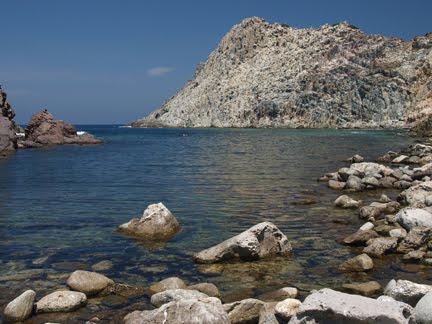
The beaches are as beautiful as everyone says they are. It would be easy to spend weeks here, trying a new beach every day. The water is the color turquoise, rather than emerald, despite the "Emerald Coast" name that has attached to the north coast of the island. The beaches are often in secluded coves decorated all around with rock formations sometimes reminiscent of Antoni Gaudí. Sheep and goats roam everywhere.

The food has been excellent, the people uniformly friendly and helpful, and I have really enjoyed drinking the Vermentino wines (which have always been a favorite of mine) here in the land that produces them. Far and away the best was the Funtanaliras Vermentino di Gallura made by the cooperative in the little town of Monti, where I was able to buy a few bottles at €5.9 a bottle (less than $7), having seen it on restaurant menus for as much as €20. The best Vermentino wines, like this one, are wonderfully fruity, but crisp and dry at the same time. Perfectly balanced and reminiscent of a good Chablis in some ways.

From Portoscuso, at the southern tip of Sardinia, crossed to the little neighboring island of Isola di San Pietro, which has spectacular cliffs and more good beaches. At an inlet called Cala Fico facing Isolo del Corno, an even smaller island off the coast, I had the privilege of seeing Eleanora's Falcons circling high overhead near the lighthouse, a very rare bird, like the Griffon Vulture. In Europe, they live only here and in similarly small pockets on the Dalmatian coast, in Greece and Turkey, and in coastal areas of North Africa. A very long and tiring drive late into the night (compounded by entirely inadequate headlights on the increasingly annoying rented Mercedes B Class) brought us to Olbia, near the northern coast. The following morning, we backtracked somewhat to visit Monti, which is the heart of the country that produces Sardinia's best Vermentino wines. The area looks rather like parts of California, with its soft, rolling hills, brown grasses, and oaks, but here the oaks are all cork oaks, many showing signs of recent cork harvesting.

Tuesday, July 13, 2010

On the Road (Europe 2010): Barcelona--Sagrada Familia, Palau Música Catalana, Picasso Museum, Park Güell

Spent most of the day yesterday visiting Gaudí's grand temple, the Sagrada Familia. Despite knowing that the church is unfinished, nothing quite prepares you for the shock of entering an active construction site as you step into the building. Sagrada Familia is recognizably a church, but it is very much a work in progress. Forklifts carry in palettes of mortar, workmen in hardhats direct loads suspended from cranes, teams of architects and engineers can be seen consulting high above the church floor on platforms built for access to the work under way. Everywhere the space reverberates with the sound of jackhammers, the clanging of pipes, the engines of work vehicles. Heavy dust floats in the air—sometimes very prettily in the shafts of light created by still unfilled openings for windows—but leaving one’s throat sore by the end of the visit.

Some of the stained glass windows have been installed, but mostly the glass is unfinished. The main columns that support the weight of the towers are in place and these branch from nodes high above the floor into three, four, sometimes five thinner columns that support palm frond-like structures above. From below, Gaudi’s design gives the impression that you’re looking up into a forest canopy.  Below the palm canopy is enough seating for a choir of 1,200 voices. I wonder what the place will sound like. The use of branching supports is not only interesting to look at, but it allowed Gaudí to abandon the flying buttresses that have been a staple of cathedral architecture for centuries, giving the exterior a somewhat sleek look, despite the heavy ornamentation, especially on the Nativity Façade. I much preferred the more traditional sculpture on this side of the church to the stark, angular, modern sculptures that adorn the opposite side of the church, the Passion Façade, although they were interesting too.

I enjoyed seeing the school building next door, which was originally intended to be a temporary structure to house a school for the children of men working on the church. This is another Gaudí design. It has a wave-form roof that reminded me of a surface of rippled mud—yet another example of Gaudí drawing on natural forms for inspiration.

Had an interesting lunch afterward at La Muscleria, a restaurant that specializes in mussels and claims to be the best mussel specialty restaurant in Barcelona—a claim I have no inclination to dispute. Nearly everything on the menu is mussels steamed or sautéed in various styles—from the traditional (such as steamed mussels with onions and white wine) to the more exotic (steamed mussels in a curry sauce). The steamed mussels are served in big, domed metal pots. Delicious, and highly recommended, unless you dislike shellfish, as some people do. If you're a fan of mussels and find yourself in Barcelona, don't miss this place.


The Palau Música Catalana is another architectural gem well worth visiting in Barcelona. We visited it on our last day in the city. It was not designed by Gaudí, but by Lluis Domènech i Montaner, who at the time was far better known than Gaudí. The Palau was built between 1906 and 1908 as the performance and administrative headquarters of the Orfeó Català, a choral group founded around 1891, one of many that were active at the time, singing mostly Catalan popular songs. The Palau still serves its original function, but now hosts performers of all kinds from all over the world. Everything—the façade, the original outdoor ticket windows (ticket sales have since moved to an addition), the stairways, and the concert hall itself—is decorated in tile, glass, and terracotta sculpture. Like the building that houses the Natural History Museum in London, there is an unseen steel framework that supports the structure. The steel is hidden by the exuberant terracotta decorations. In the concert hall proper, the organ is impressive, but the centerpiece is the terracotta and tile frieze of the 12 muses behind the stage (below the organ). This, too, is a UNESCO World Heritage site.

Visited the Picasso Museum, which is an excellent introduction to Picasso's early work. I knew that his father had been a painter and was under the impression that Picasso had had his early training mostly from his father, but I see now that he went to art school, in Barcelona. The many examples of the early work are interesting because the tension between his academic training and his own instincts is palpable in some of the work. Picasso is not one of my favorite painters, but this museum was well worth the visit just for the perspective it gives by showing much of his earliest work and by showing the work of many painters he associated with in his earliest days. It was an appropriate end to a day with lunch at Els Quatre Gats, one of Picasso's Barcelona hangouts.

Also saw Park Güell, partly designed by Gaudî. The park was something of a disappointment because it's not an integrated whole. It gives the impression of having been an existing park that Gaudî embellished after the fact (which I think it was). That said, the mosaics are interesting--when you can see them through all the tourists and illegal street vendors. Watching the vendors disperse like scared roaches on the approach of policemen was amusing. 

Sunday, July 11, 2010

On the Road (Europe 2010): Barcelona (Spain Wins the World Cup)

Well, it was interesting being in Barcelona as Spain won the 2010 World Cup. It's well after midnight and the town is still awash with people celebrating--people draped in Spanish flags, people wearing red Spain jerseys, people with their faces painted red and yellow. Anything that can make noise is making noise--plastic trumpets, car horns, scooter horns, fireworks. People are dancing in the streets.

On the Road (Europe 2010): Barcelona

Busy day in Barcelona. Started with an early morning tour of Gaudí's Casa Batlló (pronounced casa bahtYO), one of the many fashionable houses that line the Passeig de Gràcia, a restoration and redesign (1904-1906) of a late 19th century building existing on the site. A truly remarkable building. It's hard to imagine a more photogenic piece of architecture. You can look anywhere and the effect is calculated and pleasing. Every detail has been considered. I could post dozens of photos of this place alone.

The use of light is particularly interesting. Gaudí expanded the inner open space in the building that brings light to each floor and added skylights in various places, so that there is natural light almost everywhere. The space is covered in varying shades of tiles evocative of the ocean--as the entire building is--with darker tiles at the top and lighter tiles at the bottom, creating the illusion of even light from top to bottom. Inversely, the windows get larger toward the bottom of the building to bring in more light on the lower floors and block some of the stronger light on the higher floors.

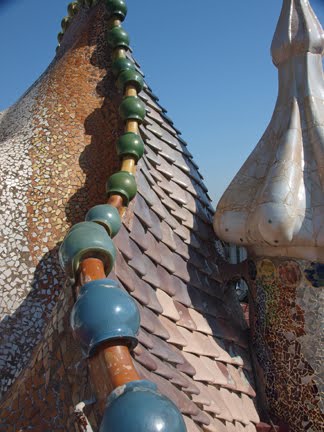
The roof has a sinuous ridge of tiles that made me think of an iguana, although others have likened it to the back of a giant sea creature. The cross-topped tower resembles a bulb of garlic.  A strange and wonderful design. It must have been quite a shock to more conservative tastes at the time of its construction, but the building next door is not exactly tame, and everywhere in Barcelona the facades are richly decorated. Still, nothing is quite like this. It's deservedly famous. The admission price is steep, but I didn't feel cheated, and the money goes to preservation work.

Next visited La Pedrera, another Gaudí design. This is an apartment complex, part of which is open to the public. Another remarkable building, but not so photogenic as the Casa Batlló. I found it interesting mainly for the arched structures that support the roof of the building and for the sheer spaciousness of the apartments. One of these is open to tour. There are many large rooms, a big kitchen, rooms for children, for maids, for sewing.... All attractively lit with natural light.

Following lunch, visited the Fundació Antoni Tàpies, a museum of contemporary art and a research facility with an impressive library of art books. It was created by Antoni Tàpies to promote the study and understanding of modern art. I was hoping to see more work by Tàpies himself there, but the small current exhibit of works by Eva Hesse was interesting. Saw Flamenco after dinner. It was decent, but I've seen far better in Madrid. The World Cup Final match was going on, we could hear the cheering when Spain scored its goal. The dancers were clearly pleased and it showed in the dancing.

Saturday, July 10, 2010

On the Road (Europe 2010): Berga, Montserrat, and Barcelona

Left Berga on the morning of July 10 for Barcelona by way of Monsterrat. Berga redeemed itself the evening before with one of the best meals of the trip, at Restaurant Sala (Paseo de la Pau, 27, Berga 08600), following perhaps the worst meal of the trip at Hotel Estel. The hotel itself was fine--nothing fancy, but serviceable--but I'd avoid the restaurant there at all costs. Having said that, breakfast was pleasant enough on the terrace the following morning, which was blessedly cool for a change.

The meal at Restaurant Sala featured carpaccio of shrimp, apple ravioli (ricotta cheese in paper thin slices of apple, on top of even thinner slices of tomato with a light olive oil and balsamic vinegar dressing), a wonderful mushroom soup, Scampi, baby squid with vegetables and wild mushroms (pictured), and other tasty things. The chef seems to really like mushrooms. There were many dishes on the menu that featured one kind or another. Washed it all down with a crisp, fragrant 2008 Vionta Rias Baixas Albariño.

Spent most of the 10th in Montserrat.  The place reminded me of Lourdes, which isn't much of a recommendation. It's rather commercialized (with big souvenir shops), and I was surprised to see that nearly all of the construction is new (only about 100 years old), but the place has its good points as well--and apparently nothing much is old because Napoleon's army razed the place.

The mountains are undeniably beautiful. Montserrat, or "serrated mountain," is aptly named--there is a stark ridge of exposed stone points at the summit. At the top there are good hiking trails (accessible by a very steep funicular railway) that give wonderful views all the way to Barcelona and beyond. The rock is a very attractive pegmatite with inclusions of many colors of fist size or bigger. There is a small but interesting art museum (the collection is mostly modern Catalan and uneven, but there are quite a few paintings worth seeing, including two very early Picassos; I liked many of the Catalan works, but no photography is allowed, so I was unable to remember any of the names). Besides paintings, the museum has a small collection of art from antiquity from various parts of the Holy lands (glass, pottery, cylinder seals, etc.).

The famous Virgin of Montserrat in the monastery was worth a look. It is the most revered piece of sacred art in Catalonia. While standing in the long line of pilgrims and tourists waiting to view her, there was a wedding going on in the church. I couldn't see much of what was happening, but someone sang Schubert's Ave Maria beautifully. Schubert would have been famous if he had written nothing else.

The wooden statue is Romanesque, from the 12th century, and probably carved in Jerusalem. According to legend, it was found in a cave below where the monastery stands today (the cave can be visited, but there wasn't time). The monastery was built to house it. Because it has blackened over the centuries, it is known as La Moreneta, or "the little dark one."

On the bird watching front, I've added four new species to my life list since last writing, for a total of 30 new birds since leaving the US. I got a glimpse of a Eurasian jay and good looks at long-tailed tits in the mountains between Cardona and Berga, and good looks at alpine swifts (bigger than the swifts at Pouzolles, and with a pale belly) and a Dartford Warbler, both at Montserrat, in the hills above the monastery. The swifts came quite close at times, sounding exactly like bottle rockets as they whizzed past.

Arrived in Barcelona in the early evening. It took about an hour to get to the hotel because many of the streets were blocked off, for reasons that weren't clear. Had time to walk around a little and have a late-night meal. Tomorrow will be the start of a couple of days seeing the sights.

[It later became apparent that the blockages were related to the World Cup soccer matches.]

Friday, July 9, 2010

On the Road (Europe 2010): Cardona, Spain

Yesterday spent the day in the Cardona area, visiting the main local attraction, which is the mountain of salt that first made this area prosperous. The mine in the folded mountain formation is no longer active, but you can tour part of the old works, which allows you to see some of the tunnels miners used, but, more interestingly, it allows you to see the salt formations in detail. Mining in this area goes back to neolithic times and the Romans extracted salt here as well. It wasn't until fairly recently that vertical shafts were dug into the deposit to mine it.

There are only three places in the world where salt deposits have been folded vertically into a mountain. One is in Colombia, one is in Romania, and one is here. The deposits originated in an arm of the Atlantic Ocean that once covered most of Catalonia. They are about 40 million years old. Stained with iron oxide, they are mostly shades of brown and orange, but fresh crystals of white sodium chloride (common table salt) have formed on the surface of the ancient deposits in many areas because of water seepage. There are impressive salt stalactites in places.

At least three kinds of salt are present, sodium chloride (halite), potassium-magnesium chloride, (carnalite), and another, that I've forgotten the name of that is mostly potassium chloride. The carnalite crystals were especially pretty, looking like topaz and in some places like the stone carnelian (the names share a root, of course; carne, or "meat," which is appropriate as some of the ubiquitous Spanish hams look rather like carnelian, too).

Commercial mining in the 20th century seems to have focused on extracting potassium salts. The unwanted sodium chloride was dumped next to the natural formation. In the first photo here, the ancient folded salt dome is the area of exposed cliffs. The flat area with machinery on it and the area just behind that is the dumped mine waste that is itself now being "strip mined" for sodium chloride for industrial applications. Worth a visit.

On the road (Europe 2010): Carcassonne to Berga, Spain

Spent most of yesterday looking around Carcassonne. Carcassonne is really two cities. There is a new city and the old walled city. The two are separated by a river crossed by two bridges, the Old Bridge (now for pedestrians only) and the New Bridge, reserved for vehicles. The new city looks fairly prosperous. There is a substantial railway station, several large squares, and a long, pedestrian-only shopping street with fashionable shops. But even the modern city is here and there dotted with the occasional old building, sometimes several centuries older than what surrounds it, decorated with carved stone. The old town consists mostly of old stone structures, but there is a thriving tourist trade, so many shops sell the usual post cards and souvenirs. Had a fair dinner at Le Saint Jean and a very good lunch at L'Auberge des Lices, which is very hard to find, but probably worth seeking out.

Like so many places in Europe, the old city is a layer cake of construction and destruction over the centuries. If I understand correctly, most of the lower level of the walls is Gallo-Roman, but much of that is itself built on older construction. Medieval additions were made over hundreds of years. Carcassonne fell into ruin (and was to be torn down at one point) after the border between France and the Kingdom of Aragon was moved further to the west (to the Pyrenees) and Carcassonne was no longer a border stronghold. When the ever-present Viollet-le-Duc began restoration work in the 19th century, Carcassonne appears to have been in rather poor shape. Viollet-le-Duc attempted to restore the walls to what they would have looked like at the time of King Louis IX in the 12th century, but he seems to have taken quite a few liberties. Notably, he added the pointed tops to the towers that today everyone associates with Carcassonne, but these are actually of a style common in northern France and probably were never present at Carcassonne.

The defences are impressive. Two complete walls (built at different times) ring the old town. The space in between was used for such things as military training, jousting, and the placement of catapults and trebuchets used to attack besiegers. A good trebuchet, according to something I read, could throw a 100kg rock projectile as far as 600 feet. Many sections of the stone walls have interesting brickwork incorporated into the masonry.

In the new town, I just happened to find the church of St. Vincent, about which I knew nothing in particular (or so I thought). However, an English translation of one of the pamphlets at Tourist Information mentioned that the tower of the church was one of the high points used by Delambre and Méchain in their work laying out a meridian through France during the Revolution. The tower is more than 150 feet high and from what I can see it is still one of the tallest structures anywhere in the area of Carcassonne. Cassini and his sons also used the tower for their mapmaking work. I really enjoyed seeing it just for these associations. I recommend Ken Alder's excellent book The Measure of All Things (Free Press, 2002) if you want the full story of what Delambre and Méchain were up to.

Inside, a funeral happened to be in progress. I listened to the organ for a while. The space was rather interesting. It has no side aisles (which I don't think I've ever seen before), giving the church a very broad, open look. The sides are lined with high-roofed chapels, but the impression is of a single open space. Later I read that this design is fairly typical of the southern French Gothic style.

The drive into Spain was marked by extremely twisty mountain roads--the sort that love a sports car--and a violent thunderstorm, complete with pea-sized hail. There was no border control. French wine regions announce their presence with bigger signs than the one I saw indicating the start of Spanish territory. Wildflowers were in bloom everywhere. Crossing the mountainous terrain involved two long toll tunnels that saved a great deal of time, but we arrived late in Berga. Happily, Spanish restaurants serve very late. Unhappily, we chose the hotel restaurant, which had food I'd generously describe as barely edible.

[Oddly, the best meal on the entire trip was the following night about two miles away. See this post for details.]

Thursday, July 8, 2010

On the road (Europe 2010): Carcassonne

Not much to report. I've been mostly working the past couple of days. Now in Carcassonne on the way to Barcelona. I have driven past Carcassonne a number of times in the past, but never stopped here. Had a brief look late last night after dark. Today will be a day of exploring the walls.

On the drive over I very much enjoyed the countryside along the River Orb, passing through Roquebrun (of my recent wine tastings, where I found Cave de Roquebrun; the town is beautiful), Murviel les Beziers, Cessenon, Vieussan, Olargues, St. Pons de Thomieres, Albine, and Mazamet. Early on the route were many places to swim in the river. There are rafting and kayak rental places as well. Later the winding, nicely paved roads were in heavily forested areas, which had me wishing I was driving my own car, rather than the rather surprisingly poorly designed Mercedes B Class that we have rented.

Tuesday, July 6, 2010

Wines I'm Drinking: 2007 Saint-Chinian-Roquebrun "Terrasses de Maynard"

Tonight I tasted the 2007 Cave de Roquebrun Saint-Chinian-Roquebrun "Terrasses de Maynard," an inky purple wine smelling of violets and vanilla creme. Gradually the nose shifted in the direction of oranges and cream, but the scent of violets was there from start to finish. At first the wine seemed harshly tannic, a bit sharp, and excessively alcoholic, but that was mostly because I was drinking it far too warm (it had warmed to a warm room temperature)--hardly fair to the wine or its maker. After cooling the bottle to a more reasonable temperature, it began to seem much more tame. The wine retained a certain rustic brashness, but suddenly acquired the balance it had lacked. The alcohol no longer bit with every sip and the tannins seemed to melt away. Not an especially smooth or sophisticated sort of wine, but attractive nevertheless, with tasty plum and coffee flavors and crisp acidity suggesting it would benefit from another two to three years in bottle. A good value at only €6.5 (a little more than $7).

For many more wine reviews, use the "Wines I'm Drinking" tab on the right.

Monday, July 5, 2010

Birds I'm Watching: Stilts, Flamingoes, and a Pair of Great Tits

Spent the day yesterday mostly near Saintes-Marie de-la-Mer, at the tip of land that projects south at the mouth of the Rhône. The wetlands of the Rhône delta, the Camargue, are the most extensive in Europe and comparatively undisturbed, I'm told--although I saw an awful lot of rice paddies, which, obviously, are manmade (in places the roadside view was reminiscent of Japan). I did see some of the famous Camargue horses and bulls, but few of them seemed to be wild. Horse and bull were on the menu in all the restaurants. I saw signs for upcoming bullfights.

This is supposed to be one of the world's greatest bird watching areas, but July must be a bad time of year, as there were not many birds around and the diversity of species was low--which has been true throughout this trip. It makes me appreciate the extraordinary number of species that live near home, where I can see more species in a morning at my bird feeder on a good day than I've seen on this whole trip--or so it seems. A place like Bodega Bay is overflowing with birds by comparison. Having said that, the birds here are different and mostly new to me. Despite the relative paucity of species, I added seven new species to my life list yesterday, so I can't really complain.

The town of Saintes-Marie de-la-Mer itself was mostly tourist restaurants and cheap shops. Go early if you want to park anywhere. I read that the population in the winter is about 2,500 and that it's around 50,000 at this time of year. The beaches are beautiful, nevertheless. When I enquired about a good restaurant, though, I was told that to eat well in the town you have to leave the town--which didn't surprise me much.

There is a very old church that looks as much like a fortress as a church, complete with crenelations and loopholes. You can climb up on the roof to get a view of the town and the sea in one direction, the marshes of the Camargue in the other. In May, the town hosts a gypsy festival that draws people from all over Europe. Inside the church was a statue of Saint Sara, the patron saint of the gypsies.

I had the best luck birding in some of the marshes flanking the main road through the area, the D570, near Pont du Gau. There I finally got a good close-up look at flamingoes in the wild (this is the Greater Flamingo, a bit different from the Chilean Flamingo better known in the Americas). The flamingo here is the flamingo of Africa, and the Camargue is the only place in Europe that it breeds in the wild, according to what I've read. They are nearly white--barely pink--but with bubble-gum pink legs and pale pink bills, flaming orange and black wings, and impossibly long necks--most obvious with the wings spread in flight.

Other new birds for me were: Grey Heron, Black-winged Stilt, Little Egret, Spoonbill, Black Kite, and Great Tit. I watched a pair of the tits flitting around the small, wiry trees by the side of the marshes. The stilts are similar to our black-necked stilts, but with a white neck. The Grey Heron looks like a whiter, blotchy great blue heron. The Little Egret looks very much like our Snowy Egret. I've probably seen a spoonbill before, but I count it as a new bird as I doubt I've ever seen one in the wild, until yesterday.

The Great Tit is similar to the Coal Tit I saw in England, but it has a distinctive black stripe down its belly. It's also a somewhat larger bird. This is an area that would take weeks to explore. I may have simply missed the best spots. During spring and autumn migration, I imagine there are many more birds. There is a Parc Ornithologique (admission costs €7) that gives convenient access to extensive marshy areas, but I saw nothing there that I hadn't already seen outside the park, except the Great Tits. There was a small group of Common Pochards, as well, but I haven't counted these, as they seemed to have taken up permanent residence at the park--so not completely wild. Still, a Pochard is a Pochard.


Late in the day, we drove to the ocean again but on the east side of the main wetlands, down to Salin-de-Giraud and the vast salt pans to the south of the town. The photo here looks like Dover, but the white "cliff" is a 40ft-high wall of sea salt. The salty water had a pinkish cast, as briny places always seem to do. I have heard the color comes from myriad brine shrimp--and even that flamingoes are pink because they eat mostly these or other little shrimp. I'm not sure that's true, but salt pans always seem to be pink. When flying into San Francisco I always enjoy coming in low over the pink partitioned areas of water you can see there, which are also salt pans, I believe. French sea salt is famous and much of it comes from this place. I wonder what happens to San Francisco sea salt?

Wines I'm Drinking: Two More Languedoc Rosés

Last night I tried two more local rosés, again from the expensive end of the spectrum. Domaine de L'Arjolle has the best reputation of any of the wineries in the immediate area, and its prices are three to four times higher than any one else's. Having tasted what must be about the least expensive rosé in the area early in my stay (five liters for €6), I thought it would give me some perspective to try one of the most expensive (€11, or about $12 for a standard 750ml bottle). I also tasted a mid-range wine (for this area, that is) from St. Chinian. Tasting notes follow.

2009 Domaine de L'Arjolle Méridienne Vin de Pays des Cotes de Thongue Rosé
The label offers no information about the grapes used, but this is likely a blend of the usual red grapes of the area, such as Grenache, Syrah, Cinsault, or Mourvedre. The wine was a medium-deep orange-pink, very pretty to look at. It had distinctive citrus rind scents. I was put in mind of orange marmalade. There were also floral scents--rose water, maybe. Fruity on the palate, suggestive of raspberries. Generally, round and generous. Smooth and easy to drink. No rough edges, but with a little attractive bitterness on the mid-palate followed by a lingering, toasty finish. Fairly low in acid. I would have preferred a bit more crispness. Still, this is very well made wine. Delicious, but I'm not sure it's worth two to three times the best values I've come across so far (the following wine, for example). I little bit too round and neat, perhaps.

2008 Les Hauts de Coulinié Saint-Chinian Rosé
A blend of Syrah (60%) and Grenache (40%). From Cave de Roquebrun. A very pretty, medium-deep orange pink--a pale burnt sienna color. Fairly light on the nose but with a hint of strawberries laced with caramel. Clean and crisp on the palate. Compared with the above wine, this seemed just a little rough, but, in the end I preferred its crispness and edge. A hint of tannin. Fruity and light but good body and length and an attractive, toasty mid-palate again suggestive of caramel (although the wine is quite dry). Delicious and reasonably priced. At only €4.50 a bottle (less than $5), perhaps the best value I've encountered so far. If I were living here permanently, I'd go back for a case or two of this.

To read other wine reviews, use the "Wines I'm Drinking" tab to the right.
Related Posts with Thumbnails