I don't know how long ago I picked up Barcelona, by Robert Hughes (Vintage, 1992). It's been on my bookshelf for a long time. Could it have been sometime after I visited the city, in 2010, prompted by that visit? It's a book I ought to have read before going to Barcelona, but, even long after my trip there, it was a worthwhile read. The book clears up a lot of misconceptions about the city and about Catalonia more broadly. Notably, it makes clear the relationship between Catalan and Spanish (Catalan is not a dialect or corrupt form of Spanish, as so many seem to believe) and it goes a long way toward explaining why Barcelona and the rest of Spain have so long been at odds with one another.
The book is dense, particularly in its first half, which devotes rather a lot of space to political history, with a long cast of characters that can be hard to keep straight, but Hughes is a consummate writer. His prose is lucid and he's a lot of fun to read almost regardless of subject matter because of that and because of his inventive use of language. The clarity of his writing makes it possible to push through the more difficult sections until you get to what seemed to me more interesting material; Hughes really comes into his own when he turns to art and architecture.
When we think of art and architecture in the context of Barcelona, we tend to think only of Antoni Gaudí. This book puts Gaudí into his historical context and explains his relations with the people that became his patrons, mostly Eusebi Güell i Bacigalupi. Hughes introduces a host of other architects working at the time, several of them far better known in their day than Gaudí, most notable among these Lluís Domènech i Montaner, designer of The Palau de la Música Catalana, which is dissected in detail (as are many of Gaudí's most important projects, including Sagrada Familia, which, Hughes notes, has became a travesty of itself). Again, I would like to have read this before having visited Barcelona's many architectural gems years ago, but the critiques were very pleasurable to read nevertheless.
Likely to be a bit too demanding for readers casually interested in Barcelona, but a very satisfying deep dive for anyone with a serious interest in history, particularly history of art and architecture. Recommended. Read it before you go.
Showing posts with label Barcelona. Show all posts
Sunday, September 16, 2018
Friday, July 16, 2010
On the Road (Europe 2010): Sardinia
Haven't had much time to write as we've been moving around almost non-stop, but arrived in Sardinia on the morning of the 14th via a very large Grimaldi Lines ferry from Barcelona. The boat left at 10:00 at night and arrived the following morning about 11:00 in Porto Torres, in the north. Slept poorly--or so I thought, but when I checked my watch, thinking it was probably about 3:00AM, it was already time to get ready to disembark.
Drove south along the west coast of the island, through Alghero (where it was fun to pass the vineyards and winery of Sella & Mosca, a name I know from drinking their wines in Tokyo). I found a funny T-shirt that says Cannonau in white script on a red background, imitating the Coca-Cola logo--a joke only a wine lover (and one that knows the wines of Sardinia) will understand.
In the rugged cliffs between Alghero and Bosa, I was lucky enough to get a look at three griffon vultures. They were circling high up and quite far away, but I could see them well enough to discern their distinctive features. A very big, impressive bird. So far, Sardinia has been good for birds. I've added ten new species to my life list. I finally got to see bee eaters--amazing-looking birds that fly fast like swifts one moment and then seem to stop in mid-air the next. They are unmistakable with their bright blue bellies, rufous and gold backs, golden throats, and angular, kite-like wings and tails.
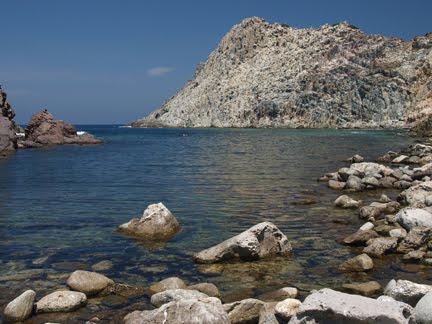
The beaches are as beautiful as everyone says they are. It would be easy to spend weeks here, trying a new beach every day. The water is the color turquoise, rather than emerald, despite the "Emerald Coast" name that has attached to the north coast of the island. The beaches are often in secluded coves decorated all around with rock formations sometimes reminiscent of Antoni Gaudí. Sheep and goats roam everywhere.
The food has been excellent, the people uniformly friendly and helpful, and I have really enjoyed drinking the Vermentino wines (which have always been a favorite of mine) here in the land that produces them. Far and away the best was the Funtanaliras Vermentino di Gallura made by the cooperative in the little town of Monti, where I was able to buy a few bottles at €5.9 a bottle (less than $7), having seen it on restaurant menus for as much as €20. The best Vermentino wines, like this one, are wonderfully fruity, but crisp and dry at the same time. Perfectly balanced and reminiscent of a good Chablis in some ways.
From Portoscuso, at the southern tip of Sardinia, crossed to the little neighboring island of Isola di San Pietro, which has spectacular cliffs and more good beaches. At an inlet called Cala Fico facing Isolo del Corno, an even smaller island off the coast, I had the privilege of seeing Eleanora's Falcons circling high overhead near the lighthouse, a very rare bird, like the Griffon Vulture. In Europe, they live only here and in similarly small pockets on the Dalmatian coast, in Greece and Turkey, and in coastal areas of North Africa. A very long and tiring drive late into the night (compounded by entirely inadequate headlights on the increasingly annoying rented Mercedes B Class) brought us to Olbia, near the northern coast. The following morning, we backtracked somewhat to visit Monti, which is the heart of the country that produces Sardinia's best Vermentino wines. The area looks rather like parts of California, with its soft, rolling hills, brown grasses, and oaks, but here the oaks are all cork oaks, many showing signs of recent cork harvesting.
Drove south along the west coast of the island, through Alghero (where it was fun to pass the vineyards and winery of Sella & Mosca, a name I know from drinking their wines in Tokyo). I found a funny T-shirt that says Cannonau in white script on a red background, imitating the Coca-Cola logo--a joke only a wine lover (and one that knows the wines of Sardinia) will understand.
In the rugged cliffs between Alghero and Bosa, I was lucky enough to get a look at three griffon vultures. They were circling high up and quite far away, but I could see them well enough to discern their distinctive features. A very big, impressive bird. So far, Sardinia has been good for birds. I've added ten new species to my life list. I finally got to see bee eaters--amazing-looking birds that fly fast like swifts one moment and then seem to stop in mid-air the next. They are unmistakable with their bright blue bellies, rufous and gold backs, golden throats, and angular, kite-like wings and tails.
The beaches are as beautiful as everyone says they are. It would be easy to spend weeks here, trying a new beach every day. The water is the color turquoise, rather than emerald, despite the "Emerald Coast" name that has attached to the north coast of the island. The beaches are often in secluded coves decorated all around with rock formations sometimes reminiscent of Antoni Gaudí. Sheep and goats roam everywhere.
The food has been excellent, the people uniformly friendly and helpful, and I have really enjoyed drinking the Vermentino wines (which have always been a favorite of mine) here in the land that produces them. Far and away the best was the Funtanaliras Vermentino di Gallura made by the cooperative in the little town of Monti, where I was able to buy a few bottles at €5.9 a bottle (less than $7), having seen it on restaurant menus for as much as €20. The best Vermentino wines, like this one, are wonderfully fruity, but crisp and dry at the same time. Perfectly balanced and reminiscent of a good Chablis in some ways.
From Portoscuso, at the southern tip of Sardinia, crossed to the little neighboring island of Isola di San Pietro, which has spectacular cliffs and more good beaches. At an inlet called Cala Fico facing Isolo del Corno, an even smaller island off the coast, I had the privilege of seeing Eleanora's Falcons circling high overhead near the lighthouse, a very rare bird, like the Griffon Vulture. In Europe, they live only here and in similarly small pockets on the Dalmatian coast, in Greece and Turkey, and in coastal areas of North Africa. A very long and tiring drive late into the night (compounded by entirely inadequate headlights on the increasingly annoying rented Mercedes B Class) brought us to Olbia, near the northern coast. The following morning, we backtracked somewhat to visit Monti, which is the heart of the country that produces Sardinia's best Vermentino wines. The area looks rather like parts of California, with its soft, rolling hills, brown grasses, and oaks, but here the oaks are all cork oaks, many showing signs of recent cork harvesting.
Tuesday, July 13, 2010
On the Road (Europe 2010): Barcelona--Sagrada Familia, Palau Música Catalana, Picasso Museum, Park Güell
Spent most of the day yesterday visiting Gaudí's grand temple, the Sagrada Familia. Despite knowing that the church is unfinished, nothing quite prepares you for the shock of entering an active construction site as you step into the building. Sagrada Familia is recognizably a church, but it is very much a work in progress. Forklifts carry in palettes of mortar, workmen in hardhats direct loads suspended from cranes, teams of architects and engineers can be seen consulting high above the church floor on platforms built for access to the work under way. Everywhere the space reverberates with the sound of jackhammers, the clanging of pipes, the engines of work vehicles. Heavy dust floats in the air—sometimes very prettily in the shafts of light created by still unfilled openings for windows—but leaving one’s throat sore by the end of the visit.
Some of the stained glass windows have been installed, but mostly the glass is unfinished. The main columns that support the weight of the towers are in place and these branch from nodes high above the floor into three, four, sometimes five thinner columns that support palm frond-like structures above. From below, Gaudi’s design gives the impression that you’re looking up into a forest canopy. Below the palm canopy is enough seating for a choir of 1,200 voices. I wonder what the place will sound like. The use of branching supports is not only interesting to look at, but it allowed Gaudí to abandon the flying buttresses that have been a staple of cathedral architecture for centuries, giving the exterior a somewhat sleek look, despite the heavy ornamentation, especially on the Nativity Façade. I much preferred the more traditional sculpture on this side of the church to the stark, angular, modern sculptures that adorn the opposite side of the church, the Passion Façade, although they were interesting too.
I enjoyed seeing the school building next door, which was originally intended to be a temporary structure to house a school for the children of men working on the church. This is another Gaudí design. It has a wave-form roof that reminded me of a surface of rippled mud—yet another example of Gaudí drawing on natural forms for inspiration.
Had an interesting lunch afterward at La Muscleria, a restaurant that specializes in mussels and claims to be the best mussel specialty restaurant in Barcelona—a claim I have no inclination to dispute. Nearly everything on the menu is mussels steamed or sautéed in various styles—from the traditional (such as steamed mussels with onions and white wine) to the more exotic (steamed mussels in a curry sauce). The steamed mussels are served in big, domed metal pots. Delicious, and highly recommended, unless you dislike shellfish, as some people do. If you're a fan of mussels and find yourself in Barcelona, don't miss this place.
The Palau Música Catalana is another architectural gem well worth visiting in Barcelona. We visited it on our last day in the city. It was not designed by Gaudí, but by Lluis Domènech i Montaner, who at the time was far better known than Gaudí. The Palau was built between 1906 and 1908 as the performance and administrative headquarters of the Orfeó Català, a choral group founded around 1891, one of many that were active at the time, singing mostly Catalan popular songs. The Palau still serves its original function, but now hosts performers of all kinds from all over the world. Everything—the façade, the original outdoor ticket windows (ticket sales have since moved to an addition), the stairways, and the concert hall itself—is decorated in tile, glass, and terracotta sculpture. Like the building that houses the Natural History Museum in London, there is an unseen steel framework that supports the structure. The steel is hidden by the exuberant terracotta decorations. In the concert hall proper, the organ is impressive, but the centerpiece is the terracotta and tile frieze of the 12 muses behind the stage (below the organ). This, too, is a UNESCO World Heritage site.
Visited the Picasso Museum, which is an excellent introduction to Picasso's early work. I knew that his father had been a painter and was under the impression that Picasso had had his early training mostly from his father, but I see now that he went to art school, in Barcelona. The many examples of the early work are interesting because the tension between his academic training and his own instincts is palpable in some of the work. Picasso is not one of my favorite painters, but this museum was well worth the visit just for the perspective it gives by showing much of his earliest work and by showing the work of many painters he associated with in his earliest days. It was an appropriate end to a day with lunch at Els Quatre Gats, one of Picasso's Barcelona hangouts.
Also saw Park Güell, partly designed by Gaudî. The park was something of a disappointment because it's not an integrated whole. It gives the impression of having been an existing park that Gaudî embellished after the fact (which I think it was). That said, the mosaics are interesting--when you can see them through all the tourists and illegal street vendors. Watching the vendors disperse like scared roaches on the approach of policemen was amusing.
The Palau Música Catalana is another architectural gem well worth visiting in Barcelona. We visited it on our last day in the city. It was not designed by Gaudí, but by Lluis Domènech i Montaner, who at the time was far better known than Gaudí. The Palau was built between 1906 and 1908 as the performance and administrative headquarters of the Orfeó Català, a choral group founded around 1891, one of many that were active at the time, singing mostly Catalan popular songs. The Palau still serves its original function, but now hosts performers of all kinds from all over the world. Everything—the façade, the original outdoor ticket windows (ticket sales have since moved to an addition), the stairways, and the concert hall itself—is decorated in tile, glass, and terracotta sculpture. Like the building that houses the Natural History Museum in London, there is an unseen steel framework that supports the structure. The steel is hidden by the exuberant terracotta decorations. In the concert hall proper, the organ is impressive, but the centerpiece is the terracotta and tile frieze of the 12 muses behind the stage (below the organ). This, too, is a UNESCO World Heritage site.Visited the Picasso Museum, which is an excellent introduction to Picasso's early work. I knew that his father had been a painter and was under the impression that Picasso had had his early training mostly from his father, but I see now that he went to art school, in Barcelona. The many examples of the early work are interesting because the tension between his academic training and his own instincts is palpable in some of the work. Picasso is not one of my favorite painters, but this museum was well worth the visit just for the perspective it gives by showing much of his earliest work and by showing the work of many painters he associated with in his earliest days. It was an appropriate end to a day with lunch at Els Quatre Gats, one of Picasso's Barcelona hangouts.
Also saw Park Güell, partly designed by Gaudî. The park was something of a disappointment because it's not an integrated whole. It gives the impression of having been an existing park that Gaudî embellished after the fact (which I think it was). That said, the mosaics are interesting--when you can see them through all the tourists and illegal street vendors. Watching the vendors disperse like scared roaches on the approach of policemen was amusing.
Sunday, July 11, 2010
On the Road (Europe 2010): Barcelona (Spain Wins the World Cup)
Well, it was interesting being in Barcelona as Spain won the 2010 World Cup. It's well after midnight and the town is still awash with people celebrating--people draped in Spanish flags, people wearing red Spain jerseys, people with their faces painted red and yellow. Anything that can make noise is making noise--plastic trumpets, car horns, scooter horns, fireworks. People are dancing in the streets.
On the Road (Europe 2010): Barcelona
Busy day in Barcelona. Started with an early morning tour of Gaudí's Casa Batlló (pronounced casa bahtYO), one of the many fashionable houses that line the Passeig de Gràcia, a restoration and redesign (1904-1906) of a late 19th century building existing on the site. A truly remarkable building. It's hard to imagine a more photogenic piece of architecture. You can look anywhere and the effect is calculated and pleasing. Every detail has been considered. I could post dozens of photos of this place alone.
The use of light is particularly interesting. Gaudí expanded the inner open space in the building that brings light to each floor and added skylights in various places, so that there is natural light almost everywhere. The space is covered in varying shades of tiles evocative of the ocean--as the entire building is--with darker tiles at the top and lighter tiles at the bottom, creating the illusion of even light from top to bottom. Inversely, the windows get larger toward the bottom of the building to bring in more light on the lower floors and block some of the stronger light on the higher floors.
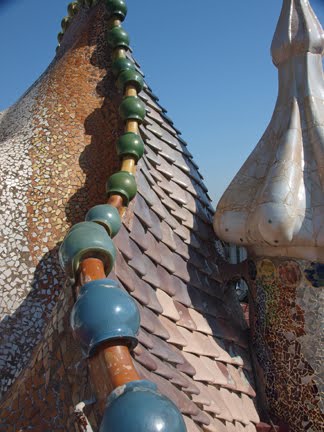
The roof has a sinuous ridge of tiles that made me think of an iguana, although others have likened it to the back of a giant sea creature. The cross-topped tower resembles a bulb of garlic. A strange and wonderful design. It must have been quite a shock to more conservative tastes at the time of its construction, but the building next door is not exactly tame, and everywhere in Barcelona the facades are richly decorated. Still, nothing is quite like this. It's deservedly famous. The admission price is steep, but I didn't feel cheated, and the money goes to preservation work.
Next visited La Pedrera, another Gaudí design. This is an apartment complex, part of which is open to the public. Another remarkable building, but not so photogenic as the Casa Batlló. I found it interesting mainly for the arched structures that support the roof of the building and for the sheer spaciousness of the apartments. One of these is open to tour. There are many large rooms, a big kitchen, rooms for children, for maids, for sewing.... All attractively lit with natural light.
Following lunch, visited the Fundació Antoni Tàpies, a museum of contemporary art and a research facility with an impressive library of art books. It was created by Antoni Tàpies to promote the study and understanding of modern art. I was hoping to see more work by Tàpies himself there, but the small current exhibit of works by Eva Hesse was interesting. Saw Flamenco after dinner. It was decent, but I've seen far better in Madrid. The World Cup Final match was going on, we could hear the cheering when Spain scored its goal. The dancers were clearly pleased and it showed in the dancing.
The use of light is particularly interesting. Gaudí expanded the inner open space in the building that brings light to each floor and added skylights in various places, so that there is natural light almost everywhere. The space is covered in varying shades of tiles evocative of the ocean--as the entire building is--with darker tiles at the top and lighter tiles at the bottom, creating the illusion of even light from top to bottom. Inversely, the windows get larger toward the bottom of the building to bring in more light on the lower floors and block some of the stronger light on the higher floors.
The roof has a sinuous ridge of tiles that made me think of an iguana, although others have likened it to the back of a giant sea creature. The cross-topped tower resembles a bulb of garlic. A strange and wonderful design. It must have been quite a shock to more conservative tastes at the time of its construction, but the building next door is not exactly tame, and everywhere in Barcelona the facades are richly decorated. Still, nothing is quite like this. It's deservedly famous. The admission price is steep, but I didn't feel cheated, and the money goes to preservation work.
Next visited La Pedrera, another Gaudí design. This is an apartment complex, part of which is open to the public. Another remarkable building, but not so photogenic as the Casa Batlló. I found it interesting mainly for the arched structures that support the roof of the building and for the sheer spaciousness of the apartments. One of these is open to tour. There are many large rooms, a big kitchen, rooms for children, for maids, for sewing.... All attractively lit with natural light.
Following lunch, visited the Fundació Antoni Tàpies, a museum of contemporary art and a research facility with an impressive library of art books. It was created by Antoni Tàpies to promote the study and understanding of modern art. I was hoping to see more work by Tàpies himself there, but the small current exhibit of works by Eva Hesse was interesting. Saw Flamenco after dinner. It was decent, but I've seen far better in Madrid. The World Cup Final match was going on, we could hear the cheering when Spain scored its goal. The dancers were clearly pleased and it showed in the dancing.
Saturday, July 10, 2010
On the Road (Europe 2010): Berga, Montserrat, and Barcelona
Left Berga on the morning of July 10 for Barcelona by way of Monsterrat. Berga redeemed itself the evening before with one of the best meals of the trip, at Restaurant Sala (Paseo de la Pau, 27, Berga 08600), following perhaps the worst meal of the trip at Hotel Estel. The hotel itself was fine--nothing fancy, but serviceable--but I'd avoid the restaurant there at all costs. Having said that, breakfast was pleasant enough on the terrace the following morning, which was blessedly cool for a change.
The meal at Restaurant Sala featured carpaccio of shrimp, apple ravioli (ricotta cheese in paper thin slices of apple, on top of even thinner slices of tomato with a light olive oil and balsamic vinegar dressing), a wonderful mushroom soup, Scampi, baby squid with vegetables and wild mushroms (pictured), and other tasty things. The chef seems to really like mushrooms. There were many dishes on the menu that featured one kind or another. Washed it all down with a crisp, fragrant 2008 Vionta Rias Baixas Albariño.
Spent most of the 10th in Montserrat. The place reminded me of Lourdes, which isn't much of a recommendation. It's rather commercialized (with big souvenir shops), and I was surprised to see that nearly all of the construction is new (only about 100 years old), but the place has its good points as well--and apparently nothing much is old because Napoleon's army razed the place.
The mountains are undeniably beautiful. Montserrat, or "serrated mountain," is aptly named--there is a stark ridge of exposed stone points at the summit. At the top there are good hiking trails (accessible by a very steep funicular railway) that give wonderful views all the way to Barcelona and beyond. The rock is a very attractive pegmatite with inclusions of many colors of fist size or bigger. There is a small but interesting art museum (the collection is mostly modern Catalan and uneven, but there are quite a few paintings worth seeing, including two very early Picassos; I liked many of the Catalan works, but no photography is allowed, so I was unable to remember any of the names). Besides paintings, the museum has a small collection of art from antiquity from various parts of the Holy lands (glass, pottery, cylinder seals, etc.).
The famous Virgin of Montserrat in the monastery was worth a look. It is the most revered piece of sacred art in Catalonia. While standing in the long line of pilgrims and tourists waiting to view her, there was a wedding going on in the church. I couldn't see much of what was happening, but someone sang Schubert's Ave Maria beautifully. Schubert would have been famous if he had written nothing else.
The wooden statue is Romanesque, from the 12th century, and probably carved in Jerusalem. According to legend, it was found in a cave below where the monastery stands today (the cave can be visited, but there wasn't time). The monastery was built to house it. Because it has blackened over the centuries, it is known as La Moreneta, or "the little dark one."
On the bird watching front, I've added four new species to my life list since last writing, for a total of 30 new birds since leaving the US. I got a glimpse of a Eurasian jay and good looks at long-tailed tits in the mountains between Cardona and Berga, and good looks at alpine swifts (bigger than the swifts at Pouzolles, and with a pale belly) and a Dartford Warbler, both at Montserrat, in the hills above the monastery. The swifts came quite close at times, sounding exactly like bottle rockets as they whizzed past.
Arrived in Barcelona in the early evening. It took about an hour to get to the hotel because many of the streets were blocked off, for reasons that weren't clear. Had time to walk around a little and have a late-night meal. Tomorrow will be the start of a couple of days seeing the sights.
[It later became apparent that the blockages were related to the World Cup soccer matches.]
The meal at Restaurant Sala featured carpaccio of shrimp, apple ravioli (ricotta cheese in paper thin slices of apple, on top of even thinner slices of tomato with a light olive oil and balsamic vinegar dressing), a wonderful mushroom soup, Scampi, baby squid with vegetables and wild mushroms (pictured), and other tasty things. The chef seems to really like mushrooms. There were many dishes on the menu that featured one kind or another. Washed it all down with a crisp, fragrant 2008 Vionta Rias Baixas Albariño.
Spent most of the 10th in Montserrat. The place reminded me of Lourdes, which isn't much of a recommendation. It's rather commercialized (with big souvenir shops), and I was surprised to see that nearly all of the construction is new (only about 100 years old), but the place has its good points as well--and apparently nothing much is old because Napoleon's army razed the place.
The mountains are undeniably beautiful. Montserrat, or "serrated mountain," is aptly named--there is a stark ridge of exposed stone points at the summit. At the top there are good hiking trails (accessible by a very steep funicular railway) that give wonderful views all the way to Barcelona and beyond. The rock is a very attractive pegmatite with inclusions of many colors of fist size or bigger. There is a small but interesting art museum (the collection is mostly modern Catalan and uneven, but there are quite a few paintings worth seeing, including two very early Picassos; I liked many of the Catalan works, but no photography is allowed, so I was unable to remember any of the names). Besides paintings, the museum has a small collection of art from antiquity from various parts of the Holy lands (glass, pottery, cylinder seals, etc.).
The famous Virgin of Montserrat in the monastery was worth a look. It is the most revered piece of sacred art in Catalonia. While standing in the long line of pilgrims and tourists waiting to view her, there was a wedding going on in the church. I couldn't see much of what was happening, but someone sang Schubert's Ave Maria beautifully. Schubert would have been famous if he had written nothing else.The wooden statue is Romanesque, from the 12th century, and probably carved in Jerusalem. According to legend, it was found in a cave below where the monastery stands today (the cave can be visited, but there wasn't time). The monastery was built to house it. Because it has blackened over the centuries, it is known as La Moreneta, or "the little dark one."
On the bird watching front, I've added four new species to my life list since last writing, for a total of 30 new birds since leaving the US. I got a glimpse of a Eurasian jay and good looks at long-tailed tits in the mountains between Cardona and Berga, and good looks at alpine swifts (bigger than the swifts at Pouzolles, and with a pale belly) and a Dartford Warbler, both at Montserrat, in the hills above the monastery. The swifts came quite close at times, sounding exactly like bottle rockets as they whizzed past.
Arrived in Barcelona in the early evening. It took about an hour to get to the hotel because many of the streets were blocked off, for reasons that weren't clear. Had time to walk around a little and have a late-night meal. Tomorrow will be the start of a couple of days seeing the sights.
[It later became apparent that the blockages were related to the World Cup soccer matches.]
Subscribe to:
Posts (Atom)