Last night I opened one of two bottles of the Arakèna bottling of Vermentino di Gallura I purchased at Cantina del Vermentino, in Monti, in Sardinia's premier wine-growing region of Gallura. In an earlier post I noted that the best Vermentino wine I encountered while in Sardinia was the Funtanaliras from the same cooperative. Arakèna is the Cantina's high-end vendemmia tardiva (late harvest) Vermentino, but this is fermented into a strong (14%) almost completely dry wine (there is just a hint of residual sugar).
Compared with the delicate, light Funtanaliras, the Arakèna is weighty. Aged in oak (the Funtanaliras is made in stainless steel) and made from riper grapes, it's more perfumed on the nose and more substantial on the palate, but both wines are delicious. The pale gold color does not quite prepare you for the suite of scents coming out of the glass. Something suggested olive brine at first. There were hints of pears, candied fruit or fruit cake, cherries, and even something vaguely smoky. Later I started detecting roses, passion fruit, brown sugar, and a dried apricot scent that put me in mind of a fine Riesling from the Moselle.
On the palate, however, the wine was more suggestive of a good wine from Alsace in its combination of powerful scents and flavors in a dry style of winemaking. In fact, served blind, I'd bet that most experienced wine drinkers would fairly confidently call this a Gewürztraminer from Alsace. Long, concentrated, rich, and delicious, with just enough acidity to keep things fresh. I very much enjoyed the wine with grilled shrimp and pan-fried, breaded baby mackerel. Dry enough to pair with seafood, but with the presence to stand on its own as an aperitif wine. However you drink it, it's excellent. Highly recommended. I had the privilege of buying this directly from the producer for an exceedingly reasonable €11 euros or so (roughly $12). Various retailers in Europe are selling it for €15-25 a bottle, however, suggesting you might expect to pay around $30 for it in the US, if you can find it. It's worth looking for.
To see more wine reviews, use the "Wines I'm Drinking" label to the right at the top of the page.
Showing posts with label Sardinia. Show all posts
Friday, July 30, 2010
Thursday, July 29, 2010
Birds I'm Watching: Where Have All the Swifts Gone? (and Other Topics)
Having arrived in London June 7, I've been in Europe for going on two months now, with three weeks to go. I had hoped to add 100 birds to my life list this summer, but so far have seen only 52 (see below). Birds have been relatively few and far between here--which is somewhat surprising. In habitats that would be rich with birds in Sonoma County, California (home) there is often little activity here-- notably, at the coast. Still, 52 isn't bad. I've averaged almost one new bird every day. The Camargue area and Sardinia have been the best sites, so far.
In total, I have seen 64 species I've been able to identify. I've seen about 10 more I've been unable to figure out. I'm working on another five or six from photographs I've taken--for example, the terns shown here. I'm pretty sure these are Common Terns, but I try never to add anything to my lists unless I'm certain.
[Update: I've now decided these are Common Terns, which raises my total of species identified in Europe to 65. Further update: On July 31, I added the Tree Pipit to my list for Europe, so now 66, of which 54 have been life birds. On August 4, added Yellow Wagtail, for totals of 67 and 55. On August 11, I added Green Woodpecker and Melodious Warbler (or possibly Icterine Warbler) for totals of 69 and 57.]
New birds (new to me, that is) I've identified so far: Great Crested Grebe, Great Cormorant, Little Egret, Squacco Heron, Gray Heron, Purple Heron, Greater fFamingo, Eurasian Spoonbill, Common Pochard, Eurasian Coot, Common Tern, Black-winged Stilt, Common Sandpiper, Black-headed Gull, Greater Black-backed Gull, Red-legged Partridge, Eurasian Griffon Vulture, Black Kite, Red Kite, Common Kestrel, Eleanora's Falcon, Wood Pigeon, Turtle Dove, Common Cuckoo (heard only), Scops Owl (heard only), Common Swift, Alpine Swift, Spotted Flycatcher, Common House Martin, Hoopoe, European Bee Eater, European Roller, Coal Tit, Blue Tit, Great Tit, Long-tailed Tit, Eurasian Jay, Western Jackdaw, Hooded Crow, Common (Eurasian) Magpie, Rock Pipit, Tree Pipit, Spotless Starling, Black Redstart, Dartford Warbler, Cirl Bunting, Common (Eurasian) Blackbird, Spanish Sparrow, the Corsican race of the Spanish Sparrow, European Goldfinch, Linnet, Chaffinch, European Greenfinch, and Serin.
In addition to these, I've seen the following birds familiar from the US: House Sparrow, European Starling, Barn Swallow, Ring-necked Pheasant, Herring Gull, Eurasian Collared Dove, Common Moorhen*, (winter) Wren, Mute Swan, Whimbrel, and Cattle Egret. Many of these, of course, are imports from Europe. Pied Wagtails were common in England, but I had seen these before in Japan--assuming this is the same species.
[Update: I checked on the wagtail. They appear to be considered different races of the same species, with those resident in England called Motacilla alba yarrellii and those resident in Japan and elsewhere in Asia called Motacilla alba lugens. Isn't the Internet wonderful?]
[*Further update: The European moorhen, or Common Moorhen, and our Moorhen, now called Common Gallinule, were split in 2011 into separate species, so, technically, that added a species to my total of new birds on this European trip.]
Saturday, July 17, 2010
On the Road (Europe 2010): Sardinia to Corsica
Yesterday crossed from Sardinia to Corsica on a smallish ferry, a one-hour crossing. Corsica was easily visible from the port at Santa Theresa. The Corsican coast is impressive. The sea approach to Bonifacio is guarded by fortified walls, and the rocky cliffs themselves are imposing. The Moby Line ferry has a funny whale logo.
The drive through mountainous countryside from Bonifacio to Ajaccio, Napoleon's place of birth, gives a taste of the scenery here, which is much more rugged than the lower, softer hills of most of Sardinia. Arrived late at the hotel. Today will be spent visiting the museum at Napoleon's home before moving north and east. Tomorrow we will cross to Livorno, to begin the drive back to France, via Florence and the Italian coast.
Friday, July 16, 2010
On the Road (Europe 2010): Sardinia
Haven't had much time to write as we've been moving around almost non-stop, but arrived in Sardinia on the morning of the 14th via a very large Grimaldi Lines ferry from Barcelona. The boat left at 10:00 at night and arrived the following morning about 11:00 in Porto Torres, in the north. Slept poorly--or so I thought, but when I checked my watch, thinking it was probably about 3:00AM, it was already time to get ready to disembark.
Drove south along the west coast of the island, through Alghero (where it was fun to pass the vineyards and winery of Sella & Mosca, a name I know from drinking their wines in Tokyo). I found a funny T-shirt that says Cannonau in white script on a red background, imitating the Coca-Cola logo--a joke only a wine lover (and one that knows the wines of Sardinia) will understand.
In the rugged cliffs between Alghero and Bosa, I was lucky enough to get a look at three griffon vultures. They were circling high up and quite far away, but I could see them well enough to discern their distinctive features. A very big, impressive bird. So far, Sardinia has been good for birds. I've added ten new species to my life list. I finally got to see bee eaters--amazing-looking birds that fly fast like swifts one moment and then seem to stop in mid-air the next. They are unmistakable with their bright blue bellies, rufous and gold backs, golden throats, and angular, kite-like wings and tails.
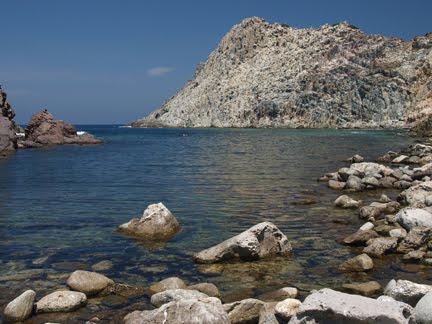
The beaches are as beautiful as everyone says they are. It would be easy to spend weeks here, trying a new beach every day. The water is the color turquoise, rather than emerald, despite the "Emerald Coast" name that has attached to the north coast of the island. The beaches are often in secluded coves decorated all around with rock formations sometimes reminiscent of Antoni Gaudí. Sheep and goats roam everywhere.
The food has been excellent, the people uniformly friendly and helpful, and I have really enjoyed drinking the Vermentino wines (which have always been a favorite of mine) here in the land that produces them. Far and away the best was the Funtanaliras Vermentino di Gallura made by the cooperative in the little town of Monti, where I was able to buy a few bottles at €5.9 a bottle (less than $7), having seen it on restaurant menus for as much as €20. The best Vermentino wines, like this one, are wonderfully fruity, but crisp and dry at the same time. Perfectly balanced and reminiscent of a good Chablis in some ways.
From Portoscuso, at the southern tip of Sardinia, crossed to the little neighboring island of Isola di San Pietro, which has spectacular cliffs and more good beaches. At an inlet called Cala Fico facing Isolo del Corno, an even smaller island off the coast, I had the privilege of seeing Eleanora's Falcons circling high overhead near the lighthouse, a very rare bird, like the Griffon Vulture. In Europe, they live only here and in similarly small pockets on the Dalmatian coast, in Greece and Turkey, and in coastal areas of North Africa. A very long and tiring drive late into the night (compounded by entirely inadequate headlights on the increasingly annoying rented Mercedes B Class) brought us to Olbia, near the northern coast. The following morning, we backtracked somewhat to visit Monti, which is the heart of the country that produces Sardinia's best Vermentino wines. The area looks rather like parts of California, with its soft, rolling hills, brown grasses, and oaks, but here the oaks are all cork oaks, many showing signs of recent cork harvesting.
Drove south along the west coast of the island, through Alghero (where it was fun to pass the vineyards and winery of Sella & Mosca, a name I know from drinking their wines in Tokyo). I found a funny T-shirt that says Cannonau in white script on a red background, imitating the Coca-Cola logo--a joke only a wine lover (and one that knows the wines of Sardinia) will understand.
In the rugged cliffs between Alghero and Bosa, I was lucky enough to get a look at three griffon vultures. They were circling high up and quite far away, but I could see them well enough to discern their distinctive features. A very big, impressive bird. So far, Sardinia has been good for birds. I've added ten new species to my life list. I finally got to see bee eaters--amazing-looking birds that fly fast like swifts one moment and then seem to stop in mid-air the next. They are unmistakable with their bright blue bellies, rufous and gold backs, golden throats, and angular, kite-like wings and tails.
The beaches are as beautiful as everyone says they are. It would be easy to spend weeks here, trying a new beach every day. The water is the color turquoise, rather than emerald, despite the "Emerald Coast" name that has attached to the north coast of the island. The beaches are often in secluded coves decorated all around with rock formations sometimes reminiscent of Antoni Gaudí. Sheep and goats roam everywhere.
The food has been excellent, the people uniformly friendly and helpful, and I have really enjoyed drinking the Vermentino wines (which have always been a favorite of mine) here in the land that produces them. Far and away the best was the Funtanaliras Vermentino di Gallura made by the cooperative in the little town of Monti, where I was able to buy a few bottles at €5.9 a bottle (less than $7), having seen it on restaurant menus for as much as €20. The best Vermentino wines, like this one, are wonderfully fruity, but crisp and dry at the same time. Perfectly balanced and reminiscent of a good Chablis in some ways.
From Portoscuso, at the southern tip of Sardinia, crossed to the little neighboring island of Isola di San Pietro, which has spectacular cliffs and more good beaches. At an inlet called Cala Fico facing Isolo del Corno, an even smaller island off the coast, I had the privilege of seeing Eleanora's Falcons circling high overhead near the lighthouse, a very rare bird, like the Griffon Vulture. In Europe, they live only here and in similarly small pockets on the Dalmatian coast, in Greece and Turkey, and in coastal areas of North Africa. A very long and tiring drive late into the night (compounded by entirely inadequate headlights on the increasingly annoying rented Mercedes B Class) brought us to Olbia, near the northern coast. The following morning, we backtracked somewhat to visit Monti, which is the heart of the country that produces Sardinia's best Vermentino wines. The area looks rather like parts of California, with its soft, rolling hills, brown grasses, and oaks, but here the oaks are all cork oaks, many showing signs of recent cork harvesting.
Subscribe to:
Comments (Atom)