I stopped into Willi's Seafood & Raw Bar at the corner of Healdsburg Ave. and W. North St. in Healdsburg yesterday, tired after a long day of landscaping work, to treat myself to a glass of wine with my lobster roll--a late lunch. I noticed a Vermentino on the wine list from Portalupi Wines, a winery I'd never encountered before. At its best, Vermentino is both crisp and flavorful. It seemed a perfect choice, as I wanted something refreshing--although I was wary; so many California versions of the more obscure European grapes turn out heavy, monolithic, and too alcoholic to be either refreshing or very interesting. I ordered a glass, reassured by my waitress, who appeared to know what she was talking about, and I was impressed from the first sip. I very much enjoyed the 2013 Vermentino from Portalupi (from the Las Brisas vineyard, in the Carneros region). It was exactly what I wanted. The wine has fruity presence and good length with just the right amount of crisp, balancing acidity (suggestive of key limes) to make it seem delicate. An excellent example of wine made from this grape--as good as any I've had in the variety's heartland, in Sardinia.
Vermentino seems to be gaining a foothold in California. Mahoney Vineyards, also in the Carneros region, has a good reputation (although I've not tried their wines yet). I've tasted the Vermentino Tablas Creek Winery (affiliated with France's Château de Beaucastel) is making in Paso Robles and I've talked Vermentino with one of its champions in the state, Ken Volk, who makes Vermentino wines (and many others) in Paso Robles. There has been activity in the Lodi area and the Sierra foothills as well. I look forward to tasting more Vermentino wines from local producers (and it would be nice to see them on retail shelves at the kind of affordable prices they go for in Italy--often less than $10 for even the best examples--where they are everyday wines).
While eating, I happened to look across the street and was surprised to see a sign for the Portalupi tasting room, literally a stone's throw from the raw bar--something of an odd coincidence. I resolved immediately to stop there after my lunch. I ended up having a very enjoyable conversation and tasting, the wines poured by the winemaker himself, Tim Borges (Portalupi is his wife's family name). Borges has been making wine for others for decades, but the Portalupi label appears to have emerged around 2002. The Healdsburg tasting room has been in operation since 2010. Portalupi makes small lots (10 wines totaling about 5,000 cases annually) and the love shows. I tasted all the wines available in the tasting room. I was particularly impressed by the Vermentino (as noted above); a somewhat unusual, but quite successful white blend that Portalupi packages in what look like liter milk bottles; and a wonderfully perfumed old vine Zinfandel redolent of raspberries that put me in mind of Paul Draper's Geyserville. That said, the entire line-up is marked by a refreshing lightness and restraint that gives the wines more elegance and nuance than is often the case in California. Delicious. Recommended. The Portalupi Wine tasting room is at 107 North St., Healdsburg, 95488 (707 395-0960) grazie@portalupiwine.com.
I have no financial connections of any kind with the companies mentioned in this post.
Showing posts with label Vermentino. Show all posts
Wednesday, May 21, 2014
Tuesday, September 14, 2010
Wines I'm Drinking: 2009 Mas Brunet Coteaux du Languedoc Blanc
I've been home from a 10-week stay in southern France (with side trips to Barcelona, Corsica, Sardinia, and Italy proper) for a month tomorrow. I'm finally getting the last of the suitcases squared away. Among various receipts, brochures, odd bits of change (from this trip and, evidently, others), and the occasional rock labeled with a vineyard or other name in the bottom of one bag, I came across a cork in an envelope covered with tasting notes. I had forgotten about this wine, but it was a good one, so I've decided to belatedly write up the thoughts I jotted down while enjoying it.
I bought the wine in an excellent little shop in St. Guilhem-le-Desert. I regret not having made a note of the name of the place. There was an excellent selection of high-end local wines, the proprietor spoke English, and he knew his product well.
The 2009 Mas Brunet Coteaux du Languedoc Blanc is a blend of Rousanne, Vermentino, and Vioginer. I chose it mostly because of the Vermentino component, having recently had so many good Vermentino wines in Sardinia--notably the 2007 Funtanaliras Vermentino and the 2008 "Arakèna" Vermentino di Gallura, both from the Cantina del Vermentino, in Monti, in Sardinia's Gallura region (the northeast). Having said that, the assertiveness of the Viognier made this selection rather different from any straight Vermentino wine. Brief tasting notes follow.
A very pale but pretty straw color. The sort of wine that makes its presence known immediately. Floral scents and a telltale peachy, Viognier-scent were evident even before putting my nose to the glass--but there was more than that. There was something like butter cream (or cake icing, perhaps), and there were vanilla scents. Initially seemed astringent, smoky, and a bit woody on the palate, but then it began to give an impression of creamy richness followed by some tannic graininess and then a lingering, fruity sweetness on an extended finish (although the wine is quite dry). With a little time, new scents and flavors emerged. I began to get hints of iron, honey, vanilla yogurt, and finally nutmeg. Complex, assertive, interesting, and delicious. I paid about €12 (or around $15) for the bottle. Recommended (although this wine is unlikely to be available in the US). If you can find it, it's well worth a try, and I suspect this is a producer worth keeping an eye out for.
For more wine reviews, use the Wines I'm Drinking label.
I bought the wine in an excellent little shop in St. Guilhem-le-Desert. I regret not having made a note of the name of the place. There was an excellent selection of high-end local wines, the proprietor spoke English, and he knew his product well.
The 2009 Mas Brunet Coteaux du Languedoc Blanc is a blend of Rousanne, Vermentino, and Vioginer. I chose it mostly because of the Vermentino component, having recently had so many good Vermentino wines in Sardinia--notably the 2007 Funtanaliras Vermentino and the 2008 "Arakèna" Vermentino di Gallura, both from the Cantina del Vermentino, in Monti, in Sardinia's Gallura region (the northeast). Having said that, the assertiveness of the Viognier made this selection rather different from any straight Vermentino wine. Brief tasting notes follow.
A very pale but pretty straw color. The sort of wine that makes its presence known immediately. Floral scents and a telltale peachy, Viognier-scent were evident even before putting my nose to the glass--but there was more than that. There was something like butter cream (or cake icing, perhaps), and there were vanilla scents. Initially seemed astringent, smoky, and a bit woody on the palate, but then it began to give an impression of creamy richness followed by some tannic graininess and then a lingering, fruity sweetness on an extended finish (although the wine is quite dry). With a little time, new scents and flavors emerged. I began to get hints of iron, honey, vanilla yogurt, and finally nutmeg. Complex, assertive, interesting, and delicious. I paid about €12 (or around $15) for the bottle. Recommended (although this wine is unlikely to be available in the US). If you can find it, it's well worth a try, and I suspect this is a producer worth keeping an eye out for.
For more wine reviews, use the Wines I'm Drinking label.
Friday, July 30, 2010
Wines I'm drinking: Cantina del Vermentino 2008 Vermentino di Gallura "Arakèna"
Last night I opened one of two bottles of the Arakèna bottling of Vermentino di Gallura I purchased at Cantina del Vermentino, in Monti, in Sardinia's premier wine-growing region of Gallura. In an earlier post I noted that the best Vermentino wine I encountered while in Sardinia was the Funtanaliras from the same cooperative. Arakèna is the Cantina's high-end vendemmia tardiva (late harvest) Vermentino, but this is fermented into a strong (14%) almost completely dry wine (there is just a hint of residual sugar).
Compared with the delicate, light Funtanaliras, the Arakèna is weighty. Aged in oak (the Funtanaliras is made in stainless steel) and made from riper grapes, it's more perfumed on the nose and more substantial on the palate, but both wines are delicious. The pale gold color does not quite prepare you for the suite of scents coming out of the glass. Something suggested olive brine at first. There were hints of pears, candied fruit or fruit cake, cherries, and even something vaguely smoky. Later I started detecting roses, passion fruit, brown sugar, and a dried apricot scent that put me in mind of a fine Riesling from the Moselle.
On the palate, however, the wine was more suggestive of a good wine from Alsace in its combination of powerful scents and flavors in a dry style of winemaking. In fact, served blind, I'd bet that most experienced wine drinkers would fairly confidently call this a Gewürztraminer from Alsace. Long, concentrated, rich, and delicious, with just enough acidity to keep things fresh. I very much enjoyed the wine with grilled shrimp and pan-fried, breaded baby mackerel. Dry enough to pair with seafood, but with the presence to stand on its own as an aperitif wine. However you drink it, it's excellent. Highly recommended. I had the privilege of buying this directly from the producer for an exceedingly reasonable €11 euros or so (roughly $12). Various retailers in Europe are selling it for €15-25 a bottle, however, suggesting you might expect to pay around $30 for it in the US, if you can find it. It's worth looking for.
To see more wine reviews, use the "Wines I'm Drinking" label to the right at the top of the page.
Compared with the delicate, light Funtanaliras, the Arakèna is weighty. Aged in oak (the Funtanaliras is made in stainless steel) and made from riper grapes, it's more perfumed on the nose and more substantial on the palate, but both wines are delicious. The pale gold color does not quite prepare you for the suite of scents coming out of the glass. Something suggested olive brine at first. There were hints of pears, candied fruit or fruit cake, cherries, and even something vaguely smoky. Later I started detecting roses, passion fruit, brown sugar, and a dried apricot scent that put me in mind of a fine Riesling from the Moselle.
On the palate, however, the wine was more suggestive of a good wine from Alsace in its combination of powerful scents and flavors in a dry style of winemaking. In fact, served blind, I'd bet that most experienced wine drinkers would fairly confidently call this a Gewürztraminer from Alsace. Long, concentrated, rich, and delicious, with just enough acidity to keep things fresh. I very much enjoyed the wine with grilled shrimp and pan-fried, breaded baby mackerel. Dry enough to pair with seafood, but with the presence to stand on its own as an aperitif wine. However you drink it, it's excellent. Highly recommended. I had the privilege of buying this directly from the producer for an exceedingly reasonable €11 euros or so (roughly $12). Various retailers in Europe are selling it for €15-25 a bottle, however, suggesting you might expect to pay around $30 for it in the US, if you can find it. It's worth looking for.
To see more wine reviews, use the "Wines I'm Drinking" label to the right at the top of the page.
Sunday, July 25, 2010
Wines I'm drinking: Cinque Terre
I knew very little about the Cinque Terre wines, having only heard of the sweet wine made here, known as Schiacchetrà (which I did not taste), as a rarity of the wine world. The Cinque Terre also make dry white wines that simply bear that name--Cinque Terre (granted DOC status in 1973). Both these and the sweet wines are made mostly from three grapes, Bosco, Albarola, and Vermentino blended. The wines must contain at least 40% Bosco. Up to 20% can be other white grapes approved for winemaking in the area more generally, besides these three. The vines are grown high on steep, terraced hills that recall the vineyards on the Duoro river that make port or some of the steep plantings along the Moselle and elsewhere in Germany. The vines are trained high and flat--almost espaliered.
Schiacchetrà is made from the same blend, but it is a passito wine. Essentially, some of the harvest is reserved and allowed to raisin in the sun (typically on straw mats; these wines are sometimes known as "straw wines") or hung in the rafters of buildings until partially dehydrated, which greatly increases the sugar content, allowing a powerful dry wine or production of sweet, concentrated wines like Schiacchetrà or Recioto della Valpolicella, the sweet wine made around Verona, of which Amarone is the better known dry version.
How have I missed these to date? I had no idea such interesting wines were made here. The only logical explanation is that production is so small (the entire producing area is only 200 acres), that they rarely make it far from home. I feel lucky to have had a taste. I understand that most of the wine labeled Cinque Terre DOC is made at a cooperative, but there are bottlings by individual producers as well. All four of the wines I tasted were of the latter type. They are likely to be unavailable outside of the Cinque Terre. Indeed, searching on WineSearcher yields nothing available for purchase from the Cinque Terre DOC at all*.
I tried four wines. I didn't take extensive notes, but a few comments based on the notes I did take will serve to give some sense of what these wines are like. I had the 2009 Cantina Litàn Casata dei Beghee Cinque Terre (from Riomaggiore), with an intriguing smoky, bacon fat scent. It was bone dry, but richly flavored and very long on the finish. I had the 2008 Luciano Capellini Cinque Terre (from Volastra), which was interesting for its lemon rind scent and extremely dry, slightly bitter character--but again tempered by an intense richness. All the wines were remarkable for seeming very rich and lush yet extremely dry at the same time. This was a more alcoholic, headier wine. The 2008 Agricola Campogrande Cinque Terre smelled of honey, anise, and watermelon. It was similarly intense, yet dry. The 2008 Walter de Batté Cinque Terre was one of those wines that just keeps on going on the palate, lingering a minute or more. Perfumed, rich, giving the impression of sweetness and opulence without being sweet at all. It had a deep, brandy-like color. All the wines were the tawny hue of an old white wine, but they were fresh and crisp, despite the concentration of their flavors. Excellent. What a shame they are so hard to come by!
*More recently searching WineSearcher I see that some of these wines are, in fact, available. They are worth trying.
Friday, July 16, 2010
On the Road (Europe 2010): Sardinia
Haven't had much time to write as we've been moving around almost non-stop, but arrived in Sardinia on the morning of the 14th via a very large Grimaldi Lines ferry from Barcelona. The boat left at 10:00 at night and arrived the following morning about 11:00 in Porto Torres, in the north. Slept poorly--or so I thought, but when I checked my watch, thinking it was probably about 3:00AM, it was already time to get ready to disembark.
Drove south along the west coast of the island, through Alghero (where it was fun to pass the vineyards and winery of Sella & Mosca, a name I know from drinking their wines in Tokyo). I found a funny T-shirt that says Cannonau in white script on a red background, imitating the Coca-Cola logo--a joke only a wine lover (and one that knows the wines of Sardinia) will understand.
In the rugged cliffs between Alghero and Bosa, I was lucky enough to get a look at three griffon vultures. They were circling high up and quite far away, but I could see them well enough to discern their distinctive features. A very big, impressive bird. So far, Sardinia has been good for birds. I've added ten new species to my life list. I finally got to see bee eaters--amazing-looking birds that fly fast like swifts one moment and then seem to stop in mid-air the next. They are unmistakable with their bright blue bellies, rufous and gold backs, golden throats, and angular, kite-like wings and tails.
The beaches are as beautiful as everyone says they are. It would be easy to spend weeks here, trying a new beach every day. The water is the color turquoise, rather than emerald, despite the "Emerald Coast" name that has attached to the north coast of the island. The beaches are often in secluded coves decorated all around with rock formations sometimes reminiscent of Antoni Gaudí. Sheep and goats roam everywhere.
The food has been excellent, the people uniformly friendly and helpful, and I have really enjoyed drinking the Vermentino wines (which have always been a favorite of mine) here in the land that produces them. Far and away the best was the Funtanaliras Vermentino di Gallura made by the cooperative in the little town of Monti, where I was able to buy a few bottles at €5.9 a bottle (less than $7), having seen it on restaurant menus for as much as €20. The best Vermentino wines, like this one, are wonderfully fruity, but crisp and dry at the same time. Perfectly balanced and reminiscent of a good Chablis in some ways.
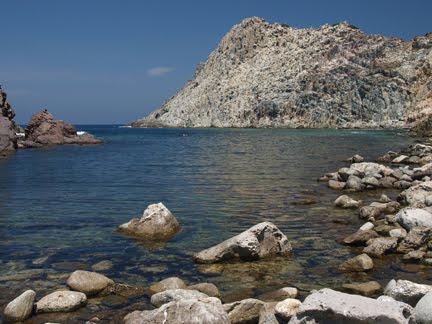
From Portoscuso, at the southern tip of Sardinia, crossed to the little neighboring island of Isola di San Pietro, which has spectacular cliffs and more good beaches. At an inlet called Cala Fico facing Isolo del Corno, an even smaller island off the coast, I had the privilege of seeing Eleanora's Falcons circling high overhead near the lighthouse, a very rare bird, like the Griffon Vulture. In Europe, they live only here and in similarly small pockets on the Dalmatian coast, in Greece and Turkey, and in coastal areas of North Africa. A very long and tiring drive late into the night (compounded by entirely inadequate headlights on the increasingly annoying rented Mercedes B Class) brought us to Olbia, near the northern coast. The following morning, we backtracked somewhat to visit Monti, which is the heart of the country that produces Sardinia's best Vermentino wines. The area looks rather like parts of California, with its soft, rolling hills, brown grasses, and oaks, but here the oaks are all cork oaks, many showing signs of recent cork harvesting.
Drove south along the west coast of the island, through Alghero (where it was fun to pass the vineyards and winery of Sella & Mosca, a name I know from drinking their wines in Tokyo). I found a funny T-shirt that says Cannonau in white script on a red background, imitating the Coca-Cola logo--a joke only a wine lover (and one that knows the wines of Sardinia) will understand.
In the rugged cliffs between Alghero and Bosa, I was lucky enough to get a look at three griffon vultures. They were circling high up and quite far away, but I could see them well enough to discern their distinctive features. A very big, impressive bird. So far, Sardinia has been good for birds. I've added ten new species to my life list. I finally got to see bee eaters--amazing-looking birds that fly fast like swifts one moment and then seem to stop in mid-air the next. They are unmistakable with their bright blue bellies, rufous and gold backs, golden throats, and angular, kite-like wings and tails.
The beaches are as beautiful as everyone says they are. It would be easy to spend weeks here, trying a new beach every day. The water is the color turquoise, rather than emerald, despite the "Emerald Coast" name that has attached to the north coast of the island. The beaches are often in secluded coves decorated all around with rock formations sometimes reminiscent of Antoni Gaudí. Sheep and goats roam everywhere.
The food has been excellent, the people uniformly friendly and helpful, and I have really enjoyed drinking the Vermentino wines (which have always been a favorite of mine) here in the land that produces them. Far and away the best was the Funtanaliras Vermentino di Gallura made by the cooperative in the little town of Monti, where I was able to buy a few bottles at €5.9 a bottle (less than $7), having seen it on restaurant menus for as much as €20. The best Vermentino wines, like this one, are wonderfully fruity, but crisp and dry at the same time. Perfectly balanced and reminiscent of a good Chablis in some ways.
From Portoscuso, at the southern tip of Sardinia, crossed to the little neighboring island of Isola di San Pietro, which has spectacular cliffs and more good beaches. At an inlet called Cala Fico facing Isolo del Corno, an even smaller island off the coast, I had the privilege of seeing Eleanora's Falcons circling high overhead near the lighthouse, a very rare bird, like the Griffon Vulture. In Europe, they live only here and in similarly small pockets on the Dalmatian coast, in Greece and Turkey, and in coastal areas of North Africa. A very long and tiring drive late into the night (compounded by entirely inadequate headlights on the increasingly annoying rented Mercedes B Class) brought us to Olbia, near the northern coast. The following morning, we backtracked somewhat to visit Monti, which is the heart of the country that produces Sardinia's best Vermentino wines. The area looks rather like parts of California, with its soft, rolling hills, brown grasses, and oaks, but here the oaks are all cork oaks, many showing signs of recent cork harvesting.
Subscribe to:
Comments (Atom)