Saturday, June 25, 2022

Miscellaneous: 100 years ago, through Europe on a Harley-Davidson

It was in the spring of 1922, just over 100 years ago, that Warren R. Laity wrote a three-part account of a trip through Britain and continental Europe on a 1920 Harley-Davidson roadster (with side car) for the Harley-Davidson company magazine. His account appeared in the March, April, and May issues of "The Harley-Davidson Enthusiast." 

Although he says it's possible to enter Europe through any port, he recommends an American choosing a British point of entry, suggesting that the common language makes the transition to a new country easier than it might be through, for example, France. 

He describes his machine as "economical and dependable" and outlines the process of crating a motorcycle and having it delivered to a US port for departure, meeting the machine at the port and paying for its transport as baggage ($25, or $35 with sidecar), and also taking care of customs and other formalities, before writing about the pleasures of travel through unfamiliar lands on a motorcycle. He says "Some walk, but that is too slow, bicycling is too tiresome, and autoing too formal. The Motorcyclist may stop any moment for a prolonged view or a chat with some odd character. It is so easy to slide from the saddle to snap a picture or inspect some romantic ruin by the roadside...." 

His wanderings take him from England to Belgium, and France, and then through Switzerland, and Italy. The articles are profusely illustrated with his own photographs, and it was as a photographer that he was known (particularly for photographs of architectural subjects; he taught art history at a New Jersey women’s college that later became part of Rutgers. His special areas of interest were the history of the flying buttress and runic script on cathedrals in Europe). Warren R. Laity was my mother's father. My son Warren is named after him. Above is one of his photographs (Florence), a cover of one of the magazine issues his account appeared in, and a picture of the type of motorcycle he used (I regret that I have been unable to find a credit for the motorcycle photo). 

Sunday, June 19, 2022

Movies I'm Watching: What's so great about Blade Runner?

I generally avoid movies and TV shows that are relentlessly hyped and talked about in the media (I'm the guy who saw the first episode of 'Breaking Bad' the day the final episode aired). As a result, despite being a fan of movies in general, there are quite a few famous films I've never seen. These excessively promoted flicks are often a big disappointment, I find, so I shy away from them. For example, I didn't see any of the Godfather movies until about 2005 (the first two, against the trend, were not disappointments, and, for the record, I binge-watched 'Breaking Bad' in about two weeks). That said, I've still never seen 'Midnight Cowboy', 'Apocalypse Now', 'The Deer Hunter', any of the Star Wars films, 'Titanic', any of the Tolkein adaptations, 'Blade Runner', and on and on (as Kurt Vonnegut used to say). 

Last night, however, 'Blade Runner' was on Netflix, so I gave it a shot. I have to say, I don't understand why so many people seem to think this is a great film. First, this is supposed to be Los Angeles. Why is it raining all the time? Second, this is supposed to be Los Angeles. Why are all the stores advertising themselves in Japanese? Third, why are half the inhabitants Japanese and Chinese? Fourth, if, the job of the burnt-out cop, Rick Deckard, the Harrison Ford character, is to kill replicants, as we are told, why doesn't he eliminate the Rachel character immediately? Is he smitten? Does he see something different in her? If so, the director has failed to explain to us what makes it easy for him to 'retire' the other female replicant but not Rachel. It is suggested that she is a newer version that has been given manufactured memories and that she herself is unsure about whether she is a replicant, but never is Deckard's motivation made clear.

So, she's pretty. He's attracted to her--presumably so strongly that he's willing to rebel--but we don't even get a good sex scene to make clear his desire for her (working here on the assumption that replicants are so human-like that they can have sex, even if it's non-reproductive sex). 

Aside from that, while the acting is not notably bad, in my view, it's notably notable either. In short, I don't see why this has the following that it seems to have--I don't understand why I've been hearing about it over and over for so many years. When it was first released, I lived in Tokyo (1982). I remember seeing a billboard for the movie being painted to the right side of the entrance to Shinjuku Station (East Exit) back when real people still painted movie billboards by hand in Japan when a film was first released. Apparently, there are different versions made subsequently, though. I saw the 'Final Cut'. 

I haven't read the story the film is based on. Given the reputation of Philip K. Dick and, having read (and enjoyed) 'The Man in the High Tower', I suspect it worked better on the printed page than as an adaption. In short, I don't get it.... 

Saturday, June 18, 2022

Places I'm Visiting: The Blackhawk Automotive Museum, Danville, CA

Today I visited the Blackhawk Automotive Museum, in Danville, CA. I've long wanted to see the car collection there because it always housed at least one of the Alfa Romeo BAT cars (for more information about the BAT cars, visit the Wikipedia page on them at https://en.wikipedia.org/wiki/Alfa_Romeo_BAT). I was disappointed to find that the museum has been changed a great deal since I first heard about it (years ago). The BAT cars are no longer there and the automobile collection has been pared back substantially to make room for a large exhibit on the upper floor on the "Old West".

That seems an odd pairing, but, even stranger, in a couple of wings connected to the main building there is a large exhibit on China, another showing African Art, and another that is effectively a mini natural history museum stuffed full of stuffed animal specimens. An eclectic mess.

There are, however, some interesting cars on the first floor of the main building (see photos). The whole complex is at one end of a shopping mall that seemed very quiet, if not quite abandoned. The highlight was Draeger's Market, which has quite an impressive selection of wines from every corner of the world. I picked up a Vermentino. 


Art I'm Looking at: Alice Neel at the De Young

Hubert and Rita (1954)
With an open mind and largely ignorant about the career and work of Alice Neel, I visited the De Young Museum yesterday to see the Alice Neel retrospective. 

David Bourdon and Gregory Battcock (1970)
What struck me most forcefully was how comfortable she appears to have been with work that appears unfinished. I was reminded of some of the paintings of Edvard Munch, which likewise feature bold, unmodified brushstrokes and areas of unpainted canvas. I was also reminded of Gilbert Stuart, who is probably best known for his portraits of George Washington. I've read that Stuart loved to paint faces but found painting backgrounds and clothing tedious. As a result, he sometimes left portraits unfinished.

Richard in the Era
of the Corporation (1978-1979)
I wonder if Neel felt the same way? I doubt it. That's not the impression I got from looking at her riveting portraits. I felt rather that, having so skillfully captured the essence of her sitter, she may have felt the rest was simply superfluous. The paintings suggest not laziness but an uncanny ability to capture a look, a gesture, or a posture, that says everything that needs to be said. The palpable presence of the sitter in these paintings is unsettling because it so strongly contrasts with the economy of the brushwork, particularly in the later paintings. The paintings, as I've said, often look unfinished. They sometimes look cartoonish (an effect heightened by the creamy whites and pastel hues she sometimes uses that reminded me of Wayne Thiebaud confections). Some of the work is reminiscent of Van Gogh in its directness and almost naive use of paint. Some reminded me of David Hockney—a painter I don't much care for because his simplicity of style too often suggests vapidity to me rather than  anything substantial, in sharp contrast with the impression I get from Neel. Despite these characteristics, the sitter is always there in Neel's portraits. These paintings seem to be alive. 

Cindy Nemser and Chuck (1975)

Seeing the Alice Neel show at the De Young Museum was a very worthwhile way to spend a few hours. Recommended. The show closes on July 10. 

Pregnant Woman (1971)


Sunday, June 12, 2022

The Cocktail Glass Collection: Toot's in Crockett, California

On a short trip in the East Bay recently I found myself in Crockett, a little town near the southern coast of the Carquinez Strait. On a corner near the center of town stands a bar called Toot's. It has an unusual neon cocktail glass sign above its entrance. Besides the name "Toot's" in neon, there is a martini glass in neon—which is common—but into this one has fallen a nude woman. It's not clear whether she's frolicking or drowning, but there she is. I'd like to see this sign lit up at night. 

For more, click the "Cocktail Glass Collection" label at right toward the top of the page.

Tuesday, May 31, 2022

Art I'm Making: Untitled Collage No.239 (Santa Rosa)

A collage from around the end of last year. This was exhibited at the members exhibit at the Sebastopol Center for the Arts at the end of 2021 (Sebastopol, California). 

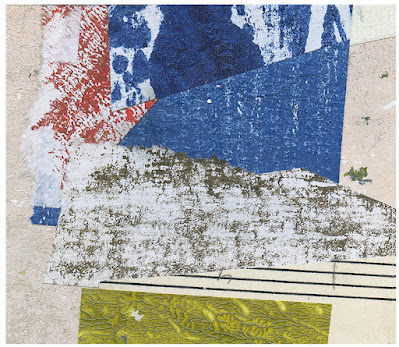
This is untitled Collage No. 239 (Santa Rosa). Acrylic on paper, acrylic monotype, collage. Image size: 29.9 x 39.4cm (11.8 x 15.5 inches). Matted to 20 x 24 inches. Signed on the mat. Signed and dated on the reverse. November 20, 2021. 

 For more of my abstract collage work, visit my website at: https://ctalcroft.wixsite.com/collage-site/home

Wednesday, April 20, 2022

Tidbits: Radu Lupu

I was very sorry to hear that pianist Radu Lupu died yesterday. He's long been a favorite. His recording of the Schubert Sonata in A Minor (D.959) is still the best in my view. 

His Brahms is great, too, but it was the Schubert D.959 recording that first brought him to my attention. Years ago, I had the unexpected privilege of being invited to dine with with Kyung-wha Chung and her entourage after a concert in Ueno, in Tokyo (another story altogether). For some reason we got on the subject of Radu Lupu. They recorded Franck and Debussy sonatas together.  I remember her calling him "a crazy man." It was something about putting his fist through a glass door—which seems a very odd thing for a pianist to do. I don't know. He may have been crazy, but he will always remain among my favorites. I heard him in recital in Tokyo sometime around 1988. He was wonderful. I was surprised, however, by his virtual baldness even then. His photos on recordings were always of him as a younger man and with more hair. Funny the things you remember...

Tuesday, March 15, 2022

Rain: A Little More Rain (March 14-15, 2022 and March 27)

We had a little rain in the early morning hours of March 14-15. We got 0.45 inches of new precipitation at my location in northeastern Santa Rosa. That brings our total for the 2021-2022 rain year to 22.45 inches. Every little bit helps, but we are woefully behind normal rainfall levels. By this time of year, we should have had about 34 inches. We got off to an excellent start early in the season, but have had almost no rain (until last night) since early in January save for a couple of tenths of an inch on one day in February. Rain is in the forecast again for Thursday, March 17. Let it rain....

[Edit: The rain predicted for the 17th failed to materialize, but a small storm passed through on March 27. It dropped 0.9 inches of rain at my location, bringing our total now to 23.35 inches--still very low, but better.]

[Edit: On 13 April we got about 0.5 inches of new rain and then it rained overnight and into the early morning or 15-16 April, adding another 0.9inches, for a total of about 1.4 inches since last reporting. That brings our total for the current rain year to 24.75 inches. That's a help, and there is rain in the forecast again for the coming week.]

Thursday, March 10, 2022

Art I'm Making: Unintentional Political Commentary

My art is not and never has been political. Most of the art I create is entirely abstract. Composition has always been my focus. It is the formal relationships between compositional elements that interests me. I think of my abstract collage pieces as silent "conversations" between the shapes and lines and patches of color they are made of. 

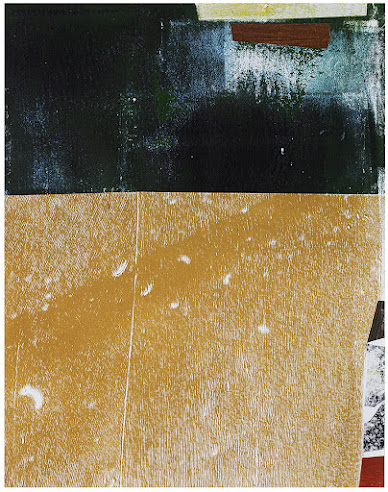
Yesterday, I finished a new collage. Untitled Collage No. 242 (Santa Rosa). This is a large piece for me, 33.2 x 41.4cm, or 12.7 x 16.3 inches. Like most of my work recently, it is a collage of acrylic monotyped papers that I make myself.

When I looked at it this morning, I saw in it something unintended. Suddenly it looked to me like a field of ripe grain with a backdrop of a dark, threatening sky and I realized that I had created a sort of dark version of the Ukrainian flag that we have seen so often since the start of Russia's war on Ukraine. I stress that this was entirely unintentional and unconscious. Yet, there it is.

For the record, art aside, I stand with the people of Ukraine—and all oppressed people, foreign and domestic. 

Saturday, February 26, 2022

Wines I'm Making: 2021 Sangiovese Rosé Bottled

Finally got around to bottling our 2021 backyard rosé today. I bottled three gallons, or 15 bottles, from the nine Sangiovese vines behind the house. Normally I do this before Christmas, but it's been a busy year. Now it's time to design a label.

[Edit: Label done—see below.]


Saturday, February 19, 2022

Miscellaneous: Random Saturday morning observations

Opera can be hard to take seriously at the best of times. Opera sung in English is impossible to take seriously ever. 

Cats love to sit in boxes. Despite that, they rarely show any interest in entering refrigerators.

Tuesday, February 15, 2022

Art I'm Making: Untitled Collage No. 236 (Santa Rosa)

Untitled Collage No. 236 (Santa Rosa). This is another very small  piece, measuring only 6.8 x 6.0cm (2.7 x 2.4 inches). September 10, 2021. Acrylic on paper, acrylic monotype, collage. Matted to 8 x 10 inches. Signed on the mat. Signed and dated on the reverse. 

For more of my abstract monotype collage work, visit my website at: https://ctalcroft.wixsite.com/collage-site 

Miscellaneous: Quintessentially American

Quintessentially American is Jiffy brand corn muffin mix. Somehow, Jiffy corn muffin mix in six packs is even more quintessentially American. First sighting.

Saturday, January 29, 2022

Art I'm Making: Untitled Collage No. 235 (Santa Rosa)

This is a fairly recent collage, Untitled Collage No. 235 (Santa Rosa)—a diminutive piece, measuring only 6.7 x 6.0cm (2.6 x 2.4 inches). September 10, 2021. Acrylic on paper, acrylic monotype, found paper, collage. Matted to 8 x 10 inches. Signed on the mat. Signed and dated on the reverse. 

For more of my abstract monotype collage work, visit my website at: https://ctalcroft.wixsite.com/collage-site

Birds I'm Watching: California Thrasher (January 22, 2022)

Doing a bird survey on private property last weekend, I came upon a California Thrasher (Toxostoma redivivum) along the Russian River, near Healdsburg. Not a truly rare bird, but unusual and always fun to see. They have some distinctive calls and sometimes mimic other birds. Notable for the long, decurved bill.

Saturday, January 15, 2022

Plants I'm growing: First blooms (2022)—Cyclamen Coum

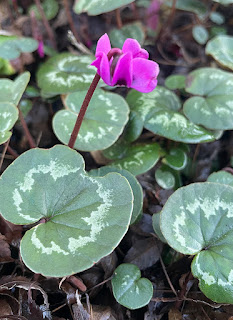
I note here a little belatedly that Cyclamen coum was the first plant in the garden to bloom this year, as it is in most years. The first couple of flowers opened this year on January 7, which is typical. Cyclamen coum normally blooms in the first week of January, occasionally in the last week of December. Also blooming in the garden right now is the pink flowering plum at the front of the house. The first flowers opened on January 10 or so, although, strictly speaking, I missed their first day.  

Friday, January 7, 2022

Rain: More Rain (January 7, 2022)

Since last reporting, there has been rain on and off on a number of days—mostly quite light—but we have had an additional 0.65 inches, which brings our total for the current rain year to 22.00 inches. 

Monday, December 27, 2021

Words I'm Writing: An Autumn Haiku

I meant to post this here back in October when I wrote it. Here belatedly is an autumn haiku.


Sun-warmed paper bag

Damp after first autumn rain

But my sleeping cat snores 


Thursday, December 23, 2021

Art I'm Making: Untitled Collage No. 233 (Santa Rosa)

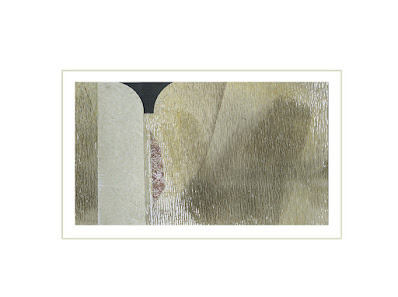
Another relatively recent collage—forgot to post this one.... This is Untitled Collage No. 233 (Santa Rosa). July 3, 2021

Acrylic on paper, acrylic monotype, collage. Image size: 19.1 x 11.3cm (7.5 x 4.5 inches). Matted to 14 x 11 inches. Signed on the mat. Signed and dated on the reverse. A quiet, contemplative piece. 
 
For more of my abstract monotype collages, visit my website at: https://ctalcroft.wixsite.com/collage-site

Wednesday, December 22, 2021

Rain: More Rain—Rain expected on and off all week

It rained overnight (December 21-22) and rain is in the forecast every day into next week. We'll see what materializes, but, so far, as of the morning of December 22, we've had 0.70 inches of new rain since last reporting. That brings our total for the year so far to 17.75 inches.  

[Edit: As predicted, we've had more rain. As of of the morning of December 24, we've had another 2.15 inches of precipitation. That brings our total to 19.90 inches--and it's supposed to rain again on Christmas Day and the day after.]

[Edit: We've had another 1.45 inches since last reporting, so our total now stands at 21.35 inches as of the afternoon of December 28.]

Art I'm Making: Untitled Collage No. 234 (Santa Rosa)


A fairly recent collage.
This is Untitled Collage No. 234 (Santa Rosa). August 25, 2021. Acrylic on paper. acrylic monotype collage. Image size: 20.2 x 21.6cm (8.0 x 8.5 inches). Matted to 16 x 20 inches. Signed on the mat. Signed and dated on the reverse.

For more of my abstract monotype collage work, visit my website at

Tuesday, December 21, 2021

Birds I'm Watching: 2021 Santa Rosa Christmas Bird Count (December 19, 2021)

I participated in the Santa Rosa Christmas Bird Count this year, as I do most years. I hiked with the group that covers the area that includes Spring Lake, Howarth Park, and also Strawberry School Park. It's a small area, really, but we managed to see 75 species despite missing a few birds we normally see, such as Wild Turkeys, White-throated Sparrows, Pileated Woodpeckers, and House Sparrows. We saw nothing rare, but most of the usual suspects. A Western Tanager was perhaps the most unexpected bird--rare at this time of year. We did, however, see three Pacific Wrens, which is fairly unusual. Shown above is a Ruby-crowned Kinglet. Below is a Hermit Thrush. 


Wednesday, December 15, 2021

Rain: New Storms in the Second Week of December

 A storm that rolled through mostly on December 14 gave us 2.6 inches of new precipitation. Another storm, supposed to hit in a few hours, will likely give us at least another inch or so. At present, however, as of the morning of December 15, our total for the current rain year is now 15.55 inches. 

[On the evening of December 15, the predicted storm moved through, dropping an additional 1.6 inches of new precipitation. That brings our total for this rain year to 17.05 inches. More rain is in the forecast for next week, but today, December 16 is a sunny day in Santa Rosa.]

Sunday, December 5, 2021

Art I’m Looking At: "Sentido: New Paintings by Bob Nugent" at the Triton Museum of Art in Santa Clara

Dominio da agua negra, Na Clareira (The Black Water
Domain, into the Clearing), 2021
I recently made the trip to the Triton Museum of Art in Santa Clara to see “Sentido: New Paintings by Bob Nugent.” Let me say at the outset that I think this is both a beautiful and an important show, but I found a few aspects of the presentation confusing.  From the publicity materials, it is a bit hard to understand whether it is formally part of “Extraction: Art on the Edge of the Abyss,” described as a “multimedia, multi-venue, cross-border art intervention which seeks to provoke societal change by exposing and interrogating the negative social and environmental consequences of industrialized natural resource extraction” (from the extraction.org website), and, contradictorily, the extraction.org website describes this show of “new paintings” as a “35-year retrospective.” The majority of the work has been completed in the past few years (mostly since around 2015), with a few pieces older and many newer than that, including several dating from 2021*. Perhaps these things don’t matter. New or old, formally part of Extraction or not, there is a great deal of art here that deserves to be widely seen. It was well worth the two-hour drive from Santa Rosa. I may even go back for a second viewing. 

Nugent has been visiting the Amazon almost yearly since 1984. Since that time, his experiences in the Amazon Basin of Brazil have been the wellspring of his art and it’s hard to avoid the fact that Nugent’s Amazon-inspired art is heavy with message. It’s a now-familiar message and it comes in two parts: 1) the Amazon is a fabulously fertile, complex, and important part of the Earth’s environment, unique and worth preserving; and 2) we are failing at the task of protecting the Amazon, which is disappearing. Baldly stated this way, the message is easily condensed into just another desperate slogan—“Save the Amazon”—already banal. The rise of Amazon, the retailer, has degraded the word “Amazon” itself.

Mostly, I find art with a political edge trite, self-indulgent, or simply boring. Too often, it is crudely presented and attempting to carry weighty ideas—desperate slogans—on art with legs too spindly to provide the necessary support. We are simply slapped in the face with an outraged cry that seems incongruously delivered in paint—a message that would have been more effective elaborated in writing (some of the work of Ed Ruscha comes to mind). Yet, I am strongly drawn to Nugent’s work, and I have to ask myself, why? How does this work escape being trite?

Jardim Inhotim 42
(Inhotim Garden 42), 2019
Nugent’s art is weighty with message, but the message is integral—and that is key. I am reminded of the music of Bela Bartók. Bartók was deeply interested in the folk music of his native Hungary. He sought out peasant musicians, had them perform for him and he wrote down their music to preserve it. He is known not only for his own compositions but also for the research he did as a musicologist. Initially he focused on Hungarian music but his interest extended to the folk music of Romania, Bulgaria, Slovakia, Serbia, and even to the music of Turkey and some of the Arabic-speaking countries. Bartók’s own music very rarely quotes any of this music, however. He seems to have absorbed it—to have completely internalized it. His music is entirely original, yet infused with the essence of the music he studied. Folk traditions were integral to his music, never set out on a shelf for display with a label pinned on. And I get that feeling from looking at Bob Nugent’s painting. The Amazon is in his bones. He has become infused with its essence and the paintings express his familiarity with the Amazon in a way that seems analogous to me with Bartók’s familiarity with Eastern European musical traditions as expressed in his compositions. The Portuguese word "sentido" in the show title is appropriate here: It means "to experience fully, with all one's senses."

Sometimes Nugent’s paintings seem alive with complexity; there is life force here. It’s not hard to imagine some of these canvases as virtual terraria. At times, the surfaces seem in motion. I look at some pieces and get the feeling I’m looking down at the rain forest floor, alive with insects, worms, perhaps unnamed, yet-undiscovered terrestrial invertebrates consuming and processing detritus under foot, or that I am peering through tangled vines or lush stands of broad-leafed vegetation under a canopy of overhead foliage. Brightly colored flowers bloom. This is Nugent giving us back in abstracted form the Amazon he has absorbed over the years. 

Occasionally, there are literal quotes—a sketch of a seed pod, a leaf, a tangled stem—often in works on unprimed linen and with grids or implied grids showing through, pieces that look unfinished**, but the bulk of the new paintings in the Triton show are not these but unabashedly painterly abstracts that draw on internalized experience rather than literal representation. When I spoke with him recently, he mentioned, doing 10, 20, sometimes 50 to 100 sketches of a detail observed in the forest that later emerges subconsciously in abstracted form. From my own experience, drawing architecturally arresting houses in the Victorian Village section of Columbus, Ohio in my college days, I would say that drawing is perhaps the best way to know an object or scene intimately. Drawing forces observation, attention to the details, and to relationships between formal elements. Drawing enhances internalization and cements memory. Again, Nugent, seems to have the Amazon in his bones and he gives it back to us concentrated, subtly distilled. 

Tawadi (Night Hawk), 2017
Other paintings are darker, more overtly reflective of the destruction going on in the wild places of Brazil. Sometimes it’s the use of heavy, ragged patches of black laid over brighter colors evocative of vegetation that hints at the taint of human activity. These black layers can have the effect of making the jungle seem jailed, set apart, and beyond our reach, lost to us—yet there. Some paintings suggest destroyed rain forest landscapes burned and laid bare. 

Yet another group of paintings references mining in Brazil. These are often grid-like. While abstract, they evoke strip-mined landscapes, or cut-away views of soil strata, and, through the use of contrasting colors or a variation in the size or shape of the “cells” in the grid, in many cases they are disturbed vertically by patterns suggestive of human intrusions into the Earth—suggestive of mine shafts.

Dominio da agua negra, Maura
(Black water domain, Maura), 2021

 So, I’m arguing that the message in Nugent’s painting is so expertly integrated with their visual content that we are not left feeling preached at, and in none of these works is the message making up for anything lacking in the art itself. However, no knowledge of Nugent’s history with Brazil is required to appreciate them. They command attention purely as abstract paintings. 

They are painterly paintings. You can see the brushwork. Sometimes it is thick and dark, vaguely reminiscent of work by Clyfford Still or Pierre Soulages. In other places you can see where thinner splashes of paint have been applied and dripped. In some pieces semi-transparent washes of brightly colored paint are laid over sections of the canvas. These washes put me in mind of some of Rauschenberg’s large collage work, but Nugent’s painterly effects never become an end in themselves, and by seeing these affinities I in no way mean to suggest imitation. This is strong, starkly original, and, yes, meaningful work. Highly recommended. The show is accompanied by a musical score composed by Richard Derwingson and orchestrated by Scot Derwingson-Peacock inspired by Nugent's paintings. 

The show will run through January 2, 2022 at the Triton Museum of Art, at 1505 Warburton Avenue, Santa Clara, CA 95050. Phone: (408) 247-3754. Admission and parking free. 

*A few days after seeing the show, I ran into Bob and spoke with him a little about the background. He said emphatically that the show is not a retrospective in the sense of being a survey of an artist’s entire career. He suggested the curator may have been trying to say the show is in some ways a summation of Nugent’s work so far that has been inspired by his experience in the Amazon. While the Amazon-inspired work may have become the most substantial phase of Nugent’s work, it is only one phase in a long, varied, and ongoing career. 

**Here is a link to an interesting video about the show. In it the narrator suggests that some of these unfinished pieces can be interpreted as expressive of the voids that habitat destruction in the Amazon has created. I suppose that is fairly obvious once pointed out, but it hadn't occurred to me. https://www.youtube.com/watch?v=GeYeqDCn75Y

Saturday, November 13, 2021

Music I'm Listening To: San Francisco Symphony, November 12, 2021—MTT back on the podium

Michael Tilson Thomas underwent surgery for a brain tumor in early August. I guess it wasn't too bad as brain tumors go, as he was back last night for the first time since the surgery (and the pandemic break) after only three months. He got a prolonged standing ovation as he first walked on stage. I've never particularly liked him as a conductor and so have usually avoided seeing him by choosing the subscription options that are mostly guest conductors, but he is loved by San Francisco and clearly everyone was glad to see him back again, perhaps particularly because the pandemic made it impossible to give him a formal public send-off as he handed over direction of the Symphony to Esa-Pekka Salonen. He appeared moved by the reception. He looked a bit frail and has gained weight since last time I saw him, but he seemed reasonably well. He conducted a set of Mozart German dances, a piece of his own composition featuring flutist DeMarre McGill (I didn't know that he composed), and, after intermission, Schumann's Symphony No. 1.

When you subscribe, you have to buy a block of at least six concerts that come in a series. Once they've sent you your tickets, you can call in and swap out ones you don't like for something you prefer, then they send you the new tickets and you destroy the replaced ones. I've been a subscriber for about 12 years and never had any trouble doing this, but last night when they scanned our tickets they were rejected. I had to go to the box office to enquire. It turns out we had swapped out last night's tickets (avoiding MTT!) and replaced them with something else but I hadn't destroyed the old tickets. So, in fact, we did NOT have tickets to the concert last night. I was prepared to buy a pair (as we had driven an hour to get to the concert hall and were prepared for an evening of music) but the box office guy just laughed it off and gave us a free pair, which was very nice of him. With the pandemic situation, the concerts are only about two-thirds full, so there were plenty of seats and, as I say, we're long-time subscribers, but he didn't have to do that.

At dinner, after the concert, we went to Monsieur Benjamin, a French restaurant near Davies Symphony Hall (good, but expensive). Because it's expensive, it has never been our usual after-concert restaurant, but, because of the pandemic situation, many restaurants are closing their kitchens too early to get to after a concert and there are fewer choices now. Last time I was there was several years ago after a recital with Jean-Yves Thibaudet and Gautier Capuçon. Just before we left that night, we noticed that Thibaudet and Capuçon had been in the restaurant the whole time. We didn't bother them. We were reminiscing about that last night and just after talking about it we realized that McGill was sitting three tables down from us. I guess it's the place musicians go after the concerts. This time, we DID bother the performer. We greeted him and told him we enjoyed the concert. He was very friendly and seemed genuinely pleased that we had come over to say hello. Very gracious--enthusiastic even. Despite the ticket mistake, everything turned out well.

Wednesday, November 10, 2021

Rain: A little more rain (November 8-9)

Overnight on November 8-9, we had another storm pass through. It added 1.45 inches of welcome new precipitation to our total for the 2021-2022 rain year. That brings our total to 12.95 inches. The forecasters continue to say this is likely to be a dry winter again, but, so far, we're doing pretty well. Let's hope it continues. 

Sunday, October 31, 2021

Wines I'm Making: 2021 Cabernet Sauvignon/Cabernet Franc pressed

Spent much of yesterday and today (October 31) pressing this year's wine (Cabernet Sauvignon/Cabernet Franc) from the backyard vines. I made two batches this year, one using French Red yeast, one using Rockpile yeast, just for variety. I pressed about 10 gallons of must each, 20 gallons in total, which yielded seven gallons of new wine from each of the two batches. Fourteen gallons of wine will make about 70 bottles. As the grapes were harvested on October 5 and the yeast went in on October 7, fermentation took 24 days--which is about the longest it's ever gone. That reflects the fact that it has been consistently cool and mostly overcast since harvest. The wine was in a cool garage the whole time. In a typical year fermentation takes from 10 to 16 days. The rosé (from our Sangiovese vines) has been even slower. I probably won't rack and sulfite the Sangiovese for a couple of more days still. Next step for the red wines, malolactic fermentation.*

I learned a new way to test for total acidity this season--a test I've never bothered with in the past because titrating using phenolphthalein solution and trying to judge the color change as it goes from acid to basic (remember your high school chemistry?) is really, really hard because of the color of the wine. This method uses a pH meter (which I already had) and a sodium hydroxide solution to find the TA value--no need to judge a tricky color change in a highly pigmented solution. You just read values off the meter as they change. The French Red batch had a pH of 3.37 and a TA of .75. The Rockpile batch had a pH of 3.45 and a TA of .765. The total acidity value is on the high side for a red wine, but, having never tested our wine for TA before (this is our 18th vintage), I have no idea whether that's normal for us or not. According to the textbooks, it should be adjusted down slightly, but I may leave it. Time to do some further research....

[Edit: *I racked and sulfited the Sangiovese rosé on November 4, as the hydrometer showed a specific gravity of 1.000. That means the rosé fermentation took 28 days, which is longer than it ever has before by a wide margin. I tested the TA and it was quite low—.585, which would be more appropriate for a red wine. I've never had to adjust the acidity of any of the wines I've made before, but this year was different for at least two reasons. First, because of the drought, I did not water the vines at all this year. Dry farming the vines has always been my goal and I was going to attempt it this year anyway. The Sangiovese suffered a little. There were more raisins than usual and the grapes probably should have been picked a little sooner. Second, the brix was notably higher than usual. In the past I've had to chaptalize the must (adding corn sugar to bump up the sweetness of the juice and hence the alcohol level in the finished wine), but this year the grapes did not need a boost. The result was low acidity. I added 20g of tartaric acid dissolved in distilled water to three gallons of racked wine, which, assuming my calculations are correct, should raise the TA to .785, which is just right for a rosé. It takes 3.4g of tartaric acid/gallon to raise TA 0.1%. 

I inoculated the red wines with the malolactic starter on November 2. Malolactic fermentation can take anywhere from about three weeks to about three months. It can be a bit mysterious. The only reliable way to tell whether it's finished is to do a paper chromatography test, which involves the use of very smelly chemicals, so I usually just let it go and hope for the best.]

Rain: A little more after the "atmospheric river"

Last night (October 30) we had 0.35 inches of new rain following the more than 10 inches we got recently in an "atmospheric river" event. That brings our total for the current rain year to 10.80 inches. Tomorrow rain is in the forecast again. 

[Edit: Last night, the night of November 3, we got another 0.70 inches of new precipitation. That brings our total to 11.50 inches for the current rain year.] 

Wednesday, October 27, 2021

The Cocktail Glass Collection: Matteucci's in San Anselmo

It's been more than two years since I last posted an example of a neon cocktail glass I've seen. With the pandemic, I've hardly been out anywhere far from home. 

Recently, however, I saw this one in the window of a bar in San Anselmo. This is at Matteucci's, at 114 Greenfield Ave. 

For more, click the "Cocktail Glass Collection" label at right toward the top of the page.

Sunday, October 24, 2021

Rain: Rain!

Rain is on my mind. We've had 7.75 inches of rain so far since the rain we had last week (last Sunday, October 17 we had about half an inch, which was the first rain this rainy season). All the drainage channels in the garden are actively flowing with run-off this afternoon, which I haven't seen here for several years. As  historical annual average rainfall in Santa Rosa is just over 36 inches, we've already had more than 20% of our annual precipitation in the past week (although mostly last night and today). A steady, spread-out pattern of winter precipitation is ideal (because flooding is less likely and we need water as late in the rainy season as possible), but I hope this will go some way toward restoring historically low reservoir levels. At Lake Ralphine recently here in Santa Rosa, you've been able to walk over to the little island by the boathouse—which I've never seen before. I'm guessing the island is already an island again. And it's still coming down.  

[Edit: Checking the rain gauge this morning (Monday, October 25), we appear to have received a total of 9.95 inches in the storm of yesterday and the night before. With that and the rain last week, our total so far for the current rain year (October 1, 2021 through September 30, 2022) is 10.45 inches--which is nearly a third of our annual average rainfall in the past week. Let's hope it continues.]

Related Posts with Thumbnails