Saturday, April 24, 2010

Birds I'm Watching: Ellis Creek Water Treatment Ponds (April 24, 2010)


I took a walk around the Ellis Creek Water Treatment Ponds in Petaluma this morning. I saw 32 species. Crow, Canada goose, mallard, snowy egret, American coot, cinnamon teal, Brewer's blackbird, red-winged blackbird, black-necked stilt, blue-winged teal, whimbrel, common moorhen, American goldfinch, Eurasian collared dove, marbled godwit, Western kingbird (first sighting in Sonoma County for me), Bullock's oriole, house finch, black phoebe, tree swallow, killdeer, song sparrow, savannah sparrow, mute swan, pied-billed grebe, marsh wren, starling, sora, Anna's hummingbird, turkey vulture, red-tailed hawk, and northern rough-winged swallow.  I got a nice shot of a handsome savannah sparrow singing.

For more information about bird watching in Sonoma County, see my Website Sonoma County Bird Watching Spots.

Friday, April 23, 2010

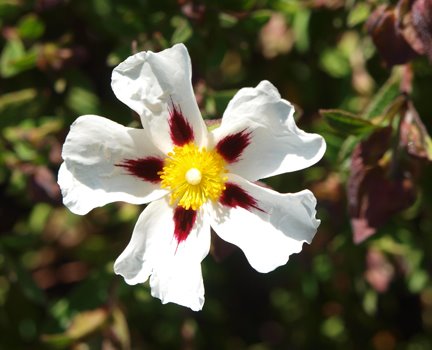
Plants I'm Growing--First Blooms: White Cistus, Trillium, and Dianthus (April 23, 2010)

First blooms of 2010 today on three plants--the big white Cistus (rock rose) under the pink crabapple (above), the Trillium at the back of the house (below), and the low Dianthus by the driveway.

I don't have records for 2009 for either the Cistus or the Dianthus, but the Trillium bloomed last year on April 21, so a year according to the Trillium was 367 days. The photo here is from last year. The leaves this year are rather bruised because of the sustained hail we had a couple of days ago.

Thursday, April 22, 2010

Movies I'm Watching: The Best Movies I've Never Seen (April 22, 2010)

In the past few days, I've seen more of the films recommended in Leonard Maltin's 151 Best Movies You've Never Seen. As noted in my previous post on the subject. I didn't think that much of any of them. So far, I remain generally unimpressed by the recommendations in the book. This post looks at Aurora Borealis and Better Than Sex.

Aurora Borealis (2005, written by Brent Boyd, directed by James C. E. Burke, starring Joshua Jackson, Steven Pasquale, Donald Sutherland, Louise Fletcher, Juliette Lewis, and others) has been much praised, I see, but it struck me as being on the level of a decent made-for-TV movie, no better. Despite some good performances, particularly by Juliette Lewis, the whole was unpersuasive. Much as I like Donald Sutherland, and despite a very convincing Parkinson's disease tremor, I found his performance uneven. 

But the script is the real problem here: Would Duncan (Joshua Jackson), a man unable to shoot a deer, really give his aging grandfather a loaded shotgun to commit suicide with? I found myself unable to accept the incongruity. Duncan's brother is a cliché. The ending of the film is more than a little too pat--how nice that the Donald Sutherland character dies on cue so that his grandson can fly off to San Diego to get back together with Kate (Juliette Lewis). If only life were so neat.  

Better Than Sex (2000, written and directed by Jonathan Teplitzky, starring David Wenham, Susie Porter, and others) is at least a little bit different. It approaches falling in love from the perspective of two people trying not to fall in love--two people surprised they have fallen in love. 

Josh (David Wenham) and Cin (Susie Porter) meet at a party, they aren't especially attracted to one another at first, but they talk some and end up sharing a taxi home. He's staying in town for only three days. During the taxi ride, both Josh and Cin begin to think about a quick fling--knowing there'd be no strings attached. Inevitably, she asks him in when they arrive at her door, and one thing leads to another. The rest of the film is a chronicle of a one-night stand that ends up lasting three days (and then some). What was supposed to have been no-hassle sex turns into emotional attachment on both sides.

We can't help our feelings. Sometimes we fall in love in spite of ourselves, in spite of everything.  

The story is told through straight narrative intercut with documentary-like interview segments, portions of phone calls between secondary characters, musings we understand to be the thoughts of the main characters (sometimes during the action, like theatrical asides; sometimes with the character sitting against a studio backdrop as if being interviewed), and through wry comments from the taxi driver. The taxi driver keeps showing up in the right place at the right time, always encouraging love, like Cupid on wheels. The creative editing keeps things moving, keeps the sex (essential to the story) from playing too dominant a role or becoming gratuitous, and it keeps the audience at a distance. We are voyeurs, but voyeurs invited to see the show and the players know they are being watched and we know they know. Despite the somewhat obtrusive devices (especially the taxi driver) and a falling back on cliché in some scenes (notably the girl-takes-forever-to-get-ready-to-go-out-and-doesn't-have-anything-to-wear scene, which is quite long, and the guy-never-bothers-to-flush-the-toilet scene), Better Than Sex was mostly intelligent and entertaining. 

Birds I'm Watching: Close to Home

I took a walk today up the long road that winds through the woods behind our house. It was in the early afternoon, which is not the best time of day to see birds, but I counted 17 species nevertheless. Most of them were birds I'm used to seeing at the bird feeder. The exceptions were a wild turkey, some tree swallows, a violet-green swallow, and a Pacific-slope flycatcher. The flycatcher sat still enough to allow me to get a good photo.

Wednesday, April 21, 2010

Movies I'm Watching: The Best Movies I've Never Seen (April 21, 2010)

In the past few days, I've seen three more of the films recommended in Leonard Maltin's 151 Best Movies You've Never Seen. I didn't think that much of any of them, to tell the truth. I wouldn't say they were a waste of time, but--so far, anyway--I have been disappointed by the recommendations in the book more often than not. I saw: Baadasssss! (2004, written and directed by Mario Van Peebles--based on a book by his father, Melvin Van Peebles--starring Mario Van Peebles, Joy Bryant, T. K. Carter, Terry Crews, Ossie Davis, David Alan Grier, and others); Better Than Sex (2000); and Aurora Borealis (2005). This post looks at Baadasssss! More about Better Than Sex and Aurora Borealis in a post tomorrow.

While Baadassss! was interesting on a number of levels, it left me wishing the film had been a straight documentary rather than a hybrid documentary/biopic. Baadasssss!, tells the story of the making of Melvin Van Peebles' groundbreaking 1971 film Sweet Sweetback's Baadasssss Song, generally considered the first film made for a black audience by a black director that wasn't forced to toady to a white-controlled studio. Baadasssss! was interesting because it tells an interesting story: The elder Van Peebles, set out to make a feature film with almost no resources and entirely outside the Hollywood system--engaging in what some have referred to as "guerilla film-making." Van Peebles worked with whatever he could scrounge. The actors were friends and family. The sets were makeshift. Money was perpetually running out (he finally finished the film with a $50,000 loan from Bill Cosby). Surprisingly, Van Peebles succeeded.

The elder Van Peebles was angry and it was an angry period in US history. The Black Panthers were agitating for change (and later championed the 1971 film), the Vietnam War was raging. Hoping to direct full-length films after making several shorts, mostly on his own, Columbia offered Van Peebles Watermelon Man, a comedy about a white man that wakes up black. Watermelon Man was a commercial success, but it was mostly his contempt for the studios born of that experience that drove Van Peebles to set out on his own. It's a testament to his determination and persistence that Sweet Sweetback's Baadasssss Song was completed and released (although rated X and initially in only two theaters nationwide). It went on to become the highest-grossing independent film made up until that time. Van Peebles paved the way for other independent black filmmakers, indirectly spawning the blackxploitation genre as well.

Baadasssss! switches back and forth between a straight retelling of the story of the original film production and documentary-like interviews with the people involved (both the actual people and the actors portraying them). Baadasssss! also attempts to say something about the relationship between the younger filmmaker and his obsessed father, but somehow that relationship never comes across as genuine, and Baadasssss! ultimately seems a fairly bland retelling of the facts. Still, Mario Van Peebles delivers an interesting performance as his father, the story is a good one, and the film gives us a glimpse of what it meant to make a film independently in the early 1970s--more interestingly, what it meant for a black man with a message the establishment didn't want to hear to make a film independently in the early 1970s. Having said that, I get the impression from reading about Sweet Sweetback's Baadasssss Song that Baadasssss! downplays that film's violence and sexuality, and, in that sense, Baadasssss! is not entirely honest. Not a great film, by any means, but probably worth seeing once. I imagine Sweet Sweetback's Baadasssss Song is available on DVD as well. Now I'm curious.

Tuesday, April 20, 2010

Found Art: Chair and Shadow (April 20, 2010)

I saw this shadow in the house under a chair today. The dark wood and the shadows of the chair and the window blinds looked interesting against the bright, warm maple floor. Found art.

Plants I'm Growing--First Blooms: Scabiosa Farinosa, Sulfur Buckwheat, Echium Wildpretii, "Altissimo" climbing rose

First blooms today on Scabiosa farinosa, a leather-leaved mounding variety of Scabiosa that does well in our hot summers. Although this plant has a tendency to die out in the center, new growth will sprout from almost anywhere, so holes tend to fill in. It grows easily from cuttings, too. This plant bloomed on May 4 in 2009, so it's comparatively early this year. A year according to this plant was only 350 days.

The first tiny flowers in some of the clusters on our sulfur buckwheat plants (Eriogonum umbellatum) opened today, although the plants still look quite closed up. This plant bloomed on April 17 in 2009. A year according to sulfur buckwheat was therefore 368 days.

First blooms today also on Echium wildprettii--only a few an the long stem are open. It will be a week or so before this plant becomes a brick red torch, attracting bumblebees and hummingbirds.

One bud on the climbing rose "Altissimo" opened today as well. I love this sturdy, deep red, single-petaled climber. Stunning in full bloom.  This flower bloomed on April 6 in 2009, calculating a rather long year this year of 379 days. Despite the range in years calculated by the three coming into bloom today that I have data for, the average of the three comes to 365.6 days--very close to a calendar year.

Rain: Another Downpour (April 20, 2010)

Another downpour during the night last night (April 19) added 0.45 inches to 2009-2010 precipitation in Santa Rosa. This morning was generally clear and sunny, if cold, but then there were more showers and after that, hail. Following the hail, we had had a total of 1.15 inches of new precipitation. Our season total now stands at 30.20 inches as of late afternoon on the 20th, which is above the historical average of 29.58 inches for this day, but some Santa Rosa stations have reported well over 35 inches already this year. The historical annual average for Santa Rosa is 31.01 inches.

Music I'm Listening to: Schleswig-Holstein Festival Orchestra and Lang Lang (April 19, 2010)

I heard a very enjoyable concert last night at Davies Symphony Hall in San Francisco. Christoph Eschenbach conducted the last of 23 concerts in a US tour by the Schleswig-Holstein Festival Orchestra in Beethoven's Leonore Overture No. 3, Mozart's Piano Concerto No. 17, Prokofieff's Symyhony No. 1, and Beethoven's Piano Concerto No. 1. The soloist in both concertos was Lang Lang.

The audience got a treat after the published program was complete. The orchestra performed an encore--although, frustratingly, no one told us what it was and no one afterwards knew either. Following the orchestral encore, Lang Lang returned to the stage for a scheduled talk with the audience. Lang Lang expressed his thanks to the orchestra, whipped out what looked like a brand new iPad, and proceeded to play what he called a "high-tech version of Flight of the Bumblebee" by drumming his fingers on the pad, occasionally reaching over to the real piano to embellish a bit, much to the audience's delight. I'm still not sure whether he was actually playing, using an app on the iPad or if he was just fooling around, pretending to play while the music played in the background (I think the latter). If that were not enough, stage hands next brought out a second piano stool and we got to hear Eschenbach and Lang Lang play two pieces for four hands--Eschenbach, of course, started his career as a pianist. Again, frustratingly, no one told us what we were listening to and no one afterward knew what the encores were, but it sounded like Debussy to me--perhaps from his Petite Suite. Probably because this was the last concert of a long tour, the mood after the show was relaxed--celebratory almost. Some of the best music I've ever heard live has been encores like this, when the pressure is off and the musicians are just enjoying themselves.

Taken as a whole, the concert was wonderful, but it got off to a slow start. Beethoven's Leonore Overture No. 3 is what I used to put on the record player, turned up loud, to listen to just before going out for final exams in college. Somehow I felt powerful, full of knowledge, in control, ready to conquer if I marched out with that music ringing in my ears. It's stirring music--or at least it should be. Eschenbach and the orchestra managed to make it sound almost lugubrious. The pace was slow, the sound was dull. I've had this experience before at Davies Symphony Hall. There seem to be pockets of rather muddled sound--although the seats were good: Upper orchestra, dead center. I noticed this also at the Itzhak Perlman concert I recently heard there. The strings in particular lacked brilliance last night. Having said that, it makes no sense to attribute the flatness entirely to the acoustics; the second half of the program was excellent. I can't explain it, but the Leonore Overture was a disappointment, and I'm afraid the Mozart suffered from the same dark, dull tone in places. The piano playing was impeccable and nicely expressive, however, especially in the middle movement (Andante). Lang Lang is one of those performers that immediately banish all worry about a possible missed or stray note, even in the most demanding of passages. He is interesting to watch--although the unnecessary flourishes suggestive of bad ballet can become tiresome after a while. His gestures while playing reminded me of Melvyn Tan (Whatever happened to Melvyn Tan?), although Lang Lang is somewhat less flamboyant.

(Photo of Christoph Eschenbach courtesy of the San Francisco Sympony. Photo by Eric Brissau.)

Three things struck me visually. First, the layout of the string instruments on stage was a mirror image of what we're used to seeing in the US. The basses and cellos were on the left, the violas on the right. I've seen European orchestras perform before, and our local conductor in Santa Rosa, Bruno Ferrandis, a Frenchman, once remarked that the layout in Santa Rosa was "backwards." I'm aware of this difference in the way we array the strings, but I've never really noticed it before. It seemed to make little difference to the sound. Second, there were only two or three blond heads among the Schleswig-Holstein performers, which was a trifle surprising at first. Again--no effect on the sound. (However, as this is an orchestra for young performers drawn from areas well outside of Schleswig-Holstein, it's not hard to explain.) Third, the women in the orchestra were dressed rather more daringly than the performers I'm used to seeing in San Francisco. One of the front-row cellos had on a tight-fitting, off-the-shoulder top, another seemed to be wearing something resembling a body suit--everyone in black, of course. Once again--no effect on the sound, but these things are part of the extra dimension that a live performance provides.

I've remarked here before that I've learned to treasure the gems of live performances and not worry too much about the disappointments. This concert would have been worth it just for the second half of the program. Eschenbach gave us a very precise, controlled performance in the first three movements of Prokofieff's Classical symphony that fit the music perfectly and allowed for a strongly contrasting, almost frenzied final movement. Here the sound was clear and clean, and bright and loud where it should have been. A delight.

Lang Lang and the orchestra were in top form for the Beethoven Concerto as well. An appreciative audience immediately stood up for an ovation at the end. I wish they had been more appreciative during the performance. I've noticed over the years an inverse correlation between the celebrity  of a performer (as distinct from his or her talent) and the manners of the audience they attract. The more famous a performer is outside the world of music enthusiasts (for whatever reason) the more likely the audience is to be full of people more interested in the person than the music. These people tend to have a low tolerance for sitting still and being quiet. Davies Symphony Hall is always a co-conspirator: The seats creak, the hollow metal backs of the seats sound like timpani, the hard wood floor might as well be a giant drum--every heel resonates; coughing, sneezing, watch alarms, rustling paper, and dropped water bottles all made an appearance. Still, with the excellent performances of the Prokofieff and the Beethoven concerto, Lang Lang's funny iPad performance, and three encores, I'm not complaining. It was a lot of fun.

(Photo of Lang Lang, courtesy of the San Francisco Symphony.)

Dinner beforehand at Café Della Stella was solid, as always, if not exciting. I had an excellent arugula salad with roasted (grilled?) pears, scampi as a main dish, and a tasty panna cotta for dessert. The highlight was a very tasty 2008 Villa Teresa Pinot Grigio from Italy's Veneto region. Very dry, deceptively delicate, very flavorful. Behind the fruit it had something of the quality of a really good Fino sherry. Delicious.

Monday, April 19, 2010

Plants I'm Growing--First Blooms: Pink Cistus, Yellow Columbine (2010)


First blooms today on the Cistus near the Higanzakura (flowering cherry) tree. I'm trying to remember which species this is, but can't. First blooms today also on the yellow, long-spurred Aquilegia (columbine) in the garden. Last year the columbine bloomed on April 21, so a year according to this flower was 363 days.

Sunday, April 18, 2010

Plants I'm Growing--First Blooms: Phlomis Lanata (2010)

The first buds on one of the Phlomis Lanata plants in the garden opened today. People seem to call this Jerusalem sage, but the plant I know as Jerusalem sage is the much bigger plant Phlomis fruiticosa. In any case, both plants do wonderfully in our hot dry summers with almost no extra water. This year the plants are especially lush-looking because of all the rain we've had. In the background of the photo here you can see Spanish lavender blooming. These two plants pair nicely. Phlomis lanata bloomed on April 20 in 2009. A year according to this plant was 363 days.

Saturday, April 17, 2010

Birds I'm Watching: Spring Lake (April 17, 2010)

I walked around Spring Lake in Santa Rosa this morning with a group from the Madrone Audubon Society. There was a lot of activity today. I saw 44 species. The highlights were four green herons, a nesting great horned owl, and excellent views of a Pacific-slope flycatcher making a nest. I got an excellent photo (if I say so myself) of the flycatcher carrying nesting material.

Birds I saw: Western bluebird, red-winged blackbird, orange-crowned warbler (7), warbling vireo, white-breasted nuthatch, Pacific-slope flycatcher, acorn woodpecker, mallard, oak titmouse, California towhee, spotted towhee, Swainson's thrush, Bewick's wren, scrub jay, black-headed grosbeak, mourning dove, violet-green swallow, cliff swallow, tree swallow, Anna's hummingbird, song sparrow, white-crowned sparrow, golden-crowned sparrow, house finch, dark-eyed junco, California quail, Wilson's warbler, yellow warbler, Bullock's oriole, Steller's jay, American goldfinch, Canada goose, green heron (4), coot, osprey, American crow, common moorhen, black phoebe, snowy egret, brown creeper, bushtit, great horned owl, and pied-billed grebe (7).

For more information about bird watching in Sonoma County, see my Website Sonoma County Bird Watching Spots.

Friday, April 16, 2010

Plants I'm Growing--First Blooms: Cistus (2010)

First blooms today on the low Cistus (rock rose) at the front of the house. This plant bloomed last year on April 16. As today is again April 16, a year according to this plant was 365 days. I think this is the first plant to have bloomed on exactly the same day two years in a row since I started keeping track. First blooms today also on the white valerian by the beehive. Many new irises opened today as well.

I regret that I can't remember the name of this Cistus (or is it a Halimiocistus?) I got it from Ken Montgomery's Anderson Valley Nursery, in Booneville. I'll have to contact him to remind me.

Thursday, April 15, 2010

Movies I'm Watching: Kinky Boots

I've just seen Kinky Boots (2005, directed by Julian Jarrold, starring Joel Edgerton, Chiwetel Ejiofor, Sarah-Jane Potts, and others), an entertaining bit of fluff, purportedly based on a true story but giving the impression that the writers have found it necessary (as they so often do) to embellish and add for "dramatic effect." It would be nice if moviemakers once in a while gave their audiences credit for having a little more intelligence. One wonders what the real story was.

Still, this was fun to watch and there are one or two truly funny moments. The highlights of the film are the performance of Ejiofor as drag queen "Lola" and the final runway show in Milan with Charlie (Edgerton) left on his own to model the family factory's new line of "boots for women who are men."

Birds I'm Watching: Annadel State Park, Santa Rosa

I went out to Annadel State Park for a hike this morning to look for spring migrants. I saw quite a lot of birds. including Band-tailed pigeon (16), turkey vulture, cliff swallow (20 or so), Bewick's wren, Anna's hummingbird, crow, mallard, red-shouldered hawk, Pacific-slope flycatcher (3), ruby-crowned kinglet, raven, oak titmouse, pileated wooddpecker (heard), acorn woodpecker, warbling vireo, wild turkey (including males in full display), quail, many Wilson's warblers (at least 9), black-headed grosbeak (7), Orange-crowned warbler (8), yellow warbler (1), robins nesting and feeding hatchlings, spotted towhee, bushtit, chestnut-backed chickadee, dark-eyed junko, and lesser goldfinch--27 species in total.

The black-headed grosbeaks (above), and the warblers have just returned from warmer parts south. Pictured below is Wilson's warbler--not a very good shot: these guys move around a lot.

Monday, April 12, 2010

Books I'm Reading: Sex on the Brain

I just finished reading Deborah Blum's Sex on the Brain: The Biological Differences Between Men and Women (1997, Penguin paperback edition), a well-written, entertaining, occasionally enlightening look at the biology behind sex differences. Although there wasn't much that seemed startlingly new, I enjoyed this. It is a concise, clear overview of a very wide range of research on the subject of sex differences.

The book includes excellent chapters on: Why sex exists at all; on the physical differences between male and female brains (there are very few, they are very subtle, and it's not at all clear what the few discernible differences mean); on emotional differences (yes, men and women build friendships and networks differently); on monogamy and polygamy (the former turns out to be very rare in the world--the human species is described as "slightly polygamous"); on homosexuality; on testosterone in men (and women); on estrogens and the female cycle (which involves far more than menstruation); on love, lust, and rape; and on gender and power.

What is perhaps most remarkable about Deborah Blum's writing here is its objectivity. There are no gender polemics in a book that could easily have been biased, and she shows an extraordinary sensitivity in her discussions of such things as hormone effects on both men and women and of rape. Frankly, it was fascinating to listen to a female voice so lucidly and empathetically articulating the typical emotional and behavioral effects of testosterone on men. Her discussion of rape as possibly persisting in human culture because it may make biological sense was somewhat uncomfortable to read, but convincing. There is much here to explain why we behave the way we do without giving anyone (male or female) facile excuses for bad behavior. Recommended.

Hmmm.... What to read next?

Rain: It Just Keeps Coming Down (April 11-12, 2010)

It just keeps coming down. This is by far the wettest year we've had in the almost ten years I've lived in Santa Rosa. Yesterday and overnight last night we had another 2.0 inches of rain. That brings our total for the 2009-2010 season to 29.05 inches, which is just below the historical average for this day in Santa Rosa (29.17 inches), but several inches higher than last year (last year the rain stopped in early March, if I remember correctly), and some stations in Santa Rosa have had as much as 33.7 inches. The historical average annual rainfall for Santa Rosa is just over 31 inches.

I could do with some sunshine now for a while, although sunshine can be a distraction when I'm stuck at my desk working, as I will be at least through the end of tomorrow.

Sunday, April 11, 2010

Wines I'm Drinking: 2006 Clos du Tal "Stone's Throw Vineyard" Cabernet Franc/Cabernet Sauvignon

Tonight I opened a bottle of the 2006 Clos du Tal "Stone's Throw Vineyard" Cabernet Franc/Cabernet Sauvignon--that is, a bottle of one of the wines we make here in the garage from grapes we grow out back. 2006 was the third vintage. The vines were planted in 2001, so they were quite young in 2006, but this wine has improved considerably since I last tried a bottle a few months ago.

The nose in particular has developed some nice leathery scents and some hints of roses that I don't remember from the last time I tasted it. The wine tastes fruitier and the tannins are beginning to soften. It still seems a bit austere compared to the riper wines we made in 2008 and 2009 (the 2009 is yet to be bottled), but this has come along nicely. It will be interesting to continue tasting a bottle every three months or so to see what kind of staying power it has.

Before long, it will be time to do a vertical tasting of everything we've ever made--from 2004 to 2009. The only real disaster was the 2005. Most of the grapes disappeared into the gullets of the local raccoons in that year. I made only six bottles from sour grapes that had to be picked too soon--what the raccoons left behind. Since then we've devised a system of nets and electric fencing that has made it possible to let the grapes hang as long as they should, which has made a big difference (needless to say). The 2008 and 2009 wines were made from grapes that were optimally ripe. The 2009 looks especially promising.

In case you're wondering, "Clos du Tal" is a play on "Clos du Val," with the T-A-L of Talcroft substituting for "Val." We call it "Stone's Throw Vineyard" because we live on an old basalt quarry--there are a lot of stones here--and the vines are a stone's throw from the house. Appropriately, our little vineyard of 32 vines is surrounded by a stone wall. "Clos" in French refers to a walled vineyard, often owned by a monastery. Such vineyards are common in parts of France, especially in Burgundy. There are some remarkable walled vineyards there, notably in the town of Gevrey-Chambertin. "Clos" is related to our English word "cloister."

What a pleasure, what a luxury it is to be able to open a bottle of wine I've made myself. I wish I could share it with you. Last summer, when I drove to Ohio, I took a couple of bottles with me to share with friends. This summer I will take a couple to France, to share with friends there. Friends I haven't seen in many years.

Saturday, April 10, 2010

Movies I'm Watching: The Lives of Others

How long has it been now? Almost three years? Yes, going on three years since someone recommended The Lives of Others to me. It's taken me this long to see it. I finished watching it a few minutes ago. I feel drained.

Das Leben den Anderen [The Lives of Others] (German, 2006, written and directed by Florian Henckel von Donnersmarck, starring Martina Gedeck, Ulrich Mühe, Sebastian Koch, Ulrich Tukur, Thomas Thieme, and others) is not a perfect film, but it is a multi-layered tour de force nevertheless. It subtly conveys the brutish oppressiveness of the East German security system (although I suspect the reality was blacker than it's painted here) and it's emotionally gripping from start to carefully orchestrated finish, taking us through layer after layer of surveillance and betrayal. 

The end of the film seems hopeful, but is it really? Stasi (Ministry for State Security) Hauptmann Wiesler selflessly defies the system to cover up for the "crimes" and personal betrayals of the people he's supposed to be watching; his is an act of love almost. But the final release of the captives that people the frames of The Lives of Others (an entire nation of people) is ultimately effected by Gorbachev and glasnost in the Soviet Union, by what feels like an external accident--the consequence of a personnel change in a land far away. The fall of the Berlin Wall seems as arbitrary as the system that created it, which is a reminder of how frighteningly and pointlessly cruel human beings can be to one another. After some 45 years of oppression, with what did state security provide anyone? Little more than perks for the elite, the kind of perks that no system of government seems able to do away with.

Director Donnersmarck quickly creates a dark mood. In the opening scene, a prisoner brought in for interrogation is made to sit in a stiff chair and told to sit with his hands under his thighs, palms down--tyranny is always petty--and throughout the film, the control exerted by the state is underscored more effectively by these little details than by speeches in the mouths of the main characters. The opening interrogation, we learn, has been taped. In the following scene, Wiesler uses it in the training of new recruits being taught interrogation techniques. The state is patient. It doesn't care about the lives it destroys. It works in shifts. It has all the time in the world. It strikes at love, at loyalty, at everything human in us. Wiesler reminds his students at the Stasi school never to forget to get a scent sample from each interrogation (using a piece of cloth hidden under the seat of the chair the subject sits in). "For the dogs," Wiesler says. Even our own bodies are made to betray us.

Ulrich Mühe is superb throughout. Taut, calculating, ever-observant as Wiesler the faithful Stasi man; fragile, alone, and desperate to feel something--and, ultimately, to do something good--as Wiesler the rebel. The difference in his demeanor is subtle but powerfully evident even in scenes that show him doing almost nothing--just sitting, listening. Or just sitting, interrogating. Even with virtually no expression on his face, we know which Wiesler we're looking at.


I was immediately reminded of Ray Bradbury's Farhrenheit 451. Fireman Guy Montag (played by Oskar Werner in Truffaut's 1966 movie version of the story) finds himself in much the same position as Wiesler. He is the unquestioning enforcer working in the interest of state security, but slowly he finds himself drawn to the people and the ideas he is charged with monitoring and suppressing. The pacing and the crescendo of pursuit at the end of The Lives of Others are reminiscent of The Day of the Jackal (1973, Directed by Fred Zinneman). Emotionally wrenching. Ultimately ambiguous, but hard to forget. Recommended.


Friday, April 9, 2010

Wines I'm Making: First Leaves on the Cabernet Vines (2010)

The first leaves are beginning to appear on the Cabernet vines in the back yard. The buds actually broke a few days ago, but leaves are now pushing out. As usual, they are about two weeks behind the Sangiovese vines.

There are nine Sangiovese vines and 23 Cabernet vines in the yard, of which four are Cabernet Franc--the rest being Cabernet Sauvignon. The Cabernet Franc vines are always slightly ahead of the Cabernet Sauvignon. This is the only time of the year I can tell them apart. To the eye, they are virtually identical. Leafed out, there is little to distinguish them visually, and the fruit is identical as well--to the eye. Well, at least to my eye.

Four of the original vines we planted failed to survive the first year. The nursery that supplied them, Nova Vine (right across the street from the main entrance to Oakmont, on Highway 12, in Santa Rosa), replaced them for me but accidentally gave me Cabernet Franc instead of Cabernet Sauvignon. I decided to keep them, so the Cabernet wine each year is a blend of these two grapes--17% Cabernet Franc, 83% Cabernet Sauvignon (on the assumption that all vines yield equally.

Plants I'm Growing--First Blooms: Cistus "Sunset," Rose "Nearly Wild," Rose "Livin' Easy," Echium Vulgare

At this time of year, keeping up with the garden begins to get difficult. Every day brings new flowers. Today the first blooms of 2010 came on the rock rose (Cistus) called "Sunset," on two roses--"Nearly Wild" and "Easy Livin," on Echium vulgare, and on one plant that I can't identify any more. "Sunset" is pictured above, Echium vulgare below.

Echiums are generally very tall plants with spikes of tiny flowers sometimes as much as 20 feet high. They are native to places like the island of Madeira. You've probably seen them on the coast if you live in California or visit here--at places like Bodega Bay and Mendocino. They have common names like "Tower of Jewels."

Vulgare is the smallest and least showy of the Echiums I know, but it's pretty nevertheless. The flowers bloom in loose spikes (the photo here shows only a single small blossom). They start out clear blue and fade to a washed-out violet pink. The plant is only about 18 inches tall. It's strong (tolerating neglect), but it tends to look a bit ratty late in the season. Still, it's a nice addition to the spring color parade.

Like many of the Echiums, it will reseed itself if you let the flowers go. There are about 8 Echium boissieri plants around the garden this year--none of which I planted. The original, single plant was put in about four years ago. It's long gone, but its descendants continue to thrive. The Echium vulgare is a volunteer, too, from a single plant I put in several years ago. Two or three Echium wildpretii are set to bloom this year as well. A few of the Echiums are perennials. Most are biennials (producing a rosette of low leaves the first year, a tall flower spike the second year and then dying). Echium vulgare is an annual.

Wines I'm drinking: 1998 Cuvée des Sommeliers Châteauneuf du Pape

I enjoyed this wine at a family birthday celebration we did recently at the Fig Café, in Glen Ellen--sister restaurant to The Girl and the Fig, in Sonoma. I like the Fig Café because it's one of the very few restaurants in the area that doesn't charge a high corkage fee. In fact, the Fig Café will happily uncork and serve wines you bring in yourself for nothing. Yes, I know it's hard to believe that right in the middle of one of the world's great wine-growing regions, you'd find a restaurant that was friendly to wine lovers, but it's true. (I don't know if The Girl and the Fig has the same policy; I've been there only for lunch.)

I moved to Santa Rosa in the autumn of 2000, exhausted from years of living in Tokyo and from the pressures of twelve years in the financial industry there, including six years as a securities analyst during Japan's economic bubble period (which admittedly had its perks, but I was exhausted nevertheless). Everything was new here in California. I think I was in a state of shock for a while after coming "home"--although nowhere really feels like home to me, the consequence of never having lived any one place for very long. If anywhere is home, I suppose Tokyo is, but, at that time, I was dazed and continually surprised by all the space, by all the sunshine, and by the bounty in the supermarkets in the US. What is now Whole Foods was a store called Food for Thought. It had an interesting wine section and an interesting wine buyer that I became friendly with. This is a wine I bought shortly after landing back here in the US. The bottle still has the price sticker on it. I paid $21.99 for it.

It was in beautiful condition when we drank it at the gathering, probably at its peak. It had spent its final ten years in my cellar. More than anything, I enjoyed it for its heady bouquet of violets. I'm a sucker for the scent and taste of violets in a wine. I suppose that's why so many of my favorite French reds come from the southern Rhône. This one was full of violets. Delicious. Another very good yet inexpensive 1998 wine from the southern Rhône.

For a long time, references to "violets" in wine perplexed me. The violets I knew never had much scent (they were an aggressive spreader in the Dayton, Ohio garden I took care of for my mother as a teenager. Pretty, but not especially fragrant. I spent a lot of time ripping them out of places they didn't belong.) It wasn't until I encountered Viola odorata, the violet the French like to entomb in sugar crystals, that I understood. Find this plant at a nursery and plant it in your garden (steal and eat one of the flowers at least). Everything will make sense.

Familiar, as I say. The first time I smelled and tasted one of these flowers I found myself suddenly standing in the New York City of my childhood. Brooklyn, to be exact. St. John's Place. On the sidewalk in front of our apartment building, unrolling a roll of candies. No violets grew at St. John's Place. Very little grew there. I mostly remember asphalt and concrete and yellow bricks. But there was a candy store at the corner of our street--the store that my brother and I were sent to on Sunday mornings to bring back the New York Times from, the candy store where occasionally I was allowed to use my allowance to buy some candy (I think I was given 10¢ a week). [Looking at Google Maps, I see that this candy store must have been at the corner of St. John's Place and Underhill Ave. Our address on St. John's Place was 283.]

I remember my favorite candies. LifeSavers above all else. I remember the sense of outrage I felt when they went from 5¢ a roll to 7¢ a roll--seven seemed such an untidy number--not to mention that my allowance suddenly bought only one roll. My favorite flavor was "Tropical." Mangoes? Coconuts? Pineapples? I don't remember exactly, but they were wonderful. I used to dissolve them slowly in my mouth, trying to see how small and thin I could let the round candy become before it broke in two. Another favorite was a candy I've been unable to remember the name of. It came in small rolls--about half the size of a LifeSavers roll (both in length and diameter). Each candy was round and slightly cupped. One fit into the next like a nestled spoon. They came in pastel colors. One of the flavors in the multi-colored roll (I realized after I encountered Viola odorata)  was redolent of violets. Perhaps that childhood association is part of the reason I respond to the scent of violets so instinctively, so powerfully, so pleasurably.

Miscellaneous: When Product Safety Warnings Don't Make Sense

Recently, while out and about, I popped into a supermarket for something quick to drink. Seduced--as always--by the lovely lime, I chose a bottle of Stewart's Key Lime Soda. While idly reading the back label (as one does) I found a warning. I regret not saving the bottle because I can't quote it exactly, but it more or less said this: Soda bottles can explode, which is dangerous, so don't point a soda bottle at your face, particularly when opening one.

I got to thinking about that. "Particularly when opening one." It didn't say exclusively when opening one. The wording implies you should never point a soda bottle at your face--or at least not a bottle of Stewart's Key Lime Soda. I started trying to imagine drinking from a bottle of soda without pointing it at my face.... The mind boggles.

Having said that, the soda is good--old-fashioned soda fountain flavor. I also love the Boylan Black Cherry Soda they sell at Pearson & Co. here in Santa Rosa (and elsewhere, I'm sure). Real fruit flavor and sweetened with cane sugar--which really does taste better than high-fructose corn syrup.

Birds I'm Watching: Lake Ralphine and Spring Lake

In a lull between bouts of work today (April 8)--in need of a change of pace, and mindful of predictions of yet more rain in the coming days--I spent a couple of hours at Lake Ralphine and Spring Lake, just a few minutes from my house. I had to go late in the day--not the best time of day to see birds--and there was comparatively little activity. A fair number of birds were singing, but I saw very few of them--which is always frustrating. Having said that, I did see the following at Lake Ralphine: Common merganser, pied-billed grebe, crow, Canada goose, red-winged blackbird, bufflehead, double-crested cormorant, Brewer's blackbird, common goldeneye, turkey vulture, and the spotted sandpiper that's been hanging out on the east side of the lake for a couple of months now.

In walking around Spring Lake, I saw: Scrub jay, song sparrow, orange-crowned warbler (many singing in addition to the one I actually saw), several spotted towhees, bushtits, crow, red-winged blackbird, Anna's hummingbird, acorn woodpecker, yellow-rumped warbler, snowy egret, a bittern, double-crested cormorant, golden-crowned sparrow, six pied-billed grebes, five Canada geese, two green herons, and a partridge in a pear tree.... No, wait. Strike that last one.

The highlights were the spotted sandpiper, the green herons, the snowy egret (which let me approach very close), and a very large drift of Sisyrinchium in full bloom on the shaded side of one of the saddle dams at Spring Lake.

I was also able to record an unfamiliar bird song with my iPhone (amazing little contraption) that was clearly enough captured to later identify the bird as a Black-headed Grosbeak.

For more information about bird watching in Sonoma County, see my Website Sonoma County Birding Spots

Thursday, April 8, 2010

Found Art: Gasoline Tank Covers (April 8, 2010)

Having recently found some interesting covers on the gasoline tank inlets at a local gas station, I've started looking at these every time I put gas in the car. Each station appears to be different, but there is almost always a group of four or five covers together. They often make interesting compositions. More found art.

Wednesday, April 7, 2010

Found Art: Santa Rosa Morning Fence (April 7, 2010)

Walking around the neighborhood near my son's school this morning, I came across this half-painted fence in oblique morning sunlight. Found art. Beautiful.

Tuesday, April 6, 2010

Wines I'm drinking: 2007 Château Ballan-Larquette Bordeaux

Last night I opened a bottle of the 2007 Château Ballan-Larquette, one of two wines I bought a few weeks ago at Beverages and More during one of their two-for-one sales (actually, during one of their buy-one-get-the-second-one-for-a-nickel sales, but that's much harder to type). I'm just getting around to trying these. Tasting notes follow.

A very attractive red--the color of dark plum skins or Kiwi Brand Cordovan Boot Polish (Hey, I used to dress up to go to work, too). Very full color in the glass. Looks youthful and vibrant. Scents of earth and leather. Closed at first, but a fairly typical if somewhat distant Bordeaux nose. Still cold from the garage, so I decanted it to give it some air and to help it warm up. The wine is already throwing a light deposit. Good body on the palate. Quite tannic at first (perhaps accentuated by the low temperature). Suggestive of plum skins (tart and astringent but fruity at the same time). Good acid. Seems youthful but promising. Good length with lingering fine-grained tannins. Probably best in another 4-5 years. Overall, seemed balanced and tasty, but young and a bit lacking in fruit.

With a little time in the decanter and as the wine warmed up, it began to evolve. The nose became noticeably more complex. I began to get white pepper very distinctly, along with roses and cayenne pepper. The wine kept getting softer and smoother. It gradually knit itself into a harmonious whole. Not a great wine, but a solid food wine. The kind of wine that restauranteurs like--clean, well made, and balanced, with no rough edges; that is, tasty but not so distinctive as to distract from the food. I enjoyed this. I'd call it a good value at the sale price of $19.99 for two bottles. I'm not sure I'd stock up on it at full price. Having said that, I preferred it to the 2006 Château de la Meulière Côtes de Bordeaux I tried a couple of days ago, also on sale at Beverages and More.

[Update: I subsequently tasted a white wine and a rose from the same château.]

For many more wine reviews, use the "Wines I'm Drinking" tab on the right.

Movies I'm Watching: Hedwig and The Angry Inch

Today I watched Hedwig and the Angry Inch (2001, Directed by John Cameron Mitchell, starring Mitchell, Miriam Shor, Michael Pitt, Andrea Martin, Maurice Dean Wint, Ben Mayer-Goodman, and others). I chose this film from three lists of  little-known gems of the cinema I'm going through at the moment. (For more on this topic, see my initial post on the subject, or use the "Movies I'm Watching" tab to the right.)

Hedwig and the Angry Inch might be called a philosophical rock opera--philosophical not in the sense of calm, thoughtful, and accepting in the face of adversity (although, come to think of it, there is indeed an element of the philosophical in that sense in the character of Hedwig), but philosophical in that the story draws on ideas from the history of philosophy in presenting its core theme of the duality of the human soul. According to the DVD box and what I've been able to find elsewhere, this was originally a theatrical production that evolved out of a long series of musical performances by director John Cameron Mitchell in the role of Hedwig, an East Berlin-born transexual glam rocker (Hedwig, not Mitchell) who has suffered a botched sex-change operation that leaves him without a penis or a working vagina--with an "angry inch" instead ("The Angry Inch" is also the name of his back-up band). He hilariously describes himself as having a "Barbie Doll crotch." Much of the story is propelled by the music of Mitchell's collaborator, composer Stephen Trask, and by animated sequences. These are interspersed with soliloquies spoken or half sung by Hedwig who is telling us his/her life story.

A version of the show eventually had a two-year Off-Broadway run. Having now seen the movie, I'm trying to imagine how the theater version might have been staged. The film has nothing of the feel of a filmed stage production. It's thoroughly cinematic.

There is some memorable imagery--notably the bemused spectators at the Bilgewater chain of restaurants that Hedwig's manager keeps booking the band into on the American portion of its "World Tour." The (very few) customers watching the androgynous Hedwig prance in flamboyant Farrah Fawcett-style blonde wigs don't know what to make of him. There is also quite a bit of good music in Hedwig. The score is interesting throughout, and Mitchell can sing. He can act as well. Mitchell's performance is witty and nuanced. Maurice Dean Wint has a small role, but he's wonderful as the salacious Sgt. Luther Robinson. Ben Mayer-Goodman, in the role of Hedwig as a young boy, is excellent as well--not to mention Miriam Shor, a woman, in the role of band member Yitzhak, a man. 

Hedwig and the Angry Inch seems to want to make a statement. Hedwig starts life in Berlin, a divided city. Later, he reluctantly agrees to a sex-change operation so he can marry a GI who will take him to freedom in America (Hedwig wonders if his other half, his better half, is "on the other side"), but the operation goes awry and leaves him split like the city he lives in; he is neither man nor woman. Hedwig (having been abandoned by his GI husband in America) becomes obsessed with following the singing tour of  devoutly Christian "Tommy Gnossis," (originally one of Hedwig's own fans who becomes his protégé and lover; they write songs together) after Tommy has run away from their relationship, appalled to learn that Hedwig has a stub of a penis when finally their kisses and caresses progress to something more sexual. Tommy becomes a rock star, his fame based mostly on songs he stole from Hedwig--and his departure creates another pair of separated halves, for the implication is that Tommy and Hedwig are actually two faces of the same being. The entire film is permeated with a longing for achieving wholeness, a longing for the reconciliation of separated halves.

The opening song and animation recount Aristophanes' story about the original human form told in Plato's Symposium: Man, Aristophanes tells us, originally had four arms and four legs and a head with two faces--one facing front, the other facing back--and two sets of genitals similarly positioned. Primeval humans were the children of the Sun, the Earth, and the Moon. The children of the Sun were doubled men, the children of the Earth were doubled women, the children of the Moon were androgynes. Humans could look and walk forwards or backwards as they pleased and roll sideways at furious speeds when in a hurry or on the offensive. When some of these hot-headed creatures one day decided to attack the gods on Mt. Olympus, it became clear that something would have to be done. Some of the gods advocated annihilation, but others balked at losing tribute from humankind--particularly Zeus. Zeus's solution was to cut people in half with flung thunderbolts, which doubled our numbers but halved our powers and put us in our place. This rending of us into two, we are told, has left each of us eternally seeking our lost half, our soulmate. Incidentally, Aristophanes neatly explains heterosexuality and homosexuality along the way: The human androgynes naturally seek the opposite sex in looking for their lost soul mates. The men look for other men, the women for other women. Hedwig seems to believe that Tommy is his soul mate, and at the end of the movie they appear to merge into a whole again.
   
While I enjoyed Hedwig and the Angry Inch, I'm not sure what the  film ultimately says about what it seems to be thinking most seriously about--the nature of our souls; the ending of the film is ambiguous. But perhaps that doesn't matter. The music, the compelling performance of the lead actor, and dynamic visuals keep the film entertaining--although Hedwig and the Angry Inch certainly does makes you think. Recommended. 

Monday, April 5, 2010

Miscellaneous: Santa Rosa Morning

Spring break is over. My son is back at school. The best part of my day used to be walking him to school in the morning. It was a good time to talk, a good time to look at the sort of things you miss when driving.

Unfortunately, his new school is too far away to walk to--so we drive. Most mornings I park and take a short run through the streets around the school.

I like to look at the morning sun on the houses and the gardens, especially at this time of year, when it's low and casting long shadows. I like to listen to the birds. I like to think about things. Running gets the blood going. It's a good way to start the day.

Plants I'm Growing--First Blooms: Pacific Iris, Monkey Flower, German Iris, Sonoma Sage

After another night of torrential rain (we got a full inch of precipitation), the sky is blue, the sun is out, and the garden is awash with new color. First blooms of 2010 today on some of the monkey flower plants (Mimulus sp.)--I've given up trying to remember which is which--on the small, violet Pacific iris (Iris douglasiana), and the first of the German or bearded iris (the variety called "Change of Pace" that always seems to bloom first). Salvia sonomensis (Sonoma sage) is also blooming today. Yesterday the red and yellow rose "Cocktail" had its first flowers of the year. The Cytisus scoparius called "Moonglow" is now in full bloom, along with the Australian native Isopogon Formosus, and the Rhododendron "Double Eagle," which is pictured here (top photo). In 2009, the first bearded iris bloomed on April 6. Thus, a year according to the irises in the yard was 364 days. "Cocktail" was early this year; in 2009 it first bloomed on April 20. "Change of Pace" bloomed on April 10 in 2009, for a year of 360 days. Scabiosa bloomed yesterday for the first time this year--very late compared with March 15 in 2009, for a year of 386 days.

I particularly like the Pacific iris. It blooms in large colonies on the hillsides in the area. Growers have bred fancier varieties with more frills and a wider range of colors, but this is the unaltered form, and it's quite good enough for me. I wonder if you've ever driven back to Sebastopol or Santa Rosa from the coast near Bodega Bay by way of Coleman Valley Road? There are large patches of this iris on the high bluffs there that look out over the Pacific Ocean. It's a winding, single-lane road for much of the way. It's often windy. In the late afternoon or just before or after a storm, the views can be spectacular. Heading east, it drops you into the town of Occidental. A road well worth exploring next time you're in the area. I wish I could show you.
Related Posts with Thumbnails