
Monday, October 10, 2011
Rain: Unexpected Rain Adds 0.6 inches to Our Total
I hadn't been expecting rain again today, but it was raining when I got up and it's been drizzling on and off all day. Not good for the grapes, but it's supposed to be warm and sunny for the rest of the week. We'll see. An additional 0.6 inches fell, bringing our 2011-2102 rainy season total now to 2.3 inches, which is well ahead of the historical average for October 10 in Santa Rosa, which is 0.69 inches. So, we're off to a wet start.


Friday, October 7, 2011
Music I'm Listening to: Joshua Bell with Vasily Petrenko Conducting the San Francisco Symphony (October 6, 2011)
Last night I attended a concert featuring Joshua Bell with Vasily Petrenko conducting the San Francisco Symphony. The concert opened with Shostakovich's Festival Overture. According to the program, that was to be followed by Tchaikovsky's Méditation from Souvenir d'un lieu cher, and then Glazunov's Violin Concerto in A minor, both featuring Joshua Bell on violin, but the order of these two pieces was reversed--which was a good thing given that the short, romantic Méditation probably would have sounded anti-climactic following the Glazunov. After intermission, the Symphony performed Elgar's Symphony No. 1.
 Vasily Petrenko was new to me, but I very much enjoyed his readings of the Shostakovich and the Glazunov pieces. Tall, thin, and with very long, expressive arms and hands, Petrenko looked sometimes like a large ocean-going bird gesturing with wings. At other times, during slow or delicate passages, his indications became something quite the opposite--minimalist (a slight nod of the head, a subtle gesture with one finger, or simply a look), but the performers seemed highly engaged and in top form throughout the concert. Petrenko--young, confident (almost cocky) was a pleasure to watch. According to the program notes, Petrenko has studied with Mariss Jansons, Yuri Temirkanoff, and Esa-Pekka Salonen, among others. He will become the Chief Conductor of the Oslo Philharmonic Orchestra starting in the 2013-2014 season, but is currently Principal Conductor of the Royal Liverpool Philharmonic Orcehstra.
Shostakovich's Festival Overture is not one of my favorite pieces by that composer, but it's familiar and fun and rousing. It's not a bad way to open a concert, as it gets both the audience and the performers warmed up. Actually, it was a lot of fun to hear, even if it's not very challenging music to listen to (I'm not sure how the orchestra feels about playing it). The Tchaikovsky piece was not exactly my style either, but it was a lovely selection to show off the sound of Joshua Bell's violin, which is the 1713 Stradivarius known as "The Gibson."* This is the second time I've heard Bell play in person. It's almost enough just to listen to the tone of his instrument.... Also in the Glazunov, much of the pleasure was hearing the violin with the clarity of a live performance. I'm used to this concerto in the form of two rather old LPs in my collection, a Nathan Milstein record on Capitol, with William Steinberg conducting the Pittsburgh Symphony Orchestra (Captiol SP8382) and an RCA Gold Seal Heifetz recording (RCA Gold Seal AGL1-4929). The latter is rather worn and fuzzy. Petrenko seemed particularly good at accentuating the various accents in the orchestral part, especially toward the end of the final movement. His reading gave the whole thing a very attractive sparkle. I recently happened to hear what seemed to me a rather idiosyncratic but highly persuasive performance of this concerto on the radio, with Gil Shaham playing the violin (it appears to be a Deutsche Grammophon recording with Mikhail Pletnev conducting the Russian National Orchestra). I suppose it's time to acquire this concerto on CD. The Gil Shaham interpretation may be a good choice. Bell was given a warm standing ovation for both of his performances, but he wasn't sufficiently moved to play an encore.
After intermission, the Sympony played the Elgar piece, which I can't say I enjoyed a great deal. Petrenko succeeded in eliciting a crisp, energetic performance, but the music itself is rather repetitive and much longer than I'd say it needs to be to explore the ideas it presents. Simply put, it was dull and taxing. This is not Elgar at his best. I can't understand why the piece was chosen for a program of music that was otherwise Russian. Something Russian (and shorter) would have been more appropriate. Several people near me fell asleep. The audience was palpably restless by the end of the performance. That said, I very much enjoyed the evening just to hear Joshua Bell play the Glazunov concerto.
*For more about the violin, see my thoughts on one of Joshua Bell's 2010 performances with the San Francisco Symphony here.
[Update: I happened upon an online review of this concert today (November 26, 2011) by Jeff Dunn in "San Francisco Classical Voice." Dunn suggests the Elgar sounded so ponderous because of Petrenko's too-rigid tempos. While the work is undoubtedly rather long, it may have been unsuccessful in this case more because of the conducting than because of any fault in the music itself. I'll have to listen to this piece again....]
Photo of Vasily Petrenko by Mark McNulty, courtesy of the San Francisco Symphony.

Shostakovich's Festival Overture is not one of my favorite pieces by that composer, but it's familiar and fun and rousing. It's not a bad way to open a concert, as it gets both the audience and the performers warmed up. Actually, it was a lot of fun to hear, even if it's not very challenging music to listen to (I'm not sure how the orchestra feels about playing it). The Tchaikovsky piece was not exactly my style either, but it was a lovely selection to show off the sound of Joshua Bell's violin, which is the 1713 Stradivarius known as "The Gibson."* This is the second time I've heard Bell play in person. It's almost enough just to listen to the tone of his instrument.... Also in the Glazunov, much of the pleasure was hearing the violin with the clarity of a live performance. I'm used to this concerto in the form of two rather old LPs in my collection, a Nathan Milstein record on Capitol, with William Steinberg conducting the Pittsburgh Symphony Orchestra (Captiol SP8382) and an RCA Gold Seal Heifetz recording (RCA Gold Seal AGL1-4929). The latter is rather worn and fuzzy. Petrenko seemed particularly good at accentuating the various accents in the orchestral part, especially toward the end of the final movement. His reading gave the whole thing a very attractive sparkle. I recently happened to hear what seemed to me a rather idiosyncratic but highly persuasive performance of this concerto on the radio, with Gil Shaham playing the violin (it appears to be a Deutsche Grammophon recording with Mikhail Pletnev conducting the Russian National Orchestra). I suppose it's time to acquire this concerto on CD. The Gil Shaham interpretation may be a good choice. Bell was given a warm standing ovation for both of his performances, but he wasn't sufficiently moved to play an encore.
After intermission, the Sympony played the Elgar piece, which I can't say I enjoyed a great deal. Petrenko succeeded in eliciting a crisp, energetic performance, but the music itself is rather repetitive and much longer than I'd say it needs to be to explore the ideas it presents. Simply put, it was dull and taxing. This is not Elgar at his best. I can't understand why the piece was chosen for a program of music that was otherwise Russian. Something Russian (and shorter) would have been more appropriate. Several people near me fell asleep. The audience was palpably restless by the end of the performance. That said, I very much enjoyed the evening just to hear Joshua Bell play the Glazunov concerto.
*For more about the violin, see my thoughts on one of Joshua Bell's 2010 performances with the San Francisco Symphony here.
[Update: I happened upon an online review of this concert today (November 26, 2011) by Jeff Dunn in "San Francisco Classical Voice." Dunn suggests the Elgar sounded so ponderous because of Petrenko's too-rigid tempos. While the work is undoubtedly rather long, it may have been unsuccessful in this case more because of the conducting than because of any fault in the music itself. I'll have to listen to this piece again....]
Photo of Vasily Petrenko by Mark McNulty, courtesy of the San Francisco Symphony.
Wednesday, October 5, 2011
Tidbits: RIP--Steve Jobs
I was surprised and saddened to hear this afternoon that Steve Jobs has died. We all knew he wasn't well, but I hadn't believed him so close to death. I still vividly remember the first time I saw a Macintosh in action. My best friend at the time worked for a company that used Apple computers in its publications department. In my own work, I had been stuck using computers running DOS (this would have been around 1987). I remember the thrill of watching my friend select a group of icons on the screen with a flourish of his mouse. No text commands with meaningless abstract elements like " *.*" were required. That was all I needed to see. Although it was another three years before I bought my own Apple computer, I was hooked. Since then I have purchased 12 Apple computers, including gifts--not to mention my iPhone. Thank you, Mr. Jobs, for all you did. You will be missed. RIP
Monday, October 3, 2011
Rain: 0.65 Inches (October 3, 2011)
Real rain today. We got 0.65 inches, which is good for the garden but bad for people growing grapes, like me. It's supposed to be cool and dry tomorrow but another storm is forecast for Wednesday the 5th and that's to be followed by cool temperatures. The grapes will not ripen much in such cool weather. Raccoons have been stealing grapes again--having made a big new hole in the nets. If any grapes survive, they'll need another week or two to ripen..... Very frustrating.
[Update: Overnight, another 0.25 inches fell and we had about that much a couple of weeks back, so I'd say the total for the current season so far is about 0.70 inches.]
[Update: On the night of the 4th, we got another 0.85 inches of rain, bringing the total so far for the 2011-2012 rainy season to 1.55 inches. Average annual rainfall for Santa Rosa, California is 31.91 inches. On the 5th we got an additional 0.15 inches, bringing the total to 1.70 inches so far this season.]
[Update: Overnight, another 0.25 inches fell and we had about that much a couple of weeks back, so I'd say the total for the current season so far is about 0.70 inches.]
[Update: On the night of the 4th, we got another 0.85 inches of rain, bringing the total so far for the 2011-2012 rainy season to 1.55 inches. Average annual rainfall for Santa Rosa, California is 31.91 inches. On the 5th we got an additional 0.15 inches, bringing the total to 1.70 inches so far this season.]
Sunday, October 2, 2011
Places I'm Visiting: Chico, California--National Yo-Yo Championships
 I spent the day yesterday in Chico, California, which is the home of the National Yo-Yo Museum (a modest affair in the back of a toy store, but interesting nonetheless) and since 1993 has been the site of the National Yo-Yo Championships. My son, an avid yo-yo fan, wanted to go. All the sport's celebrities were there. He collected many autographs, learned new tricks, and got to hang out with about 200 kids that spoke the language. He was in yo-yo heaven. I hadn't been looking forward to the long (about three hours) drive to Chico and back. I brought a book with me and even my camera and binoculars, thinking I might slip away and do some bird watching if things got tedious, but I ended up watching all the qualifying rounds and the finals.
 The yo-yo has come a long way since I was fooling with them in the mid-1970s--about the time when plastic Duncan butterfly-style yo-yos were something new (butterfly designs have the traditional rounded halves mounted backwards to create a large, flared opening for the string rather than a thin slot). Today, that butterfly shape is the norm, yo-yos are mostly made of metal rather than wood or plastic (sometimes very fancy metals, but usually aluminum), and they have sophisticated bearings around the axle; they are mostly designed not to return to the hand, but rather to spin free as long as possible, allowing a variety of tricks--sometimes quite spectacular tricks.
About 50 contestants, winners and strong placers at regional championships, competed in five classes. The most popular 1A class is also called "freestyle," where anything goes (this is what most of us think of when fancy yo-yo work comes to mind). The 2A class involves looping tricks with two yo-yos. The 3A class uses two yo-yos at the same time to do freestyle tricks. The 4A class is called "off-string," because the yo-yo is free to leave the string. The 5A class uses yo-yos with a counterweight on the end of the string that's usually tied to the players finger. The counterweight allows a unique range of tricks and effects.

Thursday, September 29, 2011
Found Art: Sidewalk Animals (September 29, 2011)

For more found art, see my blog Serendipitous Art.
Monday, September 26, 2011
Birds I'm Watching: Shollenberger Park, Petaluma, (September 26, 2011)

In addition to the sparrow, there were many Northern Shovelers, Black-necked Stilts (below), White Pelicans, Dowitchers, and other water-loving birds. There was a particularly pretty Lesser Scaup and four Wilson's Phalaropes--another fairly uncommon bird around here. The Clay-colored Sparrow was life bird number 339 for me and Sonoma County bird number 206.
For more information about bird watching in Sonoma County, see my Website Sonoma County Bird Watching Spots.

Sunday, September 25, 2011
Rain: First Rain of the 2011-2012 Season Today
Rain was predicted overnight and for this morning. I was skeptical (although the first day of rain last year was about a week earlier), but it did rain last night and it's raining now. This is the first rain of the 2011-2102 rainy season, which officially began on July 1. Last year we had around 41 inches--10 inches more than in an average year. I wonder how much we'll get this year?
Saturday, September 24, 2011
Wines I'm Drinking: Sicilian Wine Tasting at Traverso's in Santa Rosa (September 24, 2011)

I also tasted the 2009 Tasca D'Almerita "Leone" Sicilia Bianco, a white again made mostly of Catarratto, but with 20% Chardonnay--another tasty wine, but without the zip and zing of the Donnafugato wine. The dry reds, also from Donnafugato, were a mainly Nero d'Avola wine with some Cabernet, Merlot, Syrah, and other grapes (the 2009 "Sedara" bottling), a fairly tannic, somewhat rustic offering with an interesting hint of bitterness on the finish, and the "Tancredi" bottling, 70% Nero d'Avola, 30% Cabernet Sauvignon, a very nicely balanced, much more sophisticated wine that I enjoyed very much. The tasting finished with the 2007 Donnafugato "Ben Rye" Passito di Pantelleria, a passito wine (wine with raisined grapes added to the fermentation to boost the sugar and alcohol content of the finished wine) from the little island of Pantelleria, off the southwest coast of Sicily, a wine that tasted like bottled apricots. The "Anthilia" wine was excellent with raw oysters, and with the cheeses I bought. These Saturday tastings at Traverso's are well worth attending.
[Update: Traverso's has gone out of business since this was written.]
Tuesday, September 20, 2011
Wines I'm Making: Grapes Coming Along Nicely (2011)

It's the time of year that grape growers sit back and wait, periodically checking sugar and acid levels, looking also at the visible signs of ripeness in their grapes. This morning and yesterday I tested a couple of berries for ripeness. I was a little surprised to find the Sangiovese at 19 brix, the Cabernet Sauvignon already at 20.5 brix. The berries are deeply colored. The Cabernet seeds are uniformly brown and they are crunchy. In other words, the Cabernet fruit is looking rather more ripe than I was expecting. I think it will still be two to three weeks to harvest (I try to pick at about 24.5 brix), but the grapes appear to be coming along nicely, aided by uniformly warm weather in the past week or so. The forecast is for temperatures into the low 90s for the coming week, which should keep sugar levels rising.
Sunday, September 18, 2011
Books I'm Reading: The Art Instinct

Dutton looks at art, beauty, and pleasure from an evolutionary perspective. That simple sentence would be enough to set off alarms in some quarters--notably among feminists, always wary (and probably rightly so) of anything that might suggest cultural (often male-dominated) norms are somehow determined by evolution (and therefore unassailable) or that mainstream pop-culture ideas about beauty are innate and therefore inevitable. However, Dutton is not a polemicist and he's mostly not making claims about what specifically is and is not beautiful. He is talking more about broad tendencies that go across cultural boundaries. He is less concerned with particular instances of preferences in beauty and art than in arguing that we do, in fact, have preferences, that they appear to be nearly universal, and that the existence of preferences has been adaptive in an evolutionary sense. I think feminists would have relatively little to take offense at here, although I'm willing to admit that, being a man, I may be insufficiently sensitive.
Acknowledging that evolutionary psychology can be rather too easily used to justify existing cultural constructs, I think Dutton has much useful and interesting to say about both people and art. He starts by asking one of many interesting questions: Why should discussions of art be excluded from examination from a Darwinian perspective when so many other fields have advanced through just such a view? As Dutton puts it, "The evolution of Homo sapiens in the last million years is not just a history of how we came to have acute color vision, a taste for sweets, and an upright gait. It is also a story of how we became a species obsessed with creating artistic experiences with which to amuse, shock, titillate, and enrapture ourselves, from children's games to the quartets of Beethoven, from firelit caves to the continuous worldwide glow of television screens." In fact, he argues against the view that feminists seem to fear. Defining art quite broadly to include a wide array of images and creative endeavors (for example, calendar photos), not only what we call "fine arts," he suggests, for example, that tastes in landscapes "are not just products of social conditioning, stemming from manipulative choices made by calendar manufacturers (or by landscape artists); rather people who make and sell calendars are catering to prehistoric tastes shared by their customers across the globe." As the title of the book suggests, the main point Dutton makes is that the need to create art is potent and universal--we instinctively create art--and, to understand that, we must assume that the presence of an art instinct has been an adaptive advantage.
There isn't room in a short review to cover all the arguments in the book, but I applaud the author for attempting to define art--a daunting task--even if I don't agree entirely with the criteria he chooses (for example, his list of traits common to what we call art would seem to slight abstract art and to exclude art created by atheists). The chapter on fiction--storytelling--was especially thought-provoking, and I enjoyed the sections that dealt with artistic intention (does the artist's intent have a legitimate bearing on how we evaluate a work of art?), with notions of originality in art (why do we treat forgeries and originals differently?), with the difference between an art and a craft, and with kitsch. For Dutton, these questions are important because they shed light on aspects of the adaptive advantages of an art instinct. This is the sort of book that's hard to digest on first reading. I suspect I'll read it again. Recommended.
Music I'm Listening To: Yo-Yo Ma with MTT Conducting the San Francisco Symphony (September 15, 2011)
Thursday night [September 15] I attended a performance of the San Francisco Symphony, Michael Tilson Thomas conducting. Yo-Yo Ma was guest soloist in Hindemith's Cello Concerto of 1940. The concert opened with Beethoven's Lenore Overture No. 3 and closed, after intermission, with a performance of the Symphony No. 1, by Brahms.
 The last time I heard Yo-Yo Ma was in Tokyo, about 15 years ago, at a sold-out concert for which I was unable to get good tickets. Many of the seats had been bought up by corporations and given away to clients--people that didn't really have much interest in being there except to see a musical celebrity (that's my theory anyway). Whatever the reason, the concert was marred by a very noisy, inattentive audience and by my distance from the stage. Thursday was a rather different experience: I got the impression the crowd was there for the music and not the star status of the soloist (although a few people left at intermission). Perhaps it helped that the concert was being taped--before the performance began a man came out on stage and asked everyone to be as quiet as possible so as not to mar the recording. Also, last night I was sitting close to the performers.
I'm used to sitting at the back of the first floor at Davies Symphony Hall, but having noticed a dead spot just under the overhang of the balcony, I had the seats changed this season to the fourth row. I like being able to see the instruments at close range--stringed instruments come in a fascinating variety of colors, ranging from deep chestnut brown through various reddish tones and into almost blonde shades. I like being able to watch fingers flying up and down the fingerboards of the cellos and I like feeling the low-frequency vibrations of the string basses. Close seats allow a good view of the soloist (although on Thursday night the conductor blocked my view as often as not). On the down side, the sound can lack integration. Sitting at the right side of the hall (facing the stage), I got rather too much of the basses and the cellos while the violins and other sections of the orchestra seemed slightly distant. As the closer seats are also lower seats, you don't get a full view of the players when sitting close; I missed being able to see all of the orchestra in action, and it was difficult to see which musicians the conductor was acknowledging after each piece. So, the up-front location has both advantages and disadvantages.
Watching Mr. Ma play reminded me of seeing Rostropovich play in Tokyo in the late 1990s and, for what are probably less obvious reasons, of watching violinist Hilary Hahn in San Francisco a couple of years ago. Rostropovich was well into his seventies when I saw him, but he had a focus, intensity, and sheer energy that would have been remarkable in a man half his age. Mr. Ma has the same sort of presence, the same sort of focus and intensity while playing.Both men (and Hahn) simultaneously exude a relaxed self-assuredness and an inner joyfulness that seems perpetually in danger of brimming over. After the Hindemith Mr. Ma spent as much time applauding for the orchestra with a grin of pleasure as he did acknowledging the applause meant for him. He assumes a rather more slouched posture than many cellists when playing, which adds to his general air of easy-going confidence. During passages in the Hindemith concerto when the cello rests, Mr. Ma frequently turned half around to look at the orchestra with a broad smile on his face. Ms. Hahn did something similar during the performance of the Tchaikovsky's Violin Concerto I attended. In both cases, you could almost hear an inner voice saying "What fun this is--how lucky I am to be here!" The best performers at their best always seem to be having a great deal of fun, no matter how serious the music. I've seen it in performances by the New Century Chamber Orchestra, by Kyung-Wha Chung, by Elly Ameling, by conductors such as James Gaffigan and Gustavo Dudamel. It's infectious.
The performance of the Beethoven overture seemed correct but lacking in sparkle. I enjoyed hearing the Brahms Symphony No. 1 live for the first time--in places, the unison of the string sections was thrilling, concertmaster Alexander Barantschik played the solo violin sections near the end of the piece especially sweetly--but MTTs reading seemed uneven in the final movement, where the tempo was allowed to wander in a way that broke the tension written into the music--or so it seemed to me. I wonder why such familiar standards as the Beethoven and Brahms pieces were chosen to bracket the very mid-20th century Hindemith concerto (which turned out to be the highlight of the evening)? Despite a little confusion when Mr. Ma's music misbehaved (at one point MTT was crouched down, conducting with one hand, while reaching back with his other hand, trying to hold the pages open for the soloist), the orchestra was tight, focused, and electrifyingly precise. It's unusual to be able to single out a tympanist, but the man behind the copper pots was amazing on Thursday night--shooting out bullets of sound that punctuated some of the more exuberant passages with a superb combination of power and precision. The woodwinds were in top form as well (especially the oboe and flute), but that's normal in San Francisco. I'm familiar with some of the less well known modern cello concertos--those by Dutilleux and Lutoslawski, in particular--but the Hindemith was unfamiliar to me. I enjoyed it enough to think I'd like to hear it again. I wonder who has recorded it?
Photo of Yo-Yo Ma by Michael O'Neill, courtesy of the San Francisco Symphony

I'm used to sitting at the back of the first floor at Davies Symphony Hall, but having noticed a dead spot just under the overhang of the balcony, I had the seats changed this season to the fourth row. I like being able to see the instruments at close range--stringed instruments come in a fascinating variety of colors, ranging from deep chestnut brown through various reddish tones and into almost blonde shades. I like being able to watch fingers flying up and down the fingerboards of the cellos and I like feeling the low-frequency vibrations of the string basses. Close seats allow a good view of the soloist (although on Thursday night the conductor blocked my view as often as not). On the down side, the sound can lack integration. Sitting at the right side of the hall (facing the stage), I got rather too much of the basses and the cellos while the violins and other sections of the orchestra seemed slightly distant. As the closer seats are also lower seats, you don't get a full view of the players when sitting close; I missed being able to see all of the orchestra in action, and it was difficult to see which musicians the conductor was acknowledging after each piece. So, the up-front location has both advantages and disadvantages.
Watching Mr. Ma play reminded me of seeing Rostropovich play in Tokyo in the late 1990s and, for what are probably less obvious reasons, of watching violinist Hilary Hahn in San Francisco a couple of years ago. Rostropovich was well into his seventies when I saw him, but he had a focus, intensity, and sheer energy that would have been remarkable in a man half his age. Mr. Ma has the same sort of presence, the same sort of focus and intensity while playing.Both men (and Hahn) simultaneously exude a relaxed self-assuredness and an inner joyfulness that seems perpetually in danger of brimming over. After the Hindemith Mr. Ma spent as much time applauding for the orchestra with a grin of pleasure as he did acknowledging the applause meant for him. He assumes a rather more slouched posture than many cellists when playing, which adds to his general air of easy-going confidence. During passages in the Hindemith concerto when the cello rests, Mr. Ma frequently turned half around to look at the orchestra with a broad smile on his face. Ms. Hahn did something similar during the performance of the Tchaikovsky's Violin Concerto I attended. In both cases, you could almost hear an inner voice saying "What fun this is--how lucky I am to be here!" The best performers at their best always seem to be having a great deal of fun, no matter how serious the music. I've seen it in performances by the New Century Chamber Orchestra, by Kyung-Wha Chung, by Elly Ameling, by conductors such as James Gaffigan and Gustavo Dudamel. It's infectious.
The performance of the Beethoven overture seemed correct but lacking in sparkle. I enjoyed hearing the Brahms Symphony No. 1 live for the first time--in places, the unison of the string sections was thrilling, concertmaster Alexander Barantschik played the solo violin sections near the end of the piece especially sweetly--but MTTs reading seemed uneven in the final movement, where the tempo was allowed to wander in a way that broke the tension written into the music--or so it seemed to me. I wonder why such familiar standards as the Beethoven and Brahms pieces were chosen to bracket the very mid-20th century Hindemith concerto (which turned out to be the highlight of the evening)? Despite a little confusion when Mr. Ma's music misbehaved (at one point MTT was crouched down, conducting with one hand, while reaching back with his other hand, trying to hold the pages open for the soloist), the orchestra was tight, focused, and electrifyingly precise. It's unusual to be able to single out a tympanist, but the man behind the copper pots was amazing on Thursday night--shooting out bullets of sound that punctuated some of the more exuberant passages with a superb combination of power and precision. The woodwinds were in top form as well (especially the oboe and flute), but that's normal in San Francisco. I'm familiar with some of the less well known modern cello concertos--those by Dutilleux and Lutoslawski, in particular--but the Hindemith was unfamiliar to me. I enjoyed it enough to think I'd like to hear it again. I wonder who has recorded it?
Photo of Yo-Yo Ma by Michael O'Neill, courtesy of the San Francisco Symphony
Thursday, September 15, 2011
Found Art: Shadows and Light (September 15, 2011)

For more found art, see my blog Serendipitous Art.
Sunday, September 11, 2011
Wines I'm Making: Racked 2010 Cabernet Sauvignon (September 11, 2011)

I'll be bottling this wine in the next few weeks, ahead of harvesting the 2011 grapes. I tested a random Cabernet grape today and was surprised to find it at 18 brix already. I'm aiming for 24.5. If the weather remains good, that means we should be harvesting in about the third week of October. With the electric fence on and the nets secured, I'm hoping we'll get there with no further losses to animals.
Wines I'm Drinking: Three Inexpensive Pinot Noirs
They say you get what you pay for. While that's certainly not always true in the case of wine, it seems to be most nearly true when it comes to Pinot Noir. It really is hard to find good, inexpensive Pinot Noir, but that doesn't keep me from trying. Yesterday I sampled three inexpensive Pinots from my local Grocery Outlet, two from New Zealand and one from Germany. I was especially interested in the German wine as Pinot Noir is not much grown there.
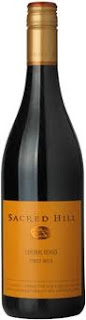 I tasted the 2008 New Harbor Vineyards Marlborough Pinot Noir, the 2008 Sacred Hill Central Otago Pinot Noir, and the F. W. Langguth "Black Slate" Pinot Noir. I couldn't find a vintage on the German wine, which may mean that it involves a blend of grapes from different years or simply that it's poorly labeled. The wine is from the Rheinhessen and only 90% Pinot Noir (something I failed to notice when I bought the wine). It is 10% Regent--a grape variety I had never heard of, and one that goes without mention in Jancis Robinson's Vines, Grapes and Wines (Mitchell Beazley, 1986)--the first time I've not been able to find grape information in that book--but Regent appears to be a newcomer. According to the Wikipedia article on the variety, Regent is a hybrid created in the late 1960s at the Geilweilerhof Institute for Grape Breeding. According to the Institute's website, Regent is a cross between Diana (itself Silvaner x Müller-Thurgau) and Chambourcin). Appreciated in large part for its resistance to fungal diseases, it appears to have entered general cultivation in the mid-1990s. Regent is planted mostly in Germany and the UK. It seems to make decent single-variety wine in some parts of Germany, but I don't understand exactly what it was intended to add to this blend--perhaps color, as several German web pages I looked at emphasize the good color Regent achieves, and many winemakers seem to think their Pinot Noir won't sell if it's too pale in color. In California, a little Syrah is often added to Pinot Noir to boost the color--and often to the detriment of the distinctive Pinot Noir flavor. Brief tasting notes follow.
 2008 New Harbor Vineyards Marlborough Pinot Noir
A fairly typical, pale, Pinot Noir sort of color. Closed nose, but hints of leather, orange water, and red raspberries. There was a suggestion of cloves as well. Moderate acid on the palate. Light tannins. Not badly balanced, but rather simple. Moderate to good length. Doesn't really evolve in any way on the palate. Perfectly acceptable everyday wine--I've had much, much worse cheap Pinot Noir--but this offers no special attraction either. Reasonably priced at $4.99, but I won't be going back for more. That said, this was the best of the three wines I tasted.
2008 Sacred Hill Central Otago Pinot Noir
Pale, slightly garnet-tinged, typical Pinot Noir color. Slightly deeper in color than the above wine. Citrus and leather on the nose. Initially appealing on the palate but quickly begins to seem too sweet. Smooth--rather too smooth. There is little acid to balance the sweetness and very little tannin either. Very long finish, but a finish without nuance--just a lingering nondescript fruity sweetness. Flavors tend toward cherries. Not unpleasant. Essentially, just boring. Priced at $5.99 a bottle.
F. W. Langguth "Black Slate" Rheinhessen Pinot Noir
A pale tea color--red tending toward brown. Some floral notes on the nose. Marmalade. Bubble gum. On the palate gives an initial impression of sweetness with fairly low acid. Shortish on the finish but with some lingering sweetness with vaguely port-like flavors. Not really recognizable as Pinot Noir. Has some odd flavors that suggest plastic--although the wine is not as bad as that may make it sound. Drinkable, but not very attractive or interesting--beyond the interest provided by an opportunity to experience Regent (see above). That said, I'd prefer to try a 100% Regent wine for that purpose. Priced at $3.99 a bottle.
A fairly typical, pale, Pinot Noir sort of color. Closed nose, but hints of leather, orange water, and red raspberries. There was a suggestion of cloves as well. Moderate acid on the palate. Light tannins. Not badly balanced, but rather simple. Moderate to good length. Doesn't really evolve in any way on the palate. Perfectly acceptable everyday wine--I've had much, much worse cheap Pinot Noir--but this offers no special attraction either. Reasonably priced at $4.99, but I won't be going back for more. That said, this was the best of the three wines I tasted.
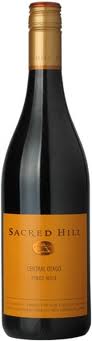
2008 Sacred Hill Central Otago Pinot Noir
Pale, slightly garnet-tinged, typical Pinot Noir color. Slightly deeper in color than the above wine. Citrus and leather on the nose. Initially appealing on the palate but quickly begins to seem too sweet. Smooth--rather too smooth. There is little acid to balance the sweetness and very little tannin either. Very long finish, but a finish without nuance--just a lingering nondescript fruity sweetness. Flavors tend toward cherries. Not unpleasant. Essentially, just boring. Priced at $5.99 a bottle.
F. W. Langguth "Black Slate" Rheinhessen Pinot Noir
A pale tea color--red tending toward brown. Some floral notes on the nose. Marmalade. Bubble gum. On the palate gives an initial impression of sweetness with fairly low acid. Shortish on the finish but with some lingering sweetness with vaguely port-like flavors. Not really recognizable as Pinot Noir. Has some odd flavors that suggest plastic--although the wine is not as bad as that may make it sound. Drinkable, but not very attractive or interesting--beyond the interest provided by an opportunity to experience Regent (see above). That said, I'd prefer to try a 100% Regent wine for that purpose. Priced at $3.99 a bottle.
I have no financial connection with any producer or retailer of wine.
For more wine reviews, use the Wines I'm Drinking label.
Books I'm Reading: The Complete Cartoons of the New Yorker

The cartoons are presented by decade, from the magazine's start in 1925, each section preceded by an essay about the cartoons of the era. In addition to introductory information about the magazine and the cartoons, there are short essays about individual cartoonists important in the magazine's history--Arno, Thurber, Addams, Stein, Steinberg, Booth, Ziegler, Chast--and essays about some of the themes recurring in the cartoons over the years, such as drinking, nudity, television, the space program, business culture, slipper dogs, politics, and the Internet.
I say smugly that I finished the book in short order, but I initially misunderstood the meaning of the note on the cover saying the book "includes two CDs with all 68,647 cartoons ever published in the magazine." I thought that meant the cartoons were also on the disks, as a convenience. I failed to think about the sheer volume of work here. As one of the introductory pieces in the book points out, printing all 68,647 cartoons on paper would require an impossibly fat book (or multiple volumes)--nearly 23,000 pages--even putting three cartoons on a page. The printed portion of The Complete Cartoons of The New Yorker presents only about 3,000 selected cartoons. The bulk of the material is on the two CDs, and I haven't even freed the disks from their packaging yet. While my mouth waters at the thought of the hours of entertainment latent there, I'm afraid to start looking at the disks, knowing it will be hard to stop. I'll want to read and enjoy every one of the remaining 65,000-odd cartoons without a break. I'll miss meals, neglect family, work will suffer....
Recommended at just about any price.
Recommended at just about any price.
Thursday, September 8, 2011
Wines I'm Making: The Critters Are at it again (September 8, 2011)

That said, it's my own fault. While I netted the grapes a couple of weeks ago, I hadn't finished completely securing all the possible entry points, particularly at the top of the vines, and I hadn't yet turned on the electric fence. Needless to say, I'll be doing both today, securing things (I hope) before nightfall.
I checked some of the fallen grapes with my refractometer. They tested between 15.5 and 17 brix. I aim to harvest at about 24.5 brix, so we still have about a month to go, I'm guessing, but the grapes are (obviously) already ripe enough to attract animals. Past experience has taught me that about 14 brix is sweet enough for a raccoon to find a grape attractive.
Looking back at old posts about the ongoing fight with the various animals that want my grapes as much as I do, I see that I've put the nets on as early as August 12th in the past. I think I need a new rule--ALWAYS get the electric fence on and the nets secure (including the top nets that cover the seam in the nets that run lengthwise along the rows) by August 1. That way (one hopes) all access is denied long before the animals have any reason to pay attention to the fruit. I'll try it next year. The problem with winemaking is that you do it all only once a year. It's easy to forget from year to year what works and what doesn't.
Monday, September 5, 2011
Wines I'm Drinking: 2007 Wellington Vineyards Sonoma Valley Grenache

The wine is a deep purple-red, but beginning to show a little age. It doesn't look like an old wine, but it no longer has the inky, bright purple hue of youth either. Redolent of licorice and roasted meat on the nose (somehow pork spareribs came to mind) with hints of black cherries and other dark fruits. Nicely poised on the palate. The wine is silky and soft, but remains vibrant, with good tannins and a lively acidity followed by a core of sweet, black cherry fruit interlaced with licorice and meaty flavors. The long, delicate finish is characterized mostly by the slightly bitter licorice flavors, but these are embraced in the arms of the sweet black cherry in an extended, balanced dance. Delicious. Forgive me for repeating myself, but Wellington is one of my favorite wine producers in Sonoma County. I love this winery for its dedication to quality and its ongoing willingness to price its wines reasonably--for the sort of people (like me) that drink wine everyday. Affordable bliss.
I have no financial connection with any producer or retailer of wine.
For more wine reviews, use the Wines I'm Drinking label.
Friday, September 2, 2011
Found Art: Water Access Cover and Paint Mark (September 2, 2011)

For more found art, see my blog Serendipitous Art.
Monday, August 29, 2011
Birds I'm Watching: Hermit Warbler at Bodega Bay

For more information about bird watching in Sonoma County, see my Website Sonoma County Bird Watching Spots.
Sunday, August 28, 2011
Art I'm Looking At: Seiko Tachibana at The Ren Brown Collection, Bodega Bay
A new show featuring printmaker Seiko Tachibana opened yesterday at The Ren Brown Collection, 1781 Highway 1, in Bodega Bay (Wednesday through Sunday 10-5). The Ren Brown Collection, established in 1989, is one of the North Bay's best galleries. It features contemporary Japanese as well as local printmakers and offers work by well known local potters such as John Chambers. The gallery sells Japanese antiques, modern sculpture, and fine jewelry as well. Sophisticated stuff. As Mr. Brown puts it "Just because we're in Bodega Bay doesn't mean we have to sell seagulls on driftwood." The Seiko Tachibana show continues through October 9, 2011, allowing plenty of time to plan a trip.
 Tachibana was born in Japan but has long worked in the Bay Area, having completed a Master of Art Education degree at Kobe University and subsequently earned an MFA at San Francisco Art Institute. Her work is in the Los Angeles County Museum, the Legion of Honor, the Portland Art Museum, and other institutions, as well as in private collections throughout the US, Europe, and Japan. The show that opened yesterday features a recent series of etchings with aquatint called Blue Consonant, but includes paintings and prints from other series, and a small installation made specifically for the gallery space.
What unites these disparate works is a fascination with the circle or sphere. It appears in some form in almost every piece on display--in some work evoking the microscopic world of cells or molecules, in others the opposite extreme, suggesting planetary spheres or an eclipsed Sun. Not surprisingly, Tachibana explains that she is fascinated by all the creative forces of the universe, from the multiplication of single-celled organisms to the process of planet formation. Her work reminds us that the physics of a spherical boundary at the microscopic level is identical to the physics that operates in far-off galaxies as planets coalesce into spheres from dust and gas.
On a technical note, Tachibana is remarkably good at aquatint, a process that uses rosin dust during the etching process to create finely pitted areas of varying density in the printing plate, allowing tonal gradations in a process (etching) that lends itself more naturally to linear expression. Aquatint is difficult to control. Tachibana uses it masterfully and combines it with great skill in manipulating ink on the plate to create effects that mimic watercolor and other wet techniques.
Although Bodega Bay is a bit out of the way for San Francisco art lovers, there's much in the area to justify a journey. Try some of the Bay Area's best clam chowder at Spud Point Crab Co. (1860 Westshore Rd., Bodega Bay; 9-5, closed Wednesdays), have dinner at Terrapin Creek Café (1580 Eastshore Dr., lunch and dinner, Thursday through Sunday), or enjoy a glass of wine at Gourmet Au Bay (913 Coastal Hwy. 1; open every day during the summer 11-7), sitting on the deck overlooking the Bay--an excellent place to taste wine but also a good spot to watch shorebirds on the mud flats--and to watch people. Heading north on Hwy 101, take the Railroad Ave. exit, turn left onto Railroad Ave. and take the 2nd right, onto Stony Point Rd., until Roblar Rd. Go left on Roblar Rd. until you can take a right onto Valley Ford Rd., which is Hwy. 1. Hwy 1 winds west from here to the coast through pretty countryside--or you can do the Google Maps thing. The Ren Brown Collection is on the northern outskirts of the town of Bodega Bay in an attractive house with its own Japanese gardens and teahouse. Don't miss the topiary snail.


What unites these disparate works is a fascination with the circle or sphere. It appears in some form in almost every piece on display--in some work evoking the microscopic world of cells or molecules, in others the opposite extreme, suggesting planetary spheres or an eclipsed Sun. Not surprisingly, Tachibana explains that she is fascinated by all the creative forces of the universe, from the multiplication of single-celled organisms to the process of planet formation. Her work reminds us that the physics of a spherical boundary at the microscopic level is identical to the physics that operates in far-off galaxies as planets coalesce into spheres from dust and gas.
On a technical note, Tachibana is remarkably good at aquatint, a process that uses rosin dust during the etching process to create finely pitted areas of varying density in the printing plate, allowing tonal gradations in a process (etching) that lends itself more naturally to linear expression. Aquatint is difficult to control. Tachibana uses it masterfully and combines it with great skill in manipulating ink on the plate to create effects that mimic watercolor and other wet techniques.
Although Bodega Bay is a bit out of the way for San Francisco art lovers, there's much in the area to justify a journey. Try some of the Bay Area's best clam chowder at Spud Point Crab Co. (1860 Westshore Rd., Bodega Bay; 9-5, closed Wednesdays), have dinner at Terrapin Creek Café (1580 Eastshore Dr., lunch and dinner, Thursday through Sunday), or enjoy a glass of wine at Gourmet Au Bay (913 Coastal Hwy. 1; open every day during the summer 11-7), sitting on the deck overlooking the Bay--an excellent place to taste wine but also a good spot to watch shorebirds on the mud flats--and to watch people. Heading north on Hwy 101, take the Railroad Ave. exit, turn left onto Railroad Ave. and take the 2nd right, onto Stony Point Rd., until Roblar Rd. Go left on Roblar Rd. until you can take a right onto Valley Ford Rd., which is Hwy. 1. Hwy 1 winds west from here to the coast through pretty countryside--or you can do the Google Maps thing. The Ren Brown Collection is on the northern outskirts of the town of Bodega Bay in an attractive house with its own Japanese gardens and teahouse. Don't miss the topiary snail.

Friday, August 26, 2011
Wines I'm Drinking: 2009 "La Piazza" Sicily Catarratto/Chardonnay

While lingering, I got out my copy of Jancis Robinson's Vines, Grapes, and Wines (Mitchell Beazley, 1986), my favorite book about grape varieties. I always turn here when encountering a grape new to me. The La Piazza label calls Catarratto "an indigenous Sicilian grape," which seems true enough, but Robinson in her section on such grapes mentions two distinct varieties with similar names--Catarratto Bianco Comune and Catarratto Bianco Lucido. That left me wondering which is involved here. Robinson notes only that the first of the two is widely used in making Marsala.
The Oxford Companion to Wine, however, refers to these as forms of the same grape, saying that the latter--Catarratto Bianco Lucido--is the superior form for winemaking, while dismissing the grape in general as mostly producing "excess" wine that is distilled or made into grape concentrate. After these disparaging remarks, the book says (in something of a contradiction) that some "characterful white table wines" are made from Catarratto and points the reader to the entry for "Sicily"--which I turned to. That entry mostly suggests modern winemaking techniques (refrigeration, in particular) have begun to reveal possibilities that may have been dormant in the grape. A good, modern Catarratto is described as having "fruity and floral qualities not unlike the wines of Friuli and Alto Adige" (both in northeastern Italy).
Going back to the wine after it had warmed a little, it had gained considerable body and the citrus element on the finish was more pronounced. There was also a little spiciness on the finish that I hadn't noticed at first and there were hints of nuts as well. While this is not exciting wine, it's not at all bad either. Crisp, light, and easy to drink. It is probably excellent with seafood. I suspect it would be a good oyster wine. At $2.99 a bottle ($2.49 a bottle if you buy by the case), it's hard to complain. I will probably go back and buy a case of this one for use at home. At $32.42 a case (including tax), it's a steal.
I have no financial connection with any producer or retailer of wine.
Art I'm Making: New Nudes (Summer 2011)

Thursday, August 25, 2011
Wines I'm Drinking: 2006 Beni di Batasiolo "Granée" Gavi di Gavi

A pretty, pale gold in the glass with limes, honey, and floral scents--the latter something like a restrained gardenia. A hint of hazelnuts perhaps, too. Very attractive and appetizing on the nose. I was reminded of some of the white wines of France's Costieres de Nîmes district (near the town of Nîmes, just west of the mouth of the Rhône)--wines that always smell of honey and have a certain waxy texture on the palate. This wine had those qualities and more--a subtly fruity mid-palate, a nuanced finish, and a crisp, balancing tartness throughout. Although low in alcohol by California standards (at 12%) this is the sort of wine that's very easy to drink too much of: Each sip leaves you wanting to go back again to try to pin down the tantalizingly elusive flavors. The current vintage (2009) sells locally for $15.99. Recommended.
I have no financial connection with any producer or retailer of wine.
Wednesday, August 24, 2011
Wines I'm Making: Grapes Netted (August 24, 2011)

Tuesday, August 23, 2011
Birds I’m Watching: Bodega Bay (August 23, 2011)

For more information about bird watching in Sonoma County, see my Website Sonoma County Bird Watching Spots.

Saturday, August 20, 2011
Places I'm Visiting: Santa Rosa Air Show (August 20, 2011)
 I spent the day today at the Santa Rosa "Wings Over Wine Country"Air Show out at the Santa Rosa Airport. I had never been before. I've lived in Santa Rosa for 10 years now. Every year at this time (usually the third weekend in August) I hear about the show and consider going. On the Sunday at the end of the show it's common to hear the sound of vintage aircraft overhead, which usually sends me out with my binoculars to look at the old WWII fighter or odd transport plane flying over as it leaves Santa Rosa after the end of the show. My house seems to be on the flight path out of town. That always makes me wish I had been at the show to see what I missed. This year I determined to go. Parking cost $3 and the $20 entry fee ($5 for kids 12 and under) seemed steep, but it was worth going at least once. There were many, many aircraft parked on the runways for viewing, including military, commercial, and private aircraft, and there was a stream of displays in the air, including workhorses like the DC-3 and planes as exotic as a U-2, which made a brief appearance before disappearing into the clouds at an alarming angle.
There was a lot of standing around waiting for things to happen. I got some sunburn despite a hat and sunglasses, but it was still fun. The show continues tomorrow, Sunday, August 21, 2011.

Music I'm Listening To: Neil Buckley Octet at Plaza Bistro (August 19, 2011)

Wednesday, August 17, 2011
Wines I'm Drinking: 2009 La Ronescina Collio Pinot Grigio

A typical, very pale straw color, pretty in a well-chilled glass. Melon and sappy scents on the nose. A hint of lime. A suggestion of toasted grain. A little honey perhaps. Overall, fairly fresh and attractive. Quite tart on the palate with some fruity sweetness on the mid-palate followed again by a rush of tartness and then a delicate lingering finish with hints of nuts and an attractive slight bitterness at the very end. A trifle too tart perhaps, but at least this has some flavor and it's clean and refreshing with a little nuance. Likely to be good with foods that need to be offset by something with an acidic bite. Probably excellent as an aperitif on a hot summer night. Not complex or profound, but quite acceptable light summer wine. A cut above nearly all the wines I tasted in the first bunch from Trader Joe's, where this costs $6.99 a bottle.
I have no financial connection with any producer or retailer of wine.
For more wine reviews, use the Wines I'm Drinking label.
Tuesday, August 16, 2011
Found Art: Tree Bark, Shevlin Park, Bend, Oregon (August 16, 2011)

For more found art, see my blog Serendipitous Art.
Subscribe to:
Posts (Atom)



 Posts
Posts

