Thursday, November 7, 2013

Miscellaneous: The New $100 Bill--Design Disaster

I was deeply disappointed by the new design of the $100 bill when images of it first began appearing on the Internet, but I thought I'd keep an open mind before judging it. I figured the real article might show better than the representations of it I was seeing on my computer screen, but now that I've handled the new $100 bill, I still think it's a design disaster. What were they thinking?

This new design is a veritable definition of the term "half-baked." Rather than start from scratch and design a new bill incorporating cutting-edge anti-counterfeiting technologies in an elegant way, the people in charge have simply allowed half of the old bill to be overlaid with some of these technologies. The mismatch is glaring. It's embarrassing.

The left side of the front of the bill looks mostly like the old design. The right side of the front looks new, but even the right side suggests a badly thought-out collage. The contrast between the two sides of the front face is hard to reconcile, and the purplish hologram stripe that separates them looks like a strip of tape sticking together two halves that don't go together. The reverse is just as bad. A large, yellow "100" has been slapped onto the old design in an awkwardly large hole that's been carved more or less out of the existing layout. The whole thing looks amateurish--or worse. No attempt has been made to make the range of common denominations ($1, $5, $10, $20, $50, and $100) complement one another. Each ought to be part of a coordinated suite of bills with some kind of design harmony. Instead, the new $100 bill makes it look as if no one cared one way or the other what our currency looks like. I give the new $100 bill a big thumbs down.

Found Art: Perforated Trailer (November 7, 2013)

A trailer with holes in its bed. Parked on a street in Graton, California. I'm not sure what this vehicle is designed for, but the holes and their shadows on the street below looked like art to me. Found art.

For more unintended art, see my blog Serendipitous Art.

Wednesday, November 6, 2013

Wines I'm Making: 2013 Sangiovese Rosé Racked and Sulfited (November 6, 2013)

I racked and lightly sulfited the 2013 Sangiovese Rosé today, transferring five gallons of new wine to a new carboy of the same size, leaving behind a layer of yeasty sludge. I got a taste of the wine when starting the siphon and I'm very pleased with it. It's a nice deep pink. Although a little cloudy still, at this stage, it already looks pretty--as a rosé should. I sulfited the wine to about 52ppm (four Campden tablets in the five gallons of wine). If it clears quickly enough, we might be able to start enjoying some already at Thanksgiving, but it will probably have to wait until Christmas.

Tuesday, November 5, 2013

Books I'm Reading: Fast-talking Dames

The fast-talking dame of 1930s and 1940s Hollywood was a uniquely American phenomenon argues author Maria Di Battista in her 2001 book Fast-Talking Dames (Yale University Press) and she notes that the fast-talking dame had passed from the screen by the early 1950s as the movie-land ideal of American womanhood shifted toward the dumb blonde--a shift away from sexually alluring but articulate woman that knew how to stand up for themselves toward a more passive, controlled type often admired for her sex appeal alone. Di Battista argues persuasively that it was an unfortunate shift. Her book is an affectionate tribute to the snappy, sassy stars of the earlier era.

The book gets off to a slow start. Its dense text requires more concentration to digest than I was expecting. It's a serious book of scholarly importance, not the quick read I had imagined before picking it up (based on no evidence). It was worth the work.

Di Battista's book seems valuable not only for its insights into Hollywood's attitudes toward gender roles in the golden age of the screwball comedy, but also for its looks at the careers of actresses such as Claudette Colbert, Jean Harlow, Ginger Rogers, Jean Arthur, Carole Lombard, and Myrna Loy (under the heading of "Hot Heiresses and Working Girls"); at the actresses she calls "The Grande Dames" (Katharine Hepburn, Irene Dunn, Greta Garbo, Barbara Stanwyck); and through detailed looks at a few of the most important films of the era--His Girl Friday, Bringing Up Baby, The Lady Eve, Ninotchka, and The Awful Truth. Along the way, there is much useful discussion of dozens of other films worth watching. Fast-talking Dames would be worth reading just for its indirect recommendations of good films from the period it covers. My one complaint is that there is no list of films mentioned in the text, which makes it tedious to find them once passed over. Halfway through, I started writing down titles that seemed worth seeking out. I've been visiting my local video store to rent quite a few I'd never seen. I've particularly enjoyed seeing Theodora Goes Wild, The Bombshell, If You Could Only Cook, and Wife Versus Secretary, among others. Recommended.

Sunday, November 3, 2013

Wines I'm Making: Malolactic Fermentation Initiated (November 3, 2013)

I started malolactic fermentation today in the Cabernet Sauvignon/Cabernet Franc wine that's been fermenting in the living room. The alcoholic fermentation has mostly finished, so it's time to get the malolactic going. I added two 125ml packets of the Wyeast brand malolactic culture to my 8 gallons of new wine. As malolactic bacteria can be finicky, I've wrapped the carboys in blankets and inserted a small electric blanket between them, which is what I've always done, even though this Wyeast strain says it will remain active at a temperature as low as 55 degrees. In the winter months, the house temperature generally ranges from about 58 degrees to 68 degrees, but warmer will be better, I imagine. Malolactic fermentation can take anywhere from four to 12 weeks. After about six weeks, I'll test the wine to see how it's coming along.

Art I'm Making: More Collages (November 3, 2013)

I continue to play with paper and paint, producing collages with acrylic-painted paper elements and fragments of monoprints on paper, again using acrylic paint to print with. I particularly like the colors made by Sennelier. In the past 10 days or so I've finished three more small pieces. The monoprint element is strong in these works. Endlessly fascinating. Shown here in the order I made them. The largest is the last one, about 7 inches on the long side.

Photos never capture the subtleties of the printed surfaces, but they're enough to get some idea of what the pieces look like. Clicking on the photos will enlarge them.


Monday, October 28, 2013

Wines I'm Making: 2013 Sangiovese Rosé--First Racking (October 27, 2013)

Yesterday (October 27, 2013) I racked this year's Sangiovese rosé off the gross lees. Moving it from a mostly full 5-gallon carboy to a new 5-gallon carboy, which I then topped off with a couple of bottles of last year's wine. I didn't sulfite the wine as it seems to be still fermenting a little--although not very much. Still, I thought it best to let it go a little longer. Yesterday was day 21 of fermentation, which is on the long side, but I want to be sure it's gone completely dry before sulfiting the wine and cold stabilizing it. Cold stabilization amounts to leaving it out in the cold for a few days. That usually causes a layer of tartaric acid crystals to form over the fine lees that will have settled to the bottom of the carboy, making the final racking very easy with the lees trapped under the tartaric acid crystals. The first photo here shows the murky wine before racking, full of carbon dioxide and yeast. That soupy raspberry colored liquid will be crystal clear in a few weeks through the action of gravity and time. The photo below shows the gross lees left behind after racking.

So far, the wine looks, smells, and tastes good. I think it will be tasty this year. Five gallons will make 25 bottles--a little more than usual because the vines set a lot of fruit. If all goes well, there should be some new rosé ready at Thanksgiving--or by Christmas at the latest.

Meanwhile, the Cabernet continues to ferment in the living room, but it will soon be dry and ready for the addition of malolactic bacteria to begin malolactic fermentation.

Tidbits: RIP--Lou Reed (October 26, 2013)

I heard that Lou Reed died yesterday. I know very little about the man, but I remember the day back in the early 70s that I first heard his voice on the radio. He was singing "Walk on the Wild Side." A new sound, something different. Reed somehow managed to sing without singing. What he sang made little sense to me, but I liked it anyway.

Sunday, October 20, 2013

Wines I'm Making: 2013 Cabernet Pressed (October 20, 2013)

Today (October 20, 2013) I pressed the 12 gallons of Cabernet Sauvignon/Cabernet Franc that's been fermenting in the living room the past couple of weeks. The must yielded a little over eight gallons of new wine, which is still fermenting in the glass carboys that now contain it. It smells excellent and doesn't taste bad either, although a little sweetness is still apparent. I expect it will be fermented completely dry in another three days or so.

As I added the yeast on October 10, the wine was fermenting 10 days on the skins, but had had a four-day pre-soak, so a total of two weeks on the skins. It looks dark and heavily extracted. So far, so good.


Thursday, October 17, 2013

Music I'm Listening To: Leila Josefowicz with the San Francisco Symphony conducted by Pablo Heras-Casado (October 4, 2013)

Because of work and various other obligations I make this brief and very belated comment on a recent concert in San Francisco. I attended the October 4, 2013 San Francisco Symphony performance at Davies Symphony Hall. The program included the Overture and Passacaille from Armide, by Lully. Three Studies from Couperin, by contemporary composer Thomas Ades, Stravinsky's Violin Concerto, and, after intermission, Mendelssohn's Symphony No. 3 "The Scottish Symphony." This was the first program in a series of three conducted by Spanish guest conductor Pablo Heras-Casado (above) featuring the music of Ades and Mendelssohn--which seems an odd pairing. The common thread conductor Heras-Casado sees in these two men is apparently a fascination with the Baroque.

The Lully piece was forgettable--literally. It's been only a couple of weeks since the concert, but I can't say I remember being moved by the piece at the time, and now I can't recall anything about it. The Ades composition was more interesting, if strange. It had a surreal quality. It sounded like a piece of early 18th century music that had been run through a computer and altered with a set of algorithms. I suppose the brain of Mr. Ades (who was in attendance) was, in fact, the computer that processed the underlying music of Francois Couperin and presented it to us in this new form. I'd have to hear the music again--probably several times--before I could say anything sensible about it, but it was interesting to listen to and probably worth the time to get to know better.

Having heard violinist Leila Josefowicz's exciting performance of Esa Pekka-Salonen's Violin Concerto in San Francisco not long ago (December 8, 2011), I was most eager to hear Ms. Josefowicz play again. I was not disappointed. She played the Stravinsky concerto with the same mixture of fierce determination and sheer delight she showed at the earlier concert. She seemed truly engaged with the orchestra and the conductor, turning to the other performers during her periods of rest--listening, watching, moving subtly with the music--before bursting in to play her solo sections. Overall, the concerto seemed powerfully yet deftly played--and played with a joyful verve that made the piece as much fun to watch as it was to listen to. The Mendelssohn was played impeccably too. Good to have Heras-Casado back in San Francisco again.

Photo of Pablo Heras-Casado courtesy of the San Francisco Symphony (photographer uncredited). Photo of Leila Josefowicz from Internet press kits, but I've been unable to find the appropriate copyright owner to acknowledge.    

Cars: 2013 Alameda All-Italian Car and Motorcycle Show (October 13, 2013)

I showed my car, a 1978 Chocolate Brown Alfa Romeo Spider, in the 2013 Alameda All-Italian Car and Motorcycle Show on Sunday, October 13. The weather was perfect and there was a big turn-out this year. There were well over 100 cars and motorcycles on display at the usual venue, the playing fields at Lincoln Middle School on Fernside Blvd., in Alameda.

About half the cars are usually Alfa Romeos, but there were Fiats, Lancias, Maseratis, Ferraris, De Tomasos, Abarths, and more. There was a 1934 Alfa among the older cars. I love the details of styling on these and Italian cars in general. Some of the older motorcycles were beautiful, too. For more information about the show (for next year), go to this link. Proceeds from the show go to support the Alameda Special Olympics.


Wednesday, October 9, 2013

Wines I'm Drinking: Simple Pleasures--2010 Terre de Mistral Côtes du Rhône

I picked up a bottle of the 2010 Terre de Mistral Côtes du Rhône at my local Grocery Outlet for only $3.99 today ($3.49 a bottle if you buy it by the case). Pepper, menthol, and blackberries are the most obvious scents on the nose of this simple, inexpensive, but brazenly seductive little wine from the south of France. I wasn't expecting too much and I can't say this is profound or deeply nuanced wine, but it's nicely balanced, well made--full of berry and vanilla flavors. It's simply overflowing with ripe fruit, which makes it far too easy to drink too much of. Beware. Recommended for everyday drinking. I'll be going back for more.

(I have no financial connection with any producer or retailer of wine.) 

Wines I'm Making: 2013 Grape Harvest (October 6, 2013)

2013 marks our 10th harvest. We picked the grapes in our little backyard vineyard on Sunday, October 6--both the Sangiovese and the Cabernet grapes. October 6 is a fairly typical date for the Sangiovese (the dates have ranged from around September 29 to October 16 over the years).

It's somewhat early for the Cabernet (October 18 in 2012), but a fair number of clusters were already turning to raisins, probably because I watered less than usual this year (only twice, rather than three of four times in most years) and it seemed best not to wait any longer. We harvested 20.5kg (or 45.1 lbs) of Sangiovese grapes, which became just under eight gallons of must after crushing and de-stemming. The must measured 22 degrees Brix with pH at 3.63, just about right for the light rosé these grapes will become.

We harvested 41kg of Cabernet Sauvignon/Cabernet Franc (or 90.2 lbs), which yielded a little more than 11 gallons of must. The must tested at 27.5 degrees Brix--the highest it's ever been, reflecting the high percentage of raisined grapes. The pH was at 3.56. Because of the high sugar level, I'll probably add a small amount of acidulated water to the must to lower the Brix to around 26 to avoid producing an excessively alcoholic and therefore unbalanced wine. The lesson here is to water the grapes a little more, although I'd been hoping to eventually wean the grapes off water altogether.

The Sangiovese is already pressed and inoculated with Epernay II yeast, as usual. We ended up with about 4.5 gallons of pressed juice. I pitched the yeast on the afternoon of the 7th. The grapes spent about 20 hours on the skins, which will result in a fairly deep pink wine.

The Cabernet must is resting. I usually do a three- to four-day pre-soak, which is supposed to result in more extraction from the skins of softer (water-soluble) tannins than the (alcohol-soluble) tannins extracted during the fermentation process. I don't know, but this method seems to produce a wine we like. Today I'll be adjusting the sugar level, as noted above. Tomorrow or the day after it will be time to add the yeast and get the fermentation started. I love this time of year. The whole house will soon smell of fresh yeast and fermentation--like a winery.

[Update: This afternoon (October 9) I dissolved 15g of tartaric acid crystals in 2.5l of distilled water (using a formula provided by the kind people at The Beverage People) and added the mixture to the Cabernet must. It was difficult to mix it all in evenly, so, measuring the Brix after the addition, it comes out a bit low (at 23 degrees Brix), but I suspect that's simply because of an imperfect mixture. The sweetest juice is probably stuck at the bottom of the container. The aim was to reduce the sugar to 25.5 Brix. I'll stir it up again tomorrow and test it once more.]


Monday, September 30, 2013

Birds I'm Watching: Warblers at Point Reyes (September 28, 2013)

I went to Pt. Reyes this past Saturday (September 28, 2013) joining a local Audubon Society group that went out looking for migrating warblers. Pt. Reyes is well known among birders as a place that sometimes traps stray warblers heading south to wintering grounds in Central and South America, usually first-year birds that get lost. Birders here get excited when eastern species normally not present show up in the trees at the Outer Point. On Saturday, we got to see two such birds--a Blackburnian Warbler (pictured above) and a Prairie Warbler, both birds I'd never seen before. These are life birds no. 417 and 418 for me. These were in the trees at the ranger residences at Chimney Rock.

For more about local bird watching, see my website Sonoma County Bird Watching Spots

Art I'm Making: New Collage

I'm a bit surprised at my own productivity, lately. I've been making new collages at a pace of about one a week. I finished another yesterday that I'm pleased with. Unintentionally, it looks African. It would seem to have textile influences, but it was simply a matter of assembling pieces of a cut-up monoprint that I made with black and sepia ink. These things tend to have a life of their own. They can quickly veer off in unexpected directions. The artist's job sometimes is simply to be a shepherd and, ultimately, to be the one who decides whether a new creation lives or dies. This one will live. The photo here makes it look somewhat darker and blacker than it actually is. Photographs of art rarely do the original justice, but this shot is enough to give an idea of the actual work.

Rain: Overnight Drizzle (September 29-30, 2013)

It's been drizzling all night and into the morning today. It will be of little consequence to the plants, but I'm a bit concerned about the grapes in the back yard. It's just about time to harvest. If rain persists, they can start to mold alarmingly quickly. I'll be checking them a couple of times today. We may have to pick whether they're completely ready or not.

Looking at the rain gauge on the morning of the 30th, I see that we got a quarter inch of rain. That brings our total so far in the 2013-2014 rainy season to 0.85 inches. It's a start.

Tuesday, September 24, 2013

Birds I'm Watching: Unusual Heermann's Gull

On a recent pelagic birding trip I got to see many of the local birds that stay mostly far out to sea--birds that we rarely get to see on or from dry land. In particular, there was an unusually large number of Storm-petrels (four species--Ashy, Black, Wilson's and Fork-tailed Storm-petrel). Four birds were new to me--Cassin's Auklet, Rhinoceros Auklet, South Polar Skua, and Sabine's Gull, bringing my life list to 416--a small number, but not bad for only about four years of serious birding and birding done mostly in one area.

There have been a number of Blue-footed Boobies in the San Francisco Bay area this autumn, including around Bodega Bay, the area we set out from. We saw nothing so rare as a booby, but we did get to see an unusual variant of the Heermann's Gull, which is a fairly common visitor in Sonoma County during autumn migration and over the winter months. A few of these birds have a white patch in the wings that is not normally present and that I'd never seen before. I've heard various estimates of the frequency with which the variation occurs, ranging from one in a hundred to one in a thousand. I don't know, but I thought this bird very interesting. This particular individual has white in the secondaries, not just in the upper primary coverts, which is where the white normally occurs in birds that show this variation. Happily, the water was comparatively calm on this (my second) pelagic tour. On the first one, the water was so rough that many on the boat were sick the whole time, including me.

For more about bird watching in Sonoma County, see my website Sonoma County Bird Watching Spots

Art I'm Making: More Collages


I'm continuing to have fun making collages. I've finished ten small pieces now in as many weeks--not that quantity is important. When I finish a piece, I like to mat it and hang it on the wall a while. I like to look at it to see if it's really finished. Often some little detail will begin to bother me or some corner of the work will start asking me for a little more attention. After a while, I'll decide that a spot of color here or a line there will truly complete the piece. And then I can move on.

Once in a while, something that seems finished begins to look all wrong. Inevitably, I take it down and destroy it or I paint over it. The nice thing about collage is that destruction can be generative of new things. One of the first collages I made, the largest of them, began to look wrong after a few weeks. Usually I have an inkling that something is wrong from the beginning when something is wrong, but sometimes I'm initially quite happy with what I've done. I took this particular collage down and cut it to pieces, and from the pieces made three new, smaller collages that I like better--the three pictured here. The original collage is at the bottom of this post. Can you see where the new works came from?

Found Art: Whitewashed Window (September 24, 2013)

While walking in downtown Santa Rosa recently (near the corner of Humboldt St. and Fifth St.) I found a building with several windows obscured from within with whitewash or something similar. I liked this divided panel of grey windows. Looked like art to me.

For more unintended art, see my blog Serendipitous Art.

Saturday, September 21, 2013

Miscellaneous: A Little Bit of Whimsy

In need of a mustache? Can't grow one? Never fear, free mustaches are here. I found this whimsical offering of complimentary mustaches recently at a local printing shop. I didn't avail myself of the kind offer because I already have a mustache of my own....

Rain: First Rain of the 2013-2014 Rainy Season (September 21, 2013)

It began to rain in Santa Rosa at about 1:00AM this morning (September 21) and drizzled through most of the night. There was hard rain then in the early light of day. Looking at the rain gauge after the rain stopped (around 11:00AM), I see that we got a respectable 0.6 inches in total. This is the first real rain of the 2013-2014 rainy season, which began on July 1, 2013 and will end on June 30 2014. I believe the rain will have come and gone quickly enough that the grapes won't be adversely affected. Harvest is probably still about 10 days away.

Wednesday, September 18, 2013

Wines I'm Making: 2013 Sangiovese Berry Sample

 It's that time of year. I got out my pH meter and my refractometer today to look at the sugar and pH levels of the Sangiovese grapes in the back yard for the first time this season. I collected a sample of berries from each of the plants in the vineyard and crushed them. First the sugar level: The juice is at 20 Brix. I'm aiming for 22-23 Brix, so another week to ten days, perhaps. The pH is at 3.40, which is a bit higher than I would have expected at this stage. I'll test again in a few days. If the pH seems to be rising steadily without the sugars going up much, I may have to pick at a somewhat lower sugar level than is ideal. We'll see how things progress.

[Update: I took another Sangiovese berry sample today, September 29. The sugar is now at 21 Brix, so up a point from the sample I took ten days ago. The pH is higher, too, but not alarmingly so, at 3.45. pH squared times Brix is 249.9. I'd like to get one more degree of sugar, but can probably pick any time. Rain is in the forecast--which may have a bearing on things, depending on how much we get.

I also checked the Cabernet Sauvignon grapes for the first time today, taking a similar berry sample. The sugar is already at 25 Brix--right where I want it--and the pH is at 3.42, which is a good level) pH squared times Brix is 292), but I suspect the sugar is where it is in large part because the number of raisins on the vines is greater than usual at this time of year. It's normal for some raisins to form before harvest, but I suspect my attempt to dry farm the grapes this year (I've watered them only once or twice the whole summer) may have something to do with it. Normally I water three to four times. Some of the seeds look quite mature, others are still somewhat green. It's beginning to sprinkle just as the sun is starting to go down. If we get a heavy rain tonight (September 29) or a prolonged rain begins to look likely, it may be best to pick very soon.]

Friday, September 13, 2013

Music I'm Listening to: The San Francisco Symphony at the Green Music Center (September 12, 2013)

Last night was the first concert in the 2013-2014 subscription concert series that features the San Francisco Symphony at the Green Music Center in Rohnert Park. Michael Tilson Thomas conducted Zosha di Castri's Lineage, Tchaikovsky's Piano Concerto No. 1, and Prokofiev's Symphony No. 3. Pianist Yefim Bronfman was soloist in the Tchaikovsky.

The highlight of the concert was the Di Castri piece, which is brand new (having been premiered only a few months ago). Describing highly abstract modern music is an impossible task, but it was an engaging expanse of shifting colors and textures that I enjoyed very much. It seemed a bit nostalgic and melancholy on the whole, but somehow forward-looking in mood at the same time. The long droning notes in some places put me in mind of ancient Japanese court music (gagaku) or Noh music. I would have asked the composer (who was in attendance) about whether she was familiar with gagaku, but she was pinned down throughout intermission by well-wishers and others asking questions, so I didn't bother her.

This year, we're sitting in new seats, having chosen to look down on the performers from the upper balcony. It's quite a different experience. I enjoyed being able to watch the conductor and the mechanics of the performance--the turning of pages on the music stands, the taking up and putting down of mutes, the quiet cleaning of instruments, the sometimes frantic activity in the percussion section. Lineage keeps no fewer than seven percussionists busy. According to the program notes, they were handling timpani, marimba, vibraphone, xylophone, glockenspiel, snare drum, bass drum, ocean drum, suspended cymbals, crash cymbal, china cymbal, nipple gongs, tubular bells, almglocken, tam-tams, woodblocks, and rainstick--not to mention a piano and a celesta. Viewing from above is a compromise. The sound is a little muddy. During the Tchaikovsky, there were times when the piano was inaudible over the orchestra. During the Prokofiev, sometimes the harps were inaudible. That said, the sound isn't bad up top and it's a lot of fun to be able to see everything that goes on during a performance. Watching from the balcony makes a concert a much more visual experience.

One unexpected visual was a half-empty concert hall. No one seemed to know why so many seats were unsold (I asked several ushers). We subscribed to the San Francisco concerts at the Green Music Center last year, and I remember a full house on every occasion. Another change from last year--a very positive change--is the parking situation. They are no longer creating long traffic jams in Rohnert Park by charging for parking. Parking has been folded into the ticket prices--as it should have been from the outset. Bravo!

Food I'm Eating: Wine from the Cinque Terre at Cucina Paradiso, in Petaluma

Locals have been flocking to Cucina Paradiso in Petaluma for about five years now, it seems. I don't know how I missed hearing about this restaurant until just a few days ago, but I'm glad I recently had a chance to get acquainted with the place.

I visited on a Saturday night. It was packed, but the service was up to the task of handling a full house, and the food came promptly but not so quickly that things felt rushed--just the way I like it. Solid Italian fare, an interesting wine list, and surprisingly reasonable prices for food of this quality make the place hard to resist; a meal for four with appetizers, main dishes, desserts and a $45 bottle of wine was just over $200--including tax and tip. While not cheap, high-end local restaurants in the area far too often ask considerably more than that for food much less good. I had ravioli filled with roast duck under a sauce of sundried tomatoes, pine nuts, and basil (below). The restaurant uses organic vegetables exclusively. At dessert, the tiramisu was excellent.

What most impressed me, however, was seeing a bottle of Cinque Terre wine on the extensive (but not bloated) wine list featuring many good Italian and local wines. The Cinque Terre wines are delicious and extremely rare. The entirety of the Cinque Terre zone is only about 200 acres. Most of the small output is consumed locally. Cinque Terre is hard to find even in Italy outside the immediate area of production. Exceedingly dry but flavorful (reminiscent of a good Riesling from Alsace) these wines are the perfect accompaniment to Italian cooking--northern Italian cooking in particular. This one (pictured above), was from the cooperative that makes most wines labeled "Cinque Terre." It was less interesting than some of the (even rarer) wines bottled by individual Cinque Terre producers I've had, but a pleasure nevertheless; deceptively simple at first--like so many Italian whites--but with a delicate balance of fruit and acidity on the mid-palate and a lingering finish. I look forward to my next visit to Cucina Paradiso (114 Petaluma Blvd. North, Petaluma, CA 94952, (707) 782-1130).

Here's a blog post I uploaded from Italy a couple of years ago while visiting the Cinque Terre.


Monday, September 9, 2013

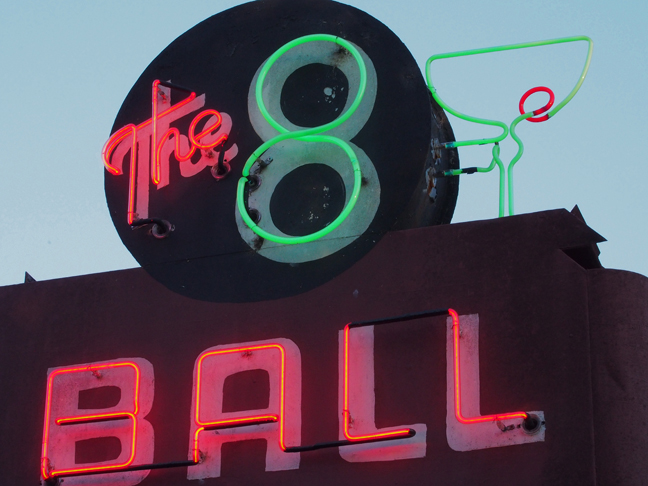
The Cocktail Glass Collection: The 8 Ball, Cotati, California

There are two or three bars in downtown Cotati. I've never been to any of them, but they keep the town center lively on weekend evenings. I noticed recently that one has a neon cocktail glass sign, so I thought I'd add it to my small but growing collection. This one has a cherry but the glass has no stirring stick or skewer. The bar is at 8 Charles St., Cotati, CA 94931.

To see others in this series of photographs, click on the "cocktail glass collection" label. 

Monday, September 2, 2013

Miscellaneous: No Green Zebras

We planted about eight tomato vines this year. Two of them were supposed to be the Green Zebra variety, an heirloom that has done comparatively well in the garden before. Both plants were mislabeled, however. The tomatoes we're now getting from these vines (pictured) are definitely not Green Zebras. I don't know what they are, but they are tasty and attractive, so I can't complain. Despite cool weather, our tomatoes have done very well this year. These are the best I've grown since living in Ohio many years ago--a place where any fool can grow good backyard tomatoes. I've always believed tomatoes are harder to grow here because of our cool nights, but this season has made nonsense of that idea. More important seems to be fresh soil, a lot of good, organic fertilizer, and attentive watering, although the shallow soil in our new beds carved out of former lawn have not allowed deep watering and we've had a fair number with blossom-end rot, a condition I'd read about before but never actually seen. Interestingly, the rot, when it occurs, is very localized. It's easily cut out, leaving usable fruit behind.

Wines I'm Making: 2013 Cabernet at 20 Brix

Yesterday I got out the refractometer for the first time this year--out of curiosity; we are still several weeks from a normal harvest date--but a random berry I tested from one of our Cabernet vines was at 20 brix. I normally aim to harvest at around 24 brix. As generally it takes about a week of good weather to raise the brix level by one degree, that would suggest we're about a month from harvest. As we usually harvest in the first week of October, everything seems to be on track, despite the rather cool summer we've had. Looking at the grapes, I noticed some that were beginning to shrivel a little. I'd watered only once so far this year. Given the cool weather, I was trying to see if we could go entirely without supplemental water this year, but I decided it would be best to water once before harvest. I turned on the irrigation system for five and a half hours.

Sunday, August 25, 2013

Miscellaneous: Covering All the Bases--1955 Chevrolet Bel-Air Hood Ornament

A bright orange-red 1955 Chevrolet Bel-Air was parked not far from me in a Santa Rosa, California parking lot the other day. I walked over to take a look at it. A classic from the period when American automakers were trying to equate driving with flight (and later more specifically with rocketry), this one covers all the bases; the sleek ornament is half airplane, half bird--some kind of raptor seems to be intended.

Saturday, August 24, 2013

Wines I'm Making: 2013 Grapes--So Far, So Good

The 2013 grapes look good so far. The clusters have taken on full color by now. The grapes are netted. The electric fence around them has been on for a couple weeks now. So far, critters haven't shown much interest in them. I'm hopeful that we'll be able to harvest everything that's on the vines. Fruit set was good this year. I expect we'll get a fair amount of fruit. The 32 vines in the back yard have yielded anywhere from about 90lbs to a little over 200lbs over the years. I expect we'll be at the high end of the range this year. We probably have about six weeks to harvest now.

Thursday, August 22, 2013

Found Art: Yellow Arrows, Berkeley (August 22, 2103)

Every time I go to Berkeley--which isn't really very often--I find pavement markings that I find beautiful. This arrow is virtually worn away--looking almost melancholy. It seems the echo of the newer arrow to the right that was painted over it.  Found art.

For more unintended art, see my blog Serendipitous Art.
Related Posts with Thumbnails