Tuesday, September 25, 2018

Places I'm Visiting: San Francisco Film Locations

The plaque on Burritt St., near Bush and Stockton
111 Sutter St., the Hunter-Dulin Bldg.
Walking around San Francisco last week I looked up some old film locations. I finally figured out where the plaque is that locates the murder of Miles Archer in The Maltese Falcon (1941). It's on the wall of a building on Burritt St., near the corner of Bush and Stockton. There is now a building in the spot where Archer breaks the railing and tumbles down the hill in the film, which is why the location is a bit confusing today, but the plaque is there. It reads "On approximately this spot, Miles Archer, partner of Sam Spade, was done in by Brigid O'Shaughnessy" 
(The coordinates 37.7902, -122.4075 will take you to the location of the plaque on a map.)

Elevator lobby of the Hunter Dulin Bldg. Spade and Archer had offices here
Entrance to the Hunter-Dulin Bldg.
In the opening scenes, there's a view of the Bay Bridge from Spade's office windows (that establishing shot is one of the few actually done in San Francisco, apparently; most of the film was made on set). The view is supposed to be from the fifth floor of the Hunter-Dulin Building at 111 Sutter Street. Built in 1927, it was originally the head West Coast office of NBC. The entry and interior are rather ornate. They don't build them like they used to....

Irene Jansen (Lauren Bacall) lived here, in Dark Passage (1947)
Art Deco reliefs at 1360 Montgomery St.
I also found the building that was Lauren Bacall's apartment in Dark Passage (1947), where Humphrey Bogart hangs out while waiting for his face to heal after his plastic surgery. The building has some interesting Art Deco-style reliefs. The address is 1360 Montgomery St., but it's best approached by car on Union St. On foot, you could walk up the Filbert St. steps to approach the apartment (with a view of Coit Tower behind) as Bogart does in the movie....

View from the top of the Filbert St. stairs

Sunday, September 16, 2018

Books I'm Reading: Barcelona

I don't know how long ago I picked up Barcelona, by Robert Hughes (Vintage, 1992). It's been on my bookshelf for a long time. Could it have been sometime after I visited the city, in 2010, prompted by that visit? It's a book I ought to have read before going to Barcelona, but, even long after my trip there, it was a worthwhile read. The book clears up a lot of misconceptions about the city and about Catalonia more broadly. Notably, it makes clear the relationship between Catalan and Spanish (Catalan is not a dialect or corrupt form of Spanish, as so many seem to believe) and it goes a long way toward explaining why Barcelona and the rest of Spain have so long been at odds with one another.

The book is dense, particularly in its first half, which devotes rather a lot of space to political history, with a long cast of characters that can be hard to keep straight, but Hughes is a consummate writer. His prose is lucid and he's a lot of fun to read almost regardless of  subject matter because of that and because of his inventive use of language. The clarity of his writing makes it possible to push through the more difficult sections until you get to what seemed to me more interesting material; Hughes really comes into his own when he turns to art and architecture.

When we think of art and architecture in the context of Barcelona, we tend to think only of Antoni Gaudí. This book puts Gaudí into his historical context and explains his relations with the people that became his patrons, mostly Eusebi Güell i Bacigalupi. Hughes introduces a host of other architects working at the time, several of them far better known in their day than Gaudí, most notable among these Lluís Domènech i Montaner, designer of The Palau de la Música Catalana, which is dissected in detail (as are many of Gaudí's most important projects, including Sagrada Familia, which, Hughes notes, has became a travesty of itself). Again, I would like to have read this before having visited Barcelona's many architectural gems years ago, but the critiques were very pleasurable to read nevertheless.

Likely to be a bit too demanding for readers casually interested in Barcelona, but a very satisfying deep dive for anyone with a serious interest in history, particularly history of art and architecture. Recommended. Read it before you go.

Friday, September 14, 2018

Wine I'm Making: First Berry Sample of 2018 (September 14, 2018)

I took my first sample of the 2018 vintage of fruit on our 34 backyard vines today. The Sangiovese looks healthy and comparatively plentiful this year. The berry sample I took showed a brix of 19 and a pH of 3.22. The Cabernet Sauvignon/Cabernet Franc sample showed a brix of 22.6 and a pH of 3.16. I like to pick the Sangiovese (from which we usually make rosé) at about 22 brix and the Cabernet at about 24-25 brix. So, we've probably got a couple of weeks to go in both cases.

So far, it looks like we'll have much more Cabernet fruit this year than last because of the removal of trees that were shading the vines, although there is a disheartening amount of mildew in some areas, despite careful sulfur spraying and exposing the fruit more than I usually do by pulling leaves earlier in the season. I don't know what the answer to that problem is, but, at least we've had no animal or bird damage so far. Fingers crossed.

I'm also watering the vines today. They'll get a six-hour drip, but this is only the second time they've been watered this year. It will probably be the last time as well.


Friday, September 7, 2018

Art I'm Making: Untitled Collage No. 204 (Santa Rosa)

A recent collage. This is Untitled Collage No. 204 (Santa Rosa). Acrylic on paper, acrylic monotype, fragment of a doodling robot drawing in archival marker, collage. August 5, 2018. Image size: 13.3 x 13.1cm (5.2 x 5.2 inches). Matted to 11 x 14 inches. Signed on the mat. Signed and dated on the reverse. One of a number of recent pieces I've done using mostly blue monotypes.

For more of my collage work, visit my website at http://http://ctalcroft.wixsite.com/collage-site/

2018 will be my fifth year participating in ArtTrails, Sonoma County's autumn open studio event. This year, I will be Studio 40. Studios around the county will be open from 10:00AM to 5:00PM on October 13-14 and October 20-21. Come by and see my art in person. In addition to new collages, I'll be showing photography and printmaking.

Miscellaneous: Reflections at SFMOMA

Last time I was at SF MOMA, I noticed these reflections in the top of a display case positioned near a window looking out over the city.

Wednesday, September 5, 2018

The Cocktail Glass Collection: The Buddha Lounge

I recently came across The Buddha Lounge, in San Francisco's Chinatown—a new addition to my collection of photographs of neon cocktail glass signs outside of bars. The glass itself looks fairly generic, but it's in an unusual pink that goes with the "Buddha" text. The bar is at 901 Grant Ave., San Francisco, CA 94108.

For more, click the "Cocktail Glass Collection" label at right toward the top of the page.

Saturday, August 25, 2018

Books I'm Reading: How to Paint

I imagine it's rare to finish a book feeling that you've retained nothing at all from reading it, but that's how artist Jerry Zeniuk's book How to Paint (Sieveking Verlag, 2017) left me. Having finished it recently, I'm struggling to recall anything useful in it.

I picked this book up while traveling in Germany, in June, at the museum store in Pinakothek der Moderne, in Munich. I admit that I was attracted to it in part because of its cloth cover and because of the promise of its title—however unrealistic: how nice it would be if you really could just read a how-to book and suddenly know how to paint better. I didn't expect that, but I suppose I was hoping to glean something useful from its pages. I suspect this is a book that needs to be mined during several readings. Happily, it's a short book of 37 chapters of only one or two pages each at most. Some of the chapters are less than a page long. I may come back to it some day. For the moment, judgment reserved. This is a bilingual German/English edition.

Miscellaneous: Another Funny License Plate

Best license plate I've seen in a while. Captured yesterday in Santa Rosa California. And then the little bumper sticker.....

Friday, August 24, 2018

Art I'm Making: Untitled Collage No. 203 (Santa Rosa) and Untitled Collage No. 202 (Santa Rosa)

A newer collage—one of several I've finished in the past three weeks in a spate of activity following a period of too many distractions (What I need is a year-long artist's residency that would allow me to do nothing but work, instead of having to work. All expenses paid, with a stipend, of course. Oh yes, and somewhere like Paris.)

This is Untitled Collage No. 203 (Santa Rosa), August 4, 2018. Acrylic on paper, acrylic monotype, collage. 11.3 x 11.4cm (4.5 x 4.5 inches). Matted to 11 x 14 inches. Signed on the mat. Signed and dated on the reverse. 

Having just posted the above, I notice that I never put up the piece that preceded this one. Below is Untitled Collage No. 202 (Santa Rosa). May 13, 2018. Acrylic on paper, acrylic monotype, collage. 15.9 x 12.2cm (6.3 x 4.8 inches). Matted to 14 x 11 inches. Signed on the mat. Signed and dated on the reverse. 

 Click on the image for a larger view. For more, see my collage (and photography) website at http://ctalcroft.wixsite.com/collage-site

Monday, August 20, 2018

Miscellaneous: Things We Need Words For

Things we need words for: The little raft of dead fruit flies that floats on top of the wine you've just poured from yesterday's bottle left uncorked overnight.

Sunday, August 12, 2018

Art I'm Making: Imagery Estate Winery 2017 North Coast Viognier Featuring My Art to Launch August 19, 2018

I'll be helping launch Imagery Estate Winery's 2017 North Coast Viognier, which features one of my collages on the label, next Sunday (August 19th) at the winery (14335 Sonoma Hwy, Glen Ellen, CA 95442).

I'll be there between 1:00PM and 3:00PM showing some recent collage work, signing bottles, talking to fans, sipping some wine.... If you're in the neighborhood, come by and say hello. :)

Sunday, August 5, 2018

Serendipitous Art: Red, White, and Black (August 5, 2018)

A perfect, unintended composition. Paint and glue on concrete. Serendipitous art.

Click on the image for a larger view. For more unintended art, see my blog Serendipitous Art.

Sunday, July 29, 2018

Two More Inexpensive 2015 Bordeaux Wines from Grocery Outlet

A few days ago, I compared four inexpensive Bordeaux wines from the 2015 vintage from Grocery Outlet. Here are two more.

2015 Chateau de Reguignon, Bordeaux: Comparatively deep in color for a young wine, but looks youthful nevertheless. A medium purplish red. The deepest in color of the six young Bordeaux wines from Grocery Outlet I've recently compared [see below]. Leathery, meaty scents initially on the nose. On the palate, subtle fruit nicely balanced by tannins from the outset, tannins that linger through the mid-palate before receding on a moderately long finish. Something milky on the mid-palate as well. Overall, seems well made, compact, and honest. Not especially complex, but immediately appealing. Probably a bit too dry and too tannin-driven for consumers used to more fruit-driven California wines, but anyone familiar with Bordeaux will recognize this as an attractive "little Bordeaux" for everyday drinking. $6.99 at Grocery Outlet.

2015 Chateau La Cure, Bordeaux: Typical medium red of a young Bordeaux, but looks a bit thin, relatively speaking. Light floral scents with hints of something citrusy. Something reminiscent of those orange marshmallow peanuts that used to appear in Halloween candy bags--which is to say, oranges and marshmallow. Later, somewhat darker scents, but I'm at a loss to characterize them more precisely than that. Maple and wood perhaps? On the palate, light citrusy fruit but also with a hint of cherries. Tannins considerably lighter than in the Chateau de Reguignon, but not so distant as to make the wine seem unbalanced. Light, but immediately approachable. Already drinking easily. Tannins are soft enough that I suspect this won't be for long keeping, but delicious now. Another inexpensive, attractive little Bordeaux from a very good year. $6.99 at Grocery Outlet.

I have no financial or other connections with any producer or retailer of wine. For more wine reviews, use the "Wines I'm Drinking" label at top right.

Friday, July 27, 2018

Miscellaneous: Blood Moon (July 27, 2018)

A view of tonight's "blood moon," the result of the moon being in the Earth's shadow. As seen from Santa Rosa, CA, at around 11:00PM, July 27, 2018.

Tuesday, July 17, 2018

Wines I'm Drinking: Four Inexpensive Bordeaux Wines from Grocery Outlet

It's been quite a while since I sat down and did a comparative blind tasting of cheap wines from Grocery Outlet, but, as 2015 was such a good year in Bordeaux, it's likely that even small, little-known producers made good wine. I tasted four wines from my local Grocery Outlet in the hope of discovering at least one gem worth going back to stock up on. Brief tasting notes follow.

2015 Château Jalousie Beaulieu Bordeaux Supérieur
Medium ruby red. Typical color for a young Bordeaux. Fairly closed at first, with vague hints or red fruit—cranberries, perhaps—and oak. Later something a bit metallic on the nose. Initially seems quite ripe on the palate but with pronounced tannins on the mid-palate that fade into a fruity, moderately long finish with decent acidity. Not exciting at first, but balanced, and with promise. With a little time in the glass, began to suggest cherries and roses on the palate, becoming richer, more approachable.  $6.99

2015 Château Saby Bordeaux Supérieur
Again, a medium ruby red. Typical color for a young Bordeaux. Closed at first, but with distinct earthy notes not present in any of the other wines. Later, some floral scents. Has considerable body and presence on the palate. Round, fruity, and with light tannins. A bit hot for a Bordeaux, and, checking the label, I see that this is 14%, the most alcoholic of the four wines. Immediately appealing for its up-front fruitiness, but could do with more tannin and a bit more acidity. Seems somewhat unbalanced—too alcoholic. Likely to appeal to California palates used to big, fruit-forward wines. This one is 100% Merlot. $7.99

2015 Château du Peuil Bordeaux Supérieur
Medium ruby red. Fairly typical color for a young Bordeaux but this was the palest of the four wines. Flowery, perfumey scent at first, with leather and candied citrus rind in the background, fading later in the direction of woody scents. Less fruity than the other three wines on the palate, at least at first. Flavors tending toward wood and leather with the citrus element present on the palate as well. Overall, light, very soft tannins, and a little low in acidity, yet with enough nuance in the flavors to make it interesting. My favorite of the four wines on first tasting (also see below). Only $4.99 a bottle.

2015 Château du Pin-Franc
Medium ruby red. Again, fairly typical color for a young Bordeaux but this was the deepest in color of the four wines. Initially very closed. Little scent on the nose at all. Later developed suggestions of cherries and wood. Quite closed on the palate as well. Good tannins. Likely to need time to develop. An attractive push of red fruit on the finish, but, ultimately, not very approachable at the moment. Would be interested to try this again in about five years. $6.99

Any of these four wines is a decent value. Ranging in price from $4.99 to $7.99, it would be hard to fault any of them. My initial impression was that the cheapest, the Château du Peuil, is the best, but given a little time to open up, the Château Jalousie Beaulieu began to seem more interesting than at first. The Pin-Franc may improve with time. That said, coming back to them the morning after, the Château du Peuil still seemed most appealing. Although it's a bit disappointingly light in body, it has a resiny, citrusy quality that I liked. I went back for more.

[Subsequently, I tasted two other inexpensive 2015 Bordeaux wines from Grocery Outlet: see also this post for details.]

I have no financial or other connections with any producer or retailer of wine. For more wine reviews, use the "Wines I'm Drinking" label at top right

Saturday, July 14, 2018

On the Road: Prague, Day 2

St. Vitus's Basilica, Prague 
On my second day in Prague, I took the tram up to Prague Castle, finding myself without the energy to make the trek up the hill on foot following 10 hours or so walking around the Old Town the day before. I was surprised by the tight security. It was much like airport security, but I realized later that some of the buildings in the castle complex are today used as government offices. The nested courtyards of the castle complex were confusing, but I soon found myself in front of the west façade of the Basilica of St. Vitus, which is a bit drab compared with the magnificent south façade with its massive central tower (pictured).

According to Blue Guide: Prague (A&C Black, 2004), the cathedral's origins go back to a "rotunda" founded by St. Wenceslas in 925, while a church was first built there about 50 years later, in 973. That church was replaced by a three-aisled basilica in 1060 that stood until 1344 when construction of the existing gothic building began under the direction of Matthew of Arras, court architect to the papal court at Avignon, called in by Charles IV. "Matthew of Arras laid the foundations of the cathedral and had completed the east end of the structure up to the triforium level before his death in 1352" the book says. (The triforium is a gallery or arcade above the arches of the nave, choir, and transepts of a church.) Construction was passed on to Petr Parléř in 1353 and he remained in charge until his death in 1399 when his sons assumed the work. Construction was halted when the Hussites took over the building in 1421. The partially completed building was then walled up until the end of the 15th century, when fitful construction resumed on parts of the interior, but it wasn't until 1861 that construction began again in earnest. The cathedral was finally completed only in 1929.


The Renaissance Grill
The south façade (photo above) is dominated by the main tower which is interesting for the intricate renaissance grill that protects the main window, among other things. The base of the tower was built by Petr Parléř's sons in the 15th century. Above is a 16th century arcaded gallery and above that a steeple begun in the late 18th century. The façade has a porch with three arches, decorated above with a mosaic that Blue Guide: Prague describes as "heavily restored" made by Venetian artists. It includes depictions of the work's sponsors, Charles IV and his wife on either side of the central arch. The fanned ribbed vaulting of the porch is rather interesting, and above the porch is an openwork staircase (not easy to see in my photograph of the south façade) that is considered architecturally daring.

Arched porch in the south façade of the cathedral
Stained glass window designed by
Alphonse Mucha
The interior has beautiful stained glass windows, mostly relatively modern, including one designed by Alphonse Mucha. The various chapels around the building are each interesting in their own way, but the Wenceslas Chapel and the tomb of St. John of Nepomuk are probably the highlights, the former jutting into the transept and roped off now so that you can see the interior only by peering in from a small distance. The tomb of St. Wenceslas (14th century, although the saint died around 929) is in the chapel—another bit of the cathedral Blue Guide: Prague describes as "much restored." Otherwise notable are the large wooden door from 1370 that incorporates a lion-headed knocker to which Wenceslas is supposed to have "clung as he was murdered by his brother." The lower level of the interior is set with huge semi-precious stones in gold-painted stucco such as amethysts—some the size of a football. There is a series of paintings here that seemed interesting as well, but they were too far away to get much of a look at. The tomb of St. John of Nepomuk is set rather awkwardly, I thought, into the ambulatory so that it half blocks the way. It is an elaborate silver affair with a canopy and draperies and flying angels.

The tomb of St. John of Nepomuk
After visiting the cathedral, I moved on to the Old Royal Palace, which I thought most interesting for Vadislav Hall and the famed windows of the Second Defenestration of Prague (1618), which involved the attempted murder of two Catholic regents during a row with protestants led by one Count Thurn over questions related to the rights of protestant believers in Bohemia. It's quite a drop from the windows. Surprisingly, the two survived. Blue Guide: Prague repeats the story about a heap of excrement breaking their fall, but a sign in the castle refutes that claim, suggesting it was simply the slope below the windows that was responsible for the relatively minor injuries suffered by the regents. This incident helped to precipitate the Thirty Years' War, while the First Defenestration of Prague (1419) helped precipitate the Hussite Wars.

Vladislav Hall, Old Royal Palace, Prague
Vladislav Hall (built 1493-1502), with its simple Renaissance windows, looks like nothing much from the outside and it is approached by a fairly simple passageway, but the interior is rather splendid. First, the room is huge. I overheard a guide say that it was the largest secular interior in Europe at the time of its construction. It's big enough that jousting tournaments were held here—indoors. At one end is a slope with broad, shallow stone steps leading into the space that allowed riders to enter mounted on their horses. This is known as The Riders' Staircase, built around 1500. The vaulting above the Riders' Staircase is a complex mesh of intersecting ribs almost as elaborate as the ribbing in Vladislav Hall itself, which looks like an elegantly espaliered tree has been used to hold up the ceiling.  

There was much more to see in the castle complex, but I had time only to look briefly at the Convent of St. George and then to take a walk down "Golden Lane," so-called because it was once the haunt of goldsmiths. Golden Lane, a row of tiny houses built at the end of the 16th century, also housed castle guards, although in the 18th and 19th centuries, the lane mostly housed the very poor. It wasn't until the 1960s that the little dwellings were painted the bright colors we see today and transformed into souvenir shops, although some are mini-museums of a sort. One shows a goldsmith's shop, for instance, another an alchemist's. One is a mini Kafka museum, as Franz Kafka lived at No. 22 Golden Lane for almost a year in 1916. He is said to have been inspired to write his novel The Castle while living there. Poet Jaroslav Seifert (Nobel Prize in Literature, 1984) is also associated with the street. He wrote two collections of poetry while living in Golden Lane in the late 1920s to early 1930s.

Man on Paris Street, Prague
Most of my last day in Europe was spent on the train from Prague back to Munich, my starting point. It was supposed to have been a straight run, but some foul up caused the train to stop short of its destination and we were forced to make two connections using local trains to get into the city, arriving more than an hour behind schedule with a phone running out of power (meaning maps to my lodgings for the night were about to disappear). I finally made it and, happily, there was a very good Italian restaurant still open nearby where I enjoyed a simple but delicious rucola and parmesan cheese pizza and a selection of Italian wines by the glass. The flight home the next day was long but uneventful—which is how I like flights to be.

From Wenceslas Square looking toward Old Town Square

Tuesday, July 10, 2018

On the Road: Prague

Charles Bridge and the tower from Prague Castle
I spent my first full day in Prague on a self-guided walking tour of the old city, using Prague Self-guided Walks: Old Town (Krysti Brice, 2014), which I found used on the Internet before my trip. It proved its worth. Following the book's suggested route, I got an excellent overview of the old part of Prague while at the same time avoiding some of the most congested areas and also avoiding pickpockets (the book points out the most notorious places for losing a wallet). I had no trouble, nor have I had trouble today (touring the castle), but an older couple from the US at a table near me at breakfast was busy calling credit card companies to cancel cards. They told me he'd had his wallet taken while in line to buy a ticket for the castle and surrounding attractions. Evidently it's worth heeding the warnings about thieves.

The Powder Tower and adjoining Municipal House
The tour began at Republic Square. At one end of the square stands the Powder Tower (15th century). On the site of an earlier gate through the city's walls into the old town, it is now joined with the Municipal House (1910), a beautiful Art Nouveau building with work by Alphonse Mucha, among others. I then had a quick look at the rather pretty Paris Hotel down the street before heading to The House of the Black Madonna, a cubist-inspired building that once housed a museum of Cubism. The building gets its name from a black Madonna set into a second-storey wall, apparently a leftover from a church that once stood on the spot. According to author Brice, Prague is about the only city in the world that has Cubist buildings to be seen, and we'll see another further along the tour.

The tour next went to the Church of St. James, known for its baroque façade, decorated with elaborate scenes of saints, angels, and cavorting cherubs made of stucco, by way of narrow streets that show in places that the old city of Prague was raised long ago because it so often flooded. The result is that here and there you see vestiges of windows or doors or arches from earlier times at foot level. The old town visible today was built on top of Gothic and Romanesque buildings. I didn't think much of the St. James façade, but apparently the church has excellent acoustics. It's often used for concerts as well as for worship. I next headed into the area known as Ungelt (apparently there was once a customs house here). It's an area that preserves the 1560 Granovsky Palace, with a second-story loggia. The date 1560 is inscribed in the stone over the doorway, which today is the entrance to an Irish pub.

Building decorated using sgraffito
Here Brice points out a wall decorated using the sgraffito technique, which I had heard of, and I was aware that our word "graffiti" comes from "sgraffito", but I had never seen an example. The wall was rather plain, with a simple geometric pattern. Elsewhere in the city I saw it used much more elaborately, to depict figures and animals, but it seems most often used in creating geometric decoration. Sgraffito involves putting down two layers of stucco and selectively scraping away the upper layer while still wet to reveal the lower layer of a contrasting color or texture. Later, at the Castle, I saw an entire building done in sgraffito (pictured). From here, the tour enters Old Town Square, from behind, skirting Tyn Church on the left.

The Kinsky Palace, Old Town Square. Prague
The square is surrounded by notable buildings. In its center is a large, dark statue of Jan Hus, burned at the stake in 1415. The statue is by Ladislav Saloun. It was erected in 1915 to commemorate the 500th anniversary of Hus's death. The first building the tour notes is the Kinsky Palace dating to the mid-1700s. It is rather attractive with its white walls, salmon pink trim and deep orange roof tiles. There is supposed to be a Franz Kafka bookstore here, so named because Kafka's father once had a shop in the building and because Kafka himself attended a German school the building once housed. I found a bookstore but no particular mention of Kafka. The Palace is now joined to an older Gothic building to its right (when facing the building) with a stone bell set into the corner of one of its walls. I'm not sure what the significance of the bell is supposed to be, but the house was, according to Brice, probably used "as a residence for the royal family, most likely for Elizabeth of Bohemia, mother of Charles."

Towers of Tyn Church, Old Town Square
Prague, statue of Jan Hus in foreground
The 14th century Tyn Church, which dominates the square, is just to the right of this (continuing clockwise). It was built as a Catholic church but taken over by the Hussites for a period before reverting to Catholic hands. According to Brice, there was once a golden chalice in the niche now occupied by a golden Madonna, but the chalice was melted down following the battle that finally ended Protestant rebellions in Bohemia, its gold used to make the Madonna's golden halo. When I saw the church, however, the was a golden chalice in place, below the Madonna's niche (just visible in my photograph here; click on the image for a larger view). It appears a chalice has been added since my little guidebook was published. Apparently, Tycho Brahe is buried in this church. I would have liked to have seen his grave, but wasn't able to go inside.

On the opposite side of the square is the Old Town Hall, with its famous Astronomical Clock.  The whole thing was invisible, under scaffolding, being renovated, so I missed the main attraction.

I headed next to the St. Nicholas Church, also on the square, which I was able to enter. It has quite an amazing glass chandelier from the 19th century. From the church, the tour next sends you into a little square to its side. This is Franz Kafka Square, so named because Kafka was born at No. 3 on the square. There is a bust of Kafka on the building, but, yet again, I was frustrated because the building was under scaffolding, being renovated. A plywood box had been built over the little bust of Kafka to protect it during the construction.

Bohemian glass chandelier in St. Nicholas Church
Paris Street, which leads out of the area, is what I imagined Unter den Linden in Berlin would look like, a boulevard of high-end shops in buildings of individual character and suggestive of the wealth their builders once commanded, the pavement shaded by rows of lush trees. All the world's major designers seem to have shops here—Hermès, Dior, Fendi, and all the rest. According to Brice, the major brands rushed into the area the moment the Berlin Wall fell.

Prague's Old-New Synagogue
I enjoyed looking in the store windows, looking at the many interesting architectural details, and at the occasional memorial to Nazi victims. These are all over the city, usually a plaque listing the names of a group of men murdered on the spot indicated, sometimes just a small brass plate set into the street with a name and a date, always a date between 1938 and 1945.

Markers noting Nazi deportations
Brice notes that construction of the street was fairly recent. It was created in the 19th century (when it seems so many European cities destroyed neighborhoods and relocated churches and graveyards to build boulevards) by relocating a large part of the Jewish neighborhoods of Prague, and, before long, walking down Paris Street brings you to the old Jewish Quarter where I visited the Old-New Synagogue, the oldest functioning synagogue in Europe, erected in the 13th century. It is called the "Old-New Synagogue" because when built it was the newest in the city, but it is today the oldest. Next door is the old Jewish Town Hall, which was supposed to have two clocks on it, one with Roman numerals, the other, rotating counter-clockwise, with Hebrew numerals, but I saw only one clock (the one with the Roman numerals).

The Jewish Cemetery, Prague
Beyond the synagogue a block or two lies the Jewish Cemetery, which is strangely poignant. It's like no other I've ever seen. The jumbled tombstones stand five or six deep, as though they were gathered up from somewhere else and deposited here rather than as markers of actual graves—and perhaps at least some of these are markers relocated from the areas cleared out to build Paris Street or elsewhere. Many of the stones were crumbling and barely legible. Fragments of old stones, some going back to the 14th century, were set into the walls surrounding the cemetery.

The Soviet-era Intercontinental Hotel, Prague
 Further along, I came to a view with a bridge in the distance and, beyond that, a hill with a giant metronome atop it. Apparently a huge image of Stalin once stood in in place of the metronome—the largest image of Stalin in the world, until the Czechs blew it up in the 1960s. Brice notes that the sculptor committed suicide after his work was destroyed. Nearby was the Soviet-Era Intercontinental Hotel, which has a quintessentially mid-century modern look to it. Apparently it has a restaurant on its upper floor with excellent sunset views of Prague Castle and exorbitant prices. From the hotel, the tour takes you to Teachers' House, another example of Cubist architecture in the city, built around 1920 as housing for teachers at the law school of Charles University.

Teachers' House, an example of Cubist Architecture in Prague
I next visited the Spanish Synagogue, which stands on the site of Prague's first synagogue. It's rather extraordinary for being elaborately decorated and in moorish style. Again according to the author of the guide book I used, it was built in 1868 by Spanish jews who fled the inquisition in Spain, which explains the choice of decor. It was striking inside. In the delicacy of its decorations and the use of gold stars against a blue ground it reminded me of Saint Chapelle, in Paris. The large  stained glass windows are particularly beautiful. There is a loft-like second storey that gives an excellent view of the whole interior.

Interior of the Spanish Synagogue, Prague
Franz Kafka statue, Prague
From here, it's not far to the Franz Kafka statue, a rather strange sculpture that I overhead one guide call "the vagina." It was unveiled to the public in 2003, the work of one Jaroslav Rona, who is said to have chosen its location between the Spanish Synagogue and the Catholic Church of the Holy Spirit because of the tensions between the two religions, although I don't understand why that is especially important in relation to Kafka. A small figure wearing a hat sits astride a faceless figure with an ovoid gap where its chest and neck ought to be. It has no hands, only holes there. The statue is inscribed simply "Franz Kafka." Is this intended to be a portrait of Kafka? I don't know.

The Estates Theater, Prague
Mozart premiered Don Giovanni here in 1787
From the Kafka statue, the tour next leads to the Estates Theater, a fairly elaborately decorated green building in the Neo-Classical style (although it seems half of Europe is Neo-Classical). Few people seemed to notice it, but this building, originally called the Nostitz Theater (it was a private theater catering only to the nobility built between 1780 and 1785 by a Count Nostitz) is where Mozart conducted the house orchestra in 1787 to premiere his Don Giovanni—and performances of that opera were on the bill the week I was in Prague, but not on a day that would have allowed me to attend. You can see the interior only by attending a concert. I believe the Viennese opera scenes in Amadeus were filmed inside.

Sleeping man, in front of the
Česká Spořitelna Bank, Prague 
The building immediately to the left of the Estates Theater is the Carolinium, which has a gothic oriel that dates to the 14th century, the most obvious feature of an otherwise fairly bland building. I stopped to have a look. Apparently, this is the original location of the Charles University, which is the oldest in central Europe, having been established in 1348 by King Charles IV. The tour next pointed out a bank building with an interesting interior, but it was closed when I was there, although the large carved wooden doors were impressive. A man, apparently drunk, was asleep in the doorway. Another man was busy scolding him (though the drunken man remained unresponsive). I didn't understand what the scolding man was saying, but got the impression he was accusing the drunk of giving tourists the wrong impression about Prague.

Ice cream seller, near Charles Bridge, Prague
If I had had another day in Prague, I would have come back to the open-air market that was around the next corner, Havel's Marketplace. It was just closing down when I arrived. A long, comparatively broad street is full of stalls selling just about everything, from fruits and vegetables to cheap tourist trash. Laughing witch dolls are a popular item, it seems. I don't know why. As Brice points out, it's pretty clear that this strip of land was built as a market. It is flat and open in the center and flanked by gothic arches with dwellings built on top of them. She mentions that this is the oldest part of Gothic-era Prague still visible and notes that a market has been held at this place virtually every day since 1232. After a few twists and turns, you end up back at the Old Town Square, near the Astronomical Clock, after passing a large store selling Bohemian crystal on one side of the street and, oddly,  a museum of sex machines on the other. I stopped into the latter, which was mildly interesting for its displays of all kinds of contraptions designed both to enhance sexual pleasure and to deny it, the latter often rather cruelly. There was a great deal of electrical gagdetry from the early post-WWII era on display. Although marketed as beauty or health aids, they must have been easily understood as intended for other purposes as well.

Johannes Kepler lived here from 1607 to 1612
The tour next landed me in a small square to the side of the main square called Little Square, ringed with pretty buildings and with a fountain in the center enclosed in a delicate iron cage. The most prominent building is emblazoned with the name V. J. Rott, which is today the home of Prague's Hard Rock Café. Brice says it was in the Communist era a large hardware store that survived the fall of Communism for a while before eventually succumbing to rising real estate prices, causing it to move to a less prestigious nearby side street. I happened to walk by the latter incarnation later in the day. From this area, the tour took a back street to avoid crowds on Karlova Street, which is the main street leading to the famous Charles Bridge. It was near this place that I saw the house with the mention of Johannes Kepler (who lived there from 1607 to 1612, according to the inscription) and from this back street I eventually ended up on the bridge. The last major building the tour introduces (aside from the bridge itself) is the Clam-Gallus Palace, an 18th century building built by Fischer von Erlach in the Viennese Baroque style for a Count Gallus. The front of the building has some impressive statues, but I didn't linger as I was now in view of the bridge and the massive tower at its foot, a busy intersection that, according to Brice, is another favorite haunt of pickpockets because hordes of tourists get packed together, stopped there to make the crossing to the bridge.

Posing for friends on the Charles Bridge
I strolled across the bridge, watching the people and looking at the many sculptures along the length of the span, some easy to interpret, others less so. The bridge itself, designed by Petr Parker, is Gothic (completed in 1380). The sculptures are of a later style, having been added over a couple of hundred years in the 16th to 18th centuries. The original bridge here was washed away in a flood. This one seems in danger of wilting under the weight of all the tourists. If I were a pickpocket, this would be my haunt. It was hard to walk in places for all the people, some strolling, looking at the views and the statues, but just as many stopped along the sides posing for photographs with friends or taking selfies. I crossed the bridge and decided to turn back on the far side, knowing I hadn't the time or the energy to look at the castle above, which occupied most of the following day, my last day in Prague.

A Czech beauty with her scooter

Sunday, July 8, 2018

On the Road: Dresden

Frauenkirche, Dresden
Only one corner of the building
survived the Allied bombing in 1945
I had planned to do much more in Dresden than I ended up doing. I needed a break from walking. I ended up spending most of my time resting in cafés and walking about the town only a little. I did, however, see the Frauenkirche, eventually reconstructed after it was almost entirely destroyed in 1945 and left in ruins during the Communist period. What stands today, although entirely faithful to the original design, is essentially a brand new church. Only a small section of one corner of the building and random stones here and there were salvageable. Because the old stones were not cleaned, it's easy to see what's old and what's new. If you've ever seen fragments of an ancient pottery vessel with its missing sections filled in with synthetic material in a museum case, you know what the Frauenkirche looks like. Perhaps in a couple hundred years it will all look old again. The inside of the church appears entirely new. All the columns are plain stone painted to look like marble. I wonder if the old church was marble inside or originally done in this way.

I also enjoyed a good dinner in the new section of town at a place called Lila Sosse, in a courtyard decorated with mosaics of imaginary beasts. On my way back to my hotel, I stopped at a wine bar called Barceloneta, and had a conversation about wine with the owner. I had a cheese and sausage plate while tasting some modern German wines. Since I last spent much time with German wine, they seem to have got the trocken style right finally. Trocken (dry) German wines once tended to be rather thin and acidic. These were more like their counterparts from Alsace—quite dry but with some character and without the sharp acidic bite I remember.

A medallion showing the
famous Habsburg lip
I did have a quick look at the Green Vault, but this house of treasures would take a week to see properly. What isn't here? There are rooms full of armor and weapons, rooms full of things made of ivory, rooms full of things made of amber, rooms full of things made of silver and gold, rooms full of Turkish treasures—rugs and other textiles, more weapons, jeweled daggers, a Janissary cauldron—, rooms full of medals and decorations, rooms full of gems, rooms full of coins.... I could have spent a day in the coin rooms alone, which include coins from all over the world and from antiquity to the present day—but much more than that. Every aspect of coin making is covered. There are minting presses, examples of engraving tools and dies, samples of ores of the metals coins are made from and examples of coins made from metals unusual for coinage, such as aluminum and titanium. There is even a section on counterfeiting with examples of counterfeit coins from antiquity to the present day alongside the real coins they copy. It was overwhelming really.

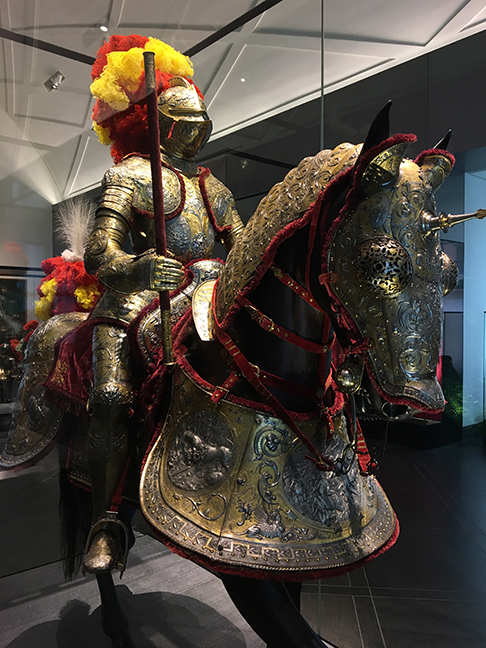
Parade armor made for
King Erik XIV of Sweden, 1563
Years ago, I saw the collection of armor at Les Invalides, in Paris. The armor in the Green Vault is just as impressive. The collection is rich in fancy parade armor (as opposed to armor intended for actual combat). To take just one example, the armor I've shown here was made in connection with King Erik XIV of Sweden's suit for the hand of England's Queen Elizabeth I. The decoration in gold was commissioned in 1563 from a goldsmith in Antwerp and done on a suit of semi-finished armor that had been made in Sweden and sent to Antwerp. Apparently, the finished work never made it back to King Erik, having been captured by Danish troops and sent to Copenhagen. The decoration shows scenes from the legend of Hercules and the Trojan War. There were many pieces like this.

Maurice, Elector of Saxony
and his Wife Agnes
Lucas Cranach the Younger 1559
At the very end of my stay I found a room full of paintings, many by Lukas Cranach the Younger, that I would have liked to have seen in more detail, including a number of interesting portraits and an Adam and Eve that's well known.

I left early, but, as noted in my previous post, I missed my train to Prague nevertheless. I had to wait nearly two hours for the next train—time I wish I had had at the Green Vault.

The first third of the journey followed the course of a river—the Elbe, I assume. At some unmarked point we left Germany and entered the Czech Republic. There was no checkpoint or even an indication of the border. The transition was apparent only because the names of the stations we passed through were suddenly in a script I don't know how to pronounce.

Scenery along the Elbe, south and east of Dresden
It was pretty countryside, the river valley flanked by sheer bluffs of blackened stone that looked very much like the sandstone so common in the buildings—a sandy beige where fractured and a new surface is visible. As we left the river, the landscape flattened into farmland, mostly wheat again, but also something that looked like corn (but wasn't corn) and occasionally hops. After arriving in Prague, I had a hard time finding my lodgings again, this time because the one direct subway line to my destination is under construction for the three days I'll be in Prague. There is a bus link in operation, but I couldn't find the stop anywhere. I finally had to take an Uber, which left me near to my destination but lost again with a phone about to lose power.... I did eventually make it.
Related Posts with Thumbnails