Tuesday, April 2, 2019

Music I'm Listening To: Gil Shaham, Christian Tetzlaff, and Elena Urioste

Gil Shaham after the concert
Three recent concerts, two in San Francisco, one in Santa Rosa. I attended the February 8 performance of the SF Symphony at Davies Symphony Hall. On the program were Steven Mackey's
Portals, Scenes and Celebrations (a Symphony commission and world premiere), Prokofiev's Violin Concerto No. 1, and Tchaikovsky's Symphony No. 4. Michael Tilson Thomas conducted. Gil Shaham was soloist in the Prokofiev. This is a belated report. I can't say I remember the first piece at all, which shouldn't really count against it, but, by definition, it wasn't memorable. Shaham was his usual, highly competent self. MTT's rendition of the Tchaikovsky was on the slow side but quite enjoyable. It was particularly fun to see the substantial pizzicato sections live. This is a very familiar piece of music but not one I'd seen in person before.

Christian Tetzlaff takes a bow
On March 15, I was at Davies Symphony Hall again, this time to hear Christian Tetzlaff play Mozart's Violin Concerto No. 3. He played some unfamiliar cadenzas, which added interest. Also on the program were Ravel's Le Tombeau de Couperin and Sibelius's Symphony No. 2. MTT conducted. Although I generally find MTT bland, I must admit he does the very late romantic stuff well. I very much enjoyed his handling of the Sibelius. So, that's twice that I've found him really engaged and putting a distinctive stamp on the music—this and a recent performance of Mahler's Fifth Symphony

Violinist Elena Urioste
The following day, it was the Santa Rosa Symphony at the Green Music Center under the baton of Conductor Emeritus Jeffrey Kahane. On the program were Gershwin's An American in Paris in its original version (as Gershwin orchestrated it), Barber's Violin Concerto, and Copland's Symphony No. 3. Elena Urioste was the soloist in the Barber concerto. I was impressed by Urioste's performance and she was very gracious backstage. It was fun to see Kahane again, too. The Gershwin in the original orchestration sounded rather different than the version we're used to, which, according to Kahane, was cleaned up substantially by a Hollywood orchestrator. Gershwin apparently had little experience writing for full orchestra at the time. The Copland is not a favorite. It's rather ponderous, but it's interesting to hear the sections of Fanfare for the Common Man (1942) that were written into the symphony, which followed Fanfare by a year or two.

SR Symphony Conductor Emeritus Jeffrey Kahane

Art I'm Looking At: The Art Wall at Shige Sushi Closes (April 2019)


The Art Wall at Shige Sushi is no more. The restaurant owners have decided to permanently close the Cotati location to focus on their new location in Sonoma. It was a really fun four-plus years. As curator, I feel like I was able to show a great deal of really good local art in that time. I sincerely thank everyone who helped to make The Art Wall possible.

The first show was in December and January 2014-2015. Only one person came to the opening reception. It was pouring with rain, no one had heard of the place (except as a restaurant) and it was right before Christmas. In the end, that was a good thing. There would have been room for no more. We held the reception while the restaurant was open—a mistake in such a small space. I quickly learned to have the receptions on Mondays, when the restaurant was closed. I will always be grateful to Claude Smith and Sherrie Parker for agreeing to participate in the first show.

I curated 26 shows of 8 weeks each with a couple of exceptions—one was six weeks, one ten weeks. I showed the work of 28 artists, 27 living, one deceased (Lewis Bodecker). There were 23 solo shows, three group shows (collage work by Claude Smith, Sherrie Parker, and me; Lisa Beerntsen and Deborah Salomon had a show together, and we did a show of contemporary photography that included work by nine artists). Of the 23 solo artists, 17 or 74% were women. Several artists participated in more than one show, including Janis Crystal Lipzin, Sherrie Parker, Claude Smith, and Deborah Salomon.

We sold at least one piece in (or as a result of) seven of the shows, not including work I bought myself. Including that, we sold at least one piece in 11, or 42% of the shows. Katie McCann sold the most in one show, with three of her collages going to an enthusiastic collector. The most expensive piece sold was a piece in Sherrie Lovler’s show, which sold for over $800. As I took only a 25% commission on sales, The Art Wall at Shige Sushi was not a profitable venture in monetary terms. It would not have been possible at all if the owners at Shige Sushi had not allowed me to use the space at no cost. It was profitable in terms of other, more important things. 

Please join us next Monday, April 8, 2019 for a final closing party from 6:00PM to 9:00PM. Everyone's invited. If you never made it to one of our shows, this will be your last chance. Wine and beer will be provided, but please bring a little something to eat to share with friends. Pot luck. Bring your own bottle, too, if you care to. But come, even if you come empty-handed. I'd really like to personally thank everyone who was involved—the artists and the art lovers—with making The Art Wall at Shige Sushi a success.

The photo above shows postcards for each of the 26 shows I curated, in chronological order.

Books I'm Reading: Laurie Lee—Red Sky at Sunrise

I wonder if Laurie Lee (1914-1997) is not better known in the US because his name sounds feminine. I imagine it confuses people to learn, if they ever do, that Laurie is a man, Laurie being short for Laurence in this case. It's the sort of thing the British are more at ease with than we are. It may also be that the British, on the whole, have better taste than we do and that they are better educated. Or is that an illusion? Whatever the case, our current president has shown what a fundamentally ignorant, insensitive, mean-spirited people we Americans are—on the whole. The writings of a man like Laurie Lee could never go mainstream here, but perhaps not anywhere. His writing is too pretty to go mainstream. His prose reads like poetry, often requiring the attention and concentration that poetry requires. It can be tiring—although never overwrought and burdensome like the prose of a D.H. Lawrence.

I thought this particularly so in the case of Cider with Rosie, one of the three autobiographical books (originally published separately) collected in this omnibus volume from Penguin (2004). Not surprisingly, Lee is best known as a poet aside from these books.

Cider with Rosie, memories of the author's childhood in the Cotswold countryside, originally appeared in 1959. It's a nostalgic remembrance of his early life in an isolated village before the First World War, before automobiles were common, before the encroachment of modernity. Lee writes beautifully of the countryside, life with his sisters, life with his distracted mother, life with his absent father—his experience of growing up there from the age of three (his first memories) until just before he steps out into the world on his own as a young man—by walking to London (a distance of about 110 miles) and then across Spain.

The opening is beautiful and memorable. He remembers the first time he was out of the house on his own, at age three. 

I was set down from the carrier's cart at the age of three; and there with a sense of bewilderment and terror my life in the village began.

The June grass, amongst which I stood, was taller than I was, and I wept. I had never been so close to grass before. It towered above me and all around me, each blade tattooed with tiger-skins of sunlight. It was knife-edged, dark, and a wicked green, thick as a forest and alive with grasshoppers that chirped and chattered and leapt through the air like monkeys.
The prose throughout is as vivid.

The very idea of leaving home by spending several weeks to walk to London and then to walk across Spain (the subject of the second book, As I walked Out one Midsummer Morning, originally published in 1969) is alien in this age. A young American setting out on his or her own would rarely think to walk anywhere today, much less the distance from Scranton, Pennsylvania to New York City to look for work and independence from family. We are coddled and separated from the physical world by our computerized vehicles and computerized devices. Today, walking such a distance simply to get somewhere, or walking across a foreign country is reserved for the well-heeled tourist (always with money and privilege to fall back on in a pinch) or it's an act of defiance, a conscious attempt to return to some kind of ill-defined authenticity. Lee starts out in life by walking to London because he has no other way to go. Later, he walks across Spain, supporting himself by playing his violin in the streets, for much the same reason; he wants to go and he has no other conveyance. He is ill-prepared in both cases and nearly expires on several occasions from heat stroke in Spain, but the kindness of strangers and plain dumb luck save him. Lee at the end of the book ends up in jail and very narrowly escapes getting himself shot. His experience illustrates just how important happenstance often is in determining the path of an individual through life.

At the end of As I walked Out one Midsummer Morning, Lee is in a Spain on the brink of civil war. In the third and final book, A Moment of War (originally published in in 1991), he decides to go back to Spain (having once returned to England) with the idea that the Spanish Republicans deserve his help. Once again, hopelessly ill-prepared, he walks into Spain from France to join the cause, nearly freezing to death in the process. During his time in the Republican army he is met with suspicion and incompetence in a swirl of doomed enthusiasm among his peers that quickly deteriorates into a pool of squalid disillusionment. In the confusion of the early stages of the Spanish Civil War,  in far greater danger of being shot as a spy or dying of hunger and exposure than he is of receiving a mortal wound in the little combat he sees, he absorbs the random cruelty, waste, stupidity, and oppressive boredom that war always brings. In the end, he's sent home, lucky to have come away with his life intact, once again saved by coincidence. We should be glad of it. Had he died, none of these three books would have been written. Recommended. 

Wednesday, March 27, 2019

Art I'm Making: Cyanotype progress

Under the heading of "For What it's Worth": I've been working with the new Christina Z. Anderson Cyanotype book, following a couple of months of experimentation on my own (but with the generous help of another member here who happens to live nearby), focused on classic cyanotype and Arches Platine paper.

Looking at the book, I was very impressed by the work by Eugene Starobinskiy (for example, on page 117). Saying to myself "That's the kind of print I want to make!" and reading his comment saying his best-looking prints have been done on Canson XL Watercolor paper (in a 9 x 12 tablet), I decided to start a new calibration using this paper. It has one huge advantage right off the bat--it's much cheaper than Arches Platine. Also, I don't like that the Arches Platine sheets always come with a sticker on them that ruins part of the already expensive paper. On the downside, the Canson paper is less absorbent, making it a little harder to coat evenly. The blues are slightly different, but hard to characterize. The Arches Platine blue is a little fatter, a little more velvety, but I don't dislike the color of the Canson XL.

The Canson seems to give me a much better range of tones. I used Christine's method to determine a base exposure (I hope I've done it right), based on the information on pages 49-53. I've modified my standard processing slightly, by increasing the acidity of the developing water--going from one tbsp of vinegar/quart to 1 tbsp/500ml, essentially doubling the vinegar--although that's still a comparatively small amount.

The first cyanotype I posted here, and my first real effort was appealing and I put it up with some enthusiasm because I was simply pleased to got an interesting image of any kind (the image of the Transamerica Pyramid in San Francisco). However, the shadows are blocked up in the original print (on the left) and the mid-tones are muddy. Changing to the Canson XL Watercolor paper with the above-noted modification immediately produced a much better result. So, I think I will move forward trying to create a curve for this new paper and development routine. Information about the two prints is given below the images (I hope it's readable). Both were exposed in a beautiful UV-light box my brother made for me. Identical negative. Both classic cyanotype formula from Bostick and Sullivan. Double coated. Naturally, these are images of images, so approximations, but I've made an effort to tweak them so that the on-screen versions look as close as possible to the real prints--although they may look rather different on your monitor. Still, I hope the comparison is of some interest to anyone considering these papers. 

[Having posted this on the Facebook cyanotype page I unexpectedly triggered a long thread with many people much more experience than me. They've convinced me that the Canson is not a good choice for serious work because it has buffers in it that react badly with cyanotype chemistry over time. Although it works very well, it's not archival. Back to the Arches Platine.]

Thursday, March 21, 2019

Rain: More Rain and More Rain (March 21, 2019)

As of this morning (March 21, 2019), we've had another 0.65 inches of precipitation at my location in northwest Santa Rosa since last reporting. That brings our total for the 2018–2019 rain year to 34.00 inches. Today is clear and sunny, but rain is predicted again over the weekend and into next week.

[Update: Subsequent rain added 0.95 inches to our total, which, as of March 24, is 34.95 inches, but more rain is in the forecast for the coming week.]

[Update: As of the morning of April 2, we've had another 1.2 inches of rain, bringing the total to 36.15 inches, which is about the historical average for Santa Rosa. This year has been wet and cold. Everyone is ready for some spring weather....]

Saturday, March 16, 2019

Plants I'm Growing: First Blooms—Species Tulips (Tulipa Bakeri, 2019)

The first species tulips in the garden started blooming on March 10 this year. These are Tulipa bakeri, a pretty pink with a blazing yellow center. I planted several hundred of these years ago. Most were devoured in a season by ground squirrels, but about a dozen survive. Always nice to see them in the spring.

It is from species like these that  what most people think of as tulips today were developed. Tulips are native to places like Turkey and the countries of the Caucasus region. This is a variety called "Lilac Wonder." Tulipa bakeri bloomed in the garden on March 5 in 2009 and on March 16 in 2010 (although I seem to have two contradictory dates for 2010--also February 24), on March 14 in 2011, on March 4 in 2012, on February 25 in 2013, on March 6 in 2014, on February 20 in 2015, and on March 9 in 2018, so this is toward the late end of the range I've noted over the years, but nothing out of the ordinary.

Friday, March 8, 2019

Plants I'm Growing: First Blooms—Two-toned Daffodils (March 2019)

I belatedly report today that the first of the two-toned daffodils in the garden opened on March 4 this year. They typically open later than the yellow daffodils—and have done so this year nearly a month later. The yellow daffodils first bloomed on February 6 in 2019.

The two-toned daffodils first opened on February 22 in 2010, on February 24 in 2011 and 2012, on February 18 in 2014, on February 20 in 2016, and on February 24 in 2018. So, this is a little later than usual. 

Miscellaneous: Things We Need Words For

Things we need words for: A small machined metal or molded plastic part separated from its intended application carefully preserved in the (usually) vain hope that someday it will become apparent what it was made for and where it belongs. These things are clearly important and probably irreplaceable but not where they ought to be. The sort of little bit that, if you have it, the thing it goes to is ten times more valuable than an example of that thing missing the little bit you can't figure out.

Thursday, February 28, 2019

Art I'm Making: My Museum Shadows Series Photographs on The Art Wall at Shige Sushi


On The Art Wall at Shige Sushi: Colin Talcroft—Selections from the Museum Shadows Series
March 5 through April 28, 2019
Opening reception: Monday, March 11, 2019 5:00PM-7:00PM

Abstract photographs by me. The Art Wall at Shige Sushi presents selections from my Museum Shadows Series, an ongoing series of shadow photographs begun in 2012 captured in museums and galleries around the San Francisco Bay Area and in Europe.

On the Art Wall at Shige Sushi, 8235 Old Redwood Highway, Downtown Cotati, 94931.
Art viewable during regular business hours. Restaurant closed Mondays. More information at http://ctalcroft.wix.com/artwallatshige

Wednesday, February 27, 2019

Rain: Atmospheric River Dumps 5.5 Inches on Santa Rosa (Februray 27, 2019)

Looking at the rain gauge this morning, it was overflowing. I've never seen it completely filled before. The scale ends at five inches. I'm guessing there was another half inch above that, but I have no idea how long it was completely full and therefore not registering new precipitation. Suffice it to say that we've had at least 5.5 inches of new rain in the last couple of days. That brings our total to 32.60 inches at least at my location in Northern Santa Rosa, close to normal annual rainfall for the entire rain year (about 36 inches). Rain is in the forecast for the next seven to ten days. It seems very likely that this will be a wetter-than-average year. The Russian River and the Santa Rosa Laguna are already above flood level in places.

[Update: As of  noon on March 7, we've had another 2.4 inches of rain. That brings the total now to 35.00 inches for the current rain year at my location. More rain is forecast over the upcoming weekend and into early next week. Perhaps then we'll get a break. It would be nice to see a little sun again....]

[Another update: As of today, March 12, we've entered a dry spell. Nice to see the sun again. Between my last report and today we had another 0.75 inches of precipitation, bringing the total at my location to 33.35 inches so far this year.]

Monday, February 25, 2019

Books I'm Reading: Five Equations that Changed the World

Dr. Michael Guillen, in his book Five Equations that Changed the World (Hachette, 1995) succeeds in making five important equations easy to grasp and even entertaining to read about. None of the  equations he's chosen is especially difficult to understand, and the book might be faulted by some for trying to make things a little too approachable, but Guillen's writing only occasionally feels condescending. 

The book is divided into five sections, one for each of the equations. Each essay is itself divided into five parts—a prologue that relates an incident in the life of the man at the center of the story (and they are all men) intended, as the author says, to "set the tone for what is to follow;" sections headed Vini, Vidi, and Vici; and an epilogue. The vini (I came) sections describe how the hero of the story recognizes the problem that his theory solves. The vidi (I saw) sections attempt to explain why the problem was important. The vici (I conquered) sections describe how the protagonist arrived at the equation that solved the central problem developed in each section.

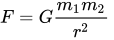
The hero of the first essay is Sir Isaac Newton. The equation discussed is his Universal Law of Gravitation, written as , where F stands for the gravitational force acting between two objects, m for mass (of the two objects in question), r for the distance between their centers of mass, and G for the gravitational constant, an example of an inverse square equation. The law was revolutionary in that it flew directly in the face of the idea that different rules applied to the earthly and heavenly realms. Guillen draws a direct line from Newton's realization that gravity acts the same way throughout the Universe to the landing of astronauts on the moon about 300 years later.
The second essay discusses Daniel Bernoulli's Law of Hydrodynamic Pressure, which deals with the pressure in a flow of liquid. It was Bernoulli's insight that as a fluid moves more quickly, its pressure declines and vice versa. While Bernoulli was concerned with liquids, airplanes (and birds) fly because the shape of an airfoil (whether natural or a man-made) causes air (in essence a very thin liquid) to flow more quickly over its curved upper surface than along its lower surface. Accompanying the speed differential is a pressure differential. Wings produce lift because the slower air flowing below them exerts more pressure than the faster air flowing over them.

The third essay tells the story of Michael Faraday's rise to prominence from humble beginnings and his Law of Electromagnetic Inductance, which Guillen writes as  . According to other sources that is actually a modified form of Faraday's original law, this version known as the Maxwell-Faraday Equation, and I noticed that in other instances the forms Guillen uses are not necessarily those most familiar to us (for example, he gives E = mc2 as E = m x c2). However stated, the core idea and Faraday's insight was that magnetism and electricity are two sides of the same coin—that electric currents produce magnetic fields and that, conversely, a changing magnetic field generates electric current in a conductor. Essentially, he recognized the principles behind dynamos and electric motors, and, once large reliable supplies of electricity became available, electric motors performed work far more efficiently than steam engines, important as steam engines had been. This essay dwells in some detail on the difficulties Faraday faced as a member of the lower classes (originally apprenticed as a book binder) in the English science establishment of his day dominated by wealthy gentleman scholars.

Rudolf Clausius, the subject of the fourth essay, is a less familiar figure than the others, but his Second Law of Thermodynamics is well known. Heat fascinated him. His breakthrough was understanding that cold things normally never become cold on their own, that natural temperature flows always go from warmer to colder—or, more formally stated: "heat always flows spontaneously from hotter to colder bodies, and never the reverse, unless external work is performed on the system" (from the Wikipedia article "Second Law of Thermodynamics"). By extension, he realized that energy changes and temperature changes were, again, two sides of one coin: they were changes in entropy.

The final essay, on Einstein's E = mc2 was particularly interesting, I thought, as it explained why Einstein started thinking along the lines that eventually led him to his conclusion about the interchangeability of energy and matter. According to Guillen, Einstein had understood that if you could travel as fast as sound waves emanating from a certain spot (only about 767mph) that you would cease to hear them because you would be moving away from their point of origin as quickly as they were; they would never reach you. Einstein apparently wanted to know what light would look like if you could travel at the speed of light away from a light source (almost 671 million mph, but more commonly given as 300,000m/sec). Ultimately, he concluded that the gravitational effects associated with travel at that speed would make it impossible to move so quickly and that light performs the feat because the photon is the only known particle believed to be pure energy and thus mass-less (and therefore not subject to gravity). Einstein decided that space and time are forced to change in such a way that the speed of light never changes—in short that space and time are mutable and everything, except light, is relative. An entertaining read if the history of science lights your lamp.

Saturday, February 23, 2019

Art I'm Making: Untitled Collage No. 213 (Santa Rosa)

Another comparatively large collage. I was in a dry spell, collage-wise, from the end of last year and into the start of this year, but recently I've started making more monotypes again, and that has led to some new collage work.

This is Untitled Collage No. 213 (Santa Rosa). February 12, 2019. Acrylic on paper, acrylic monotype, graphite, collage. Image size: 28.1 x 37.5cm (11.1 x 14.8 inches). Matted to 20 x 24 inches. Signed on the mat. Signed and dated on the reverse.

Plants I'm Growing--First Blooms: Daffodils, Pink Flowering Plum 2019

The yellow daffodils in front of the house and the pink flowering plum behind the house generally bloom at about the same time each year. This year, the first daffodils opened on February 6. The first flowers on the plum (Prunus blireiana) opened on February 9. Early to mid-February is normal for both plants. They have bloomed between February 2 and about February 20 in a typical year in the past. A storm is on the way that is supposed to drop as much as 10 inches of rain in the coming seven days. I hope these blossoms aren't all lost before we've had a chance to enjoy them.

Serendipitous Art: Red Tape Line on a Black Floor (February 23, 2019)

A line of orange-red tape on a battered, black floor. Serendipitous art.

Click on the image for a larger view. For more unintended art, see my blog Serendipitous Art.

Wednesday, February 13, 2019

Rain: Heavy Rain Continues (February 13, 2019)

We've been in the middle of another storm last night and so far today. The storm system and other rain since last reporting here has added another two inches to our total, but it's still raining. Therefore, we've had at least 23 inches so far, but I will update this precisely after the storm passes.

[STILL raining: As of 10:00AM on February 14 we've had 4.5 inches of new rain at my location since my last post here. I'm updating here because the gauge goes to only five inches. So, as of this morning, our total stands at 25.80 inches. That puts us ahead of the historical average, which is just under 24 inches for this date in Santa Rosa.]

[Update: As of 4:30 today (February 16) we've had another 1.3 inches since last reporting. Our total is now 27.10 inches.]

Friday, February 8, 2019

Art I'm Making: Untitled Collage No. 212 (Santa Rosa)


Just when I thought I had no more collages in me, I started making new monotypes yesterday and one thing led to another....

This one doesn't photograph well. The subtleties in the rice paper area get lost a little, but the image here is a reasonable facsimile. I think too often we forget that photographs of art, while they allow a general impression, are never a substitute for seeing the real thing.

Untitled Collage No. 212 (Santa Rosa), my first collage so far in 2019. Acrylic on paper, acrylic monotype, found paper (antique rice paper, found letter with fragments of stamps, handmade paper sample), collage. Image size: 28.0 x 37.5cm (11.0 x 14.8 inches). Signed on the mat. Signed and dated on the reverse.

For more, see my website at http://ctalcroft.wixsite.com/collage-site

Tuesday, February 5, 2019

Books I'm Reading: On Photography

Having just read Susan Sontag's Against Interpretation and Other Essays, I felt inspired to finally read her collection called On Photography. I read an old Delta paperback edition (1978—apparently the first paperback edition) that I picked up used somewhere ages ago; although I thought I had a newer edition somewhere. No matter, the content is the same, although newer editions may have worthwhile ancillary material attached. It's a shame that Sontag didn't live long enough to add thoughts in the age of smartphones, Facebook, and Instagram.

This was much easier going than Against Interpretation—not because it is somehow lacking in depth, breadth, or rigor of thought—but simply because the subject matter is so much more familiar to me. I'm able to immediately see in my mind virtually all the images she mentions, none of which are shown in the text (I wonder if there's an illustrated edition?). I know the photographers she mentions. I know most of the history. But this is not about the history of photography or about the work of specific photographers except as useful for the purposes of supporting an argument.

The essays (six of them, although together they read as a single narrative) are mostly about the function of photography within human culture, and virtually every page has something worthwhile to say about the subject. Sontag talks about how photography relates to painting, to travel and tourism, about the way photography levels all events by transforming them into physical records, about ethical issues faced by documentary photographers and war correspondents, about the paradoxical way photographs can shock by exposing what is normally unseen while at the same time anesthetizing us to the shocking through repeated exposure, and about the way photography has come to shape the way we view and understand environments, both natural and man made.

Ultimately, she suggests that photography has usurped reality--that we have become more comfortable relating to images of the world than to the world itself. She was prescient. She had this insight when images were more pervasive than they'd ever been yet still far fewer and far more difficult to create than they are today. In 1977, making a photographic image usually involved film  sent out for processing. There was typically a lag of at least several hours--sometimes as long as a week--between composing a photograph and seeing it. Polaroid cameras were available, but even at the height of their popularity and availability, most images were not made with instant cameras (and a Polaroid image took several minutes to appear). Today, virtually any phone handset can produce an image in seconds and that image can be made visible to hundreds of millions of viewers just as quickly. What would Sontag have had to say?

[A few days later I found the more recent edition I was pretty sure I had (Picador, 1990). The text is identical to the text of the version I read. No illustrations have been added, and there is no additional content. ]

Sunday, February 3, 2019

Rain: New Storms in Early February

Storms moving through the area yesterday and today have so far dropped 1.3 inches of new precipitation. That brings the total at my location in northwest Santa Rosa so far to 20.10 inches for the 2018-2019 rain year (which runs through October 31, 2019), about an inch below the historical average for the first week of February, but it's still raining....

[Update: Subsequent rain added 1.20 inches of precipitation. That brings the total now to 21.30 inches as of noon February 5, 2019)]

Friday, February 1, 2019

Miscellaneous: Slate-colored Junco (February 1, 2019)

I had an unusual visitor in the garden today--a Slate-colored Junco, a Junco variety usually more at home on the East Coast and around the US-Canadian border east of the Rocky Mountains (our local "Oregon Junco" has a brownish back and flanks). Although a few of these all-grey birds turn up here every year and they aren't really rare, they are uncommon and I've never seen one this dark before (even in the East).

Thursday, January 31, 2019

Books I'm Reading: Susan Sontag's Against Interpretation and Other Essays

I finally got around to reading Susan Sontag's Against Interpretation and Other Essays, which appears to have remained in print since its initial publication in 1966. I read a Picador paperback edition of uncertain date (pictured). It looks like 1990, but it's hard to tell from the front matter. Whatever the year, my copy is from the 21st printing in this format.

It's easy to see why this collection continues to interest readers—why the publishers continue to make it available: although the essays here are from 1961 to 1966, making even the most recent more than 50 years old, they've held up well. While they are clearly of their time (and, in part, fascinating for that reason), they do not feel dated in the sense of no longer having much relevance or of being outmoded in style. Sontag writes charmingly, her familiarity with a wide range of philosophy, literature, theater, and film is impressive, and her thinking is lucid. On top of that, she had pretty good taste. I found the essays engaging even when they dealt with writers I've never read (or never even heard of in a couple of instances) and films I've yet to see. Reading Against Interpretation and Other Essays has given me another reason to delve into classic French cinema and to get around to reading Sartre, Camus, and their ilk. So many books, so little time, as they say. I most enjoyed the title essay, "Against Interpretation," her discussion of science fiction films, the piece about "happenings," and the collection of thoughts entitled "Notes on 'Camp'." Next, I plan to read Sontag's On Photography, a book I've been meaning to read for years.

Coincidentally, I recently (just this week) stumbled upon kanopy, an online film-streaming service that gives free access to a large selection of high-quality films through the public library system. All that's required is a public library card to get a pass to watch up to 10 films a month free (at least with a San Francisco Library card; limits differ from library to library apparently). Once you select a film, you can watch it as many times as you want for three days. I've already added most of the classics of French cinema Sontag discusses to my watch list.

Serendipitous Art: Windowpane Landscape (January 31, 2019)

A green windowsill and a cloudy sky in a windowpane looked like a landscape to me, looked like art to me. Serendipitous art.

Click on the image for a larger view. For more unintended art, see my blog Serendipitous Art.

Music I'm Listening To: Johannes Moser with the San Francisco Symphony (January 25, 2018)

I first heard of and heard cellist Johannes Moser when he appeared with Edward Gardner conducting the Santa Rosa Symphony, in 2007. He played Elgar's Cello Concerto. I don't have the clearest memory of that performance (it was a year before I started writing this blog) but I do remember thinking he was outstanding. I subsequently looked for him often, but he seems to perform mostly in Europe. So, I was thrilled to learn that he would be among the guest artists performing  with the San Francisco Symphony this year (his debut with the Symphony). I attended the January 25 performance, which included Richard Strauss's Don Juan, Lutoslawski's Cello Concerto, with Moser the soloist, and Prokofiev's Symphony No. 5. Resident conductor Christian Reiff on the podium did a very creditable job, I thought.

I don't know Don Juan well, but Reiff had the piece well in hand from the get-go. Never a dull moment. The energy was remarkable. Too often the opening piece on a program serves as a warm-up  with nothing quite gelled. Not so in this case. The same energy was present throughout the Lutoslawski and after intermission.

The Lutoslawski concerto is a fairly obscure piece by a composer even many classical music enthusiasts don't know well, but I'm quite familiar with it, having many years ago purchased a CD of Rostropovich playing the concerto (along with  Dutilleaux's Cello Concerto--EMI CDC 7 49304 2). The piece was written for Rostropovich (premiered by him in London in 1970). Although I've heard it many times, I'd never seen it performed before. In a letter from Lutoslawski to Rostropovich (quoted in the liner notes to the EMI recording and in the San Francisco Symphony program for the Johannes Moser performance), the piece is described as a kind of battle between the soloist and the orchestra. Although the Cello Concerto opens rather languidly with a repeated single note on the cello (which Lutoslawski says in the letter to Rostropovich is to be played in an "inexpressive (indifferent) manner" things quickly escalate and Moser not only played the music, he played the piece rather theatrically—pugnaciously—jabbing and sawing, with every stroke in the aggressive sections seemingly a deliberate provocation aimed at the orchestra, which gave as good as it got. I was reminded of the famous description of the premiere performance of Tchaikovsky's Violin Concerto by unsympathetic critic Eduard Hanslick who complained that 'The violin is no longer played; it is pulled, torn, drubbed." While that was intended as a criticism, what a spirited and delightful performance Moser gave us. He had the audience giggling in places at his antics on stage, but never did he let the presentation get in the way of his tautly precise playing. He was marvelous. A memorable performance. Among the best I've seen in San Francisco—and that's saying a lot. I hope we'll see more of Moser here.

As an encore, he played a section of one of the Bach Cello Suites, introducing the piece by saying "And now for something completely different," which got another laugh. After the concert I had the pleasure of speaking with him briefly. I regret not asking him if all performers are so expressive when playing the Lutoslawski, but he remembered his performance with the Santa Rosa Symphony years ago and seemed pleased that I had enjoyed it and mentioned it and come back to see him. He autographed a CD for me and even added a doodle of himself playing the cello.

I thought Reiff handled the Prokofiev well, particularly the second movement, which I think among the most thrilling symphony movements ever written, when done well. Although I thought the first movement a little unsettled in places and I think the second movement should be launched into right away, while the tones of the first are still ringing in the ears (audience applause prevented this), overall, it was a fine performance. That second movement soars. It has a remarkable buoyancy and an irresistible momentum—again, when done right—and Reiff achieved that. It's a feeling few other pieces can generate, although I've had the same sensation when listening to the final movement of Dvorak's "American" quartet and in places in Schumann's Cello Concerto. It creates something of the thrill of effortless skiing—a rapid but relaxed, floating, forward motion. Again, this concert was a standout among the many fine concerts I've had the pleasure of attending recently.

Friday, January 25, 2019

Art I'm Making: Recent Collages

I say in the headline "recent collages" but I've come to a point where I feel like I've done with collage what I can do with collage. I know there are an infinite number of potential works that I might create, but I've lost the intense feeling of urgency about experimenting. This has been typical of me in the past. There was a period when photography was my obsession, a period of intense woodblock and other kinds of printmaking, a period of oil painting, most recently this phase of collage-making. The collage phase lasted almost five years--much longer than usual (although I've never really stopped photography since I began at the age of about eight). The printmaking phase lasted about two years, painting and drawing about the same. I guess I need to take breaks between periods of activity. At the moment, my attention is mostly on making cyanotypes, which, so far, have proved far more difficult than I anticipated. For the time being, though, I post here my three most recent collages.

Above is Untitled Collage No. 209 (Santa Rosa), October 9, 2018,  Acrylic on paper, acrylic monotype, collage. Image size: 14.6 x11.0cm (5.7 x 4.3 inches). Matted to 14 x 11 inches. Signed on the mat. Signed and dated on the reverse.

Below that is Untitled Collage No. 210 (Santa Rosa), October 20, 2018,  Acrylic on paper, acrylic monotype, collage. Image size: 17.5 x21.3cm (6.9 x 8.4 inches). Matted to 16 x 20 inches. Signed on the mat. Signed and dated on the reverse.

And below that is Untitled Collage No. 211 (Santa Rosa), November 24, 2018,  Acrylic on paper, acrylic monotype, collage. Image size: 11.2 x 6.6cm (4.4 x 2.6 inches). Matted to 11 x 14 inches. Signed on the mat. Signed and dated on the reverse.

Miscellaneous: Another Indictment--Roger Stone

Photo: Drew Angerer/Getty Images
I don't have the resources to independently confirm any of the following, which I found in a comment today on the Roger Stone arrest, but nothing here contradicts anything I've read from reliable sources. It's quite remarkable when you lay it out like this. I post it with no further comment except to suggest that impeachment is overdue.
That said, there are arguments supporting the idea that an electoral defeat in 2020 and then arrest would be a greater and more appropriate humiliation for a man who appears to so richly deserve to get his come-uppance.

Hillary Clinton Benghazi "Investigation"
4 years
0 indictments
0 convictions

Hillary Clinton E-mail "Investigation"
2 years
0 indictments
0 convictions

Trump-Russia Investigation
15 months

34 Indictments/charges--and counting (Individuals)

3 Indictments/charges (Companies)
5 GUILTY pleas (and counting)
4 CONVICTIONS (and counting)

Indicted: Roger Stone
Indicted: Paul Manafort
Indicted: Rick Gates
Indicted: George Papadopoulos
Indicted: Michael Flynn
Indicted: Michael Cohen
Indicted: Richard Pinedo
Indicted: Alex van der Zwaan
Indicted: Konstantin Kilimnik
Indicted: 12 Russian GRU officers
Indicted: Yevgeny Prigozhin
Indicted: Mikhail Burchik
Indicted: Aleksandra Krylova
Indicted: Anna Bogacheva
Indicted: Sergey Polozov
Indicted: Maria Bovda
Indicted: Dzheykhun Aslanov
Indicted: Vadim Podkopaev
Indicted: Irina Kaverzina
Indicted: Gleb Vasilchenko
Indicted: Internet Research Agency
Indicted: Concord Management

Guilty Plea: Michael Flynn
Guilty Plea: Michael Cohen
Guilty Plea: George Papadopolous
Guilty Plea: Richard Pinedo
Guilty Plea: Alex van der Zwaan
Guilty Plea: Rick Gates

Over 191 Criminal Charges (and counting):

Conspiracy against the USA (2 counts)
Conspiracy to launder money (2 counts)
Bank fraud (8 counts)
Bank fraud conspiracy (10 counts)
Subscribing to false tax returns (10 counts)
Making false statements (6 counts)
Failure to file reports of foreign bank accounts (14 counts)
Unregistered agent of a foreign principal (2 counts)
False FARA statements (2 counts)
Subscribing to false tax returns (10 counts)

Assisting in preparation of false tax documents (5 counts)
Conspiracy to defraud the United States (13 counts)
Conspiracy to commit wire fraud and bank fraud (2 counts)
Aggravated identity theft (24 counts)

For further information, here is a link to a NY Times article on the subject. This article was originally published in February 2018 but has been updated online repeatedly. The last update was January 25, 2019, so it is current as of today. 

Monday, January 21, 2019

Music I'm Listening To: So Many Concerts

Musician's case backstage at The Green Music Center
The last couple of months of 2018 were unusually busy months for me. I had art work in multiple shows. I was curating a new show on The Art Wall at Shige Sushi. I was more than usually busy with other work. I did three Audubon Christmas bird counts this year, leading a section of one of them. I attended a larger number of concerts than usual, concerts of both the San Francisco Symphony and the Santa Rosa Sympony. I've fallen far behind in mentioning them. That bothers me not so much because I think anyone will have missed my comments or photographs but because, by posting here, I keep a record that I can return to when trying to remember who I heard where and when.

Concerts I've failed to mention include an extraordinary performance of Ravel's Bolero, Friday October 19, 2018 in San Francisco with Pablo Heras-Casado conducting the San Francisco Symphony (I can't remember what else was on the program). Bolero is extremely familiar, but I'd never heard it live before, never seen it before. Visually, what was striking was the way the snare drum was positioned not at the back of the stage in the percussion section but right in the middle—in front of the woodwinds and just behind the violas. The snare drum sounds from beginning to end, without a break, establishing and maintaining the beat throughout. It is central to the piece in more than one sense. How hard it must be to keep it going flawlessly for the 15 minutes or so that Bolero lasts. It was an extraordinary performance—in its entirety, not just the percussion, although the snare drummer enjoyed a long and enthusiastic spell of applause.

Jean-Yves Thibaudet and Gauthier Capucon take a bow
And then there was Gauthier Capuçon and Jean-Yves Thibaudet in recital, also in San Francisco, on Sunday December 2, 2018. They played Debussy's Sonata No. 1 in D minor for Cello and Piano; Brahms' Sonata No. 1 in E minor for Cello and Piano; and Rachmaninoff's Cello Sonata in G minor, along with a number of encores, which, at this remove, I can't recall. Capuçon, as always, exuded confidence and a kind of strong but contained joy in playing. A joy to hear and to watch. Thibaudet was mostly hidden by the piano from my vantage point, but you could feel a presence nonetheless equal to that of Capuçon. Grabbing a bite to eat after the concert, my mother and I were surprised to see Capuçon, Thibaudet and their entourage come into the same restaurant about half an hour after we had arrived. Usually we eat at Absinthe after concerts, but the place closes early on Sundays. The only restaurant I could find a space at was Monsieur Benjamin, where the food was very tasty but boldly overpriced--particularly the wines by the glass. I resisted the temptation to intrude on the musicians, to say something, but it was fun to see them offstage.

Nokuthula Ngwenyama and Jayce Ogren coming offstage after Harold in Italy
Francesco Lecce-Chong conducting the Santa Rosa Symphony
The day before, December 1, I was backstage in Santa Rosa taking pictures for the symphony during a concert at The Green Music Center. On the program were the William Tell Overture (Rossini), Berlioz's Harold in Italy, and Vivaldi's Gloria. The concert was led by guest conductor Jayce Ogren. Nokuthula Ngwenyama was the viola soloist in Harold in Italy. 

On January 12, in the new year, I was backstage again for a concert conducted by new music director Francesco Lecce-Chong. He led the Santa Rosa Symphony in a couple of short brass fanfares by Takemitsu, Mozart's Symphony No. 40 and Mahler's Symphony No. 4. Soprano Marie Plette was soloist in the Mahler.

Not to mention the Santa Rosa Symphony concert with Sharon Isbin on November 8, 2018 and also seeing Hilary Hahn in recital in San Francisco on the following day—two concerts I wrote about briefly here—or to mention the several art shows I saw in those months that I never got a chance to write about, notably the Muslim Fashions show, the René Magritte show, and the Pre-Raphaelites show, all in San Francisco.
Soprano Marie Plette and Francesco Lecce-Chong
coming offstage after the Mahler
 

Books I'm Reading: The Monuments Men

First book of the new year. The Monuments Men (2009, Little, Brown and Co.), by Robert M. Edsel, with Bret Witter, is the book from which the recent film was made. It tells the story of the German looting of art treasures in Europe during WWII. This is the same story told in Lynn H. Nicholas's 1994 book The Rape of Europa, but from the perspective of the men and women charged with finding, protecting, and repatriating the loot.

An extraordinary tale in many ways. First, it vividly demonstrates (yet again) the Nazi capacity for organized and meticulously documented criminal activity—activity condoned and encouraged from the very top. Extraordinary that treasures of the caliber of The Ghent Altarpiece were carted away and stowed in salt mines. Extraordinary that Hitler directed all of the looted art to be destroyed at the end of the war, when it had become clear that the war was lost. Extraordinary to think that, at the same time— almost until the day he killed himself—Hitler still had visions of a great museum in Linz where all the stolen art would go. Extraordinary that so few people on the Allied side accomplished so much with so little support from the governments they were serving. The writing is workmanlike, but the tale itself is well worth the time.    

Rain: Another 0.95 Inches

Clear and sunny today for the first time in quite a while. It was still misting last night as I watched the lunar eclipse, obscured by clouds about half of the time. Now the clouds are all gone. There was 0.95 inches in the rain gauge this morning. That brings our total for the 2018-2019 rain year to 18.80 inches at my location in northeast Santa Rosa. Normal for January 21 in Santa Rosa is a little under 19 inches, so, we are right on track to see an average year of rainfall, as long as the rain doesn't suddenly stop. We'll see.

Sunday, January 20, 2019

Miscellaneous: Lunar Eclipse of January 20, 2019

We got to see only about half of the eclipse tonight because of clouds and rain, but we got to enjoy the climax at least. Here's my best shot of the action. Shot with an Olympus OMD EM-1 Mark II and a 420mm-equivalent lens (80-300mm zoom lens at 300mm plus 1.4x teleconverter) at f4 for 1/3 of a second at ISO 6400. Camera on tripod, in-camera image stabilization off. Exposed using a remote shutter release. Anti-vibration setting not used. Recorded from Santa Rosa, CA at 9:20PM Pacific Standard Time.

Friday, January 18, 2019

Plants I'm Growing: First Blooms--Pink Flowering Plum and "Noyo Dream" Rhododendron

I've been keeping track of the first flowering of many plants in the garden for about eight years now. I have analyzed the data to see if the flowering period of plants are shifting, which was my original intent in creating a kind of botanical calendar, but the Rhododendron "Noyo Dream" bloomed today, which seems very early. Usually this plant blooms in February or even early March. For example, "Noyo Dream" bloomed on February 25 in 2009, on February 7 in 2010, on February 2 in 2011, and March 2 in 2012.

On January 13, the first blossoms opened on the pink flowering plum alongside the house. Today both this plum and the white plum on the other side of the house are in full bloom and buzzing with bees.


Related Posts with Thumbnails