I attended the April 27 performance of the San Francisco Symphony at Davies Symphony Hall. Guest conductor Christian Reif led performances of Wagner's "Siegfried's Rhine Journey" from Götterdämerung, Liszt's Piano Concerto No. 2, and Holst's The Planets. Jean-Efflam Bavouzet was soloist in the concerto. Ragnar Bohlin directed women of The San Francisco Symphony Chorus in the Holst.
I hadn't heard of either conductor Reif or pianist Bavouzet before the concert. Reif was a replacement for Charles Dutoit, with whom the Symphony has severed ties. Both Reif and Bavouzet appear to be most active in Europe, although, according to the program for the evening, Reif has been working with The San Francisco Symphony Youth Orchestra since the 2016-2017 season. I was impressed by both.
In particular, Bavouzet,—dressed fairly casually for a classical soloist—managed to give a powerful, rapid-fire rendition of the Liszt while managing to look cool as a cucumber throughout. He had a commanding presence on stage, handling the technically challenging concerto with an air of utter confidence. Meeting him briefly after the concert to get an autograph on a copy of Volume I of his recordings of the Beethoven piano sonatas (Chandos), he achieved the same effect—seeming completely relaxed yet deeply engaged at the same time.
This was the first time I'd heard the very familiar The Planets live. It's always fun to see how the sounds of a familiar piece of music are produced. The Planets gives all parts of the orchestra lots to do, particularly the two harps and a celesta among the less common instruments. Virtually the entire audience turned around to look behind them for the source of the wordless voices coming from somewhere in the upper balconies as the ethereal end of the "Neptune" section faded to a close.
Photo of Jean-Efflam Bavouzet by Paul Mitchell. Phoo of Christian Reif by Terrence McCarthy. Photos courtesy of San Francisco Symphony.
Friday, May 4, 2018
Books I'm Reading: Danubia
Simon Winder's entertaining Danubia (Farrar, Straus and Giroux, 2013) is subtitled "A Personal History of Habsburg Europe," which gives the author ample room to digress, and the digressions are reliably entertaining—in places laugh-out-loud funny. The book is broad in scope, covering the history of Central Europe from the end of the Middle Ages to WWI, but Winder allows himself space to talk about music and art when the Habsburg ruler of the moment is a bore or to offer odd tidbits about some of the many places he explored on foot doing research for the book. That is, the book deftly balances the grand sweep of history with quirky anecdote and detail. His enthusiasm for his subject is palpable and contagious.
Perhaps the strongest impressions the book leaves are, first, that the history of Western Europe, dominated for so long by the Hapsburgs, might have been very different for any number of reasons—that the Hapsburgs remained in control of things (to the extent that they did) for as long as they did often as much because of luck as anything else—and, second, that large swaths of Central Europe were settled by one group of people, completely de-populated (ravaged by war, disease or both) and then resettled so often (rinse and repeat) that few of the ethnic narratives that have fueled rabid nationalism in modern history (meaning the past 200 years or so) have much basis in fact—that they are often myths fueled by little more than wishful thinking and opportunism.
To say that the history of Central Europe is confusing is an understatement. I'm not sure reading Danubia did as much to clarify things as I would have liked, but, having read the book in anticipation of a trip to that part of the world in June, I feel somewhat more prepared than I might otherwise have been. All joking aside, the book has at least helped me to better understand the history of the Holy Roman Empire, of the House of Habsburg, and of the 30 Years' War, among other institutions and events, if not allowed me to remember precisely which Charles, Franz, or Rudolf did what when. Recommended.
Perhaps the strongest impressions the book leaves are, first, that the history of Western Europe, dominated for so long by the Hapsburgs, might have been very different for any number of reasons—that the Hapsburgs remained in control of things (to the extent that they did) for as long as they did often as much because of luck as anything else—and, second, that large swaths of Central Europe were settled by one group of people, completely de-populated (ravaged by war, disease or both) and then resettled so often (rinse and repeat) that few of the ethnic narratives that have fueled rabid nationalism in modern history (meaning the past 200 years or so) have much basis in fact—that they are often myths fueled by little more than wishful thinking and opportunism.
To say that the history of Central Europe is confusing is an understatement. I'm not sure reading Danubia did as much to clarify things as I would have liked, but, having read the book in anticipation of a trip to that part of the world in June, I feel somewhat more prepared than I might otherwise have been. All joking aside, the book has at least helped me to better understand the history of the Holy Roman Empire, of the House of Habsburg, and of the 30 Years' War, among other institutions and events, if not allowed me to remember precisely which Charles, Franz, or Rudolf did what when. Recommended.
Wines I'm Making: First Sulfur Spraying 2018
Having the day before finished removing excess growth on the vines in the backyard vineyard, yesterday I did the first sulfur spraying of the season to prevent mold. Last year the grapes suffered badly from mildew, the result mostly of my own laziness. I should have been more diligent in my spraying--but it's the chore I least enjoy in growing grapes for wine. I've resolved to do it right this year, spraying every two weeks or so until mid-season. More light and air in the vineyard will help, I hope; last year my neighbor removed a row of small trees behind the vines that were increasingly shading them.
Tuesday, May 1, 2018
Wines I'm Making: Shoot Thinning, Spring 2018
Shoot thinning: One of the spring chores in the vineyard almost done. A before-and-after view of a Cabernet vine I worked on today. Grape vines, and Cabernet in particular, will send out far more shoots in the spring than is compatible with getting the best fruit. About half get removed.
And, as we all know, making wine is easy; growing great grapes is hard--and you can't make good wine from bad grapes. I'll finish thinning our little backyard vineyard tomorrow.
Sunday, April 29, 2018
Art I'm Making: Untitled Collage No. 200 (Santa Rosa)
For more of my collage (and other) work, visit my website at http://ctalcroft.wixsite.com/collage-site.
Monday, April 23, 2018
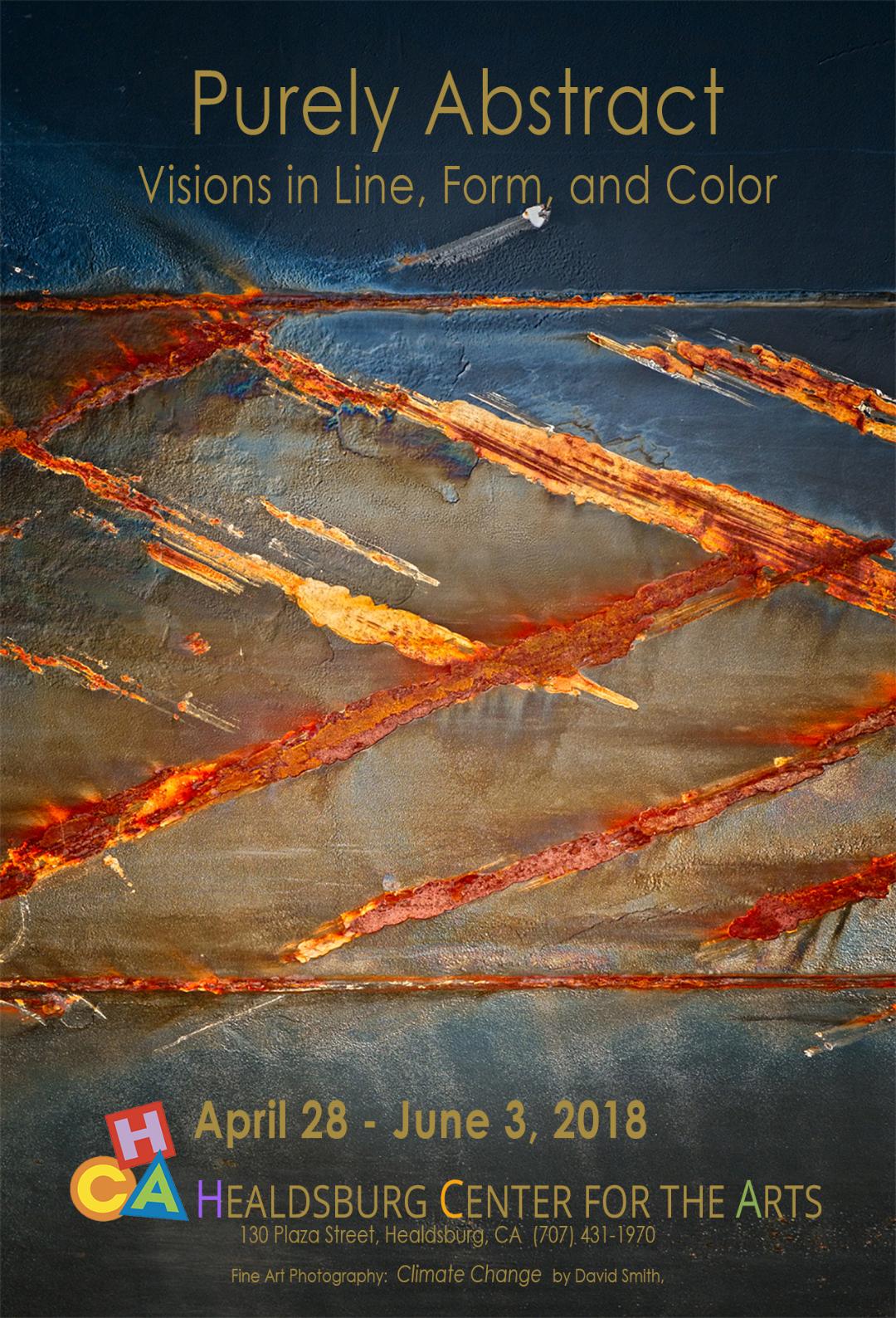
Art I'm Making: Two Collage Pieces in "Purely Abstract" at The Healdsburg Center for the Arts (April 28-June 3)
Two of my collages, Untitled Collage No. 146 (Santa Rosa), shown above and Untitled Collage No. 137 (Santa Rosa) shown below were juried into the upcoming Purely Abstract show at The Healdsburg Center for the Arts (130 Plaza St, Healdsburg, CA 95448), which will feature abstract art by artists from all over the United States, April 28 through June 3, 2018. The opening reception will be Saturday, April 28 from 5:00PM to 7:00PM. I'm working on Saturday, but hope to get to the reception by around 6:00PM https://www.healdsburgcenterforthearts.org
Art I'm Looking At: Kerry Vander Meer on The Art Wall at Shige Sushi (May 1 through July 1)
I'm pleased to announce the upcoming show on The Art Wall at Shige Sushi. I'll be showing mixed media work by Kerry Vander Meer, who works in Oakland. She's an inspiring colorist and has an exquisite sense of composition. Her work incorporates drawing, printmaking, and collage, using paper, fabric, and other found materials. Beautiful work. Artwork will be viewable during the restaurant's normal business hours from May 1 through July 1. Opening reception Monday, May 7, from 5:30 to 7:30PM. Come see the work, have a glass of wine, and meet the artist. 8235 Old Redwood Highway, Cotati, CA 94931
Kerry has recently done a wine label for Imagery Estate Winery as well. She'll be at the winery for one of their "Gallery Days" events, Sunday, May 20, 1:00-3:00PM. Her label will be on the 2017 Albariño. (Stay tuned for information about my own Gallery Days event later in the year. One of my pieces will appear on the Imagery 2017 Viognier label.)
Monday, April 16, 2018
Serendipitous Art: Tape and Numbers on Green (April 16, 2018)
Tape and scrawled numbers on a green-painted sheet of metal looked like art to me. Serendipitous art.
Click on the image for a larger view. For more unintended art, see my blog Serendipitous Art.
Rain: A Little More... (April 15-16, 2018)
Rain overnight on April 15 and in the morning of April 16 added a little more to our total (0.55 inches) for the 2017-2018 rain year, which now stands at 23.95 inches. We are still well behind normal, but late rain is always a help. I wonder if this will be the last of the season?
Sunday, April 8, 2018
Music I'm Listening to: Tracy Silverstein (and my son) with the Santa Rosa Symphony
Some photos from last night's Santa Rosa Symphony concert. Maestro Bruno Ferrandis conducted Prelude and Liebestad from Wagner's Tristan und Isolde, The Dharma at Big Sur for Electric Violin, by John Adams, and Prokofiev's Alexander Nevsky. Tracy Silverstein was the soloist on electric violin, Jacalyn Kreitzer (mezzo-soprano) was soloist in the Prokofiev, which also featured the Sonoma State University Symphonic Chorus. My son, Warren, played a solo piece before the concert Rhapsodie for Solo Clarinet, by Giacomo Miluccio (1928-1999) as part of an appeal for donations to support the Santa Rosa Symphony Youth Orchestra's upcoming European Tour, in June, which will take them to Salzburg, Vienna, and Budapest. The photo above shows Warren, Principal Clarinet of the Santa Rosa Symphony Youth Orchestra with his teacher, Roy Zajac, Principal Clarinet of the Santa Rosa Symphony. Below is Tracy Silverstein with his six-stringed electric violin.
Saturday, April 7, 2018
Rain: Storms Bring More than Three Inches
Storms yesterday and last night brought us 3.15 inches of very welcome new rain. That brings our total for the 2017-2018 rain year to 21.45 inches at my location in northeast Santa Rosa. Average rainfall on by April 7 in Santa Rosa is 32.67 inches. So we are more than 10 inches below normal but yesterday's storm was a significant help. More please.
[Thank you. Heavy rain on April 11 added another 1.95 inches, bringing our total to 23.4 inches. Better, but still well below normal.]
[Thank you. Heavy rain on April 11 added another 1.95 inches, bringing our total to 23.4 inches. Better, but still well below normal.]
Thursday, April 5, 2018
Art I'm Looking At: The Cult of the Machine at the De Young
![]() |
| Charles Sheeler, American Landscape, 1930 Museum of modern Art, New York |
![]() |
| Installation view: Shadows cast by Shaker furniture |
Strand is represented by several well-known images such as Wall Street (1915) and The Court (1924). Several of Sheeler's photographs of the Doylestown Quaker meeting house are here, as are painted and drawn versions of views he photographed there, allowing side-by-side comparisons. There are a couple of good Paul Outerbridge photos and work from photographers less familiar, such as Anton Bruehl. His Untitled, a 1929 shot of part of a Cadillac engine is striking. Some of the photographs of my grandfather, Warren R. Laity, would have been right at home here.
![]() |
| Anton Bruehl, Untitled, 1929 Fine Arts Museums of San Francisco |
![]() |
| Warren R. Laity, Mail Plane, circa 1930 (Not in show), Private collection |
![]() |
| Gerald Murphy, Razor, 1924 Dallas Museum of Art |
![]() |
| Francis Criss, Waterfront, c. 1940 Detroit Institute of Art |
![]() |
| Charles Sheeler, Upper Deck, 1929 Harvard Art Museums/Fogg Museum |
![]() |
| Bumpei Usui, 14th Street, 1924 Virginia Museum of Fine Arts |
The Cult of the Machine is on view at the De Young Museum (50 Hagiwara Tea Garden Dr, San Francisco, CA 94118) through August 12, 2018.
*It's worth noting that, in addition to the River Rouge pieces, both Upper Deck and Rolling Power were originally done as photographs (the Upper Deck photo is in the De Young show). There are many other examples of Sheeler working in a highly realistic style from photographs. I'm not aware of Sheeler being considered anticipatory to Photorealism, but surely he was, even if he usually took stylistic liberties a strict photorealist might not have.
![]() |
| Charles Sheeler, Rolling Power (1939) Smith College Museum of Art |
Wednesday, April 4, 2018
Books I'm Reading: The Second Amendment: A Biography
It seemed an appropriate time to buy The Second Amendment: A Biography (Simon & Schuster Paperbacks, 2014) when I picked it up, remaindered, at a local bookstore last year. That was before the Parkland, Florida shooting. It now seems even more appropriate to have acquired it. Having just finished the book, I can say it's an excellent introduction not only to the historical context of the 2nd Amendment's writing but to the transformation it's undergone in the past few decades—its transformation from a clause written by the founders out of fear of a standing army controlled by a tyrannical government into a statement of a fundamental individual right to own guns, a transformation effected by controversial court decisions that have had and will continue to have tragic consequences.
The Amendment, stated in full, seems simple: "A well-regulated Militia, being necessary to the security of a free State, the right of the people to keep and bear Arms, shall not be infringed." It is one of the shortest amendments to the Constitution. It has engendered disproportionate discord. While its interpretation—notably, whether it guarantees an individual's right to own and use guns—was first challenged long ago, by 1840 the idea was firmly established that the object of the Amendment was public defense not private gun ownership and that the term "bear arms" was understood to have a military meaning. This view was made explicit in a Tennessee Supreme Court ruling in that year stating, in part "A man in pursuit of deer, elk, and buffaloes might carry his rifle every day for forty years, and yet it would never be said of him that he had borne arms...."
The push to subvert these ideas began in the 1950s and gained steam in the 1970s, although the individual rights view long remained a fringe view even then. By 2008, however, District of Columbia v. Heller had overturned about 200 years of precedent. What made that possible, was intense lobbying by the NRA. Author Michael Waldman points to a survey of law review articles on the 2nd Amendment from 1888 to 1959 and notes that not a single one in that period concluded the Amendment says anything about individual gun rights. The first to contradict that idea appeared in 1960, the start of a flood of writing supporting the view. Waldman quotes one Carl Bogus (a real historian, despite his name) who points out "From 1970 to 1989, twenty-five articles adhering to the collective rights view were published [in law reviews] (nothing unusual there), but so were twenty-seven articles endorsing the individual rights model. However, at least sixteen of these articles—about 60 percent—were written by lawyers who had been directly employed by or represented the NRA or other gun rights organizations." Thus, through strategic long-term planning, the NRA and its supporters were well on their way to success in changing the legal meaning of the Amendment already by 1989. Still, Waldman argues, historians had not at that time (and largely still haven't) changed their view of the meaning of the Amendment—despite subsequent legal developments—which is to say that current law, underpinned by Heller, defies logic and the majority view, reflecting a minority viewpoint vociferously defended by the NRA and other lobbyists for gun manufacturers.
It would take almost 20 more years to get us to the Heller decision, and a willingness to toss aside the 2nd Amendment's initial clause "A well-regulated militia, being necessary to the security of a free State...." Waldman points out that Justice Scalia, in his majority opinion in Heller, essentially ignored that clause, as does the abridged quote of the Amendment on the wall of the lobby of NRA headquarters, which reads only "The right of the people to keep and bear Arms, shall not be infringed" as if the prefatory clause does not exist. What allowed the Heller decision to, as Waldman puts it, use "pages of highly selective historical readings from two hundred years ago that ignore the history of the past hundred years" to essentially rewrite the Constitution was a shift in public opinion among a disproportionately vocal minority, coached and underwritten by the NRA. Essentially, the Heller decision became possible because of NRA influence on public opinion. The 2nd Amendment doesn't and never did mean what Heller proclaims it to mean, but Heller has established a new basis for interpreting the Constitution.
Waldman's book is well worth the time it takes to read for the deep context it gives to the current difference of opinion about gun law in the United States. The essential conclusion I have drawn from reading the book is that I have been right in my conviction that the 2nd Amendment's meaning has been perverted, that District of Columbia v. Heller, like Citizens United, was a disastrously misguided decision, but that we are stuck with it. We are forced to live with it and to die with it, for the time being, at least.
The Amendment, stated in full, seems simple: "A well-regulated Militia, being necessary to the security of a free State, the right of the people to keep and bear Arms, shall not be infringed." It is one of the shortest amendments to the Constitution. It has engendered disproportionate discord. While its interpretation—notably, whether it guarantees an individual's right to own and use guns—was first challenged long ago, by 1840 the idea was firmly established that the object of the Amendment was public defense not private gun ownership and that the term "bear arms" was understood to have a military meaning. This view was made explicit in a Tennessee Supreme Court ruling in that year stating, in part "A man in pursuit of deer, elk, and buffaloes might carry his rifle every day for forty years, and yet it would never be said of him that he had borne arms...."
The push to subvert these ideas began in the 1950s and gained steam in the 1970s, although the individual rights view long remained a fringe view even then. By 2008, however, District of Columbia v. Heller had overturned about 200 years of precedent. What made that possible, was intense lobbying by the NRA. Author Michael Waldman points to a survey of law review articles on the 2nd Amendment from 1888 to 1959 and notes that not a single one in that period concluded the Amendment says anything about individual gun rights. The first to contradict that idea appeared in 1960, the start of a flood of writing supporting the view. Waldman quotes one Carl Bogus (a real historian, despite his name) who points out "From 1970 to 1989, twenty-five articles adhering to the collective rights view were published [in law reviews] (nothing unusual there), but so were twenty-seven articles endorsing the individual rights model. However, at least sixteen of these articles—about 60 percent—were written by lawyers who had been directly employed by or represented the NRA or other gun rights organizations." Thus, through strategic long-term planning, the NRA and its supporters were well on their way to success in changing the legal meaning of the Amendment already by 1989. Still, Waldman argues, historians had not at that time (and largely still haven't) changed their view of the meaning of the Amendment—despite subsequent legal developments—which is to say that current law, underpinned by Heller, defies logic and the majority view, reflecting a minority viewpoint vociferously defended by the NRA and other lobbyists for gun manufacturers.
It would take almost 20 more years to get us to the Heller decision, and a willingness to toss aside the 2nd Amendment's initial clause "A well-regulated militia, being necessary to the security of a free State...." Waldman points out that Justice Scalia, in his majority opinion in Heller, essentially ignored that clause, as does the abridged quote of the Amendment on the wall of the lobby of NRA headquarters, which reads only "The right of the people to keep and bear Arms, shall not be infringed" as if the prefatory clause does not exist. What allowed the Heller decision to, as Waldman puts it, use "pages of highly selective historical readings from two hundred years ago that ignore the history of the past hundred years" to essentially rewrite the Constitution was a shift in public opinion among a disproportionately vocal minority, coached and underwritten by the NRA. Essentially, the Heller decision became possible because of NRA influence on public opinion. The 2nd Amendment doesn't and never did mean what Heller proclaims it to mean, but Heller has established a new basis for interpreting the Constitution.
Waldman's book is well worth the time it takes to read for the deep context it gives to the current difference of opinion about gun law in the United States. The essential conclusion I have drawn from reading the book is that I have been right in my conviction that the 2nd Amendment's meaning has been perverted, that District of Columbia v. Heller, like Citizens United, was a disastrously misguided decision, but that we are stuck with it. We are forced to live with it and to die with it, for the time being, at least.
Tuesday, April 3, 2018
Art I'm Making: Untitled Collage No. 198 (Santa Rosa)
This is Untitled Collage No. 198 (Santa Rosa). April 2, 2018. Acrylic on paper, acrylic monotype, graphite, archival marker (fragment of a doodling robot drawing), collage. Image size: 13.5 x 12.3cm (5.3 x 4.8 inches). Matted to 11 x 14 inches. Signed on the mat. Signed and dated on the reverse.
For more of my collage (and other) work, visit my website at http://ctalcroft.wixsite.com/collage-site.
Thursday, March 29, 2018
Serendipitous Art: Scratched Door (March 29, 2018)
Scratches on a metal door looked like art to me. Unintended art.
Click on the image for a larger view. For more unintended art, see my blog Serendipitous Art.
Tuesday, March 27, 2018
Music I'm Listening To: Gil Shaham with the San Francisco Symphony
I attended the March 23 performance of the San Francisco Symphony at Davies Symphony Hall. MTT conducted. Gil Shaham performed Berg's Violin Concerto before intermission. Mahler's Symphony No. 5 followed the intermission. Although I have two recordings of the Berg concerto, a recent one by Gil Shaham (1930s Violin Concertos Volume 1, Canary Classics CC12), the other from 1984 (the first CD I ever bought) by Kyung-wha Chung, (London 411 804-2), I don't know the piece well enough to have a strong opinion about the interpretation, but I enjoyed watching the performers, particularly as the session was recorded for the purpose of a release on CD. The soloist was flanked by a pair of microphones and there were several in positions not usually present, although all San Francisco Symphony performances are recorded for the archives, I believe.
It was particularly interesting to watch Shaham with concertmaster Barantschik and associate concertmaster Nadya Tichman in some of the more lyrical passages where the two lead violins seem to double the soloist. I noticed also that the antiphonal seating arrangement was used for this concert, presumably because that's what Mahler would have imagined. In this arrangement, the first violins are where we are used to seeing them in the US but the second violins are on the other side of the conductor, where we normally would expect to see the cello section, with the violas toward the middle but closer to stage left (audience right), the cellos toward the middle but closer to stage right (audience left), and the basses more or less behind the first violins. Doing a little research, the familiar arrangement with the first and second violins stage right, the violas in the middle, the cello section stage left, and with the basses behind the cello section was apparently thought up by Leopold Stokowski and the change is referred to as "the Stokowski shift." Watching a live performance always highlights the sort of thing you might not notice listening to a recording.
I'm generally not a fan of MTT. In fact, when buying subscription seats, we usually go out of our way to avoid him, choosing the guest conductors instead. I suppose mine is a minority opinion, but when I've seen him conduct, he often seems aloof—bored even, simply going through the motions. I've never really been impressed. Watching him conduct the Mahler 5th was different. He seemed quite the opposite—intensely engaged throughout the performance, keeping the orchestra with him the entire way.
And a long way it is. The performance lasted 82 minutes. While that included longer breaks between movements than would be typical in a recording, I'd say it was just under 80 minutes of actual playing. I went back through my various recordings of this piece. The shortest of them is 62 minutes, a 1975 recording on LP from Maurice Abravanel and the Utah Symphony (Vanguard Everyman SRV 321/2), the longest 74 minutes, a 1969 recording by Barbirolli and the New Philharmonia Orchestra re-released on CD in the early 1990s (EMI Classics CDM 7 64749 2). Coincidentally, the three others I have are all 69 minutes--Rattle and the Berlin Philharmonic recorded live in 2002 (EMI Classics 5 57385 2), another live recording, this time with Solti and the Chicago Symphony (Decca 433 329-2), and a recording by Sinopoli and the Philharmonia Orchestra (Deutsche Gramophon 415 476-2). All of which is to say that MTT's reading was a very slow one, yet it felt perfect. In fact, much of its strength seemed to come from his willingness to resist the temptation to rush in places where the temptation must be great. This was the first time I'd heard MTT doing Mahler (for which, he is known, of course). It was a very persuasive performance indeed. The performers were superb throughout. In places the clarity and precision of the playing was breathtaking. Perhaps MTT is just lackluster when he's bored?
Photo of Gil Shaham by Luke Ratray. Photo of MTT conducting by Kristen Loken. Photos courtesy of the San Francisco Symphony
It was particularly interesting to watch Shaham with concertmaster Barantschik and associate concertmaster Nadya Tichman in some of the more lyrical passages where the two lead violins seem to double the soloist. I noticed also that the antiphonal seating arrangement was used for this concert, presumably because that's what Mahler would have imagined. In this arrangement, the first violins are where we are used to seeing them in the US but the second violins are on the other side of the conductor, where we normally would expect to see the cello section, with the violas toward the middle but closer to stage left (audience right), the cellos toward the middle but closer to stage right (audience left), and the basses more or less behind the first violins. Doing a little research, the familiar arrangement with the first and second violins stage right, the violas in the middle, the cello section stage left, and with the basses behind the cello section was apparently thought up by Leopold Stokowski and the change is referred to as "the Stokowski shift." Watching a live performance always highlights the sort of thing you might not notice listening to a recording.
I'm generally not a fan of MTT. In fact, when buying subscription seats, we usually go out of our way to avoid him, choosing the guest conductors instead. I suppose mine is a minority opinion, but when I've seen him conduct, he often seems aloof—bored even, simply going through the motions. I've never really been impressed. Watching him conduct the Mahler 5th was different. He seemed quite the opposite—intensely engaged throughout the performance, keeping the orchestra with him the entire way.
And a long way it is. The performance lasted 82 minutes. While that included longer breaks between movements than would be typical in a recording, I'd say it was just under 80 minutes of actual playing. I went back through my various recordings of this piece. The shortest of them is 62 minutes, a 1975 recording on LP from Maurice Abravanel and the Utah Symphony (Vanguard Everyman SRV 321/2), the longest 74 minutes, a 1969 recording by Barbirolli and the New Philharmonia Orchestra re-released on CD in the early 1990s (EMI Classics CDM 7 64749 2). Coincidentally, the three others I have are all 69 minutes--Rattle and the Berlin Philharmonic recorded live in 2002 (EMI Classics 5 57385 2), another live recording, this time with Solti and the Chicago Symphony (Decca 433 329-2), and a recording by Sinopoli and the Philharmonia Orchestra (Deutsche Gramophon 415 476-2). All of which is to say that MTT's reading was a very slow one, yet it felt perfect. In fact, much of its strength seemed to come from his willingness to resist the temptation to rush in places where the temptation must be great. This was the first time I'd heard MTT doing Mahler (for which, he is known, of course). It was a very persuasive performance indeed. The performers were superb throughout. In places the clarity and precision of the playing was breathtaking. Perhaps MTT is just lackluster when he's bored?
Photo of Gil Shaham by Luke Ratray. Photo of MTT conducting by Kristen Loken. Photos courtesy of the San Francisco Symphony
Plants I'm Growing: First Blooms—Flowering Crabapple, California Poppies (March 26, 2018)
Yesterday, March 26, brought the first blooms on the flowering crabapple in the side garden. The first California poppies in the garden bloomed yesterday, too, although they've been blooming in various places around town for the last week or more. This is fairly typical for the crabapple, which usually blooms in the second week of March in early years, the last week of March when it's later, and for the poppies as well. In past years they've opened as early as the first week of March and usually always before April.
Saturday, March 24, 2018
Miscellaneous: The March for Our Lives (March 24, 2018)
It was heartening today to see Santa Rosa's Courthouse Square filled with protestors of all ages demanding better gun control, but particularly heartening to see so many young people participating and speaking out. Maybe we really have reached a tipping point? I say, from now on, let an "A" rating from the NRA be a new kind of scarlet letter, standing not for "adulterer" pinned on the breast of Hawthorne's Hester Prynne, but standing for "accomplice" and "accessory" to murder. Let the NRA "A" rating be no longer a badge of submission to the NRA worn by spineless representatives in thrall to the gun lobby, but a guide to voters no longer content to tolerate politicians ignoring the will of the majority of the people on this issue.


Thursday, March 22, 2018
Rain: A week of Rain—March 19-22, 2018
Rain the past few days, at times hard, has added 1.65 inches of new precipitation to our total at my northeast Santa Rosa location. That brings the total here for the 2017–2018 rain year to 18.05 inches. That's a good bump, but normal for March 22 in Santa Rosa is almost 31 inches, so, we remain well below normal. It's easy to get tired of rain, but we need much more.
[Subsequent showers added another 0.25 inches to bring the total to 18.30 inches as of March 25.]
[Subsequent showers added another 0.25 inches to bring the total to 18.30 inches as of March 25.]
Friday, March 16, 2018
Art I'm Making: Untitled Collage No. 197 (Santa Rosa)
This is Untitled Collage No. 197 (Santa Rosa). January 29, 2018. Acrylic on paper, acrylic monotype, found paper, collage. Image size: 13.3 x 12.0cm (5.2 x 4.7 inches). Signed on the mat. Signed and dated on the reverse.
For more of my collage (and other) work, visit my website at http://ctalcroft.wixsite.com/collage-site.
Tuesday, March 13, 2018
Books I'm Reading: Heisenberg's War
I've read a number books about the development of the atomic bomb and a detailed biography of Robert Oppenheimer. These books focused on bomb development efforts in the US, only touching lightly on German efforts to build an atomic bomb during WWII. Heisenberg's War (Knopf, 1993) looks at German progress toward a nuclear device in detail by examining what Werner Heisenberg was up to during the lead-up to the war and during the conflict and what the allies thought he was up to.
During the war, Heisenberg was regarded by the allies and his peers as the most important scientist in Germany. If anyone could build a bomb for Hitler, it would be Heisenberg, and fear of Hitler with an atomic bomb was the primary motivation behind the Manhattan Project, the concerted US effort to beat Hitler to the punch, at least at the outset. It was unclear, however, whether Germany was attempting to create a bomb. A great deal of intelligence gathering was aimed at trying to piece together a picture of German bomb plans. That uncertainty was a spur in the flank of the allied bomb builders. Signs coming out of Germany were ambiguous. Clearly the Germans were interested in heavy water, but, oddly, German scientific journals following the discovery of fission (not long before the start of the war) continued to publish routine articles about nuclear theory as if it was of no immediate importance except as a potential source of energy. The US enforced a moratorium on articles about nuclear research of any kind; the government did not want to arouse suspicion that it was interested in the subject, nor did it wish to give away any useful information. But routine public activity among German scientists might have been part of a deception....
As for theory, there was disagreement among scientists around the world about the nature of the nuclear chain reaction we now know is required to produce an explosion and about how much fissile material would be required to sustain such a reaction and a detonation. If tons of uranium would be required, it would be impossible to make a bomb small enough to transport by air to any target destination (early on there was talk about exploding a large bomb on a boat in an enemy port). In the early days, there was disagreement about whether such a reaction was possible at all, although scientists in the US (many who had fled Europe) were fairly quick to understand that a bomb was possible and what it would require to build a bomb--either enriched uranium or plutonium.
Natural uranium consists of two isotopes, Uranium 235 and Uranium 238. The heavier isotope, U-238, predominates. If my understanding is correct, U-238 absorbs neutrons to the extent that it hinders the chain reaction while U-235 does less so. Therefore, a bomb can be made with a much smaller amount of U-235. With an enriched mix of the two isotopes (more U-235 than in a natural sample), critical mass, it was understood, would be about the size of a pineapple and even smaller using pure U-235. The problem is that separating the two isotopes is a slow, expensive process. Many physicists at the time concluded that a bomb would take many years to develop because of the time required to separate enough U-235 to do the job. Meanwhile some physicists surmised that certain reactor designs could be used to produce plutonium, an element that had been discovered only recently. Plutonium is much easier to produce in quantity than enriched uranium. It was a U-235 bomb the US dropped on Hiroshima, but the Trinity test detonation was a plutonium bomb, as was the bomb dropped on Nagasaki. That is, ultimately the Manhattan project succeeded in enriching uranium, in producing plutonium, and in developing explosive nuclear device designs that worked both with enriched uranium and plutonium, but, as history has shown, it was a massive effort involving more than 130,000 workers, multiple production sites, and the equivalent of about US$23 billion in today's money.
Despite worry in the US about Hitler acquiring a bomb before the allies, German scientists appear to have believed the idea was impractical (essentially that it would have required far more money than was likely to be available) and that it would be impossible to build an atomic bomb quickly enough to win the war with such a device. They also clung much longer to the idea that tons of fissile material would be required. Scientists in Germany did understand that it might have been done if there had been a will to do it (as the allies proved), yet they never asked for funding or much other support from Hitler's government. Author Thomas Powers suggests persuasively that that was a reflection of moral compunction. Few German nuclear physicists wanted a weapon of mass destruction at the disposal of a man like Hitler. More pointedly, Powers suggests Heisenberg deliberately exaggerated the difficulties of making a bomb and never let on that he understood the physics as well as he did, giving the lasting impression of relative German incompetence. When asked, Heisenberg repeatedly said critical mass would be a ton or two of fissile material long after he appears to have understood that was not true. Heisenberg attracted suspicion and mistrust in the scientific community worldwide because he decided to remain in Germany after most others had fled the country and Nazi-occupied Europe. He remained in Germany throughout the war. There was much speculation then and later about his loyalties, but he appears to have been fiercely loyal to Germany rather than to the Nazi Party.
The book does not read like an apology. It seems even-handed. It appears to be well researched and meticulously documented. Its arguments are compelling. The book is interesting for the broad sweep of history it presents as much for the intimate details it offers of allied monitoring of German bomb development, often drawn from primary sources. Recommended, although Heisenberg's War may offer a little too much detail for a reader only casually interested in its subject matter, a problem compounded by the fact that it becomes clear fairly early in the narrative that the Germans had no hope of making a bomb before the end of the war, in large part because no one in Germany was trying very hard.
Rain: More Rain (March 11-12, 2018)
A good storm yesterday and today left us with 1.15 inches of new rain, bringing our total so far in the 2017-2018 rain year to 14.65 inches. Normal for March 13 in Santa Rosa is going on 30 inches, however, which means we are way behind where we should be. Rain is forecast for tomorrow again. The more, the better.
[Update: More rain on March 14-15 added 1.65 inches to our total, which now stands at 16.30 inches. Better, but we need much more.]
[Update: Rain again since last reporting has brought the total as of today, March 18, to 16.40 inches.]
[Update: More rain on March 14-15 added 1.65 inches to our total, which now stands at 16.30 inches. Better, but we need much more.]
[Update: Rain again since last reporting has brought the total as of today, March 18, to 16.40 inches.]
Friday, March 9, 2018
Plants I'm Growing: First Blooms—Species Tulips, Michelia Yunanensis, and Two-toned Daffodils
A little warmth in the air today and a lull in the rain has coaxed out some new flowers in the garden. Today, March 9, the first species tulips bloomed (in this case Tulipa bakeri). First blooms today also on Michelia yunnanensis, a small tree related to the magnolias. Belatedly, I report also the first blooms on the two-toned daffodils in the garden, which opened on February 24.
Thursday, March 1, 2018
The Cocktail Glass Collection: Neon Cocktail Glass with Unusual Garnish
Here's another neon cocktail glass to add to my collection. Until now, I've found such signs only in front of bars, so this one's an outlier. It's not in front of a bar but in front of one of San Francisco's North Beach topless clubs--which explains the unusual garnish. It reminded me of a Mel Ramos painting. Is that a very large olive? A melon, maybe?
For more, click the "Cocktail Glass Collection" label at right at the top of the page.
Tuesday, February 27, 2018
Rain: Finally, More Rain (February-early March 2018)
After a very, very dry February, we've finally had a little real rain again (on the night of February 25-26 mostly), adding 0.30 inches. More rain is in the forecast for the coming few days. The more the better. So far, our total stands at only 10.95 inches, which is well below normal for the end of February. We'll see how much new rain we get in the coming week.
[Update: On the night of March 1, very heavy rain added 1.35 inches to our total. We now stand at 12.30 inches for the year as of March 1 noon, but more rain is forecast for tonight.]
[Update: As of noon on March 3, we've had an additional 0.90 inches, bringing the total to 13.20 inches for the year so far.]
[Update: Another 0.30 inches brought the total as of March 8 to 13.50 inches. It's supposed to rain for much of the coming week.]
[Update: On the night of March 1, very heavy rain added 1.35 inches to our total. We now stand at 12.30 inches for the year as of March 1 noon, but more rain is forecast for tonight.]
[Update: As of noon on March 3, we've had an additional 0.90 inches, bringing the total to 13.20 inches for the year so far.]
[Update: Another 0.30 inches brought the total as of March 8 to 13.50 inches. It's supposed to rain for much of the coming week.]
Friday, February 23, 2018
Miscellaneous: Mass School Shootings--Here We are Again
Personally, I believe the 2nd Amendment doesn't (and was never intended to) guarantee an unrestricted right to all citizens to own any kind of firearm. I believe the NRA and gun rights supporters have perverted the meaning of the 2nd Amendment, but, let's set that aside for a moment. Let's assume it DOES guarantee that right. If it does, then, on the face of it, it imposes no restrictions on the kind of arms citizens are allowed to bear (throwing out the well-regulated militia idea as well, for the sake of argument and ignoring the fact that "bear arms" was never, until recently, understood to be the equivalent of "own a gun"). Logically, that means all US citizens have a constitutional right to own and use ANY kind of arms--simply, "to bear arms"; this is the NRA position. There seems to be a logical inconsistency here, though. Why stop at an AR-15 then? US citizens, by this interpretation have the right to own bazookas, cruise missiles, even ICBMs with nuclear warheads, if they can afford to buy such a thing. Further then, the authorities are failing to uphold the Constitution if they refuse citizens the right to buy nuclear weapons, cruise missiles, bazookas, machine guns--anything.
Crazy? Maybe, but even the Lapierres of the world seem to balk at claiming an individual's right to own an ICBM. To own a cruise missile maybe? Probably not. To own a bazooka? Maybe: I think there are probably a few gun rights activists who are angry they can't own a bazooka. So, even the staunchest gun advocates draw a line SOMEWHERE--somewhere just beyond a bazooka, perhaps. If so, that means even gun rights advocates recognize a class of weapons the ownership of which is NOT protected by the 2nd Amendment--that is, that the 2nd Amendment does not guarantee an individual's right to own ANY kind of weapon, that there are exceptions, limits. This is the common ground between gun control advocates and gun rights advocates.
I have to wonder: on what basis do gun advocates concede (if they do) that the Constitution does not guarantee citizens the right to own certain kinds of arms--say, a cruise missile? Presumably they would acknowledge that it is because such a missile is a weapon of war designed solely for the purpose of killing many human beings quickly. That suggests an obvious question: is an AR-15 different? I don't think it is. Someone please explain to me how an AR-15 or similar small arm is different in that respect from a bazooka, a cruise missile, a nuclear ICBM?
But, of course, this is all nonsense. The Amendment was written to protect state militias (well-regulated state militias) from the potential threat of a tyrannical government wielding a standing army against the people, and, historically, "to bear arms" has almost always meant "military service," not "own a gun." The Second Amendment says nothing about a private right to own weapons, and virtually any child can see that a right to the possession of anything has no place trumping the right to live in safety and with piece of mind. It's time to take back the 2nd Amendment.
Crazy? Maybe, but even the Lapierres of the world seem to balk at claiming an individual's right to own an ICBM. To own a cruise missile maybe? Probably not. To own a bazooka? Maybe: I think there are probably a few gun rights activists who are angry they can't own a bazooka. So, even the staunchest gun advocates draw a line SOMEWHERE--somewhere just beyond a bazooka, perhaps. If so, that means even gun rights advocates recognize a class of weapons the ownership of which is NOT protected by the 2nd Amendment--that is, that the 2nd Amendment does not guarantee an individual's right to own ANY kind of weapon, that there are exceptions, limits. This is the common ground between gun control advocates and gun rights advocates.
I have to wonder: on what basis do gun advocates concede (if they do) that the Constitution does not guarantee citizens the right to own certain kinds of arms--say, a cruise missile? Presumably they would acknowledge that it is because such a missile is a weapon of war designed solely for the purpose of killing many human beings quickly. That suggests an obvious question: is an AR-15 different? I don't think it is. Someone please explain to me how an AR-15 or similar small arm is different in that respect from a bazooka, a cruise missile, a nuclear ICBM?
But, of course, this is all nonsense. The Amendment was written to protect state militias (well-regulated state militias) from the potential threat of a tyrannical government wielding a standing army against the people, and, historically, "to bear arms" has almost always meant "military service," not "own a gun." The Second Amendment says nothing about a private right to own weapons, and virtually any child can see that a right to the possession of anything has no place trumping the right to live in safety and with piece of mind. It's time to take back the 2nd Amendment.
Wednesday, February 21, 2018
Art I'm Looking At: Robert Rauschenberg and Walker Evans at SF MOMA
![]() |
| Robert Rauschenberg, Collection (1954/1955) San Francisco Museum of Art |
![]() |
| Robert Rauschenberg, From 34 Illustrations for Dante's Inferno (1958-1960) |
![]() |
| Walker Evans Garage in Southern City Outskirts, Atlanta Georgia (1936, printed 1972) |
![]() |
| Walker Evans Tin Snips by J. Wiss and Sons Co. (1955) |
Wednesday, February 14, 2018
Michael Christie and Anna Fedorova with the Santa Rosa Symphony
I had the privilege of being the backstage photographer at the Santa Rosa Symphony again on February 13 at the Green Music Center. Santa Rosa Symphony director candidate Michael Christie led the Symphony in Bernstein's music from On the Waterfront, Prokofieff's Piano Concerto No. 3, and Dvorak's Symphony No. 9. Anna Fedorova was soloist in the concerto.
Subscribe to:
Posts (Atom)