While walking in downtown Santa Rosa recently (near the corner of Humboldt St. and Fifth St.) I found a building with several windows obscured from within with whitewash or something similar. I liked this divided panel of grey windows. Looked like art to me.
For more unintended art, see my blog Serendipitous Art.
Tuesday, September 24, 2013
Saturday, September 21, 2013
Miscellaneous: A Little Bit of Whimsy
In need of a mustache? Can't grow one? Never fear, free mustaches are here. I found this whimsical offering of complimentary mustaches recently at a local printing shop. I didn't avail myself of the kind offer because I already have a mustache of my own....
Rain: First Rain of the 2013-2014 Rainy Season (September 21, 2013)
It began to rain in Santa Rosa at about 1:00AM this morning (September 21) and drizzled through most of the night. There was hard rain then in the early light of day. Looking at the rain gauge after the rain stopped (around 11:00AM), I see that we got a respectable 0.6 inches in total. This is the first real rain of the 2013-2014 rainy season, which began on July 1, 2013 and will end on June 30 2014. I believe the rain will have come and gone quickly enough that the grapes won't be adversely affected. Harvest is probably still about 10 days away.
Wednesday, September 18, 2013
Wines I'm Making: 2013 Sangiovese Berry Sample
It's that time of year. I got out my pH meter and my refractometer today to look at the sugar and pH levels of the Sangiovese grapes in the back yard for the first time this season. I collected a sample of berries from each of the plants in the vineyard and crushed them. First the sugar level: The juice is at 20 Brix. I'm aiming for 22-23 Brix, so another week to ten days, perhaps. The pH is at 3.40, which is a bit higher than I would have expected at this stage. I'll test again in a few days. If the pH seems to be rising steadily without the sugars going up much, I may have to pick at a somewhat lower sugar level than is ideal. We'll see how things progress.
[Update: I took another Sangiovese berry sample today, September 29. The sugar is now at 21 Brix, so up a point from the sample I took ten days ago. The pH is higher, too, but not alarmingly so, at 3.45. pH squared times Brix is 249.9. I'd like to get one more degree of sugar, but can probably pick any time. Rain is in the forecast--which may have a bearing on things, depending on how much we get.
I also checked the Cabernet Sauvignon grapes for the first time today, taking a similar berry sample. The sugar is already at 25 Brix--right where I want it--and the pH is at 3.42, which is a good level) pH squared times Brix is 292), but I suspect the sugar is where it is in large part because the number of raisins on the vines is greater than usual at this time of year. It's normal for some raisins to form before harvest, but I suspect my attempt to dry farm the grapes this year (I've watered them only once or twice the whole summer) may have something to do with it. Normally I water three to four times. Some of the seeds look quite mature, others are still somewhat green. It's beginning to sprinkle just as the sun is starting to go down. If we get a heavy rain tonight (September 29) or a prolonged rain begins to look likely, it may be best to pick very soon.]
[Update: I took another Sangiovese berry sample today, September 29. The sugar is now at 21 Brix, so up a point from the sample I took ten days ago. The pH is higher, too, but not alarmingly so, at 3.45. pH squared times Brix is 249.9. I'd like to get one more degree of sugar, but can probably pick any time. Rain is in the forecast--which may have a bearing on things, depending on how much we get.
I also checked the Cabernet Sauvignon grapes for the first time today, taking a similar berry sample. The sugar is already at 25 Brix--right where I want it--and the pH is at 3.42, which is a good level) pH squared times Brix is 292), but I suspect the sugar is where it is in large part because the number of raisins on the vines is greater than usual at this time of year. It's normal for some raisins to form before harvest, but I suspect my attempt to dry farm the grapes this year (I've watered them only once or twice the whole summer) may have something to do with it. Normally I water three to four times. Some of the seeds look quite mature, others are still somewhat green. It's beginning to sprinkle just as the sun is starting to go down. If we get a heavy rain tonight (September 29) or a prolonged rain begins to look likely, it may be best to pick very soon.]
Friday, September 13, 2013
Music I'm Listening to: The San Francisco Symphony at the Green Music Center (September 12, 2013)
Last night was the first concert in the 2013-2014 subscription concert series that features the San Francisco Symphony at the Green Music Center in Rohnert Park. Michael Tilson Thomas conducted Zosha di Castri's Lineage, Tchaikovsky's Piano Concerto No. 1, and Prokofiev's Symphony No. 3. Pianist Yefim Bronfman was soloist in the Tchaikovsky.
The highlight of the concert was the Di Castri piece, which is brand new (having been premiered only a few months ago). Describing highly abstract modern music is an impossible task, but it was an engaging expanse of shifting colors and textures that I enjoyed very much. It seemed a bit nostalgic and melancholy on the whole, but somehow forward-looking in mood at the same time. The long droning notes in some places put me in mind of ancient Japanese court music (gagaku) or Noh music. I would have asked the composer (who was in attendance) about whether she was familiar with gagaku, but she was pinned down throughout intermission by well-wishers and others asking questions, so I didn't bother her.
This year, we're sitting in new seats, having chosen to look down on the performers from the upper balcony. It's quite a different experience. I enjoyed being able to watch the conductor and the mechanics of the performance--the turning of pages on the music stands, the taking up and putting down of mutes, the quiet cleaning of instruments, the sometimes frantic activity in the percussion section. Lineage keeps no fewer than seven percussionists busy. According to the program notes, they were handling timpani, marimba, vibraphone, xylophone, glockenspiel, snare drum, bass drum, ocean drum, suspended cymbals, crash cymbal, china cymbal, nipple gongs, tubular bells, almglocken, tam-tams, woodblocks, and rainstick--not to mention a piano and a celesta. Viewing from above is a compromise. The sound is a little muddy. During the Tchaikovsky, there were times when the piano was inaudible over the orchestra. During the Prokofiev, sometimes the harps were inaudible. That said, the sound isn't bad up top and it's a lot of fun to be able to see everything that goes on during a performance. Watching from the balcony makes a concert a much more visual experience.
One unexpected visual was a half-empty concert hall. No one seemed to know why so many seats were unsold (I asked several ushers). We subscribed to the San Francisco concerts at the Green Music Center last year, and I remember a full house on every occasion. Another change from last year--a very positive change--is the parking situation. They are no longer creating long traffic jams in Rohnert Park by charging for parking. Parking has been folded into the ticket prices--as it should have been from the outset. Bravo!
The highlight of the concert was the Di Castri piece, which is brand new (having been premiered only a few months ago). Describing highly abstract modern music is an impossible task, but it was an engaging expanse of shifting colors and textures that I enjoyed very much. It seemed a bit nostalgic and melancholy on the whole, but somehow forward-looking in mood at the same time. The long droning notes in some places put me in mind of ancient Japanese court music (gagaku) or Noh music. I would have asked the composer (who was in attendance) about whether she was familiar with gagaku, but she was pinned down throughout intermission by well-wishers and others asking questions, so I didn't bother her.
This year, we're sitting in new seats, having chosen to look down on the performers from the upper balcony. It's quite a different experience. I enjoyed being able to watch the conductor and the mechanics of the performance--the turning of pages on the music stands, the taking up and putting down of mutes, the quiet cleaning of instruments, the sometimes frantic activity in the percussion section. Lineage keeps no fewer than seven percussionists busy. According to the program notes, they were handling timpani, marimba, vibraphone, xylophone, glockenspiel, snare drum, bass drum, ocean drum, suspended cymbals, crash cymbal, china cymbal, nipple gongs, tubular bells, almglocken, tam-tams, woodblocks, and rainstick--not to mention a piano and a celesta. Viewing from above is a compromise. The sound is a little muddy. During the Tchaikovsky, there were times when the piano was inaudible over the orchestra. During the Prokofiev, sometimes the harps were inaudible. That said, the sound isn't bad up top and it's a lot of fun to be able to see everything that goes on during a performance. Watching from the balcony makes a concert a much more visual experience.
One unexpected visual was a half-empty concert hall. No one seemed to know why so many seats were unsold (I asked several ushers). We subscribed to the San Francisco concerts at the Green Music Center last year, and I remember a full house on every occasion. Another change from last year--a very positive change--is the parking situation. They are no longer creating long traffic jams in Rohnert Park by charging for parking. Parking has been folded into the ticket prices--as it should have been from the outset. Bravo!
Food I'm Eating: Wine from the Cinque Terre at Cucina Paradiso, in Petaluma
Locals have been flocking to Cucina Paradiso in Petaluma for about five years now, it seems. I don't know how I missed hearing about this restaurant until just a few days ago, but I'm glad I recently had a chance to get acquainted with the place.
I visited on a Saturday night. It was packed, but the service was up to the task of handling a full house, and the food came promptly but not so quickly that things felt rushed--just the way I like it. Solid Italian fare, an interesting wine list, and surprisingly reasonable prices for food of this quality make the place hard to resist; a meal for four with appetizers, main dishes, desserts and a $45 bottle of wine was just over $200--including tax and tip. While not cheap, high-end local restaurants in the area far too often ask considerably more than that for food much less good. I had ravioli filled with roast duck under a sauce of sundried tomatoes, pine nuts, and basil (below). The restaurant uses organic vegetables exclusively. At dessert, the tiramisu was excellent.
What most impressed me, however, was seeing a bottle of Cinque Terre wine on the extensive (but not bloated) wine list featuring many good Italian and local wines. The Cinque Terre wines are delicious and extremely rare. The entirety of the Cinque Terre zone is only about 200 acres. Most of the small output is consumed locally. Cinque Terre is hard to find even in Italy outside the immediate area of production. Exceedingly dry but flavorful (reminiscent of a good Riesling from Alsace) these wines are the perfect accompaniment to Italian cooking--northern Italian cooking in particular. This one (pictured above), was from the cooperative that makes most wines labeled "Cinque Terre." It was less interesting than some of the (even rarer) wines bottled by individual Cinque Terre producers I've had, but a pleasure nevertheless; deceptively simple at first--like so many Italian whites--but with a delicate balance of fruit and acidity on the mid-palate and a lingering finish. I look forward to my next visit to Cucina Paradiso (114 Petaluma Blvd. North, Petaluma, CA 94952, (707) 782-1130).
Here's a blog post I uploaded from Italy a couple of years ago while visiting the Cinque Terre.
I visited on a Saturday night. It was packed, but the service was up to the task of handling a full house, and the food came promptly but not so quickly that things felt rushed--just the way I like it. Solid Italian fare, an interesting wine list, and surprisingly reasonable prices for food of this quality make the place hard to resist; a meal for four with appetizers, main dishes, desserts and a $45 bottle of wine was just over $200--including tax and tip. While not cheap, high-end local restaurants in the area far too often ask considerably more than that for food much less good. I had ravioli filled with roast duck under a sauce of sundried tomatoes, pine nuts, and basil (below). The restaurant uses organic vegetables exclusively. At dessert, the tiramisu was excellent.
What most impressed me, however, was seeing a bottle of Cinque Terre wine on the extensive (but not bloated) wine list featuring many good Italian and local wines. The Cinque Terre wines are delicious and extremely rare. The entirety of the Cinque Terre zone is only about 200 acres. Most of the small output is consumed locally. Cinque Terre is hard to find even in Italy outside the immediate area of production. Exceedingly dry but flavorful (reminiscent of a good Riesling from Alsace) these wines are the perfect accompaniment to Italian cooking--northern Italian cooking in particular. This one (pictured above), was from the cooperative that makes most wines labeled "Cinque Terre." It was less interesting than some of the (even rarer) wines bottled by individual Cinque Terre producers I've had, but a pleasure nevertheless; deceptively simple at first--like so many Italian whites--but with a delicate balance of fruit and acidity on the mid-palate and a lingering finish. I look forward to my next visit to Cucina Paradiso (114 Petaluma Blvd. North, Petaluma, CA 94952, (707) 782-1130).
Here's a blog post I uploaded from Italy a couple of years ago while visiting the Cinque Terre.
Monday, September 9, 2013
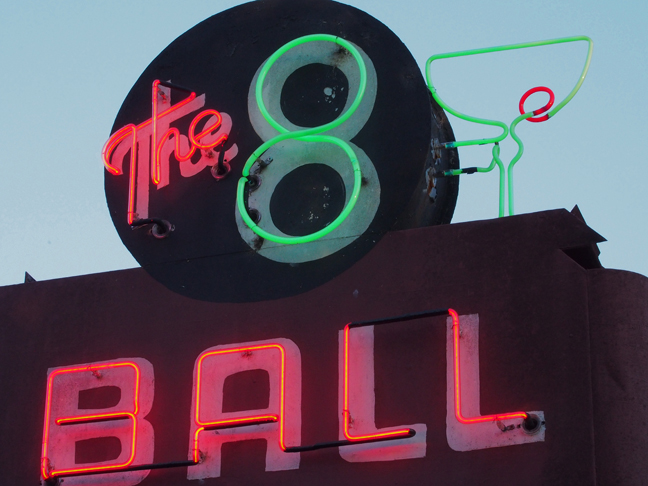
The Cocktail Glass Collection: The 8 Ball, Cotati, California
There are two or three bars in downtown Cotati. I've never been to any of them, but they keep the town center lively on weekend evenings. I noticed recently that one has a neon cocktail glass sign, so I thought I'd add it to my small but growing collection. This one has a cherry but the glass has no stirring stick or skewer. The bar is at 8 Charles St., Cotati, CA 94931.
To see others in this series of photographs, click on the "cocktail glass collection" label.
Monday, September 2, 2013
Miscellaneous: No Green Zebras
We planted about eight tomato vines this year. Two of them were supposed to be the Green Zebra variety, an heirloom that has done comparatively well in the garden before. Both plants were mislabeled, however. The tomatoes we're now getting from these vines (pictured) are definitely not Green Zebras. I don't know what they are, but they are tasty and attractive, so I can't complain. Despite cool weather, our tomatoes have done very well this year. These are the best I've grown since living in Ohio many years ago--a place where any fool can grow good backyard tomatoes. I've always believed tomatoes are harder to grow here because of our cool nights, but this season has made nonsense of that idea. More important seems to be fresh soil, a lot of good, organic fertilizer, and attentive watering, although the shallow soil in our new beds carved out of former lawn have not allowed deep watering and we've had a fair number with blossom-end rot, a condition I'd read about before but never actually seen. Interestingly, the rot, when it occurs, is very localized. It's easily cut out, leaving usable fruit behind.
Wines I'm Making: 2013 Cabernet at 20 Brix
Yesterday I got out the refractometer for the first time this year--out of curiosity; we are still several weeks from a normal harvest date--but a random berry I tested from one of our Cabernet vines was at 20 brix. I normally aim to harvest at around 24 brix. As generally it takes about a week of good weather to raise the brix level by one degree, that would suggest we're about a month from harvest. As we usually harvest in the first week of October, everything seems to be on track, despite the rather cool summer we've had. Looking at the grapes, I noticed some that were beginning to shrivel a little. I'd watered only once so far this year. Given the cool weather, I was trying to see if we could go entirely without supplemental water this year, but I decided it would be best to water once before harvest. I turned on the irrigation system for five and a half hours.
Sunday, August 25, 2013
Miscellaneous: Covering All the Bases--1955 Chevrolet Bel-Air Hood Ornament
A bright orange-red 1955 Chevrolet Bel-Air was parked not far from me in a Santa Rosa, California parking lot the other day. I walked over to take a look at it. A classic from the period when American automakers were trying to equate driving with flight (and later more specifically with rocketry), this one covers all the bases; the sleek ornament is half airplane, half bird--some kind of raptor seems to be intended.
Saturday, August 24, 2013
Wines I'm Making: 2013 Grapes--So Far, So Good
The 2013 grapes look good so far. The clusters have taken on full color by now. The grapes are netted. The electric fence around them has been on for a couple weeks now. So far, critters haven't shown much interest in them. I'm hopeful that we'll be able to harvest everything that's on the vines. Fruit set was good this year. I expect we'll get a fair amount of fruit. The 32 vines in the back yard have yielded anywhere from about 90lbs to a little over 200lbs over the years. I expect we'll be at the high end of the range this year. We probably have about six weeks to harvest now. Thursday, August 22, 2013
Found Art: Yellow Arrows, Berkeley (August 22, 2103)
Every time I go to Berkeley--which isn't really very often--I find pavement markings that I find beautiful. This arrow is virtually worn away--looking almost melancholy. It seems the echo of the newer arrow to the right that was painted over it. Found art.
For more unintended art, see my blog Serendipitous Art.
Labels:
Accidental art,
airport,
Arrow,
art is all around,
art is everywhere,
asphalt,
Berkeley,
Colin Talcroft,
ephemera,
Found Art,
pavement,
Serendipitous art,
serendipity,
Unintended art
Friday, August 16, 2013
The Cocktail Glass Collection: Willi Bird's Restaurant, Santa Rosa (August 16, 2013)
Here's another addition to my small but growing collection of cocktail glass signs on bars that I see (this is number three). The glass pictured here is on the roof of Willi Bird's Restaurant, 1150 Santa Rosa Ave, in Santa Rosa, California. This is an example of a ready-made, mass produced design that appears on many bars. The custom signs are, of course, more interesting.
To see others in this series of photographs, click on the "cocktail glass collection" label.
Tuesday, August 6, 2013
Food I'm Eating: Sushi Burritos (August 6, 2013)
Sushi Burritos? Japanese rolls meet Mexican rolls? Yes, that's about it. At Santa Rosa's farmers' market last Saturday I came across the food cart of one Takeshi Uchida, the man behind the idea. A sign advertised his mobile establishment as "The World's First Sushi Burrito Food Cart."
Essentially, Mr. Uchida creates giant versions of the seaweed rolls known in Japanese as futo-maki (literally, "fat rolls") filled with cooked stuffings--like a burrito. Three kinds are available--Tori Nanban (sweet and spicy Japanese-style fried chicken with a creamy wasabi sauce, beans, and shaved cabbage and carrots); Tara (simmered cod with wasabi tartar sauce, beans, corn, and shaved cabbage and carrots); and Vegetarian, with seaweed salad, tomatoes, shaved cabbage, romaine lettuce, Jalapeños, and cucumber. The drinks offered made me momentarily nostalgic for Japan--bottled cold green tea, ramune (a citrus-based soda), and canned iced coffee. While the idea of a sushi burrito seems a bit odd at first, a taste test quickly established that it's an idea that works. The Sushi Burrito cart is parked at various Sonoma County locations on different days. Go to http://www.shoubujapanese.com to get the latest on where to find Mr. Uchida and his unique creation, or go to the Sushi Shoubu Facebook page.
Sunday, July 28, 2013
Art I'm Making: Another Collage and Some Rethinking (July 28, 2013)
The first collage I made a couple of weeks ago began to look wrong the more I looked at it. I took it down off the wall and tried to "fix" it. I ended up completely transforming it. The original work no longer exists--which is a good thing; clearly the reworked version is much better (top photo). I've since done another one, which I'm rather pleased with (below). More is brewing in my head....
[Update: These were the first two collages I made. The first one survives. The one below here was later cut up and transformed into three smaller pieces.]
[Update: These were the first two collages I made. The first one survives. The one below here was later cut up and transformed into three smaller pieces.]
Friday, July 26, 2013
The Cocktail Glass Collection: The Distillery, Sacramento (July 26, 2013)
I visited Sacramento yesterday. Besides taking a walk around Old Sacramento (which is not devoid of interest, but mostly shops with tourist trash in them) and visiting Sutter's Fort, taking a peek at the Capital Building rotunda, and visiting the Crocker Museum of Art again, I photographed this martini glass bar sign, which belongs to a place called The Distillery (near 21st and L Streets). For some reason, I love these old-school martini glass advertising signs on bars.
To see others in this series of photographs, click on the "cocktail glass collection" label.
[Update: This was only the second example in my collection of cocktail glass bar signs, which has ended up focusing on neon signs. I've decided to leave it here because it lights up, even if it's done with incandescent bulbs rather than neon tubes.]
To see others in this series of photographs, click on the "cocktail glass collection" label.
[Update: This was only the second example in my collection of cocktail glass bar signs, which has ended up focusing on neon signs. I've decided to leave it here because it lights up, even if it's done with incandescent bulbs rather than neon tubes.]
Plants I'm Growing: Summer Bounty (July 26, 2013)
The summer of 2013 has been a good one in the garden. We had wonderful early figs and a second crop is forming. The "Santa Rosa" plum tree produced several hundred delicious fruits. There is fruit on the "Dapple Dandy" pluot tree for the first time in years, Apples and pears are on the way. The "Flavor Queen" pluot is heavily laden with fruit (above). The new vegetable garden where the lawn used to be is producing greens, and the first tomatoes are just ripening. Edamame and green beens will be ready soon. We've had summer squash and zucchini and more lemon cucumbers than we can consume. The grapes, which set a lot of fruit this year, are just beginning to show some color in the past couple of days; veraison, as the French call it, has just begun. I've finished clearing weeds and debris from under the vines. The electric fence around the grapes is working and turned on. Time to get the nets on--before the critters begin to show interest in the fruit.
Thursday, July 18, 2013
Art I'm Making: Collages (July 18, 2013)
I've never liked the feel of acrylics, but I'm beginning to see that the quality of acrylic colors has greatly improved and there is now a dizzying selection of mediums and gels and pastes and other additives available to keep things interesting. That said, I typically splash some paint around and quickly get frustrated because the acrylic colors don't leave behind the kind of brush strokes I like. The paint layer can look flat and lifeless. I've yet to figure out which gels to add to get the textures I want. Next week I plan to attend a demonstration hosted by the Sennelier company (which makes beautiful printing inks and has recently released a line of equally beautiful acrylic colors), to see what their colors are like and to get some hints. We'll see what comes of that.
I've long been attracted by the idea of printmaking using paper cutouts as the printing blocks, but never wholeheartedly pursued the idea. It's largely because I don't like the look of the shapes I cut with scissors (I'd like to be able to convert designs I make on the computer to paper cut-outs, but don't know how to do that). With the acrylic paints out, though, I splashed some on a cut-out and pressed the painted paper against another sheet, using a Japanese baren to get good contact--but that was too much and I simply glued the two sheets together. The paper tore when I tried to pull the "block" away. It turns out that I liked what was left behind, however, and the torn ochre surface I inadvertently created became the starting point for some exploration with dabbled paint and painted paper and more cutting of shapes that I then began to lay over what I'd started with, using the acrylic paints to glue layers together. After a couple of hours of absorbing fun, I came up with a composition I almost liked, but there was something disturbing about it. With my paper cutter I hacked off the offending part and, after a few more tweaks, I settled on the collage shown at the top of the page*. On the following day, I started to look at the cut-off portion and began adding to it until I got the little collage in the lower picture. I had a lot of fun making these two small works. Perhaps I've finally found a way to work with acrylics that suits me? I like that the paint dries quickly, so I don't have to interrupt my thinking while waiting for a surface to dry. I like that you can paint over things almost immediately. The layering of paint and paper gives a solid look that I've never been able to achieve just spreading acrylic paints on canvas. I'm eager to do more of these....
*Since writing this, I have completely reworked the first piece. Nothing much of it remains. The photo here is now the reworked version, completed two weeks after the initial creation.
Miscellaneous: The Martini Glass as Icon (July 18, 2013)
Interesting how the martini glass with a skewered olive or cherry remains the icon of choice for a certain kind of old-school bar. I was in Calistoga yesterday and saw this one over Susie's Bar, a place I'd never noticed before right on the main street. I liked the neon martini glass with what looks like a skewered red cherry in it.
To see others in this series of photographs, click on the "cocktail glass collection" label.
Wines I'm Making: Wine Labels (June 18, 2013)
I finally got around to designing, printing, and affixing labels to our 2012 Sangiovese Rosé and the 2011 Cabernet Sauvignon/Cabernet Franc. I created a suitably sunny label for the rosé, which normally disappears over the summer and a somewhat more sober and serious-looking label for the 2011 Cabernet wine. I will bottle the 2012 Cabernet sometime before or just after harvest this year, so, in the next couple of months. Right now, the biggest chore continues to be cleaning weeds and debris from under the vines so I can get the electric fence up and running again and get the nets on before the berries start showing enough color to interest the raccoons...
Books I'm Reading: The Crimean War by Orlando Figes (July 18, 2013)
The Crimean War--a long-ago war often referred to but one that people seem to know little about anymore. Having said something on that subject to my mother a while back, she gave me a copy of The Crimean War (Picador, 2010), by Orlando Figes, a succinct, well written account of the conflict, which seems sadly relevant today. The opening chapters dealing with the causes of the war and the war aims of the nations involved sound eerily familiar--involving much squabbling over rights of access to sacred sites in the holy lands, religious jingoism, squabbling about territorial boundaries in the Balkans, jockeying for political influence, and irredentist meddling. Figes brings to life the political background but also the horrors of the fighting, particularly during the siege of Sevastopol for both those in the bombarded city and the ill-equipped soldiers besieging the place. Much sounds depressingly familiar. Perhaps governments should have ministries of history to help avoid pointless wars that repeat the idiotic mistakes of the past. About the only good thing to have emerged from the Crimean War appears to have be an historically new concern for the well being of the common soldier. The blunders of the Crimean War led to real reform (especially in Britain) in sanitation and medical care, military organization, and recognition of merit. That Sebastopol, California, the town neighboring Santa Rosa to the west, is named after the siege is testament to the widespread impact reporting on the war had around the world. A worthwhile read.
Art I'm Looking At: Artful Animals at the Legion of Honor (July 17, 2013)
Next to the "Impressionists on the Water" show at the Legion of Honor in San Francisco is a small but engaging exhibit of works on paper depicting animals, drawn from the collection of the Achenbach Foundation for Graphic Arts. "Artful Animals, Part 2" (I wasn't aware of Part 1, but apparently there was one) includes a wide variety of works from around 1500 to the present, all taking animals as their subject.
The show is small--occupying a single room--but there is some good work here. I particularly enjoyed Whales Stranded at Ter Hyde (1577), an engraving of beached sperm whales by Flemish artist Johannes Wierix, apparently an account of an actual beaching incident; a hand-colored etching of a hedgehog by Irish artist Peter Mazell (after Peter Pailou) from a 1766 Thomas Pennant publication The British Zoology; and a Barn Owl print by Robert Havell (after Audubon; detail shown here). I didn't exactly understand the relationship between the Havell print and the well known Audubon prints from his The Birds of America (perhaps Havell printed his own edition copying some of the Audubon works?), but a striking image. Also of interest were a number of Japanese prints showing famous kabuki actors of the day depicted as fish or other animals, and I enjoyed seeing Beth Van Hoesen's droopy-eared rabbit, a very familiar image as my father had a reproduction of it, but I had never seen an actual print before. Well worth a quick look. The show runs through October 13.
Art I'm Looking At: Richard Diebenkorn at the De Young Museum in San Francisco (July 17, 2013)
After seeing the "Impressionists on the Water" show at the Legion of Honor, I went to see the Diebenkorn show now on at the DeYoung Museum—Diebenkorn: The Berkeley Years (1953-1966).
Diebenkorn has long been among my favorite abstract painters. There's something about his work that resonates with me, but I realize I knew very little about his life or about the long arc of his career before seeing this show, which helped to educate me a little. For example, I was almost completely unaware of the figurative work he did during the middle of the period covered here. Judging from the paintings included, Diebenkorn focused briefly on figurative subjects mostly between about 1956 and 1958. These works are sandwiched between earlier, purely abstract works characterized by flat patches of color (often in pinks, ochre, and other fleshy tones) and later abstract work with a greater emphasis on line. It's the earlier abstract work (roughly between 1953 to 1955) that I enjoy most. It was a real pleasure to stand in a large room surrounded by about 15 large works from the early period. Berkeley No. 3 (1953, below) is typical.
Line is not absent as an element in these earlier paintings and some of them contain abstracted letters or appear to contain fragments of text, but the emphasis is on color, and most of the colored areas in the works are loosely defined, with blurry or ragged edges. Diebenkorn is said to have been strongly influenced by the Abstract Impressionists at this stage (especially by Willem de Koonig), and I've read comments suggesting he should himself be considered an Abstract Expressionist, but these paintings seem too quiet, too contemplative to be called Abstract Expressionist. They have none of the anger or nervousness I associate with that movement. There is no deliberate, explosive splattering of paint here, no frantic, nervous brushwork. Diebenkorn instead seems to have left us with records of inner conversations about color and form. I'm not the first to note that many of the works look like landscapes. There is very often a suggested horizon line. Although these may not have been intended as actual horizons, they serve to give the paintings a solidity despite the open washes of color. There is something very reminiscent of Cezanne in these paintings. Others in the show that incorporate decorative motifs clearly show an interest in Matisse. There are even a couple of large cut-out collages in the show that borrow technique as well as style from Matisse.
The figurative paintings seem less successful to me. It may simply be a matter of taste, but they don't speak to me the way the abstract paintings do. That said, it was interesting to see Diebenkorn's foray into an area of painting that was quite unfashionable at the time—a time when American abstraction was at the center of the Western art world. Perhaps it was conscious rebellion. Perhaps it felt too easy to paint the abstractions. I don't mean to suggest that abstraction is in any way easier than figurative art. In fact, I believe quite the contrary. The figurative artist at least has his subject in front of him as a point of reference. Painting in the abstract requires the subject itself to be conjured up out of thin air, although much that passes for abstract art is, in fact, referential. I mean simply that I think artists sometimes become suspicious of their own motives and the value of their work when they produce a great deal quickly, and Diebenkorn was certainly prolific during his early years in Berkeley. Perhaps he felt the need to step away from what he was doing so successfully at the time. It was during his first couple of years in Berkeley that he appears to have quite suddenly attracted a great deal of attention from the media. Coffee (1959) is typical of the figurative paintings. It's among those I like best, but the figurative work seems somehow less authentic, less the result of committed interest, the color less inspired—certainly less sensual. Still, it was very useful to see the many works from this period included in the show.
After the flirtation with making large figurative paintings, the return to abstraction is marked by a somewhat more rigid, geometrical quality. Line becomes a much more central element. The paintings are almost cartographic. They look like aerial photographs of agricultural land broken up by the occasional line of trees along a river. They are less fluid than the earlier work. The last third of the show is mostly paintings in this more linear style, but interspersed throughout the show are figure drawings that Diebenkorn continued to make regardless of where his painting was going. Eventually the growing emphasis on line blossomed into the even more linear, straight-edged paintings with Ocean Park titles such as the one pictured here, which is in the De Young's permanent collection--Ocean Park 119 (1979).
I've never before seen so many of Diebenkorn's works collected together. It's not often that I immediately want to go back again to see a show I've just walked through, but I hope to visit the Diebenkorn show once more before it leaves the DeYoung. Well worth a visit—or two. There is much to see here. The show runs through September 29.
Diebenkorn has long been among my favorite abstract painters. There's something about his work that resonates with me, but I realize I knew very little about his life or about the long arc of his career before seeing this show, which helped to educate me a little. For example, I was almost completely unaware of the figurative work he did during the middle of the period covered here. Judging from the paintings included, Diebenkorn focused briefly on figurative subjects mostly between about 1956 and 1958. These works are sandwiched between earlier, purely abstract works characterized by flat patches of color (often in pinks, ochre, and other fleshy tones) and later abstract work with a greater emphasis on line. It's the earlier abstract work (roughly between 1953 to 1955) that I enjoy most. It was a real pleasure to stand in a large room surrounded by about 15 large works from the early period. Berkeley No. 3 (1953, below) is typical.
The figurative paintings seem less successful to me. It may simply be a matter of taste, but they don't speak to me the way the abstract paintings do. That said, it was interesting to see Diebenkorn's foray into an area of painting that was quite unfashionable at the time—a time when American abstraction was at the center of the Western art world. Perhaps it was conscious rebellion. Perhaps it felt too easy to paint the abstractions. I don't mean to suggest that abstraction is in any way easier than figurative art. In fact, I believe quite the contrary. The figurative artist at least has his subject in front of him as a point of reference. Painting in the abstract requires the subject itself to be conjured up out of thin air, although much that passes for abstract art is, in fact, referential. I mean simply that I think artists sometimes become suspicious of their own motives and the value of their work when they produce a great deal quickly, and Diebenkorn was certainly prolific during his early years in Berkeley. Perhaps he felt the need to step away from what he was doing so successfully at the time. It was during his first couple of years in Berkeley that he appears to have quite suddenly attracted a great deal of attention from the media. Coffee (1959) is typical of the figurative paintings. It's among those I like best, but the figurative work seems somehow less authentic, less the result of committed interest, the color less inspired—certainly less sensual. Still, it was very useful to see the many works from this period included in the show.
After the flirtation with making large figurative paintings, the return to abstraction is marked by a somewhat more rigid, geometrical quality. Line becomes a much more central element. The paintings are almost cartographic. They look like aerial photographs of agricultural land broken up by the occasional line of trees along a river. They are less fluid than the earlier work. The last third of the show is mostly paintings in this more linear style, but interspersed throughout the show are figure drawings that Diebenkorn continued to make regardless of where his painting was going. Eventually the growing emphasis on line blossomed into the even more linear, straight-edged paintings with Ocean Park titles such as the one pictured here, which is in the De Young's permanent collection--Ocean Park 119 (1979).
I've never before seen so many of Diebenkorn's works collected together. It's not often that I immediately want to go back again to see a show I've just walked through, but I hope to visit the Diebenkorn show once more before it leaves the DeYoung. Well worth a visit—or two. There is much to see here. The show runs through September 29.
Wednesday, July 17, 2013
Art I'm Looking At: Impressionists on the Water at the Legion of Honor (July 17, 2013)
A small but worthwhile show of mostly Impressionist works is now underway at the Legion of Honor in San Francisco. "Impressionists on the Water" looks at boats and boating in the works of the Impressionists, some of whom were enthusiastic boaters. One, the ever-interesting Gustave Caillebotte, I was surprised to learn, even designed yachts--apparently a couple dozen of them. Among the highlights of the show are a hull model carved by Caillebotte himself, a beautifully built wooden kayak-like boat, and the equally exquisite scull displayed at the entrance to the show (above). These little boats are art in themselves.
The show begins with a few examples of "traditional French maritime painting" before moving on to a body of Impressionist works interspersed with others probably not properly given that label, but the works are united by boating and waterways as a theme. Annoyingly, photography was allowed only in the entrance foyer, which makes it impossible to illustrate much here, but among the most interesting works were a pair of albumen silver prints (1856 and 1857) of boats by Gustave Le Gray from the collection of the Getty Museum; The Village of Gloton (1857) by Charles-Francois Daubigny; Storm Over Antwerp (1872) by Eugene Boudin with a wonderful glowering cloud and red pennants stretched and fluttering in the wind; an 1874 oil sketch of Monet's studio boat (apparently a number of artists had small studios built onto boats so that the could work directly on the water); View of the Right Bank of the Seine (1880), by Jean-Francois Raffaelli, showing an industrial landscape along the river; prints from the Rutgers University collection by Henri Riviere, including one from a very Japanese-influenced series of 26 views of the Eiffel Tower; a Signac view of the lighthouse (now a church) at the port of Colliure; and a rather surreal-looking Edoard Vuillard painting of a man in a rowboat, known as The Boatman or The Oarsman (1897), striking for the row of orange-yellow poplars and their reflections in the background, rather photographic cropping, and the way the line of the horizon is made to almost pierce the rower's face. Several early paintings in the show by Monet were interesting as examples of his work before he had settled into a mature style. Worth a visit. The show runs through October 13.
Wednesday, July 10, 2013
Wines I'm Making: Wine Chores (July 10, 2013)
In the past couple of days, I've made some progress toward finishing various wine chores I've been putting off. Following the odd rain we had at the end of June, it was important to spray the vines with sulfur again to prevent mildew. That I achieved a few days after the rain. So far, everything looks good--no signs of the mildew and the vines set a lot of fruit this year.
I racked the 2012 Cabernet that's been resting and topped up the containers with a bottle of our 2011 wine. Judging from the tastes I got while siphoning, the 2012 looks very promising. The 2011 was a bit light, but the 2012 seems to have real depth. I look forward to tasting it again after it's bottled. I'll probably bottle it around harvest time, or sometime in late October.
I finally bottled the "second-run" wine I made a while back from the pressed skins of the 2010 grapes. I've neglected this experiment--and for good reason. The wine was never very attractive. Making wine from pressed skins works. That much I learned, but the wine it makes is dull and lifeless. Having let this go so long, it has acquired an added oxidized component. It's in gallon jugs now and out of the way, but it's probably destined for the drain.
The most important chore remaining for this year is getting the nets straightened out and on the vines before this year's crop of grapes begins to show color, which should be in about a month. The nets are off the vines but tangled and full of dead weeds. I need to stretch them out, check them for damage, clean around the vines, and then get the nets back in place sooner rather than later. It's my goal for the day.
I racked the 2012 Cabernet that's been resting and topped up the containers with a bottle of our 2011 wine. Judging from the tastes I got while siphoning, the 2012 looks very promising. The 2011 was a bit light, but the 2012 seems to have real depth. I look forward to tasting it again after it's bottled. I'll probably bottle it around harvest time, or sometime in late October.
I finally bottled the "second-run" wine I made a while back from the pressed skins of the 2010 grapes. I've neglected this experiment--and for good reason. The wine was never very attractive. Making wine from pressed skins works. That much I learned, but the wine it makes is dull and lifeless. Having let this go so long, it has acquired an added oxidized component. It's in gallon jugs now and out of the way, but it's probably destined for the drain.
The most important chore remaining for this year is getting the nets straightened out and on the vines before this year's crop of grapes begins to show color, which should be in about a month. The nets are off the vines but tangled and full of dead weeds. I need to stretch them out, check them for damage, clean around the vines, and then get the nets back in place sooner rather than later. It's my goal for the day.
Food I'm Eating: El Molino Central--a Mexican gem (July 10, 2013)
On a fairly random drive to Sonoma the other day, I found myself hungry just as I was passing El Molino Central, on Highway 12, heading south and east toward Sonoma from Santa Rosa (11 Central Avenue, Sonoma, 95476, (707) 939-1010).
I'm sure the place has been there for years, but I've never been inspired to stop before. What was different this time? I don't know. Perhaps it was the 4th of July bunting, the recently repainted building, or the outdoor patio area with new umbrellas. Mostly, however, I think it was the large number of people in the outdoor dining area. I figured there had to be a reason. I happened to see a convenient parking spot, so I pulled over for lunch. I'm glad I did.
The long line at the counter and the appetizing descriptions of the food on the menu board were both good signs. This place appears to serve truly authentic Mexican fare with an emphasis on fresh ingredients. I had a delicious pair of Swiss chard enchiladas. The man next to me on the patio let me taste the mole sauce on his tamales--complex and with rich chocolate flavor, but not too sweet--and spicy enough to make you sit up and notice. Next time, I look forward to trying the beer-battered fish tacos or the chile relleno de elote con crema (poblano chiles stuffed with corn cream and cheese, with cherry tomato salsa, refried beans and tortillas), or the salmon ceviche with avocado. The tortillas at El Molino Central are made from organic Nebraska-grown corn, stone ground daily on the premises. According to the restaurant's website, the public is welcome to come watch the grinding "any morning around 11:00AM." A real find. I'll be back.
I'm sure the place has been there for years, but I've never been inspired to stop before. What was different this time? I don't know. Perhaps it was the 4th of July bunting, the recently repainted building, or the outdoor patio area with new umbrellas. Mostly, however, I think it was the large number of people in the outdoor dining area. I figured there had to be a reason. I happened to see a convenient parking spot, so I pulled over for lunch. I'm glad I did.
The long line at the counter and the appetizing descriptions of the food on the menu board were both good signs. This place appears to serve truly authentic Mexican fare with an emphasis on fresh ingredients. I had a delicious pair of Swiss chard enchiladas. The man next to me on the patio let me taste the mole sauce on his tamales--complex and with rich chocolate flavor, but not too sweet--and spicy enough to make you sit up and notice. Next time, I look forward to trying the beer-battered fish tacos or the chile relleno de elote con crema (poblano chiles stuffed with corn cream and cheese, with cherry tomato salsa, refried beans and tortillas), or the salmon ceviche with avocado. The tortillas at El Molino Central are made from organic Nebraska-grown corn, stone ground daily on the premises. According to the restaurant's website, the public is welcome to come watch the grinding "any morning around 11:00AM." A real find. I'll be back.
Tuesday, July 9, 2013
Found Art: Metal Box, Sonoma (July 9, 2013)
A metal box on a pole set in the sidewalk along Sonoma Plaza, in the town of Sonoma. Repeatedly painted. Plastered with stickers. Stickers removed. More paint. Found art.
For more found art, see my blog Serendipitous Art.
Sunday, June 30, 2013
Plants I'm Growing: Early Figs (June 30, 2013)
In the back yard, we have a fig tree, a variety called "Black Jack," which has dark figs rather like mission figs, but bigger. I chose this one because the tree stays small. It's been in the ground about seven years now, but it remains small enough that I can harvest the figs mostly without the use of a ladder. Normally, a few figs form in the spring. they usually stay small, shrivel and never ripen. The main crop comes late in the summer--usually sometime in August. For some reason, we've had viable early figs this year--not a lot (so far about ten)--but good-sized fruit that has ripened beautifully. I had six for breakfast this morning, doused with yogurt and honey. Fruit has set well this year on all the fruit trees, actually. We have pluots on the "Dapple Dandy" tree for the first time in many years. The "Flavor Queen" tree is groaning under the weight of all the fruit on it. About 200 Santa Rosa plums sit in the kitchen. I'm making jam from the bruised ones. We have apples and pears on the way, too. Perhaps it was because we had little rain while the trees were flowering this year? The grape vines have set a lot of fruit as well.
Wednesday, June 26, 2013
Rain: A Storm in Late June (June 26, 2013)
Rain of any kind is unusual here in June. To have a real two-day rain at the end of June is extraordinary--and welcome. In the past two days, we've had an additional 1.65 inches of rain, which brings our total for the 2012-2013 rain year to 27.25 inches. That's still well below normal (annual precipitation in Santa Rosa is usually a little over 36 inches), but every little bit helps, and a significant rain this late will do a lot to keep things going until we can expect the rainy season to begin again, usually in October. The downside is that heat expected in the next few days will create steamy conditions perfect for mold formation on the grapes in the back yard. My first job will be to spray the grapevines with sulfur again, as soon as it clears. This morning, the rain has stopped, but it's still misty and overcast.
Places I'm Visiting: San Francisco International Airport (June 24, 2013)
San Francisco International Airport is about an hour and a half from home. I drove there on the 24th to drop off family heading for Japan. It's a fairly long haul, but I always enjoy a visit. There's always something to see. I took the time to visit both the domestic and international terminals. In an obscure underground corridor connecting the parking garage to some of the domestic baggage claim areas I came upon a display of remarkable aircraft models by Edward Chavez, who appears to have had a long career as a builder of models. According to an information panel on the wall, he served as a B-24 gunner during WWII and was later commissioned by the military reserve to build aircraft recognition models from around 1947. He later began making models for pleasure, but soon began receiving commissions from private aircraft owners and he later made models for the Piper Aircraft Company. Some of his models are in the National Air and Space Museum. Many were displayed for years at the Nut Tree Restaurant and Airfield, for which Chavez built 27 models in as many years (between 1961 and 1988). In 1997, the SFO museums acquired most of the Nut Tree collection of models. It was a privilege to see some of them. Pictured is a Granville Model R-1 Super Sportster model (1:10 scale) made by Chavez and Robert Fogg.
Elsewhere in the terminals I found a display of airline cabin bags that included some very early ones from the 1930s, although there were examples from around the world and all periods. In the International Terminal, there was a large exhibit of Shaker furniture entitled "Inspired Design: Shaker Furniture from the Benjamin Rose Collection" (photo below) and another set of display cases showed a collection of travel souvenirs--everything from Honolulu matchbooks to miniature Eiffel Towers. One case was entirely souvenirs from World's Fairs of the 20th century. There was a small show of photographs by Russell Lee, mostly made for the Farm Security Administration in the late 1930s. Lee worked on a team of photographers documenting farm conditions during the depression. The team included Roy Stryker, Gordon Parks, Mary Post Wolcott, Walker Evans, Dorothea Lange, and Esther Bubley.
In the airport's aviation museum was a show high-lighting the Douglas DC-3 and another chronicling the history of United Airlines flight attendant uniforms, some of which I remember. There was also a collection of color photographs by Alfred T. Palmer showing women at work in WWII aircraft factories. These rotating shows are always in addition to the permanent displays that relate to Pan Am's Clipper service of the 1930s. There's always something of interest to see at San Francisco International Airport--and, looking at the SFO Museum website, I see that there was much more that I missed....
Elsewhere in the terminals I found a display of airline cabin bags that included some very early ones from the 1930s, although there were examples from around the world and all periods. In the International Terminal, there was a large exhibit of Shaker furniture entitled "Inspired Design: Shaker Furniture from the Benjamin Rose Collection" (photo below) and another set of display cases showed a collection of travel souvenirs--everything from Honolulu matchbooks to miniature Eiffel Towers. One case was entirely souvenirs from World's Fairs of the 20th century. There was a small show of photographs by Russell Lee, mostly made for the Farm Security Administration in the late 1930s. Lee worked on a team of photographers documenting farm conditions during the depression. The team included Roy Stryker, Gordon Parks, Mary Post Wolcott, Walker Evans, Dorothea Lange, and Esther Bubley.
In the airport's aviation museum was a show high-lighting the Douglas DC-3 and another chronicling the history of United Airlines flight attendant uniforms, some of which I remember. There was also a collection of color photographs by Alfred T. Palmer showing women at work in WWII aircraft factories. These rotating shows are always in addition to the permanent displays that relate to Pan Am's Clipper service of the 1930s. There's always something of interest to see at San Francisco International Airport--and, looking at the SFO Museum website, I see that there was much more that I missed....
Subscribe to:
Posts (Atom)


+smallcmt.jpg)