Tuesday, September 20, 2011

Wines I'm Making: Grapes Coming Along Nicely (2011)

Having recently added nets and raised the level of the electric fence around our grape vines, it's now been about a week without any further damage or losses to the raccoons or possums or whatever it is that eats them at night.

It's the time of year that grape growers sit back and wait, periodically checking sugar and acid levels, looking also at the visible signs of ripeness in their grapes. This morning and yesterday I tested a couple of berries for ripeness. I was a little surprised to find the Sangiovese at 19 brix, the Cabernet Sauvignon already at 20.5 brix. The berries are deeply colored. The Cabernet seeds are uniformly brown and they are crunchy. In other words, the Cabernet fruit is looking rather more ripe than I was expecting. I think it will still be two to three weeks to harvest (I try to pick at about 24.5 brix), but the grapes appear to be coming along nicely, aided by uniformly warm weather in the past week or so. The forecast is for temperatures into the low 90s for the coming week, which should keep sugar levels rising.

Sunday, September 18, 2011

Books I'm Reading: The Art Instinct

I just finished Denis Dutton's The Art Instinct (Bloomsbury Press, 2009), a book I picked up remaindered somewhere just because it looked interesting--and it was.

Dutton looks at art, beauty, and pleasure from an evolutionary perspective. That simple sentence would be enough to set off alarms in some quarters--notably among feminists, always wary (and probably rightly so) of anything that might suggest cultural (often male-dominated) norms are somehow determined by evolution (and therefore unassailable) or that mainstream pop-culture ideas about beauty are innate and therefore inevitable. However, Dutton is not a polemicist and he's mostly not making claims about what specifically is and is not beautiful. He is talking more about broad tendencies that go across cultural boundaries. He is less concerned with particular instances of preferences in beauty and art than in arguing that we do, in fact, have preferences, that they appear to be nearly universal, and that the existence of preferences has been adaptive in an evolutionary sense. I think feminists would have relatively little to take offense at here, although I'm willing to admit that, being a man, I may be insufficiently sensitive.

Acknowledging that evolutionary psychology can be rather too easily used to justify existing cultural constructs, I think Dutton has much useful and interesting to say about both people and art. He starts by asking one of many interesting questions: Why should discussions of art be excluded from examination from a Darwinian perspective when so many other fields have advanced through just such a view? As Dutton puts it, "The evolution of Homo sapiens in the last million years is not just a history of how we came to have acute color vision, a taste for sweets, and an upright gait. It is also a story of how we became a species obsessed with creating artistic experiences with which to amuse, shock, titillate, and enrapture ourselves, from children's games to the quartets of Beethoven, from firelit caves to the continuous worldwide glow of television screens." In fact, he argues against the view that feminists seem to fear. Defining art quite broadly to include a wide array of images and creative endeavors (for example, calendar photos), not only what we call "fine arts," he suggests, for example, that tastes in landscapes "are not just products of social conditioning, stemming from manipulative choices made by calendar manufacturers (or by landscape artists); rather people who make and sell calendars are catering to prehistoric tastes shared by their customers across the globe." As the title of the book suggests, the main point Dutton makes is that the need to create art is potent and universal--we instinctively create art--and, to understand that, we must assume that the presence of an art instinct has been an adaptive advantage.

There isn't room in a short review to cover all the arguments in the book, but I applaud the author for attempting to define art--a daunting task--even if I don't agree entirely with the criteria he chooses (for example, his list of traits common to what we call art would seem to slight abstract art and to exclude art created by atheists). The chapter on fiction--storytelling--was especially thought-provoking, and I enjoyed the sections that dealt with artistic intention (does the artist's intent have a legitimate bearing on how we evaluate a work of art?), with notions of originality in art (why do we treat forgeries and originals differently?), with the difference between an art and a craft, and with kitsch. For Dutton, these questions are important because they shed light on aspects of the adaptive advantages of an art instinct. This is the sort of book that's hard to digest on first reading. I suspect I'll read it again. Recommended.

Music I'm Listening To: Yo-Yo Ma with MTT Conducting the San Francisco Symphony (September 15, 2011)

Thursday night [September 15] I attended a performance of the San Francisco Symphony, Michael Tilson Thomas conducting. Yo-Yo Ma was guest soloist in Hindemith's Cello Concerto of 1940. The concert opened with Beethoven's Lenore Overture No. 3 and closed, after intermission, with a performance of the Symphony No. 1, by Brahms.

The last time I heard Yo-Yo Ma was in Tokyo, about 15 years ago, at a sold-out concert for which I was unable to get good tickets. Many of the seats had been bought up by corporations and given away to clients--people that didn't really have much interest in being there except to see a musical celebrity (that's my theory anyway). Whatever the reason, the concert was marred by a very noisy, inattentive audience and by my distance from the stage. Thursday was a rather different experience: I got the impression the crowd was there for the music and not the star status of the soloist (although a few people left at intermission). Perhaps it helped that the concert was being taped--before the performance began a man came out on stage and asked everyone to be as quiet as possible so as not to mar the recording. Also, last night I was sitting close to the performers.

I'm used to sitting at the back of the first floor at Davies Symphony Hall, but having noticed a dead spot just under the overhang of the balcony, I had the seats changed this season to the fourth row. I like being able to see the instruments at close range--stringed instruments come in a fascinating variety of colors, ranging from deep chestnut brown through various reddish tones and into almost blonde shades. I like being able to watch fingers flying up and down the fingerboards of the cellos and I like feeling the low-frequency vibrations of the string basses. Close seats allow a good view of the soloist (although on Thursday night the conductor blocked my view as often as not). On the down side, the sound can lack integration. Sitting at the right side of the hall (facing the stage), I got rather too much of the basses and the cellos while the violins and other sections of the orchestra seemed slightly distant. As the closer seats are also lower seats, you don't get a full view of the players when sitting close; I missed being able to see all of the orchestra in action, and it was difficult to see which musicians the conductor was acknowledging after each piece. So, the up-front location has both advantages and disadvantages.

Watching Mr. Ma play reminded me of seeing Rostropovich play in Tokyo in the late 1990s and, for what are probably less obvious reasons, of watching violinist Hilary Hahn in San Francisco a couple of years ago. Rostropovich was well into his seventies when I saw him, but he had a focus, intensity, and sheer energy that would have been remarkable in a man half his age. Mr. Ma has the same sort of presence, the same sort of focus and intensity while playing.Both men (and Hahn) simultaneously exude a relaxed self-assuredness and an inner joyfulness that seems perpetually in danger of brimming over. After the Hindemith Mr. Ma spent as much time applauding for the orchestra with a grin of pleasure as he did acknowledging the applause meant for him. He assumes a rather more slouched posture than many cellists when playing, which adds to his general air of easy-going confidence. During passages in the Hindemith concerto when the cello rests, Mr. Ma frequently turned half around to look at the orchestra with a broad smile on his face. Ms. Hahn did something similar during the performance of the Tchaikovsky's Violin Concerto I attended. In both cases, you could almost hear an inner voice saying "What fun this is--how lucky I am to be here!" The best performers at their best always seem to be having a great deal of fun, no matter how serious the music. I've seen it in performances by the New Century Chamber Orchestra, by Kyung-Wha Chung, by Elly Ameling, by conductors such as James Gaffigan and Gustavo Dudamel. It's infectious.

The performance of the Beethoven overture seemed correct but lacking in sparkle. I enjoyed hearing the Brahms Symphony No. 1 live for the first time--in places, the unison of the string sections was thrilling, concertmaster Alexander Barantschik played the solo violin sections near the end of the piece especially sweetly--but MTTs reading seemed uneven in the final movement, where the tempo was allowed to wander in a way that broke the tension written into the music--or so it seemed to me. I wonder why such familiar standards as the Beethoven and Brahms pieces were chosen to bracket the very mid-20th century Hindemith concerto (which turned out to be the highlight of the evening)? Despite a little confusion when Mr. Ma's music misbehaved (at one point MTT was crouched down, conducting with one hand, while reaching back with his other hand, trying to hold the pages open for the soloist), the orchestra was tight, focused, and electrifyingly precise. It's unusual to be able to single out a tympanist, but the man behind the copper pots was amazing on Thursday night--shooting out bullets of sound that punctuated some of the more exuberant passages with a superb combination of power and precision. The woodwinds were in top form as well (especially the oboe and flute), but that's normal in San Francisco. I'm familiar with some of the less well known modern cello concertos--those by Dutilleux and Lutoslawski, in particular--but the Hindemith was unfamiliar to me. I enjoyed it enough to think I'd like to hear it again. I wonder who has recorded it?

Photo of Yo-Yo Ma by Michael O'Neill, courtesy of the San Francisco Symphony

Thursday, September 15, 2011

Found Art: Shadows and Light (September 15, 2011)

At a gallery not long ago, I saw this pattern of shadows and light on the floor. It was more interesting than the work hanging on the walls--but, art is where you find it.

For more found art, see my blog Serendipitous Art.

Sunday, September 11, 2011

Wines I'm Making: Racked 2010 Cabernet Sauvignon (September 11, 2011)

Today I racked 11 gallons of wine--mostly the eight gallons of our 2010 Cabernet Sauvignon. Everything went smoothly. I sulfited the wine lightly, using six Campden tablets in the eight gallons, which should mean a sulfur level of about 49ppm. I also racked three gallons of "second-run" Cabernet--wine made from the lees of the real wine. I got a chance to taste both wines for the first time in about six months. I'm very pleased. Everything looks, smells, and tastes good. Even the faux wine is acceptable (this method of re-fermenting the lees seems to work better with red wine than it does with rosé).

I'll be bottling this wine in the next few weeks, ahead of harvesting the 2011 grapes. I tested a random Cabernet grape today and was surprised to find it at 18 brix already. I'm aiming for 24.5. If the weather remains good, that means we should be harvesting in about the third week of October. With the electric fence on and the nets secured, I'm hoping we'll get there with no further losses to animals.

Wines I'm Drinking: Three Inexpensive Pinot Noirs

They say you get what you pay for. While that's certainly not always true in the case of wine, it seems to be most nearly true when it comes to Pinot Noir. It really is hard to find good, inexpensive Pinot Noir, but that doesn't keep me from trying. Yesterday I sampled three inexpensive Pinots from my local Grocery Outlet, two from New Zealand and one from Germany. I was especially interested in the German wine as Pinot Noir is not much grown there.

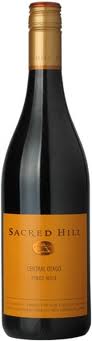
I tasted the 2008 New Harbor Vineyards Marlborough Pinot Noir, the 2008 Sacred Hill Central Otago Pinot Noir, and the F. W. Langguth "Black Slate" Pinot Noir. I couldn't find a vintage on the German wine, which may mean that it involves a blend of grapes from different years or simply that it's poorly labeled. The wine is from the Rheinhessen and only 90% Pinot Noir (something I failed to notice when I bought the wine). It is 10% Regent--a grape variety I had never heard of, and one that goes without mention in Jancis Robinson's Vines, Grapes and Wines (Mitchell Beazley, 1986)--the first time I've not been able to find grape information in that book--but Regent appears to be a newcomer. According to the Wikipedia article on the variety, Regent is a hybrid created in the late 1960s at the Geilweilerhof Institute for Grape Breeding. According to the Institute's website, Regent is a cross between Diana (itself Silvaner x Müller-Thurgau) and Chambourcin). Appreciated in large part for its resistance to fungal diseases, it appears to have entered general cultivation in the mid-1990s. Regent is planted mostly in Germany and the UK. It seems to make decent single-variety wine in some parts of Germany, but I don't understand exactly what it was intended to add to this blend--perhaps color, as several German web pages I looked at emphasize the good color Regent achieves, and many winemakers seem to think their Pinot Noir won't sell if it's too pale in color. In California, a little Syrah is often added to Pinot Noir to boost the color--and often to the detriment of the distinctive Pinot Noir flavor. Brief tasting notes follow.

2008 New Harbor Vineyards Marlborough Pinot Noir
A fairly typical, pale, Pinot Noir sort of color. Closed nose, but hints of leather, orange water, and red raspberries. There was a suggestion of cloves as well. Moderate acid on the palate. Light tannins. Not badly balanced, but rather simple. Moderate to good length. Doesn't really evolve in any way on the palate. Perfectly acceptable everyday wine--I've had much, much worse cheap Pinot Noir--but this offers no special attraction either. Reasonably priced at $4.99, but I won't be going back for more. That said, this was the best of the three wines I tasted.

2008 Sacred Hill Central Otago Pinot Noir
Pale, slightly garnet-tinged, typical Pinot Noir color. Slightly deeper in color than the above wine. Citrus and leather on the nose. Initially appealing on the palate but quickly begins to seem too sweet. Smooth--rather too smooth. There is little acid to balance the sweetness and very little tannin either. Very long finish, but a finish without nuance--just a lingering nondescript fruity sweetness. Flavors tend toward cherries. Not unpleasant. Essentially, just boring. Priced at $5.99 a bottle.

F. W. Langguth "Black Slate" Rheinhessen Pinot Noir
A pale tea color--red tending toward brown. Some floral notes on the nose. Marmalade. Bubble gum. On the palate gives an initial impression of sweetness with fairly low acid. Shortish on the finish but with some lingering sweetness with vaguely port-like flavors. Not really recognizable as Pinot Noir. Has some odd flavors that suggest plastic--although the wine is not as bad as that may make it sound. Drinkable, but not very attractive or interesting--beyond the interest provided by an opportunity to experience Regent (see above). That said, I'd prefer to try a 100% Regent wine for that purpose. Priced at $3.99 a bottle.


I have no financial connection with any producer or retailer of wine. 

For more wine reviews, use the Wines I'm Drinking label.

Books I'm Reading: The Complete Cartoons of the New Yorker

I've wanted The Complete Cartoons of the New Yorker (Black Dog & Leventhal Publishers, Inc., 2004) since it appeared, but never got over the hurdle of the $60.00 price tag (although the book is doubtless worth that much). With the collapse of Borders, I was able to pick up a copy cheaply at that company's going-out-of-business-sale. I read the book in virtually one sitting--all 655 pages of it (although there isn't a lot of text). Like so many other people, I love the wry, somewhat surreal feel of so many of the cartoons that appear in The New Yorker, even if I get to see them only occasionally. Now I own them all.

The cartoons are presented by decade, from the magazine's start in 1925, each section preceded by an essay about the cartoons of the era. In addition to introductory information about the magazine and the cartoons, there are short essays about individual cartoonists important in the magazine's history--Arno, Thurber, Addams, Stein, Steinberg, Booth, Ziegler, Chast--and essays about some of the themes recurring in the cartoons over the years, such as drinking, nudity, television, the space program, business culture, slipper dogs, politics, and the Internet.

I say smugly that I finished the book in short order, but I initially misunderstood the meaning of the note on the cover saying the book "includes two CDs with all 68,647 cartoons ever published in the magazine." I thought that meant the cartoons were also on the disks, as a convenience. I failed to think about the sheer volume of work here. As one of the introductory pieces in the book points out, printing all 68,647 cartoons on paper would require an impossibly fat book (or multiple volumes)--nearly 23,000 pages--even putting three cartoons on a page. The printed portion of The Complete Cartoons of The New Yorker presents only about 3,000 selected cartoons. The bulk of the material is on the two CDs, and I haven't even freed the disks from their packaging yet. While my mouth waters at the thought of the hours of entertainment latent there, I'm afraid to start looking at the disks, knowing it will be hard to stop. I'll want to read and enjoy every one of the remaining 65,000-odd cartoons without a break. I'll miss meals, neglect family, work will suffer....

Recommended at just about any price. 

Thursday, September 8, 2011

Wines I'm Making: The Critters Are at it again (September 8, 2011)

I had hoped this year to completely foil the critters (probably raccoons--although I've never been able to catch anyone in the act), but I looked at the grapes this morning and found about 25 clusters of Sangiovese mostly stripped of grapes and the Cabernet disturbed in a few places as well. It's so discouraging.....

That said, it's my own fault. While I netted the grapes a couple of weeks ago, I hadn't finished completely securing all the possible entry points, particularly at the top of the vines, and I hadn't yet turned on the electric fence. Needless to say, I'll be doing both today, securing things (I hope) before nightfall.

I checked some of the fallen grapes with my refractometer. They tested between 15.5 and 17 brix. I aim to harvest at about 24.5 brix, so we still have about a month to go, I'm guessing, but the grapes are (obviously) already ripe enough to attract animals. Past experience has taught me that about 14 brix is sweet enough for a raccoon to find a grape attractive.

Looking back at old posts about the ongoing fight with the various animals that want my grapes as much as I do, I see that I've put the nets on as early as August 12th in the past. I think I need a new rule--ALWAYS get the electric fence on and the nets secure (including the top nets that cover the seam in the nets that run lengthwise along the rows) by August 1. That way (one hopes) all access is denied long before the animals have any reason to pay attention to the fruit. I'll try it next year. The problem with winemaking is that you do it all only once a year. It's easy to forget from year to year what works and what doesn't.

Monday, September 5, 2011

Wines I'm Drinking: 2007 Wellington Vineyards Sonoma Valley Grenache

Another beautiful wine from Wellington. Today I opened my last bottle of the 2007 Wellington Vineyards Sonoma Valley Grenache. It was tasty when new but it's even more delicious now, having gained a certain gravitas it lacked when younger. Brief tasting notes follow.

The wine is a deep purple-red, but beginning to show a little age. It doesn't look like an old wine, but it no longer has the inky, bright purple hue of youth either. Redolent of licorice and roasted meat on the nose (somehow pork spareribs came to mind) with hints of black cherries and other dark fruits. Nicely poised on the palate. The wine is silky and soft, but remains vibrant, with good tannins and a lively acidity followed by a core of sweet, black cherry fruit interlaced with licorice and meaty flavors. The long, delicate finish is characterized mostly by the slightly bitter licorice flavors, but these are embraced in the arms of the sweet black cherry in an extended, balanced dance. Delicious. Forgive me for repeating myself, but Wellington is one of my favorite wine producers in Sonoma County. I love this winery for its dedication to quality and its ongoing willingness to price its wines reasonably--for the sort of people (like me) that drink wine everyday. Affordable bliss.

I have no financial connection with any producer or retailer of wine. 

For more wine reviews, use the Wines I'm Drinking label.

Friday, September 2, 2011

Found Art: Water Access Cover and Paint Mark (September 2, 2011)

A water access cover with a stray paint mark nearby that somehow creates a tension transforming this little scene into art. The colored paint on the metal lid is part of its charm--not to mention the cracks and seams in the cement.... Found art.

For more found art, see my blog Serendipitous Art.

Monday, August 29, 2011

Birds I'm Watching: Hermit Warbler at Bodega Bay

I drove out to Bodega Bay today on the spur of the moment, having heard that a couple of Hermit Warblers were present at Owl Canyon. I arrived in time to see one briefly before it flitted off (a first-fall female, I believe, because of the lack of black at the throat). This was my first sighting of this species. I got one decent shot before the bird left (above). A pair of American Redstarts was also reported at the same location, but I failed to see them--which is too bad, as that would have been two life birds in one day. I may run out there again tomorrow to try again. Other birds of note were a Peregrine Falcon flying by, a group of Wild Turkeys on the hill behind the canyon, and a Willow Flycatcher (I'm pretty sure).

 For more information about bird watching in Sonoma County, see my Website Sonoma County Bird Watching Spots.

Sunday, August 28, 2011

Art I'm Looking At: Seiko Tachibana at The Ren Brown Collection, Bodega Bay

A new show featuring printmaker Seiko Tachibana opened yesterday at The Ren Brown Collection, 1781 Highway 1, in Bodega Bay (Wednesday through Sunday 10-5). The Ren Brown  Collection, established in 1989, is one of the North Bay's best galleries. It features contemporary Japanese as well as local printmakers and offers work by well known local potters such as John Chambers. The gallery sells Japanese antiques, modern sculpture, and fine jewelry as well. Sophisticated stuff. As Mr. Brown puts it "Just because we're in Bodega Bay doesn't mean we have to sell seagulls on driftwood." The Seiko Tachibana  show continues through October 9, 2011, allowing plenty of time to plan a trip.

Tachibana was born in Japan but has long worked in the Bay Area, having completed a Master of Art Education degree at Kobe University and subsequently earned an MFA at San Francisco Art Institute. Her work is in the Los Angeles County Museum, the Legion of Honor, the Portland Art Museum, and other institutions, as well as in private collections throughout the US, Europe, and Japan. The show that opened yesterday features a recent series of etchings with aquatint called Blue Consonant, but includes paintings and prints from other series, and a small installation made specifically for the gallery space.

What unites these disparate works is a fascination with the circle or sphere. It appears in some form in almost every piece on display--in some work evoking the microscopic world of cells or molecules, in others the opposite extreme, suggesting planetary spheres or an eclipsed Sun. Not surprisingly, Tachibana explains that she is fascinated by all the creative forces of the universe, from the multiplication of single-celled organisms to the process of planet formation. Her work reminds us that the physics of a spherical boundary at the microscopic level is identical to the physics that operates in far-off galaxies as planets coalesce into spheres from dust and gas.

On a technical note, Tachibana is remarkably good at aquatint, a process that uses rosin dust during the etching process to create finely pitted areas of varying density in the printing plate, allowing tonal gradations in a process (etching) that lends itself more naturally to linear expression. Aquatint is difficult to control. Tachibana uses it masterfully and combines it with great skill in manipulating ink on the plate to create effects that mimic watercolor and other wet techniques.

Although Bodega Bay is a bit out of the way for San Francisco art lovers, there's much in the area to justify a journey. Try some of the Bay Area's best clam chowder at Spud Point Crab Co. (1860 Westshore Rd., Bodega Bay; 9-5, closed Wednesdays), have dinner at Terrapin Creek Café (1580 Eastshore Dr., lunch and dinner, Thursday through Sunday), or enjoy a glass of wine at Gourmet Au Bay (913 Coastal Hwy. 1; open every day during the summer 11-7), sitting on the deck overlooking the Bay--an excellent place to taste wine but also a good spot to watch shorebirds on the mud flats--and to watch people. Heading north on Hwy 101, take the Railroad Ave. exit, turn left onto Railroad Ave. and take the 2nd right, onto Stony Point Rd., until Roblar Rd. Go left on Roblar Rd. until you can take a right onto Valley Ford Rd., which is Hwy. 1. Hwy 1 winds west from here to the coast through pretty countryside--or you can do the Google Maps thing. The Ren Brown Collection is on the northern outskirts of the town of Bodega Bay in an attractive house with its own Japanese gardens and teahouse. Don't miss the topiary snail.


Friday, August 26, 2011

Wines I'm Drinking: 2009 "La Piazza" Sicily Catarratto/Chardonnay

Another inexpensive white from my local Grocery Outlet. This is a blend of Catarratto (75%) and Chardonnay, from Sicily. The label claims the Catarratto element gives the wine a greenish-gold color, but it looked a fairly typical, pale straw color to me. The nose was distantly suggestive of cantaloupe at first, but fairly closed on the whole. On the palate the wine was a bit unusual in having a rather long finish but without having much impact initially or on the mid-palate. My first impression was of a fairly thin, generic white. In other words, it really didn't taste like much until well after I'd swallowed it, when I got a slight buttery taste and hints of citrus. Suspecting I may have started out with the wine too cold to show it at its best, I lingered over a glass (several, actually).

While lingering, I got out my copy of Jancis Robinson's Vines, Grapes, and Wines (Mitchell Beazley, 1986), my favorite book about grape varieties. I always turn here when encountering a grape new to me. The La Piazza label calls Catarratto "an indigenous Sicilian grape," which seems true enough, but Robinson in her section on such grapes mentions two distinct varieties with similar names--Catarratto Bianco Comune and Catarratto Bianco Lucido. That left me wondering which is involved here. Robinson notes only that the first of the two is widely used in making Marsala.

The Oxford Companion to Wine, however, refers to these as forms of the same grape, saying that the latter--Catarratto Bianco Lucido--is the superior form for winemaking, while dismissing the grape in general as mostly producing "excess" wine that is distilled or made into grape concentrate. After these disparaging remarks, the book says (in something of a contradiction) that some "characterful white table wines" are made from Catarratto and points the reader to the entry for "Sicily"--which I turned to. That entry mostly suggests modern winemaking techniques (refrigeration, in particular) have begun to reveal possibilities that may have been dormant in the grape. A good, modern Catarratto is described as having "fruity and floral qualities not unlike the wines of Friuli and Alto Adige" (both in northeastern Italy).

Going back to the wine after it had warmed a little, it had gained considerable body and the citrus element on the finish was more pronounced. There was also a little spiciness on the finish that I hadn't noticed at first and there were hints of nuts as well. While this is not exciting wine, it's not at all bad either. Crisp, light, and easy to drink. It is probably excellent with seafood. I suspect it would be a good oyster wine. At $2.99 a bottle ($2.49 a bottle if you buy by the case), it's hard to complain. I will probably go back and buy a case of this one for use at home. At $32.42 a case (including tax), it's a steal.


I have no financial connection with any producer or retailer of wine. 
For more wine reviews, use the Wines I'm Drinking label.

Art I'm Making: New Nudes (Summer 2011)

Over the middle part of the summer I had the opportunity to work with a new model for the first time in a long time. I made hundreds of photographs of this unusually beautiful young woman using a traditional camera with black and white film, using a digital SLR, and also using the camera in my original iPhone. I love the way the iPhone camera "fails" in low-light situations, creating pictures with a lot of noise and often with ghost-like duplications where there has been movement. The iPhone photos have a dreamy quality that I like very much--as in the photo above.

Thursday, August 25, 2011

Wines I'm Drinking: 2006 Beni di Batasiolo "Granée" Gavi di Gavi

I reviewed two wines from producer Beni di Batasiolo not long ago, the 2005 "Serbato" Langhe Chardonnay and the 2003 "Vigneto Morino" Langhe Chardonnay. Both wines were from my local (Santa Rosa) Grocery Outlet. I visited Grocery Outlet  today for the first time in a couple of months and found a Gavi di Gavi from the same producer that I thought worth a try, because I liked the other Beni di Batasiolo wines and because the Gavi was priced at only $3.99 a bottle. It's from the 2006 vintage, and older whites at Grocery Outlet are always a gamble; I didn't have high expectations, but this was delicious. Gavi di Gavi is made from Cortese grapes in the eastern part of Italy's Piemonte region, famous for Barolo and Barbaresco among reds, Roero Arneis, Langhe Arneis, and others among whites, including modern (light, crisp) white wines made from such international grapes as Chardonnay (the two wines mentioned above being good examples). Gavi di Gavi was a darling of the wine media in the 1980s and much of it was over-hyped and mediocre, but at its best Gavi can be very tasty indeed. Brief tasting notes follow.

A pretty, pale gold in the glass with limes, honey, and floral scents--the latter something like a restrained gardenia. A hint of hazelnuts perhaps, too. Very attractive and appetizing on the nose. I was reminded of some of the white wines of France's Costieres de Nîmes district (near the town of Nîmes, just west of the mouth of the Rhône)--wines that always smell of honey and have a certain waxy texture on the palate. This wine had those qualities and more--a subtly fruity mid-palate, a nuanced finish, and a crisp, balancing tartness throughout. Although low in alcohol by California standards (at 12%) this is the sort of wine that's very easy to drink too much of: Each sip leaves you wanting to go back again to try to pin down the tantalizingly elusive flavors. The current vintage (2009) sells locally for $15.99. Recommended.

I have no financial connection with any producer or retailer of wine. 
For more wine reviews, use the Wines I'm Drinking label.

Wednesday, August 24, 2011

Wines I'm Making: Grapes Netted (August 24, 2011)

I got the nets on the grapes today. The berries started to take color about a week or so ago (both the Sangiovese and the Cabernet Sauvignon)--maybe a trifle earlier. As the grapes take on color and begin to gain a little sweetness, they become attractive to raccoons and other animals. I've noticed that a sugar level of around 14 brix is enough to please a raccoon, although to make wine that will please a human, the sugar  needs to be at around 24 brix. I think this is the first year I've succeeded in getting up a physical barrier before losing any grapes. The sulfur I used this year seemed to mix better in the sprayer and create a heavier layer on the grapes, so they are virtually mildew-free as well. I'm very much hoping to lose almost none of the grapes on the vines at the moment, but harvest is still about six weeks away.

Tuesday, August 23, 2011

Birds I’m Watching: Bodega Bay (August 23, 2011)

I went out to Bodega Bay this morning for a quick look around, but got going later in the day than I had intended, and there wasn't a lot of bird activity. I did spy the small group of Brants that has been hanging around all summer. It's not clear why they didn't leave with the rest of the Brants in the spring. I got some good photographs of a Whimbrel (upper photo) and some shots of Least Sandpipers (lower photo), but there was nothing out of the ordinary, and so much fog at Bodega Head that almost nothing was visible besides a lone Oystercatcher. Still, it was nice to get out after a busy week of work.

 For more information about bird watching in Sonoma County, see my Website Sonoma County Bird Watching Spots.

Saturday, August 20, 2011

Places I'm Visiting: Santa Rosa Air Show (August 20, 2011)

I spent the day today at the Santa Rosa "Wings Over Wine Country"Air Show out at the Santa Rosa Airport. I had never been before. I've lived in Santa Rosa for 10 years now. Every year at this time (usually the third weekend in August) I hear about the show and consider going. On the Sunday at the end of the show it's common to hear the sound of vintage aircraft overhead, which usually sends me out with my binoculars to look at the old WWII fighter or odd transport plane flying over as it leaves Santa Rosa after the end of the show. My house seems to be on the flight path out of town. That always makes me wish I had been at the show to see what I missed. This year I determined to go. Parking cost $3 and the $20 entry fee ($5 for kids 12 and under) seemed steep, but it was worth going at least once. There were many, many aircraft parked on the runways for viewing, including military, commercial, and private aircraft, and there was a stream of displays in the air, including workhorses like the DC-3 and planes as exotic as a U-2, which made a brief appearance before disappearing into the clouds at an alarming angle.

I most enjoyed seeing the aerobatics--particularly the stunt flying of Vicky Benzing and five-time world champion stunt flyer Kirby Chambliss (first photo)--and the WWII vintage aircraft. Chambliss flew sideways, backwards, upside down, and just about every other way airplanes don't normally fly. Among the vintage aircraft, seeing (and hearing) a flight of five P-51s, a P-47, and a Yak fighter evoked an era long past (pictured here on the runway), but I especially enjoyed seeing a Hawker Sea Fury fitted out with smoke generators that did some excellent flying (bottom photo) in Royal Air Force livery. Watching the streams of smoke and vortices created was almost as much fun as watching the airplane, which is a handsome design reminiscent of the Spitfire and the Hawker Hurricane--planes I built as a child from model airplane kits more than once. Note the tailhook on the Sea Fury for aircraft carrier landings--something I didn't see until I looked at my photographs.

There was a lot of standing around waiting for things to happen. I got some sunburn despite a hat and sunglasses, but it was still fun. The show continues tomorrow, Sunday, August 21, 2011.


Music I'm Listening To: Neil Buckley Octet at Plaza Bistro (August 19, 2011)

Last night I went to the hear the Neil Buckley Octet at Plaza Bistro, in Sonoma--right on the Plaza, as you might expect. The restaurant has a large back room where jazz bands of consistently high caliber play on Friday and Saturday nights, often booked by the Sonoma Jazz Society. The restaurant serves full meals in the back room but there is a second bar there as well (the restaurant's main bar is out front). The Octet plays 1950s cool jazz using arrangements by the late Neil Buckley, a well-known West Coast performer. This band is always good but they were in especially good form last night. Each of the eight performers (drums, guitar, bass, trombone, trumpet/flugelhorn, and three sax players) is top-notch, but we heard really tight ensemble playing as well. There was some particularly powerful but controlled trumpet work and a lot of sexy solos on the saxes. Thoroughly enjoyable. The restaurant has solid if not stellar food and an interesting wine list. My son drew his own crowd out on the patio with his yo-yo tricks. (Note that the photo above is from a different gig. Uncharacteristically, I didn't have a camera with me....).

Wednesday, August 17, 2011

Wines I'm Drinking: 2009 La Ronescina Collio Pinot Grigio

Having not long ago tasted all the Pinot Grigio wines on offer at my local Trader Joe's, I felt it my duty to try this wine, which has appeared since then. This comes from Collio (which means hills) in the Friuli Venezia Giulia region in the northeast corner of Italy (the area includes Venice). Most Italian Pinot Grigio comes from this general area, but often the best are from Collio. I liked none of the Pinot Grigio wines from Trader Joe's I tasted before--they were uniformly bland. I had higher hopes for this one. Tasting notes follow.

A typical, very pale straw color, pretty in a well-chilled glass. Melon and sappy scents on the nose. A hint of lime. A suggestion of toasted grain. A little honey perhaps. Overall, fairly fresh and attractive. Quite tart on the palate with some fruity sweetness on the mid-palate followed again by a rush of tartness and then a delicate lingering finish with hints of nuts and an attractive slight bitterness at the very end. A trifle too tart perhaps, but at least this has some flavor and it's clean and refreshing with a little nuance. Likely to be good with foods that need to be offset by something with an acidic bite. Probably excellent as an aperitif on a hot summer night. Not complex or profound, but quite acceptable light summer wine. A cut above nearly all the wines I tasted in the first bunch from Trader Joe's, where this costs $6.99 a bottle.

I have no financial connection with any producer or retailer of wine. 

For more wine reviews, use the Wines I'm Drinking label.

Tuesday, August 16, 2011

Found Art: Tree Bark, Shevlin Park, Bend, Oregon (August 16, 2011)

On my recent trip through central Oregon and north to Vancouver Island I stopped to do some walking at Shevlin Park, in Bend, Oregon. I enjoyed the miles of trails, the river that runs through the park, and the many birds I saw there. There were some huge evergreen trees with beautiful bark. Found art.

For more found art, see my blog Serendipitous Art.

Saturday, August 13, 2011

Plants I'm Growing: First Blooms--Epilobium Canum

First blooms of 2011 today on the Epilobium canum plants at the front of the garden, along the driveway. This is my favorite of the Epilobiums. There are about four varieties in the garden, but this one has especially pretty grey-green foliage and long, slender, deep red blossoms that are a favorite of both hummingbirds and bees and bumblebees. It is more upright than most of the other Epilobiums (until recently these were called Zauschneria, the common name is California fuchsia) and is very drought-tolerant once established. It's a perennial and will multiply if you let it go to seed. I can recommend this one highly.

Wednesday, August 10, 2011

Wines I'm Drinking: 2005 VJB "V" Sonoma Valley Cabernet Sauvignon

Tonight I opened a bottle of the 2005 "V" Sonoma Valley Cabernet Sauvignon bottling from VJB, the winery that is building that large new tasting room next door to Café Citti on Highway 12, near Kenwood. This was one of the first wineries I encountered when I moved to Sonoma County, in 2000. I very much liked VJB's "Dante," a blend of Cabernet and Sangiovese, which sold at that time for a very reasonable $18 at Whole Foods. In fact, I planted Sangiovese and Cabernet in my own backyard because I liked the "Dante" so much. The "V" wines have never seemed as interesting to me; they have tended to be overripe, too alcoholic, and too much lacking in tannin and acidity for my taste, but I went into this with an open mind. Tasting notes follow.

The wine is a deep pruney purple-black, showing a little age in the garnet tinge to the edge of the wine when tilted in the glass. Ripe fruit and brandy-like scents on the nose. Something suggestive of Vermouth as well--roots, or herbs, perhaps. Campari almost. Black cherries. Substantial on the palate. A trifle "hot." Again with something suggestive of roots or bitters. Black cherries and chocolate. Very soft, with light tannins. Overall, a ripe, velvety smoothness, but with a slightly bitter "medicinal" note on a moderately long finish offset by lingering fruity sweetness. Has an almost port-like quality. Rich, full, attractive, but not as complex as I'd expect from a wine at this price point (probably around $40 or so). The wine has improved compared with examples I've tasted when much younger, but I still prefer a Cabernet Sauvignon with more tannin, more of that Cabernet grassiness, a little more acidity, less overtly ripe fruit, and more complexity--in other words, Cabernet Sauvignon with better balance and a more European flavor profile--a matter of taste, naturally.

[Update: Shortly after this, I opened a bottle of the 2001 "V" Cabernet Sauvignon, and it had many of those characteristics--better balance, primarily. I enjoyed the 2001 wine very much. Worth seeking out, if it's still available anywhere. It appears to be drinking beautifully right now.]

(I have no financial connection with any producer or retailer of wine.)
For more wine reviews, use the Wines I'm Drinking label.

Tuesday, August 9, 2011

Places I'm Visiting: Santa Rosa Farmers' Market (August 2011)

I went to the Santa Rosa Farmer's Market again this past weekend, hoping to find good tomatoes--but still nothing. I continue to rely on the heirloom tomatoes at Whole Foods, which are finally down to a more reasonable $3.99 a pound, but haven't had a truly great tomato yet this year. At the Farmer's Market, I did, however, come across some rather photogenic fruits and vegetables.


Saturday, August 6, 2011

Books I'm Reading: The Age of Wonder

I've just finished The Age of Wonder (originally published in England, by Harper Press, 2008, although I read the 2010 paperback edition from Vintage Press), by Richard Holmes, a writer with a long list of publications preceding this, mostly works on Shelley, Coleridge, and the English Romantic Poets. Covering the romantic period of scientific investigation in Europe (roughly from 1770 to 1820), The Age of Wonder is a portrait of the birth of modern science and the period during which many still-current views were formed about the meaning of the pursuit of science.

Holmes paints his portrait of the age through biographies of some of the most influential men and women of the day. The story is told mostly through the lives of Joseph Banks, William Herschel and his sister Caroline Herschel (and, later, William's son John), and Humphrey Davy--although the text is delightfully wide-ranging, with sections on balloonists and Frankenstein, and much about the response of poets and writers to advances in the science of the day. Other major themes include faith--and it was during this period, it seems, that many European thinkers really embraced the notion of a godless world, even if few of them (Shelley being an outstanding exception) were willing to openly profess atheism--and the debate on vitalism (the question of whether there is something that can be called a life force). Sections on Banks in Tahiti, on Caroline Herschel (an unjustly neglected figure), on Davy nearly killing himself during experiments on laughing gas and other gases, and on the context of Mary Shelley's Frankenstein were particularly vivid. I needn't add much more, I suppose, as this was a bestseller and has been widely reviewed, but I'd call it a top-notch piece of intellectual history. I very much enjoyed it. Recommended.

Thursday, August 4, 2011

Wines I'm Drinking: Sonoma Wine Tasting

I hadn't intended to go wine tasting yesterday, but I did, and it's something I should do more often, given the proximity of the Sonoma wineries. I had planned only to drive over to Rochioli, one of our best producers of Chardonnay and Pinot Noir, to pick up some wine waiting for me there, but I got to talking with the man behind the tasting room bar and the conversation turned to rosé. Regrettably, Rochioli has run out of the most recent batch of their Pinot Noir rosé, but the man recommended Lynmar Estate for another good rosé of Pinot Noir, so I decided to make a stop there on the way home. I got sidetracked by Moshin Vineyards, which was between the two. So, I visited three wineries in all.

Moshin is a name I've heard a lot, but I'd never tried their wines, so I decided to stop when I saw the sign. I tasted a range of wines ($5 for five wines, the $5 refunded if you make a purchase) that included an usually crisp, citrus-scented Sauvignon Blanc. Usually I prefer the grassy, catty style of Sauvignon Blanc, but I thought this one successful despite its lack of the hallmark Sauvignon Blanc scent. A refreshing summer wine. I tasted two good Pinot Noirs, one a rather barnyardy Burgundy-like wine, the other a much cleaner, plummy wine. I liked both well enough to think they'd be worth sitting down with and taking some time over. Friendly staff and atmosphere.

Lynmar Estate is simply stunning. I think this is probably the most attractive winery I've ever visited in California. How have I missed this one? The garden at the entry (photo above) is overflowing with sneezeweed and bee balm pushing up in clumps through ornamental grasses, reminiscent of America's prairie lands when the wildflowers are in bloom. The building is new (2006) and of some interest architecturally, with much use of exposed wooden beams--the kind of building that likes to show you how it's engineered--and attractive sitting spaces around the tasting bar. Most striking, however, is the view from the interior spaces over the gardens and the vineyards; the rows of vines rise up like theater seats in rows on gentle slopes behind the plantings closer to the building.

These are full of colorful flowers like sunflowers, cock's comb, and salvias, but there is a heavy emphasis on edible plants as well, notably several varieties of kale, one with striking frilly black leaves. The scent of herbs was in the air (which was very pleasant, although it interfered a bit with tasting the wines; all the wines seemed to smell of herbs, mostly something like dill). An outdoor dining space appears to be used for occasional events, but it begs to be put to use as the setting for a permanent restaurant. The place has an inviting European look that suggests good food, good wine, and good conversation outdoors on summer nights--late into the evening. But, alas, this is Sonoma County, where life shuts down at 8:30. A shame the space is wasted in this way, but Lynmar Estate is a beautiful property worth visiting even if you don't care much about wine or food--which is not to put down the wine. However, there is a downside to the extravagance (see below).

The Pinot Noir rosé I went to try is delicious--dry, crisp and with some delicacy, but with stuffing as well. Aside from the rosé, the tasting room offers two tasting options, an estate tasting of four wines for $10 or a reserve tasting of four for $20--which, frankly, seems a trifle steep to me, especially as the tasting fee is not refunded in either case unless you make a purchase of $100 or more (or over $150 in the case of the reserve tasting). I have to say the wines here seem overpriced--like most California wines. As is too often the case, the consumer is being asked to pay for the unnecessarily expensive facilities, and that is the downside of the meticulously cared-for setting; it's costly. The facilities are beautiful, but when it comes right down to it, entirely unnecessary for the production of fine wine.

Having said that, I enjoyed a crisp 2009 Chardonnay and a 2007 Russian River Valley Pinot Noir (cherries, almonds, something creamy, and with a suggestion of pencil shavings on the nose). The 2008 Quail Hill Vineyard Pinot Noir (big, alcoholic, concentrated and with a hint of oranges) seemed somewhat out of balance to me, but it's young. A 2007 Sonoma Coast Syrah seemed less successful (candy, blueberries, closed tannins), although still in need of time to open up. It could still evolve nicely but it's not very approachable at the moment. Peter, behind the tasting bar, was delightful. Turns out he's an active opera singer who lived for years singing in Germany and elsewhere in Europe. The conversation, the Pinot Noir rosé, and the gardens were the highlights of the visit.

Wednesday, August 3, 2011

Places I'm Visiting: Farmers' Market, Santa Rosa

I went to the Santa Rosa Farmers' Market this weekend in search of good tomatoes, but I was mostly disappointed. There weren't a lot, and it was mostly hothouse tomatoes on offer. It's still a little too early in the season, I guess. There was much else to see. I picked up some fresh garlic from a stand that was offering five or six different kinds. I chatted with the beekeepers. I nodded hello to the man that sells oysters, although I didn't order any today--not sure exactly why. I listened to the traditional jazz band that was playing. I admired a woman's lilies and noticed that the older woman who sells jams and jellies from Southern recipes was looking a little frail. I hope she is well. I love her pepper jelly and her tomato jelly--although they last me so long that I don't buy either as often as I wish I could. I hadn't been to the market in a long time, but it was a pleasant way to start the day. As tomato season approaches, I'll be going more often in the coming weeks.

Thursday, July 28, 2011

Miscellaneous: Fun and Useful Website

A Website dedicated to promoting a resurgence of rare and little-used words. A friend sent me a link to this interesting Website and it seemed worth passing on to others. The site allows you to "adopt" rare words. By adopting a word you pledge to use it--to help it survive in the English language. As you pass your cursor over the many words on screen, they plead to be chosen, in needy little voices (yes, the words talk). One of my favorite rare words: "bloviate"--something politicians tend to do. Go to Save the Words to check it out.

Wednesday, July 27, 2011

Found Art: Manhole Cover and Asphalt, Victoria, B.C. (July 27, 2011)

Walking along a street in Victoria, BC, on my recent trip north to Canada, I saw this radially incised manhole cover surrounded by asphalt patching. Found art.

For more found art, see my blog Serendipitous Art.

Friday, July 22, 2011

On the Road: (Pacific Northwest, 2011) Home Again

I'm home again today, having stayed last night in Reno--at the same hotel I used on the way out, again for $27 a night. I stayed the previous night in Eugene, Oregon. Most of the past two days was spent driving through pretty countryside--lush in southern Oregon, gradually drier and more rocky as I moved into California and Nevada. Along the way I stopped at the Lower Klamath National Wildlife Refuge, where I took the driving tour of the wetlands there. I got a new life bird, the Redhead, a duck that's not that uncommon, but one I'd never managed to see before. There were hundreds of Eared Grebes (photo), in the breeding plumage we rarely see at home in Sonoma County. Otherwise, it was mostly Coots, Scaup, and White Pelicans--and blue dragonflies, whole clouds of them clinging to the vegetation by the water. Along the way, stopped at a stoplight, I found myself behind a pair of bikers. Check out their license plates (hers says BW8N4ME, his says IBW8N4U).

Related Posts with Thumbnails